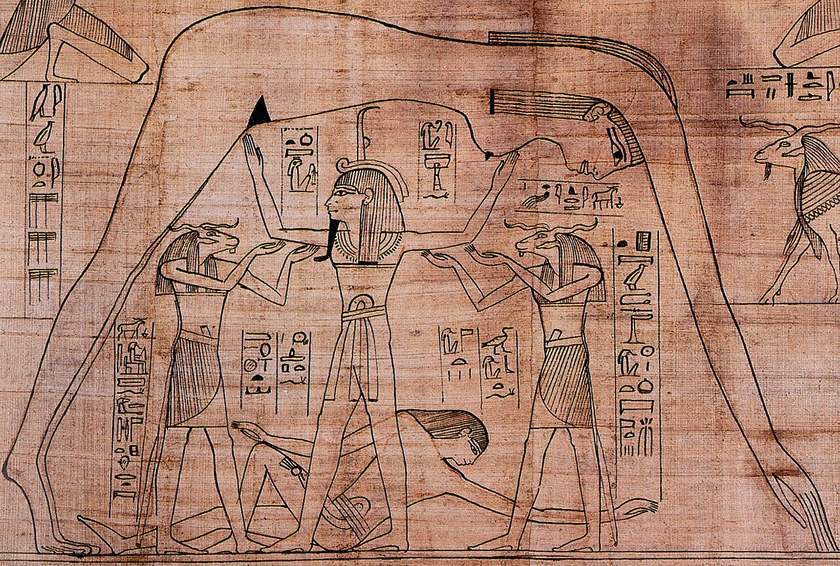
Before any bird flew above the Nile, earth and sky lay pressed face to face with no gap between them. No breath could stir. No light could fall. No seed had room to sprout.
Nut is the sky goddess of ancient Egypt, mistress of the starry canopy and mother of the chief gods. Egypt painted her stretched overhead from edge to edge on fingertips and toes. Her indigo skin carries five-pointed stars and the pale band of the Milky Way. Each night she swallows the dying sun, bears him safely along her spine, and births him fresh at dawn. Her arched body is a map, and Egypt painted it where the dead could lie beneath it and read.
The curved space that holds the stars
Space has a shape.
In A Brief History of Time, Stephen Hawking explains Albert Einstein's view of gravity. Mass and energy curve spacetime itself. Planets and moons are not pulled along by invisible strings. They glide naturally along the straightest paths through curved space, like travelers crossing a hillside. Hawking also notes that night stars gather into one glowing band because we live inside the spiral disk of the Milky Way.
The Law of One widens that view in Session 81. The voice that calls itself Ra names our Milky Way, with its two hundred billion stars, a single living Logos. It has never traveled to another galaxy, it says, and it has no need to, for it can reach them in love with the heart.
Egypt drew that sheltering curve as a woman bent like a bow across the night. You are not lost inside a cold machine. You live beneath the belly of Nut.
When air lifted heaven off the earth
This creation story stands on temple ceilings at Dendera and inside royal tombs in the Valley of the Kings.
At first, Geb the earth and Nut the sky held each other so tightly that nothing could stand or breathe between them. Their unborn children stayed trapped inside Nut's womb, unable to reach the light.
Ra saw the lock and sent Shu, god of wind and air, to step between his daughter and his son. Shu planted both feet upon Geb's chest, raised his arms, and lifted Nut high above the ground. Light poured into the gap. Winds began to blow, and living beings found space to walk upright beneath the stars.
Swallowing the sun and the five hidden days
Ra grew fearful of Nut's unborn children and laid a curse across the year. She could give birth on no day of the three hundred and sixty days on the calendar. Nut turned to Thoth, who played draughts against the moon and won five extra days outside the closed count. Inside that stolen doorway Nut bore Osiris, Horus the Elder, Set, Isis and Nephthys.
Every night after, Nut kept her post for Ra himself. At dusk she opened her mouth on the western rim and swallowed the red disk of the setting sun. All night the sun sailed inside her starry body, moving west to east along her Milky Way spine while the world slept. At the first hour of morning she birthed him fresh between her thighs, reddened with dawn light, to climb the sky again.
For that reason, painters covered the inside lid of coffins with Nut's face and open arms gazing downward. When a body lay inside the wood, it looked straight up into the starry night of its mother.
What the arched vault encodes
Two laws of consciousness sit inside Nut's posture.
First, life needs open room between matter and spirit. While Geb and Nut stayed locked together, closeness brought suffocation. Only when Shu stepped between them with breath could children be born. A seed pressed between two stones never opens.
The Mother of Creation, whom Anne Tucker channels, gives this as her own nature. She is an aperture, she says, an open doorway through which the creations of the divine unfold.
Second, light must enter darkness to renew. In his Egyptian High Alchemy glossary, Tom Kenyon calls Nut the night sky goddess into whose womb solar striving must yield. By day a person builds force through effort and fire, yet solar will alone soon burns dry. Only by entering the night womb and letting effort drop does fresh power return at dawn.
In Sound Journey through the Stars, Kenyon notes what shifts in the brain when a listener feels held inside wide space filled with stars. Thinking about that space does nothing. Feeling it on every side wakes the spatial intelligence of the brain.
Every star on her arched body
Read Nut's form from fingertips to toes as a tool for wide sight.
Her hands and feet touch opposite horizons so heaven never drifts loose from earth. No matter how high a vision rises, it stays anchored in Geb below.
Her skin shines blue like midnight, dotted with stars and the river of the Milky Way. On her head sometimes sits the round nu pot, the clay water jar that spells her name and links sky back to the primordial waters of Nun.
In tomb art she leans out from a sycamore beside Hathor to pour cool water for thirsty souls. In a Hathor message from March 2008, Kenyon writes that stability comes from tuning to two anchors at once. Feel Earth's magnetic core beneath the feet while sensing the center of the Milky Way above the crown. Nut spans that exact line.
Earth below, air between, stars above
Three bodies hold the world open. Below lies Geb, brown and green with grain and bones. Above arches Nut, vast with stars and midnight blue. Between them stands Shu, the breath keeping earth and heaven apart without breaking contact.
Out of that chamber came the five children of the hidden days: Osiris, Isis, Set, Nephthys and Horus the Elder. Every act of growth, loss and return unfolds inside the dome Nut holds open.
Where she arches across the sky
The links are modern. Uranus carries the Greek name for the sky, and Aquarius is the sign modern astrologers give it, so both belong to Nut. She answers also to the Moon and Neptune, waters of night rest and dream renewal, and to the Galactic Center near twenty-seven degrees of Sagittarius, the core of our Milky Way.
In a birth chart, check the fourth house of shelter, the eleventh house of hopes and friends, and the twelfth house of sleep and retreat. When the Moon touches Neptune or Uranus, a person feels Nut's canopy strongly at night. When Saturn meets Uranus, old ceilings lift just enough for Shu's air to enter.
How to enter Nut's night sky and close
Interface with Nut when the day's fire has burned down and must be given back. She takes in what is spent and gives it birth again.
Come at night after sunset. Lie flat on a blanket outdoors under open stars, or flat on a rug indoors with lights off. Rest your palms lightly beside your ribs and feel the solid floor holding your back, just as Geb holds everything below.
Close your eyes. Picture the ceiling lifting away until vast night space opens above your chest, as Kenyon teaches in the Womb of Nut work. Do not count stars like dots on paper. Simply sense the wide, friendly darkness arching from your fingertips to your toes.
Breathe down into your belly so Shu moves freely between earth and sky. Let the day's tired sun drop through your throat into that dark water to rest. Stay inside that open canopy for five slow minutes without forcing visions.
When you are ready to return, be born at dawn as he was. Press all ten fingertips and both heels firmly into the floor until ordinary weight returns to your bones. Take one brisk breath of room air, open your eyes to the wall, sit upright slowly, and drink a cup of water, as souls drink from her jar.
Questions people ask about Nut
Who is Nut in ancient Egyptian mythology?
Nut is the ancient Egyptian goddess of the sky, the stars and the Milky Way. She is the wife of earth god Geb and mother of Osiris, Isis, Set, Nephthys and Horus the Elder.
Why is Nut painted arching over Geb?
In Egyptian creation myth, Nut and Geb first clung together until their father Shu pushed between them to lift the sky. Her arched pose creates the open space where wind, sunlight and life can move.
Why was Nut painted inside Egyptian coffins?
Painters placed Nut on the underside of coffin lids looking straight down at the deceased. It promised that death was never a fall into emptiness. It was a return into the starry mother who births the sun each dawn.
How did Nut give birth to her five children?
When Ra barred her from giving birth on any day of the 360-day year, Thoth won five extra days from the moon's light. Outside regular calendar law, Nut bore her five children across those hidden days.
How can someone connect with Nut today?
Step outside under night stars or lie flat in a dark room, feel solid earth under your back, and release strain into open space above. Always close by pressing fingers and heels to the floor and drinking a cup of water.
The starry canopy
Nut is the arched sky above every roof, the dark cradle that rests tired light until morning returns.
The Whole of You reads the whole sky you were born under, from its roots to its roof.