Red hibiscus petals cling to damp stone steps outside a clay pandal at dusk. A priest lifts a white conch, blows one long note that rattles the brass bells overhead, and smears bright vermilion across the brow of a bronze lion. Inside the shrine, ten metal arms catch the glow of mustard-oil lamps while drums beat for the ninth night.
Adi Parashakti is the root supreme power of the Hindu and Shakta traditions. Durga is her warrior face, the impassable fortress and slayer of the buffalo titan Mahishasura. Long ago, the Rig Veda praised her as Vac, the sacred speech holding worlds together. Later, the Markandeya Purana called her Chandika and Simhavahini, the one who rides a lion. She is the consciousness that pools divided strengths into one unbreakable shield when chaos threatens life. Her nine-night rite, her ten tools, and her calm seat on a bronze lion form a craft for standing firm without rage.
Scattered beams made into one blade
Normal lamps scatter soft light across a room without cutting stone. When light waves fall into step so every crest rises and drops together, that scattered glow becomes a laser beam strong enough to slice steel. Hindu tradition describes the same shift when divided powers fold back into one root field.
Commenting on the Pratyabhijnahridayam, Swami Muktananda teaches this law. He calls supreme power Parashakti, or Citi, universal awareness creating and holding the cosmos of her own free will. Fire cannot exist apart from its power to burn. In the same way, awareness cannot exist apart from Shakti. When Citi shrinks back, Muktananda writes, a person feels small, scared, and split. When Shakti opens back to her true nature, fear breaks and whole strength returns.
Tom Kenyon writes in Kundalini Rising that Shakti is never blind force waiting for orders from stubborn willpower. She holds vast innate wisdom and knows how to move through subtle channels when a person stops fighting her. In his essay on the Cave of Brahma, he also shows how the dance of Shakti inside the third ventricle shapes how we perceive the world.
The mountain of light and the shifting beast
This story stands in Chapters two through four of the Devi Mahatmyam, also called the Durga Saptashati.
A titan king named Mahishasura grew mighty through harsh vows until he drove Indra and all the gods out of heaven. For a hundred years the gods fought him in split troops and lost every field. Robbed of their thrones, Brahma, Vishnu, and Shiva heard the news, and fierce heat blazed upon their faces.
From Vishnu's mouth shot a vast stream of fiery light. From Shiva's brow poured blinding white flame, and from Brahma's mouth came golden heat. From Indra and every god streamed bright beams of tejas, their core strength. All those rays flowed together into one towering mountain of fire that filled the three worlds.
Out of the heart of that cloud stepped one radiant woman. Shiva's light shaped her face, Vishnu's shaped her arms, and Brahma's shaped her feet. The mountain Himalaya brought her a great lion to ride.
Then every god placed his best weapon into her hands. Shiva drew a trident out of his own trident and gave it to her. Vishnu gave a spinning chakra disk. Varuna brought a conch and a noose. Agni gave a spear. Vayu handed over bow and arrows. Indra gave his thunderbolt, and Yama gave his iron rod.
She rode down from the peaks on her lion and roared until seas rose and cliffs shook. Mahishasura charged with his hosts. When her lion tore through his lines, the titan shifted shape to break her aim. First he rushed forward as a huge water buffalo tearing hills with his horns. When her noose caught him, he turned into a lion. When she swung her sword, he shifted into an armed fighter. Next he grew into an elephant pulling her lion by its mane, then flipped back into a buffalo snorting dust.
Durga smiled calmly through every trick and drank from her cup. Then she leaped onto the buffalo's neck and pressed one foot down hard on his throat. As his true shape slipped half out of the beast's mouth, she drove Shiva's trident straight into his chest. Heaven stood upright again.
Why divided gods could not hold the wall
Two clear laws stand out inside that battle.
First, split forces lose to a shape-shifting lie. None of the gods was weak alone. Yet each fought Mahisha with one narrow skill while pride kept them apart. Mahisha stayed alive by swapping masks faster than any lone fighter could track. Only when all gifts poured into one shared center did the tide turn.
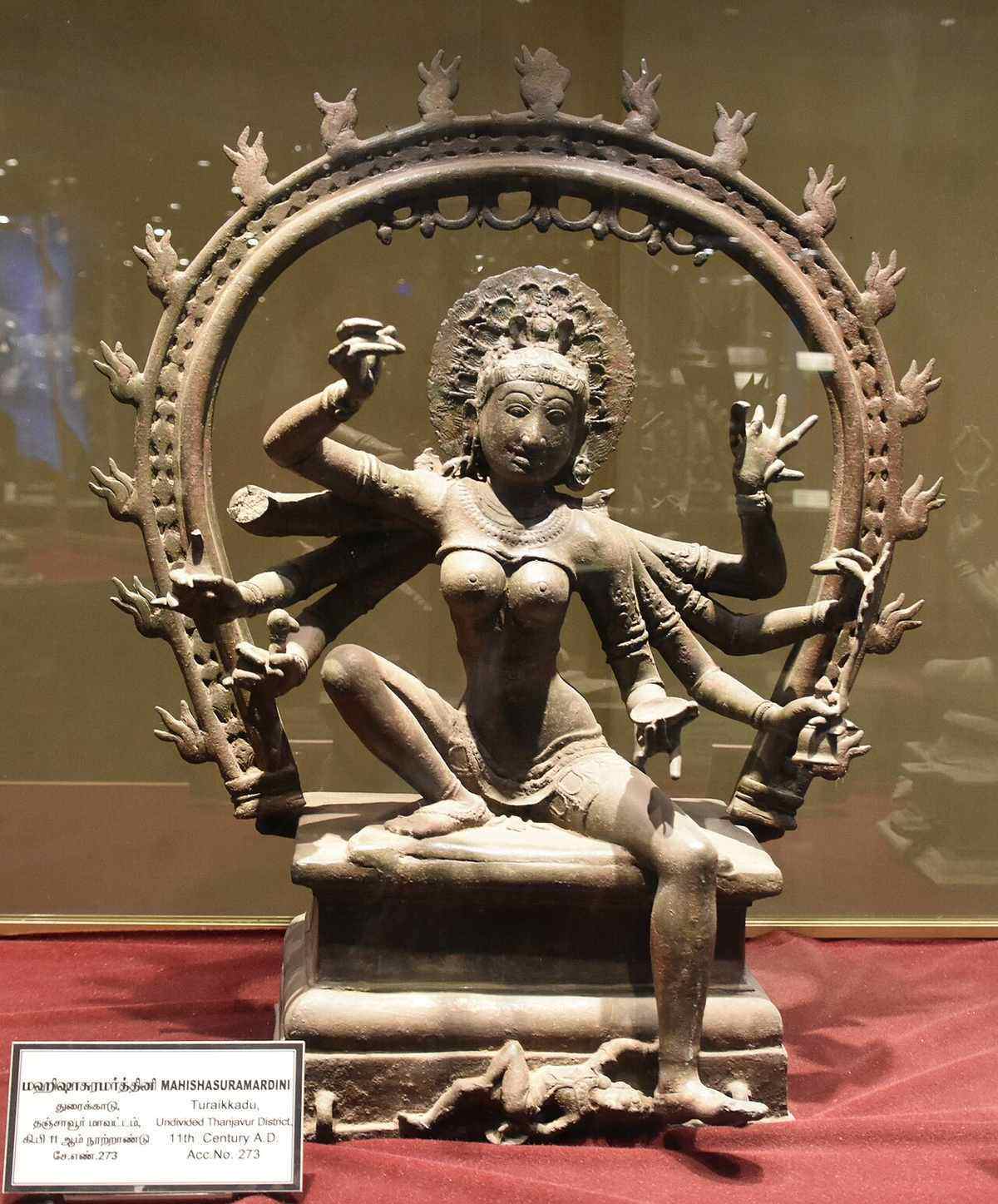
Second, supreme power does not need rage on its face to strike true. Look at Chola bronzes of Mahishasuramardini from the eleventh century. Her hips rest in calm balance. Her brow stays smooth, and her eyes stay level even while the trident pierces the buffalo under her heel. Wild fury wastes fuel and spoils aim. Centered strength moves once and finishes the work.
Ten hands and the lion beneath her feet
Look closely at Durga's ten arms, her lion mount, and the beast under her heel as a map of unified powers.
Start with her ten arms. Each weapon came from a separate god, showing many powers of mind and breath acting under one command. Shiva's trident anchors the spine between twin poles. Maia Nartoomid highlights that exact pattern in her work on the Trident of the Three Crowns, where two side currents balance around a neutral upright axis. Vishnu's spinning disk holds sharp focus. The conch from Varuna sounds a clear warning across distance, while his noose binds chaos before it spreads. Indra's thunderbolt strikes like sudden waking insight, and Agni's spear burns through fog. The bow sets a long aim, the lotus remembers grace inside war, and the sword cuts straight through double-talk.
In the older Rig Veda, long before the Puranas told of Mahishasura, the hymn called the Devi Suktam already spoke in her voice as Vac, sacred speech. She declares that she moves through every god and bends the bow for Rudra. All scattered forces already stand inside her field before they ever take separate names.
Look at her mount, the lion Simha. In Maia Nartoomid's writings on the Eye of Ra, lion beings stand as threshold guardians between the flame and the lance, watching over wisdom, the elements, and time. Riding a lion means fierce instinct stays awake and harnessed, never caged and never running wild.
The buffalo under her heel stands for stubborn dullness that refuses to yield and trades excuses every time truth corners it. Pinning his neck under one foot while holding the trident firm stops the shape-shifting game cold.
Nine nights and the undivided root
Across India, the great festivals of Durga run for nine nights, called Navaratri. People honor nine forms of the Goddess, the Navadurga, before the tenth day of victory.
Nine is no random number. In Session seventy-nine of The Law of One material on the archetypal mind, the speaker outlines the pattern before the veil fell across human sight. The Logos built creation on nine root archetypes, three for mind, three for body, and three for spirit. Lee Carroll and Kryon also teach nine core marks of the human soul. Those nine lift awareness out of cramped linear struggle into whole sight.
Across those nine nights of Navaratri, worshippers do not ask for nine different favors. They step through nine stations of one unified field, from a raw mountain footing on the first night to calm attainment on the ninth. Each night adds one clear layer until the fortress stands whole.
Remember also how Durga links with Kali and Shiva. In Shakta lore, Adi Parashakti is Mulaprakriti, the root matrix of matter and force. When a foe splits into multiplying clones like Raktabija, Durga knits her brow and Kali steps straight out to drink the flood, then folds back into Durga when peace returns. Beside Shiva, she is Citi, the active half of one whole truth.
Where Durga holds the sky
In Jyotisha, Durga joins the radiant heart of the Sun with the protective edge of Mars and the stone wall of Saturn. The Sun brings her mountain of pooled light. Mars brings the courage that meets threat face to face. Saturn builds fortress walls that hold through long sieges, matching the sense of her very name, Durga, the impassable ground.
In a birth chart, a strong link between the Sun, Mars, and Saturn often describes someone built to hold heavy duty in hard seasons without breaking rank. The Moon or Mars in Leo mirrors Simhavahini, the lion-rider, near the royal star Regulus at the lion's heart.
In the Vedic star sky, her fiery clarity echoes Krittika, the third lunar mansion, ruled by Agni and marked by the six stars of the Pleiades around Alcyone. Its sign is a sharp blade that trims away rot so life can grow strong.
Standing firm at Durga's gate
Turn to Adi Parashakti and Durga when crosswinds pull your strength in ten ways and you need scattered parts gathered back into one line.
India keeps her hours across the nine nights of Navaratri, above all the eighth night called Ashtami, and on Tuesday or Friday dusk. Stand or sit with a tall chest and straight back, shoulders loose and low. Do not hunch or clench your jaw like someone braced for a brawl. Recall the Chola bronze, with a smooth face and a firm foot.
Begin by pulling stray attention back inside your ribs. Rest awareness at the center of the chest, then lift it to the third ventricle, which Tom Kenyon calls the Cave of Brahma, where inner sight locks in place. Picture loose threads from every worry drawing back into one bright upright shaft along your spine.
Sound her seed syllable Dum slowly, or chant Om Dum Durgayai Namah in an even voice that hums through the chest without pushing the throat. Keep each breath smooth, sensing the spine stand tall like the trident shaft while noise stays outside. Name one place where you keep arguing with shifting excuses, and draw one clear line in plain words.
Set down the warrior stance before you return to dinner or bed. Let the weapons fade into clear light. Sound a small conch or strike a brass bell once if one sits nearby, and touch a pinch of red vermilion or a hibiscus petal to the center of your brow. Step barefoot onto a stone porch or threshing stone outside for one deep breath, then walk indoors with loose shoulders.
Questions people ask about Durga
What does the name Durga mean?
In Sanskrit, Durga means the impassable one or a fortress hard to breach. It names protective strength that keeps chaos from breaking sacred order.
Who is Adi Parashakti?
Adi Parashakti means the first supreme energy, the root matrix out of which worlds, gods, and goddesses rise. Durga, Lakshmi, Saraswati, and Kali stand in Shakta lore as her varied faces.
Why did the gods pool their light to create Durga?
In the Devi Mahatmyam, no single god could defeat shape-shifting Mahishasura alone. By pouring their separate rays into one unified form, they showed that whole strength wins where split power fails.
Why does Durga ride a lion?
The lion, Simha, stands for bold courage, life force, and mastered instinct. Riding the lion shows strength steered by calm awareness instead of blind rage.
Why is Durga worshiped for nine nights during Navaratri?
Navaratri honors nine forms of Durga across nine lunar nights before celebrating triumph on the tenth day. Each night marks a step in gathering a scattered mind into firm protection.
The fortress and the lion
Adi Parashakti is the undivided field of power, and Durga is that field standing tall at the gate.