At twilight inside a high mountain shrine draped in crimson silk, a brass oil lamp throws dark soot against the stone arch. A devotee sits on red wool, turning wooden rosary beads one by one beside an open palm-leaf book and a copper bowl of cooling ash. Each click of wood against thumb marks a measured breath.
Tripura Bhairavi is the fifth of the ten Mahavidyas in Hindu and Shakta tradition. Her name pairs Tripura, the three worlds of body, mind, and awareness, with Bhairavi, the fierce and bright mate of Bhairava. She is Tapas, the lasting heat of a chosen vow that burns sluggish habit into pure light. Her nested yantra, her rosary, and her book form a clear tool for holding power without leaking it.
Why discipline keeps inner fire from scattering
Most minds think of heat as sudden violence, a flash that burns a house down in minutes. Yoga and Tantra point to a deeper fire that builds endurance and holds life upright.
Without inner heat, sleep and sluggish weight pull a human life downward. With chosen practice, Tapas gathers scattered energy and keeps bright clarity lit day after day.
In The Visionary Window, Amit Goswami links that inner fire to kundalini shakti, the coiled life force mapped at the base of the spine in yoga. He notes that once fear and shadow habits clear away, this coiled force rises up the spine to join instinct with a clear mind.
Tom Kenyon writes about this power in his notes on Kundalini Rising. He treats Kundalini Shakti as a bright goddess with her own mind who opens higher sight when met with patient presence instead of brute force.
In her talk Having Highs and Lows You are in the Shift, Anne Tucker points to a matching shift. She notes that when people stand firm during wild seasons, the Earth meets them with her heat of change so heavy knots can burn off.
The dialogue in the stillness of Kailash
Battle tales tell of demons and swords. Bhairavi's purest scriptural scene is a still mountain dialogue that opens the Vijnanabhairava Tantra.
Long ago, on high peaks above noise, Bhairavi sat before Bhairava, the fierce form of Shiva. She held no pride of rank. She looked straight at the Lord who wears skulls and the trident. Then she asked one sharp question.
She asked him to set aside long sermons and heavy riddles. She wanted the plain craft by which any human being can enter Bhairava right here inside breath and flesh. She asked for a path that burns away fear of death, ends grief, and stands firm without strain.
Bhairava turned her gaze straight into her own chest. He pointed to the place where an outgoing breath stops twelve fingers past the nose. He pointed to the place where an incoming breath rests inside the heart before turning out again. In that narrow hinge between two breaths, he told her, the goddess of pure awareness shines without cover.
That question asked by Bhairavi gave India one hundred and twelve doors into waking presence. The heat of her need drew the whole teaching out of silence.
Kiln walls and the sharp question
Two strict laws sit inside Bhairavi's fire.
First, heat without walls scatters into smoke. Heat inside walls does work. Open flames warm your hands for a minute and vanish in wind. Fire sealed inside a kiln bakes raw clay into stone jars that hold water for a thousand years. Discipline is the kiln wall around bright vision.
Second, asking the right question unlocks the door. Bhairavi never settled for soft comfort or half answers. In Session 74 of The Law of One dialogues, Carla Rueckert's transcript sums up the training of the adept in three steps. Know yourself, accept yourself, and become the Creator. Only sincere effort clears the road to that third step.
Reading the red silk and nested triangles
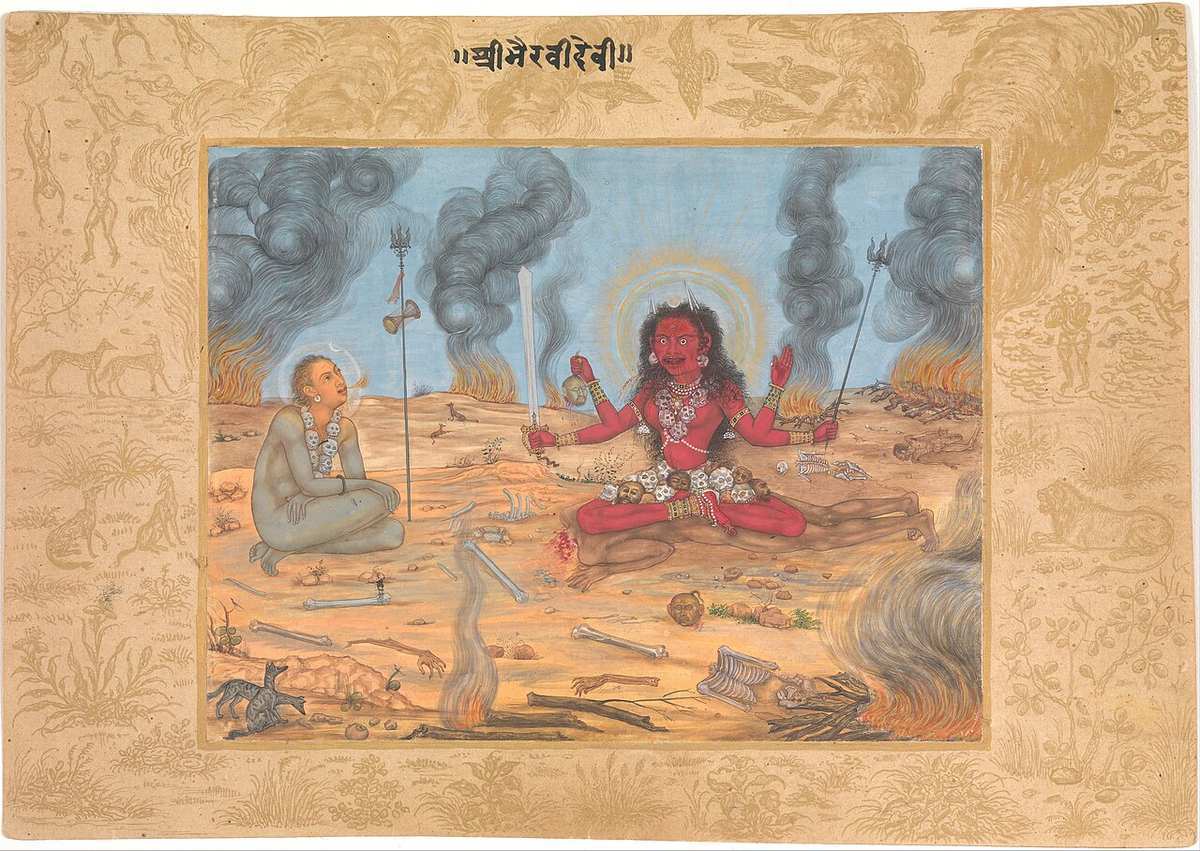
Look closely at a classic painting of Tripura Bhairavi and at the lines of her yantra to see how inner fire stays focused.
First, texts say she glows like a thousand rising suns wrapped in red silk. Red is the hue of live blood and waking dawn, never gray sleep. A thin moon sits in her hair, showing a cool mind watching over warm fire so drive never boils into blind rage.
Second, look at her four hands. One left hand holds a book of wisdom. One right hand turns a rosary of beads. Book and beads pair clear study with daily count. Heat needs both understanding and set rhythm.
Third, her other two hands open outward in abhaya, meaning do not fear, and varada, meaning grace. Even in a wall of flame, the one who keeps vows stands safe. Around her neck hangs a garland of skulls, showing stale thoughts already offered to the fire.
Fourth, check the Tripura Bhairavi Yantra. Inside a red lotus of eight petals, downward triangles nest one inside another around a bright center dot. A downward triangle in Tantra is Shakti, the womb and fire moving down into form. Nesting one triangle inside the next pulls wild attention inward until the coal catches flame.
Bhairavi and Bhairava as fuel and spark
In Kashmir Shaivism, Bhairavi never acts apart from Bhairava. Swami Muktananda makes this plain in his Kashmir Shaiva commentary when he reads verses eighteen through thirty-nine of the Vijnanabhairava.
Fire and its power to burn are one fact told in two words. Bhairava is pure witness. Bhairavi is his living heat. When verse thirty-nine speaks of chanting the root sound and resting after the tone fades, it says the seeker merges into Bhairavi through deep emptiness. Heat burns away noise until bright stillness stays behind.
Where Bhairavi burns in the sky
In Jyotisha, Bhairavi moves through Mars and the Sun. Mars gives sharp heat, nerve, and the will to cut soft excuses. The Sun gives hearth fire that shines every day without begging for praise. Modern astrologers also look at Pluto alongside her archetype for the deep anvil pressure that turns dark coal into crystal.
When Mars meets Saturn in a birth chart, raw fire learns measure and builds things that last. Mars with Pluto in modern charts points to deep drive that asks for clear vows so force never turns harsh. The Sun with Mars lights strong will that thrives on daily craft.
Her star mirror sits in Krittika, the third nakshatra spanning late Aries into early Taurus. Its Vedic deity is Agni, the altar fire of truth. Its marker star is Alcyone, the brightest star of the Pleiades, once drawn as a curved flame blade. Krittika burns off dross so gold shines pure.
Keeping the forty-day vow
Turn to Bhairavi when drive feels soggy, promises slip, or dull habits drain your days. She answers daily effort and plain vows kept in secret, never loud show.
Come at dawn just before sunrise, or on Tuesday night when Martian fire wakes. Sit tall on a firm mat with a straight spine. Rest your hands on your thighs or turn one simple string of beads.
Pick one clear vow to keep for forty days. Make it small enough to finish each day without drama. Speak it once aloud in plain words. Notice the warm spot behind your navel where breath turns into strength. Remember that threefold training from The Law of One material. Know what pulls you off track, accept where you stand today, and give your energy to clear work.
Follow the Vijnanabhairava key from Bhairavi's own talk. Watch your breath slow down. Rest attention for one still beat in the gap after breathing out, before the next breath pulls in. Let that brief pause kindle warmth along the spine without forcing air or locking your jaw.
If you use sound, repeat her seed syllable Hrim or Aim softly on a bead or slow outbreath. Keep each tone even and crisp.
Finish with a cool seal before stepping away. Drop your shoulders, snuff the oil lamp, and coil your bead string inside a fresh cotton cloth. Touch a tiny speck of cool lamp soot or sacred ash from the dish to the hollow of your throat. Step barefoot onto stone or bare earth for three slow breaths, and speak her gentle name Shubhankari once aloud before returning to daily tasks.
Questions people ask about Bhairavi
What is Tripura Bhairavi the goddess of?
She is the fifth Mahavidya and rules Tapas, the spiritual heat of discipline, courage, and lasting change across waking, dreaming, and deep sleep.
What do the rosary and book in Bhairavi's hands mean?
The rosary stands for daily counted practice and firm rhythm. The book stands for clear wisdom. Together they show that spiritual fire needs both habit and understanding.
How is Bhairavi connected to the Vijnanabhairava Tantra?
Bhairavi opens the scripture by asking Shiva for the simplest direct path to awake presence. Her questions draw out one hundred and twelve doorways centered on breath and body.
What does the Tripura Bhairavi Yantra represent?
Its nested downward triangles around one center point map how scattered focus draws inward into warm force without leaking away.
How can someone honor Bhairavi safely?
Keep one clear daily promise and watch the pause after breathing out. Finish by coiling the beads, touching a speck of lamp ash to the throat, and speaking her peaceful name Shubhankari.
The coal inside the clay walls
Bhairavi is the living fire of discipline that turns loose sparks into light that warms the whole house.