At sunrise on an open temple verandah above the trees, rose-gold light fills a wide brass water bowl set on bare limestone. No roof sits overhead. A crimson silk banner hangs loose in the morning breeze while swallows turn high in the empty air.
Bhuvaneshvari is the fourth of the ten Mahavidyas in Hindu and Shakta tradition. Her name means the supreme lady of the worlds, from Bhuvana meaning world and Ishvari meaning ruler. She rules Akasha, pure space, the first element that gives earth, water, fire, and air room to move. While other fierce goddesses carry blades or spears, she lifts no weapon of war. Her open palms and wide sky form an exact vessel for calm holding.
Why empty space is never empty
Many minds picture space as a cold blank gap between stars. Modern physics and ancient Tantra both tell another story.
In Now: The Physics of Time, Richard Muller explains what cosmology learned from Einstein and dark energy. Empty space is full of active fields, pressure, and unseen substance, including the Higgs field that gives matter its weight. Vacuum is hardly empty at all.
Amit Goswami turns directly to the Sanskrit word in The Quantum Brain. He notes that akasha means beyond local space, a shared field outside ordinary clocks where patterns across distance stay linked like pearls on one thread.
In her talk WOW Something Big Has Changed About How We Create, Anne Tucker speaks to this vessel craft. She invites people to become an open container held in stillness. Inside that wide gap, fresh patterns assemble themselves without being shoved into old boxes.
Tom Kenyon adds a brain key in his notes on traveling through the stars. He writes that sensing yourself surrounded by wide space wakes spatial vision in the right brain. Thinking about space keeps you locked in words. Feeling space around your skin opens sight wide.
The jewel island beyond the three lords
This story stands in Book Three of the Devi Bhagavata Purana.
Once, Brahma the creator, Vishnu the keeper, and Shiva the transformer rode an air chariot upward to learn who held the source behind their work. Far past heaven they found an ocean of sweet nectar, and in its center shone Manidvipa, the Island of Jewels.
Stepping inside its walls of rubies and crystal, the three gods looked upon a throne whose legs were their own forms. Upon that seat sat Bhuvaneshvari, glowing like the morning sun, wearing crimson silk and earrings shaped like the Sri Yantra. Even the birds flying through the garden sang her seed sound Hrim.
In her four hands she held a noose, a goad, and two palms turned outward in fearlessness and gift. The three gods bowed in wonder. As they watched, her body widened until she had a thousand heads, a thousand eyes, and a thousand hands holding every star and ocean inside her frame.
Then, just as swiftly, she drew all things back into open stillness. When Brahma, Vishnu, and Shiva climbed back into their chariot and looked behind them, there was no palace, no island, and no nectar sea. Only wide space remained, holding their breath from every side.
Why wide sky never fights the storm
Two clear laws rise out of Manidvipa.
First, space never fights what enters it. No sword can cut open air, and no fire can burn the sky. Bhuvaneshvari holds no blade because a true container already surrounds whatever tries to push against it.
Second, the size of the vessel sets how much peace a life can hold. A narrow cup overflows at one poured spoonful. A wide lake swallows a storm and smooths its surface back to glass before dusk.
Reading the weaponless hands and the star seat
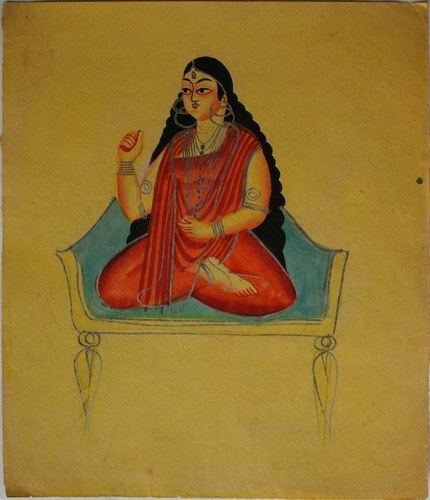
Look at a classical painting of Bhuvaneshvari to see how space holds form without a sword.
First, look at her color. Her skin glows rose gold like the sky just before sunrise. It is warm light that wakes seeds without scorching leaves. Above her head rests a thin crescent moon, showing a cool mind resting inside wide space.
Second, check her upper hands. In one hand she holds a pasha, a soft noose that binds scattered pieces into one family. In the other she holds an ankusha, a small goad that nudges drifting attention back toward center.
Third, check her lower hands. Here sit no swords, clubs, or skulls. Both open palms face forward in abhaya, meaning do not fear, and varada, meaning grace poured freely. Space gives room first and sets limits second.
Fourth, notice her earrings and her seat. Her jewels bear the triangles of the Sri Yantra. She sits inside a Satkona, a six-pointed star made from two crossing triangles. Mind and world meet sharply at her heart, where her seed sound Hrim, called Hrillekha, hums inside every creature.
Maya as the weaver instead of the enemy
Some schools warned seekers to flee Maya as a false trap. Bhuvaneshvari restores the older Shakta view, where Maya is the creative power of one awareness weaving a living world of form.
She is Mahamaya, the great mother who spins space so awareness can taste colors, voices, and seasons. As Tom Kenyon notes in his teachings on the third ventricle, called the Cave of Brahma in yoga, human beings weave their experience of Maya right inside the head. When you treat the world as a hostile cage, the container shrinks. When you honor space as the Mother's own body, the world turns transparent again.
Where Bhuvaneshvari opens in the sky
In Jyotisha, Bhuvaneshvari carries the gentle vastness of the Moon and Jupiter. The Moon gives the feeling vessel, the tidal basin that receives impressions without shattering. Jupiter gives sky room, faith, and wide perspective when life crowds into tight corners.
When the Moon meets Jupiter in a birth chart, a person often acts as a natural shelter for others during storms. Jupiter in Cancer or Pisces opens wide empathy that needs strong grounding so the cup stays clear. Moon with Saturn asks the soul to learn patient roominess inside strict limits.
Her star mirror sits in Punarvasu, the seventh nakshatra spanning late Gemini into early Cancer. Its Vedic goddess is Aditi, the boundless sky mother whose name means free from fetters. Its marker star is bright Pollux in the Twins. Punarvasu carries the sign of a quiver of arrows that always come back home, showing how space lets life travel far and still stay safe.
Opening the room under open sky
Turn to Bhuvaneshvari when life feels cramped, rushed, or crowded with noise. She opens breathing room around tight fear without numbing the heart.
Come at dawn or dusk, or on Monday and Thursday evenings when lunar and sky currents settle. Sit upright near an open window or outdoors where your eyes can see the sky.
Begin by sensing the air touching your skin on all sides, front and back, left and right. Follow Tom Kenyon's spatial cue: stop thinking about space as an idea, and feel yourself resting inside a vast dome of rose light. Let the space inside your chest widen to match the air outside your ribs.
Remember Isla's counsel in Anne Tucker's recordings on being an open container. Release the urge to fix tomorrow right this minute. Let unfinished questions float inside a wide room without grabbing them.
If you use sound, breathe out slowly on her seed syllable Hrim. Let the H soften the throat, the r stir the middle chest, and the hum of m spread outward to the walls of the room.
Return to clear borders before stepping back into daily work. Stand up slowly and step out onto an open verandah or look straight out at the open sky above the trees. Trace the stone doorframe with your eyes so the room regains clear edges. Speak her name Bhuvaneshvari once into the morning air before walking back inside.
Questions people ask about Bhuvaneshvari
What is Bhuvaneshvari the goddess of?
She is the fourth Mahavidya and rules Akasha, cosmic space, along with the whole world as a living home. In the Devi Bhagavata Purana she sits as supreme queen on the jewel island Manidvipa.
Why does Bhuvaneshvari carry no weapons of war?
Unlike Kali or Durga, Bhuvaneshvari holds only a noose, a goad, and two palms showing fearlessness and blessing. Space cannot be attacked by swords, because everything already exists inside it.
What does the mantra Hrim mean for Bhuvaneshvari?
Hrim is called Hrillekha, the heart-line of creation. In Shakta tradition, it joins ether, fire, and moon stillness to link the human heart with cosmic space.
What is Manidvipa in Bhuvaneshvari's story?
Manidvipa means the Island of Jewels in the ocean of nectar. In scripture, Brahma, Vishnu, and Shiva visit this jewel palace and see that Bhuvaneshvari holds the entire cosmos within her form.
How can someone connect with Bhuvaneshvari?
Sit still near the open sky and feel space around the body instead of rushing to solve everything. Hum Hrim gently on the breath, then step outside to look at the wide horizon and speak her name aloud.
The wide room behind every world
Bhuvaneshvari is the boundless sky mother who holds every changing world inside an open room without haste.