At Rajrappa in Jharkhand, the Bhairavi river pours into the Damodar across wet red stone. Pilgrims wade ankle-deep into the cold current beside the riverside shrine, laying bright hibiscus flowers on the dark rock while incense smoke climbs straight up between the canyon walls.
Chhinnamasta is the sixth of the ten Mahavidyas in Hindu and Tantric lore. She is also called Prachanda Chandika, the shining one. In Buddhist Tantra she appears as Vajrayogini or Chhinnamunda. Her name means the one whose head is cut off. To outer eyes her image looks stark. To yoga, she marks the waking of the central channel, sushumna, when prana leaps past the talking head and feeds the whole vessel at once.
How prana leaps along three channels
Most minds picture awareness locked inside the skull like a tiny clerk behind the eyes. Yoga and modern consciousness work both show a wider loop.
In his commentary on the Pratyabhijnahridayam, Swami Muktananda tells how Supreme Consciousness moves through the human frame as prana, the breath of life. He writes that seventy-two thousand subtle tubes called nadis run through the body, yet three stand above the rest. When the middle tube, sushumna nadi, opens from spine base to crown, prana shoots up it at lightning speed. He quotes verse twenty-nine of the Vijnanabhairava, telling the student to watch light flash like lightning through each wheel up to the crown.
Tom Kenyon maps those three tubes in his notes on yogic form. On one side of the middle sushumna runs ida, the lunar stream. On the other side runs pingala, the solar stream. When lunar and solar currents match, force enters the middle axis and sight clears.
Maia Nartoomid points to that triad in her work on the Trident of Three Crowns. She calls the central shaft the golden pillar of sushumna, flanked by twin lunar and solar currents rising toward unity.
Amit Goswami studies prana and nadis in Physics of the Soul and Quantum Creativity. He notes that nadis are subtle paths for vital waves. Real breakthroughs never creep forward one small step at a time. Like Gauss and Tesla describing sudden insight, clarity strikes like a bolt of lightning, shifting the whole frame in one leap.
In her talk You Don't Have to Earn the New Earth, Anne Tucker speaks to this shift. She describes stepping out of busy head chatter and dropping down into the heart. Once the head stops trying to rule by fear and tight control, life moves freely again.
Beside the Mandakini river
This mythic scene stands in the Pranatoshini Tantra and Shaktisangama Tantra, and lives at shrines like Rajrappa in Jharkhand.
One day, the Goddess walked by the Mandakini river with two close friends, Jaya and Vijaya, also called Dakini and Varnini. As they bathed in the clear river water, sharp hunger seized both attendants.
They turned to their lady and begged for food. Wait a while, she told them, and we will eat back home. Yet their hunger grew fiercer by the step. Their voices shook, and they pleaded again, saying a mother never lets her children faint while waiting for supper.
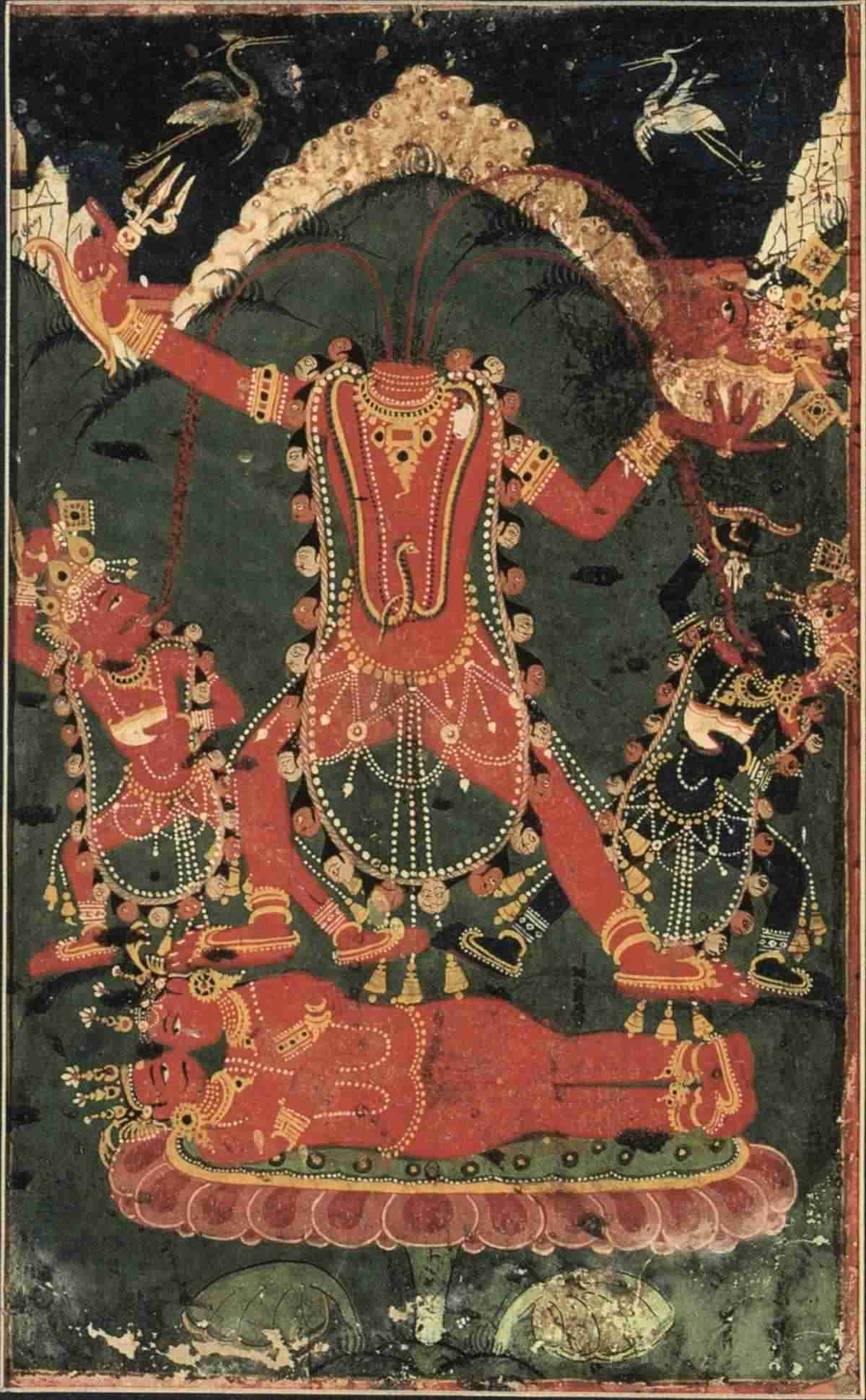
Seeing their need, the Goddess stopped on the bank. With a calm look, she raised her curved blade and cut off the false mask of her own head, holding it lightly in her left palm.
At once, three bright streams of life force rose from her neck. One stream flowed left into Jaya's mouth. One stream flowed right into Vijaya's mouth. The middle stream arched up into her own open mouth, while she stood balanced on a bloomed lotus above Kama and Rati.
Stepped-down head and the returning current
Two clear laws shine inside that story.
First, the head is a narrow gatekeeper, not the spring of life. While an anxious voice inside the skull hoards attention and counts every step, force stalls. When that false crown steps down, prana rises from the center without effort.
Second, giving and receiving belong to one loop. Chhinnamasta does not drain herself dry to feed Jaya and Vijaya. The very act that feeds her two friends sends the middle stream back into her own mouth. Nothing is lost when the current runs free.
Reading the painting from lotus to crown
Look closely at an eighteenth-century Nepalese painting of Chhinnamasta to see how the artist mapped subtle yogic craft without outer harm.
First, start at the bottom under the lotus. There lie Kama and Rati, desire and life zest, joined in bright embrace. She never tramples them in shame or drives them from the shrine. Vital longing forms the living floor on which awakening stands.
Second, look at the open lotus between them and her feet. A lotus grows up out of pond mud into fresh air. Her stance on the petals shows raw vitality lifted into grace.
Third, trace the three arching streams rising from her throat. In yogic lore, those three lines map ida on the left, pingala on the right, and sushumna in the center. When side breaths even out, the middle tube opens like a spring.
Fourth, check her right hand holding the kartri, a curved knife, and her left hand holding her own head. The knife cuts ego habit, never flesh. Holding her head in her palm shows thought turned from master into tool, watching the middle stream feed the whole system.
Where lightning cuts through the sky
In Jyotisha, Chhinnamasta moves through Rahu and Ketu, the eclipse nodes of the Moon where the Sun, Moon, and Earth cross paths and shadow drops away. Ketu is the headless tail of the dragon, famed in Vedic lore for cutting pride and opening sudden sight. Modern Western astrologers also connect her sudden flash to Uranus, the outer planet that splits stale shells open before the mind can bargain.
In Jyotisha when Ketu crosses the Moon or rising sign, or in modern charts when Uranus touches the Sun or Moon, old self-images often fall away quickly. Nothing breaks that was truly alive. Only the tight shell splits so fresh air enters.
Her star mirror sits in Swati, the fifteenth nakshatra in sidereal Libra. Its Vedic deity is Vayu, the wind and cosmic breath, prana itself. Swati holds one bright star, Arcturus, and bears the sign of a young shoot bending in the wind. It shows strength that bends without snapping when sudden breath sweeps past.
Balancing the breath at the central spine
Turn to Chhinnamasta when thinking loops lock you inside your skull, or when fear of losing face freezes your steps. Meet her through breath balance and open sight, never harsh force.
Sit tall on a folded mat at noon or under the open sky. Rest your hands softly on your thighs with palms facing up.
Notice the air moving through your left nostril and right nostril. Breathe slowly through the nose without pulling hard. Picture lunar air rising on the left and solar air rising on the right until both currents meet evenly behind the brow. Remember Isla's cue in Anne Tucker's sessions to let attention drop down from busy head thoughts into the wide chest.
Sense the central line running straight from the spine base up through heart, throat, and crown. As you breathe out, picture a thin stream of white light rising smoothly up that middle tube and falling back around your shoulders like soft rain.
If you use sound, speak her seed syllable Hum or whisper So Ham slowly on the breath. Let thought pause at the end of each outbreath.
Return smoothly to ordinary sight before standing up. Let your hands drop softly to your sides, and take three equal threshold breaths through both nostrils while feeling your spine upright. Walk across a real doorway in your home with open eyes. Notice the chair, the floor, and the daylight, and share a small piece of fruit or simple kindness with someone in your house.
Questions people ask about Chhinnamasta
What does Chhinnamasta mean in Hindu Tantra?
Chhinnamasta means she whose head is cut off. In Shakta Tantra, she marks the cutting away of narrow ego illusion so life force moves freely through the middle yogic tube.
What do the three streams in Chhinnamasta's art stand for?
In yogic thought, the three streams map ida, pingala, and sushumna, the lunar, solar, and middle channels along the spine. Together they show energy feeding both friends and the self at once.
Why does Chhinnamasta stand over Kama and Rati?
Kama and Rati stand for vital desire and life force. Standing on a lotus above them teaches that higher sight grows out of whole vitality, never hatred of the body.
Is Chhinnamasta related to Buddhist goddesses?
Yes. Her subtle-channel teaching and art share roots with Vajrayogini and Chhinnamunda in Tibetan Buddhism, where dropping ego fixation clears awareness.
How do seekers work with Chhinnamasta safely?
Breathe evenly through both nostrils and release your mental grip. Picture calm light along the central spine line, then take three threshold breaths across a doorway and share one small act of kindness.
The middle stream after the flash
Chhinnamasta is the bright lightning of prana that ends small self-rule and turns one current into food for all.