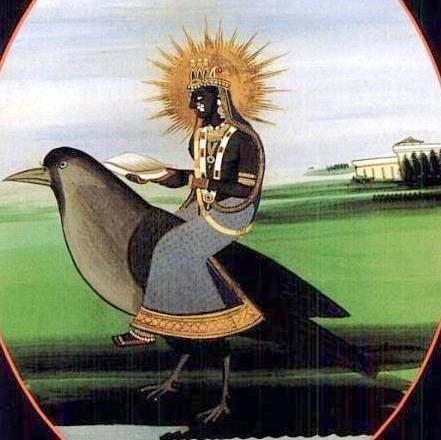
At twilight on an empty temple porch, thin gray smoke curls out of cooled ash in a clay pot. A black crow perches without moving on a bare neem branch overhead. Beside the stone steps rests an old bamboo winnowing tray holding unhulled rice.
Dhumavati is the seventh of the ten Mahavidyas in Hindu and Tantric tradition. Her name means the smoky one. Related to ancient Vedic Nirriti and elder Jyeshtha, she is the only Mahavidya who appears as an aged widow with zero consort beside her. She is the consciousness of stripped truth that meets a soul when borrowed supports fall away. Around her broken cart, her crow flag, and her winnowing basket, Tantra built a craft for separating real grain from dry chaff.
What smoke and entropy leave behind
Every shiny mask wants to pretend it will last forever. Physics and Tantra both smile at that wish and let time finish its work.
In A Brief History of Time, Stephen Hawking explains entropy through the second law of thermodynamics. Left to itself, any closed room or system drifts toward mixing and decay. You can paint a fence or stack bricks neat. Yet without ongoing effort to prop things up, wind and rust pull borrowed order back into scattering.
In The Matter With Things, Iain McGilchrist quotes the fourteenth-century Japanese monk Yoshida Kenko on transience. Kenko writes that a scroll looks truly luminous only after its silk border frays and the pearl falls off the roller, just like dew and rising smoke give life its depth. What resists wear turns plastic and dead.
In her talk Having Highs and Lows You are in the Shift, Anne Tucker speaks to this bare ground. She notes that people panic when old structures break down because they mistake collapse for pure ruin. In truth, forced separation bred the mess, and moving into the void strips away stale props so natural order can return.
Tom Kenyon adds a grounded rule in his essays on shadow work. Facing what we dread to see without dressing it up in pretty words opens the door to real strength.
The hunger that swallowed Shiva
This tale comes from the Phetkarini and Pranatoshini Tantras.
One day on Mount Kailash, the Goddess sat beside Shiva when sudden hunger rose inside her, sharper than any thirst. Bring me food, she told him, for my belly burns.
Shiva told her to wait while he sent for fruit and sweet grain. Yet the hunger only widened like a dry well. She asked a second time, and still no meal came fast enough.
Looking straight at her lord, the Goddess opened her mouth wide and swallowed Shiva himself. At once gray smoke curled upward from her lips and shoulders.
A moment later, Shiva stepped back outside from her form and spoke calmly before all present. Because you swallowed your own husband, he said, from this day forward you wear the white cloth of a widow. You stand alone among the great wisdom goddesses, needing no consort at your side.
From that hour she became Dhumavati, the elder lady shrouded in smoke, honored as Daridra-Vinashini, the power that transforms poverty of spirit into fearless dignity.
What remains when the props burn down
Two clear laws sit inside Dhumavati's story.
First, whatever needs constant props to look grand will eventually collapse under its own weight. Shiva let himself be swallowed so she could stand wholly without external shelter. When status, youth, and loud applause fall off, only what stands on its own two feet remains.
Second, loss is a sorting wind, never pure theft. A farmer tosses grain into evening breeze inside a shallow basket. Wind blows dry husks away while heavy seed drops straight back into the palm. Emptiness removes only what had zero weight.
Reading the broken cart and the crow
Look closely at a traditional painting of Dhumavati, where each plain detail rejects ornament and works like a sorting tool.
First, look at her body and dress. She is tall, gaunt, and pale with age. She wears white or ash-gray cloth with silver hair hanging loose. Her face shows wrinkles and missing teeth, refusing the gloss of easy flattery.
Second, check her seat. She rides a wooden cart with no horses hitched to the yoke, and its wheels sit still in bare dust. A cart with no horses goes nowhere fast. She stops frantic chasing so you look at what is already right here.
Third, look at the banner flying above her cart. A black crow perches on the flag. Crows thrive at edges and waste grounds where proud birds starve. They have sharp eyes, remember faces, and turn leftover scraps into life.
Fourth, check her two hands. In one hand she holds a shurpa, a woven winnowing basket used across India to shake husks off rice or wheat. Her other hand opens outward in varada, the gesture of calm blessing. Even in smoke and bare dust, she pours grace onto anyone who stops clinging to empty shells.
The twin face of Kamala
In the list of ten Mahavidyas, Dhumavati sits near the end, just before golden Kamala, the goddess of lotus abundance. That order is deliberate.
Kamala shines with wealth, elephants, and pink petals. Yet real bloom cannot last if built over rot and fear. Dhumavati sweeps the yard bare first. She burns out anxious grasping and leaves only essential grain in the basket. That clears solid ground so true fullness can take root afterward without false pride.
Where Dhumavati walks in the sky
In Jyotisha, Dhumavati moves through Saturn and Ketu, the South Node of the Moon. Saturn brings time, winter, wrinkles, and stripped truth that outlasts fashion. Ketu cuts away worldly props and shallow pride until silent essence stays behind.
When Saturn or Ketu crosses the Moon, Sun, or fourth house in a birth chart, familiar comforts often thin out or step back. Those seasons ask a person to stop chasing rescue from outside and stand tall inside bare reality. Saturn with Moon teaches deep endurance without bitterness.
Her star mirror sits in Jyeshtha, the eighteenth nakshatra in sidereal Scorpio, anchored by red Antares, the heart of the Scorpion. Jyeshtha literally means the eldest, long tied in Hindu tradition to the elder sister who precedes good fortune. Close beside it lies Mula, ruled by Nirriti, Vedic goddess of ruin and uprooting, anchored by Shaula at the scorpion's tail. Both stars sit near the dark dust lane of the Milky Way, reminding watchers that bare winter clears room for spring.
Sitting bare in the evening smoke
Turn to Dhumavati when supports fall away, grief feels thick, or fake comforts stop working. She meets those who are ready to drop excuses and stand bare in truth instead of chasing quick applause.
Come in the cool twilight before dawn or on Saturday evenings under Saturn's sky. Sit on a plain mat in a spare room with zero bright lamps or sweet incense. Keep one unlit stick or clay dish beside you.
Name one false comfort, title, or anxious prop you have been hiding behind. Look at it plainly as Tom Kenyon advises for shadow work, without dressing it up or calling it noble. Picture tossing a handful of dry mixed grain into a cool wind inside a woven basket. Let hollow worries blow off like husks while the solid seed stays heavy in your palm.
Sit inside that bare space for a few minutes without rushing to fill the gap with new plans. As Isla notes in Anne Tucker's Meditation to Find Balance and Freedom, let stillness hold the cleared floor.
If you use sound, whisper her seed syllable Dhum once slowly on a long breath out, watching the air vanish like thin smoke into the room.
End the sitting with grounded warmth so you do not linger in cold gloom. Stand up, sweep one corner of your porch or room with a courtyard broom, and shake out a shallow tray or bowl of dry rice as if sifting husks. Light one small oil lamp by the kitchen stove, eat a warm spoonful of cooked grain, and speak her blessing name Daridra-Vinashini once aloud before stepping back into the evening.
Questions people ask about Dhumavati
Who is Dhumavati in Hindu tradition?
Dhumavati is the seventh of the ten Mahavidyas, honored as an elder widow shrouded in smoke. She embodies dispassion, stripped truth, and the strength that survives when outward props fall away.
Why does Dhumavati ride a cart with no horses?
Her unhitched cart shows stopped motion and zero haste. It teaches that outward chasing has ended so a seeker can face bare reality right where they stand.
What does the winnowing basket in Dhumavati's hand mean?
The shurpa winnowing basket separates heavy nourishing grain from hollow chaff. It stands for sharp discernment that lets false illusions blow away while keeping what has real weight.
Why is Dhumavati shown with a crow?
The crow is fearless, sharp-eyed, and thrives on bare ground where showy birds flee. In her art, it marks watchfulness and resilience amid change and loss.
How can someone honor Dhumavati respectfully?
Sit simply at twilight and drop false props in plain truth. Rest in stillness, then sweep the porch, light a small kitchen lamp, and eat warm cooked grain.
The grain left in the basket
Dhumavati is the cool smoke after illusion burns down, leaving clear grain inside an empty palm.