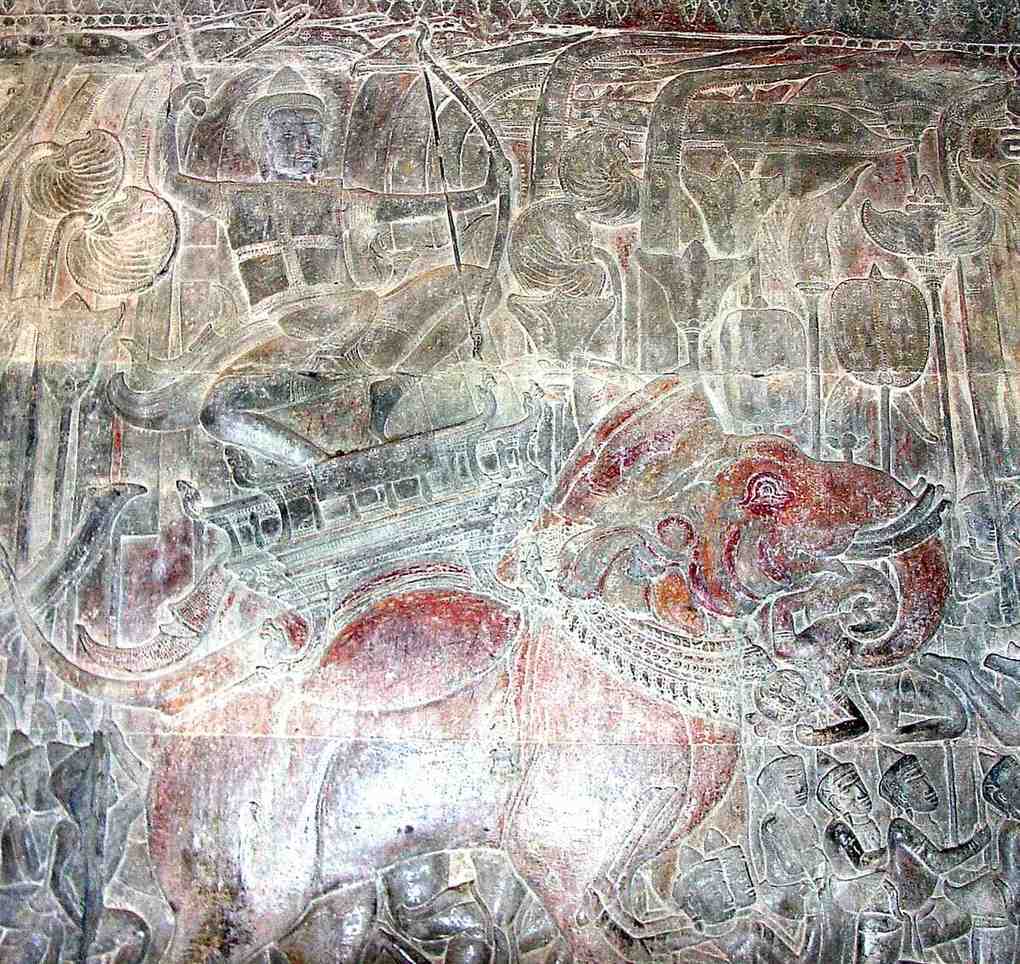
Carved onto a sandstone gallery at Angkor Wat, the storm king rides high upon a four-tusked white elephant while stone monsoon clouds curl beneath his feet. A diamond thunderbolt rests in his hand, poised above parched fields waiting for the sky to split open.
Indra is the king of the Vedic gods, the lord of storms, thunder, and the open heaven. Over two hundred hymns of the Rig Veda praise him as Shakra, Purandara the fort-breaker, Vajrapani who holds the thunderbolt, and Sahasraksha, the thousand-eyed ruler. In Vedic wisdom he is the shock that breaks hoarded stagnation loose so life can flow again. India also hid a sharp test inside his crown. His bone-carved thunderbolt, his elephant Airavata, and his web of jewels show both sky-command and the exact hour when a king must bow.
The web of jewels and a thousand eyes
Most people picture a king as one giant standing above a crowd. Indra carries a stranger sign in Indian lore: a net stretched across space.
In The Everything Answer Book, Amit Goswami turns to Indra's Net to picture what quantum physics calls potentiality. Indra rules heaven, and his net is a boundless web of links where every jewel reflects all the others. Goswami compares that old image to the field of consciousness out of which visible shapes arise.
Nature holds a living mirror of Indra's thousand eyes. In Meeting the Universe Halfway, Karen Barad studies a sea animal called the brittlestar, citing Maia Weinstock's report A Thousand Eyes Without a Face. A brittlestar has no head and no eyes on a brow. Its entire skeleton of calcite crystals acts as one array of tiny lenses. The whole body sees light and shadow from every side at once.
Ancient India painted that wide sight onto the sky-king. Indra watches every corner, yet the instant he forgets the web and hoards power alone, the rain locks shut.
Three trials from dragon cave to mountain shelter
Three classic tales from the Vedas, Upanishads, and Puranas trace Indra's lightning and his humbling.
Long ago, a giant serpent named Vritra coiled around the mountains and swallowed every cloud and river. Earth dried up under endless drought. No god in heaven dared face the dragon's walls, and no bronze blade could pierce his scales.
Indra needed a weapon born of willing surrender. He walked to the forest hut of the sage Dadhichi, whose bones were tempered by years of discipline. Hearing of the world's thirst, Dadhichi sat down, left his body freely, and gave his ribs and spine to the gods. The craftsman Tvashtri carved those bones into the Vajra, a jagged thunderbolt that could not crack. Indra mounted his war car, rode into black storm clouds, and drove the Vajra straight through Vritra's fortress. The serpent split open, and the seven trapped rivers rushed down to the sea.
Victory went to the king's head. The Kena Upanishad tells what happened after the gods won a war and boasted that the glory belonged to them alone. Suddenly, a bright stranger appeared outside their hall. None of the gods knew who stood there.
First they sent Agni, the god of fire, to learn the stranger's name. Asked what he could do, Fire boasted he could burn anything on earth. The stranger laid down one dry blade of grass and told him to burn it. Agni rushed at it with full heat, failed to scorch a single fiber, and fled back in shame. Next went Vayu, the god of wind, boasting he could blow the earth away. He blew at the same grass blade, failed to move it by a hair, and ran back.
Then Indra walked out. The moment Indra stepped close, the stranger vanished. Most kings would have turned back to the hall, yet Indra stayed waiting in the empty air. Because he did not walk away from the mystery, golden Uma Haimavati appeared in that bare space. She taught him that the stranger was Brahman, the hidden source behind every spark, wind, and crown. Only by waiting past pride did Indra learn where his lightning came from.
A third lesson came later in the Bhagavata Purana, above the pastures of Vraja. Angry that village herders offered autumn harvest prayers to Mount Govardhana instead of him, Indra sent black clouds to drown the valley in seven days of storm. Young Krishna slipped one finger under Mount Govardhana and lifted the rock like a wide umbrella. For seven days, cows and people stood dry beneath the stone while Indra emptied every cloud in heaven. At last the storm-king saw that rain serves the earth's crops instead of a ruler's pride. He stepped down from his elephant and bowed at Krishna's feet.
What the storm and the grass blade teach
Two plain laws shine out from these three tales.
First, hoarded strength turns to drought until willing sacrifice breaks the dam. Vritra is the grip that traps water behind private walls. Indra could not break Vritra with rage or boasts. He needed Dadhichi's freely given bones. Real flow starts when you lay down an old shield so stuck life can reach open ground.
Second, borrowed power fails the hour it forgets its source. Fire could not burn one blade of grass when it bragged on its own heat. Rain turned cruel when Indra punished villagers who skipped his praise. Command stays true only while it serves the web below it.
Reading the thunderbolt and the cloud elephant
Look at a carved relief of Indra at Angkor Wat or an Indian doorway, and each emblem works like weather gear.
Start with the Vajra in his hand. Half lightning bolt and half diamond, the Vajra is sudden clarity that shatters frozen locks. It strikes once, cracks the wall, and lets trapped water pour.
Look below him at Airavata, his white elephant with four tusks. Born from the churned milk sea, Airavata stands for heavy storm clouds swollen with rain. He walks with slow weight instead of frantic rush. Tradition says Airavata dips his trunk into underworld waters and sprays them upward to seed fresh clouds, closing the circle between earth and sky.
Read his thousand eyes next. When fear rules a leader, those eyes scan every ridge for rivals. When wisdom rules him, those eyes match the jewel web and sense every shift across the whole field. Swami Muktananda, quoting verse twenty-nine of the Vijnanabhairava, describes Shakti flashing like lightning up the spine. Light moves through each center until the whole body brightens at once.
In Jyeshtha, Indra's star house, the old signs are a royal umbrella and a round earring. Both emblems do one job: sheltering smaller lives under an open sky.
Where the storm-king stands in the sky
In Jyotisha, Indra answers to Jupiter, the planet of law, monsoon rain, and broad counsel. Modern astrologers also link his sudden lightning with Uranus breaking open a stale roof.
His home star is Jyeshtha, the eighteenth lunar mansion, running from sixteen degrees forty minutes to thirty degrees of sidereal Scorpio. Jyeshtha means eldest or chief, carrying the weight of standing first in line. Its marker star is red Antares at the Scorpion's heart, shining across the zodiac from Aldebaran. Sitting at the edge where watery Scorpio meets fiery Sagittarius, Jyeshtha asks whether leadership turns bitter or ripens into calm shelter.
Indra also shares Vishakha in late Libra and early Scorpio beside Agni, standing as twin pillars of a triumph gate where effort bears fruit.
Calling the monsoon with Indra
Call upon Indra when energy sits dammed behind heavy doubt, or when carrying top duty alone has left you braced and suspicious.
Come when fresh wind rises before rain, or at dusk when storm clouds build on the ridge. Sit or stand tall with your spine straight and your shoulders dropped away from your ears.
Look at one lock you have held tight through pride or fear of losing rank. Remember Dadhichi giving his bones to forge the bolt, and name one stiff grip you are ready to lay down so life can move.
Breathe in through your nose for four counts, widening your ribs like a cloud rising off warm ground. Pause for one beat at the top. Then breathe out briskly through parted lips like wind opening a storm front. Repeat seven times, letting a flash of lightning sweep dull air from crown to seat.
Then sit in open space for two minutes, remembering Indra waiting in the empty sky after the stranger vanished. Do not rush to fill the gap with plans. Let the mind bow before what holds the web together.
Finish by sounding one long breath out through pursed lips, like a conch shell blown from an open porch. Set a brass vessel or cup of rainwater on a windowsill, drop your shoulders away from your ears, and step back to your work beneath open air.
Questions people ask about Indra
Who is Indra in Hindu tradition?
Indra is the king of the Vedic gods, lord of storms, thunder, rain, and heaven. In the Rig Veda he appears as the warrior who breaks open trapped rivers and guards cosmic order.
What is Indra's Vajra?
The Vajra is Indra's diamond thunderbolt, shaped by craftsman Tvashtri from the freely given bones of sage Dadhichi. It stands for unbreakable resolve and sudden insight that cracks stagnation.
What is the story of Indra and Vritra?
Vritra was a giant serpent who wrapped around the mountains and held back the world's rivers in drought. Indra slew Vritra with the bone-forged Vajra and freed the seven waters to flow.
What does Indra's Net mean?
Indra's Net is a Vedic and Buddhist image of an infinite web with a jewel at every crossing, each jewel reflecting all others. Thinkers use it to describe how every part of reality mirrors the whole.
How can someone connect with Indra respectfully?
With humility, open air, and willingness to share stalled strength. Stepping into fresh wind, releasing tight control, breathing deeply, and placing a rainwater bowl by the window keeps storm power grounded in service.
The lightning and the rain
Indra is the sky-breaker and the jewel web, the bolt that cracks every wall until the earth shares one rain.