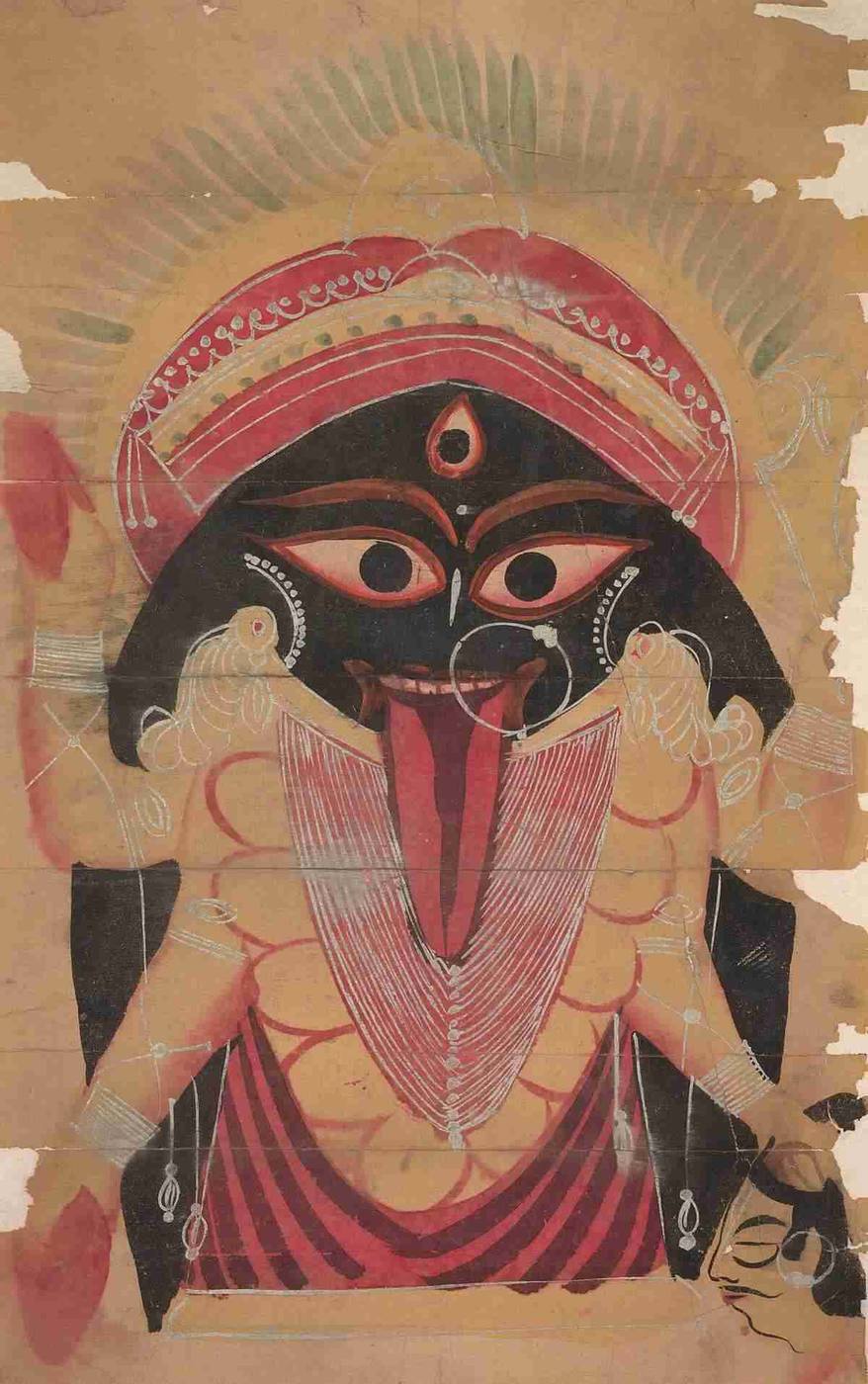
A single clay oil lamp gutters on the stone threshold of a midnight shrine, throwing black shadows across red hibiscus petals and brass bells. When the wick sinks into the oil, red flower, gray stone, and white cloth fold into one unbroken dark. Nothing inside that courtyard is broken or lost. Only the lines between separate things have returned to their source.
Kali is the fierce mother goddess of Hindu and Shakta tradition. She stands first among the ten Mahavidyas, the ten great wisdom faces of the Goddess. Her name comes from the Sanskrit word Kala, which means time, and also black. She is Mahakali, Great Time, and Kalaratri, the night when worlds fold up. She is the consciousness that swallows every false mask before it can rot in place. Tantra built an exact craft around her form so a person can face endings without dread.
The dark womb that is never empty
Many people fear the dark because they think it means empty nothingness. Physics and Tantra both say the reverse.
In Meeting the Universe Halfway, Karen Barad looks at what quantum field theory teaches about the vacuum, the void. In old science, a vacuum is dead space with zero inside it. In quantum physics, the vacuum hums with life. Every particle and force that could ever show up waits inside it as live potential. Those unseen vacuum ripples even nudge real light in hydrogen atoms, a shift physicists measure as the Lamb shift.
Shakta wisdom taught that same truth long before modern labs existed. Darkness is not the foe of light. It is the womb from which every beam steps out and back into which every spent star returns.
Anne Tucker speaks to this threshold in her talk How To Move Through the Void and on entropy. She notes that people panic when structures break down because they confuse ending with chaos. In fact, separation breeds chaos, while dissolution folds scattered pieces back into order and renewal. Sitting still inside the void forces you to face every stale bargain you have kept, without rushing to patch it over.
Maia Nartoomid points to another thread of that name in her writings on time. She calls the break in Earth's time grid the Kali Rift, a tear born when separate wills pulled away from the true stream of cosmic time. Healing that rift brings awareness back into whole rhythm.
The battlefield that drank its own blood
This tale stands in Chapters seven and eight of the Devi Mahatmyam, inside the Markandeya Purana.
Two demon chiefs named Chanda and Munda marched up the slopes with troops to drag the Goddess Ambika down. Anger darkened her face until her brow turned black as ink. Out from between her eyebrows sprang Kali, gaunt and fierce, clad in tiger skin, wearing a wreath of skulls, holding a noose and a sword.
She tore into the ranks, cut off the heads of Chanda and Munda, and laid them at Ambika's feet. From that hour she carried the name Chamunda.
Next came Raktabija, a foe harder to end than an army. Whenever a spear cut Raktabija and one drop of his blood hit the dirt, a new Raktabija sprang up out of that drop, equal in height and rage to the first. The gods struck him with clubs and arrows. Soon the plain swarmed with thousands of Raktabijas, every wound doubling the fight.
The gods stood frozen. Ambika turned to Kali and gave one order. Open your mouth wide, catch his blood as I strike, and swallow every copy before one drop reaches the ground.
Kali stepped out and rolled her red tongue across the field like a broad mat. As Ambika drove her lance into Raktabija, Kali drank every falling drop and ate the clones whole. She cleared the plain until the last giant sank dry.
Drunk on battle, Kali kept dancing on the field until earth shook and hills began to crack. No god dared cross her path. So Shiva, her own stillness, lay down flat among the slain. When Kali stepped onto his chest and looked down to see whom she stood upon, her eyes went wide. She bit her tongue between her teeth and came to a full stop.
Laws carved in bone and fire
Two stark laws sit inside that battle. Neither deals in soft comfort.
First, fighting a self-copying habit on its own terms only feeds it. Every cut on Raktabija gave him fresh blood to multiply. Certain fights and loops grow stronger the harder you push back against them. The only way out is to cut off the ground that feeds them and drink the stream dry at its source.
Second, whatever burns illusion must also burn itself at the end. In The Visionary Window, Amit Goswami recalls Ramakrishna's deep devotion to Kali, the dark goddess who strips ego bare. Goswami describes a custom at Indian burning grounds. A keeper tends the pyre with a long pole to push unburned wood back into the flame. Once the body turns to ash, the keeper throws the pole itself into the fire. Even the tool that clears away masks cannot stay behind as a new idol.
Tom Kenyon tells a vivid story in his essay from Egypt on a world going mad, naming his wife Kaliana after Kali, goddess of death and change. When facing a stubborn airline clerk who kept blocking a cleared pass, he watched Kali force cut straight through bluff until false claims collapsed on the spot.
Fifty skulls and a girdle of hands
Look closely at a Kalighat painting or stone icon of Dakshina Kali. Every grim sign is part of one working map.
First, her skin is black like midnight. White paint bounces light away, while black takes every color in. Kali draws every hue, shape, and name back home at the close of a cycle. She wears no silks because bare truth needs no cover.
Second, a wreath of fifty freshly cut heads hangs around her neck. In Sanskrit, this wreath is called the Varna-mala, the garland of letters. Fifty is the exact count of letters in the Sanskrit alphabet from A to Ksa. Swami Muktananda unpacks this while commenting on the Shiva Sutras when he explains Matrka, the hidden power inside letters. Letters build words, words paint mental pictures, and those pictures drive human desire, sorrow, and karmic knots day and night. Wearing all fifty letters as cut heads shows awareness set free from the spell of words.
Third, a skirt of severed arms circles her waist. Hands are the tools of grasping and blind busywork. Kali stops restless doing so action moves only from what is real right now.
Fourth, check her four hands. On her left side she holds a curved sword and a severed head, cutting off pride in one stroke. On her right side, two open palms face out in two clear gestures, abhaya meaning do not fear, and varada meaning blessing. Even in the ash ground, her right hand gives shelter and grace to anyone who stops clinging to dead shells.
In the Vijnanabhairava, quoted by Muktananda, verse forty-three tells the student to sense open space beyond thought above, below, right, left, and all around at once inside the body. When every side opens into wide space, dread falls off and bare awareness stays.
Speed resting upon stillness
Kali is almost always shown standing with one foot on the chest of white Shiva. At first glance it looks like triumph over a fallen enemy. In Shakta wisdom, it shows the bond of speed and ground.
Shiva lying flat like a corpse, Shava, is pure awareness with zero urge to stir. Kali is Shakti, time and motion at full tilt. Speed cannot spin on thin air. A wheel turns only because the axle holds still at its hub. Once Kali forgets what supports her, her dance shakes the hills apart. The second she looks down and sees Shiva under her heel, wild speed locks back into stillness and bites its tongue.
That is why Bengali poets like Ramprasad Sen sang to her as the fierce Mother who tears away false toys only so her child can stand up free.
Where Kali moves through the sky
In Jyotisha, Kali walks the dark ground of Saturn and Ketu, the South Node. Saturn brings the hard wall of time that wears down stone. Ketu is the headless tail of the eclipse snake, cutting off shallow pride and leaving only what cannot burn. Modern astrologers also connect her stripping force with Pluto, which clears rotten roots down to bare rock.
She rules Amavasya, the dark night of the new moon when no silver rim shines in the sky. When Ketu or Saturn meets the Moon or Sun in a traditional chart, or when Pluto crosses key points in a modern chart, stale roles often lose their hold. Nothing in a chart breaks during those seasons. They mark the exact hour when old masks run out of air.
Her star mirror sits in Mula, the nineteenth nakshatra at the start of sidereal Sagittarius. Its Vedic deity is Nirriti, goddess of uprooting and ending. Mula spans the scorpion's stinger stars, Shaula and Lesath, where our sky looks straight toward the dark center of the Milky Way. Mula means root, because you only end an old weed when you pull it up from the very bottom.
Stepping into the dark moon with Kali
Turn toward Kali only when an old skin, habit, or false deal is truly ready to end. She does not show up for mild praise. She clears away what is already dead so fresh breath can move again.
Come on Amavasya, the dark moon night, or in the late hour after midnight when street noise drops. Sit tall on the floor in a dim room with one small lamp set off to one side.
Name one false shelter or stale role you keep propping up with clever words. Speak it once, plainly, with zero excuse. Remember Anne Tucker's counsel on moving through the void. Do not rush straight into planning tomorrow or reaching for noise. Sit inside that bare gap for a few minutes and let empty space spread wide in every direction.
If you use sound, whisper her seed syllable Krim slowly as you breathe out. Or exhale long and low until the chest empties without strain. Let each thought drop off like a bead slipping from a cut string.
End the sitting firmly before stepping back into the house. Never leave a Kali sitting open in gloom. Snuff the dim room wick, strike one low beat on a wooden frame or small drum, and light a bright lamp in the hallway. Open a curtain to fresh night air and speak her kind name, Dakshina Kali, honoring the blessing on her right hands before you eat warm food or rest.
Questions people ask about Kali
Why does Kali wear a necklace of skulls?
The fifty skulls stand for the fifty letters of the Sanskrit alphabet, called Varna-mala. They show that Kali cuts through the chatter of words and labels so awareness can rest free of thought loops.
Why is Kali standing on Shiva in pictures?
Shiva under her feet stands for unmoving awareness, while Kali stands for time and active power. When wild speed sees the still ground holding it up, chaos ends and balance returns.
Is Kali considered evil in Hinduism?
No. In Hindu and Shakta worship, Kali is loved as the fierce and protective Mother. Her dark form and blade destroy pride, fear, and deceit, while her two right hands show blessing and safety.
What is the story of Kali and Raktabija?
In the Devi Mahatmyam, every drop of the demon Raktabija's blood grew into a new demon when it touched soil. Kali stretched out her tongue to drink every drop before it fell, ending the flood.
How can someone honor Kali respectfully?
With truth, plain speech, and a clear closing. Sitting still on dark moon nights, dropping false roles, lighting a bright hall lamp afterward, and honoring Dakshina Kali keeps the work balanced.
The blade and the dark moon
Kali is unbroken time, the dark mother who burns every false shell until only truth remains.