On a stone hilltop shrine in South India, brass oil lamps ring a tall leaf-bladed spear planted upright in dark rock. Emerald peacock feathers gleam beside streaks of white ash, while six tight stars called Krittika rise past the horns of Taurus into the night sky.
Kartikeya is the warrior son of Shiva and Parvati in Hindu tradition. South India knows him as Murugan, Skanda, Subrahmanya, and Shanmukha. His name means son of the six Krittika stars. In consciousness work he is the piercing spark born outside old bloodlines that fuses scattered sight into one gaze. Tamil and Sanskrit temples built a working craft around him. His spear, his peacock, his rooster, and his six-syllable chant are parts of one tool for cutting through fog.
Where two paths meet in one flash
Most people think of attention as one beam shining out of one head. Daily life rarely works that way. Mind splits into six loud tracks at once. Eyes chase movement, ears catch noise, tongue chases taste, skin flinches, nose pulls memory, and a busy voice inside tries to referee all five.
Physics sees something striking when light meets a fork. In Helgoland, Carlo Rovelli tells of a test he watched in Anton Zeilinger's lab in Vienna. A laser sends photons along two paths, left and right, before both paths join in front of two detectors. Block either path with a hand, and half the photons hit the top detector while half hit the bottom one. Leave both paths open together, and every single photon lands below. None arrive on top. The split waves meet, cancel one door, and pour through one clear exit.
In his 2017 Kryon talk in Montreal on becoming multidimensional, Lee Carroll ties that kind of clarity straight to the stars. He notes how old teachings trace human awakening to the Pleiades, the Seven Sisters, saying that star lineage seeded human beings with the sense that tells light from dark.
Ancient India wrote the same law in myth. Six sparks leave the brow, cross fire, wind, and water, drink milk from six stars, and fuse into one lance.
Sparks in the reeds and a mango in the sea
Three great stories carry the spine of Kartikeya lore, told like scripture beside temple firelight.
Long ago, a demon named Tarakasura won a boon from Brahma. No veteran god, no treaty, and no child born of ordinary union could strike him down. Heaven fell under siege, and the older gods hid behind locked gates. Only a son of Shiva could break the spell, yet Shiva sat lost in deep stillness on Mount Kailash.
When Shiva and Parvati finally joined, their heat shook the three worlds. Six sparks of fire burst from Shiva's third eye in the middle of his forehead. No womb on earth could hold that heat. In the Kanda Puranam and the Ramayana, Agni the fire god and Vayu the wind god carried the six sparks down to the river Ganga. Cold river water hissed into steam and spilled the sparks onto white reeds beside the mountain shore. Six babies appeared upon six lotuses in the Saravana marsh. Six celestial mothers, the Krittika stars, stepped down to nurse them. Then Parvati ran to the water and gathered all six infants into one fierce hug. They fused into one child with six faces and twelve arms, holding a blazing spear forged from her own power. He marched out, pierced Mount Kraunca, and brought Tarakasura down.
Years later, in the Tamil Kanda Puranam, the war reached its climax on the sand at Tiruchendur against Surapadman, king of a thousand worlds. Surapadman's brothers fell first. Cornered on the beach with his armies broken, Surapadman dived deep beneath the waves. Down on the sea floor, he turned into a giant mango tree crowned with wildfire and storm clouds. He hid his pride underwater where daylight could not reach. Muruga lifted the Vel spear and threw it straight into the surf. The blade cut the tree at its root and split Surapadman down the middle. Out of the two halves sprang a peacock and a rooster, still charging blindly through the spray. Muruga did not throw again. He turned one calm glance upon them, and their rage turned to gold. The peacock folded its wings to carry him, and the rooster rose to perch on his flag.
Two shorter tales complete the map. At Swamimalai, young Skanda asked creator Brahma to explain the syllable Om. Brahma rattled off textbook lines from memory. The boy tapped Brahma on his four crowns, locked him in a cell, and ran the universe himself until Shiva came to free the builder. Before unlocking the door, Shiva sat on the floor like a student while his son climbed to the high seat and whispered the living sense of Om into his father's ear. From that hour he bore the name Swaminatha, teacher of his own Lord.
And on Mount Kailash, the sage Narada brought a golden mango of wisdom that could not be sliced. Shiva promised it to whichever son circled the cosmos first. Muruga leapt onto his peacock and raced across oceans and stars. His brother Ganesha walked slowly around Shiva and Parvati, saying his parents held all worlds inside them, and took the prize. When Muruga landed and saw the fruit gone, he made zero excuses. He walked south, dropped his silk robes and crown at the foot of Palani hill, wrapped one strip of cloth around his waist, took up a wooden staff, and climbed the rock alone. His parents followed, calling out that he himself was the fruit.
Breaking locked spells and splitting the hidden root
Look past the battle scenes and two hard laws stand clear.
First, a locked house cannot break its own spell. Brahma's boon sealed heaven from inside. Every veteran god tried the old rules and failed. That is why Kartikeya could not be born inside a palace room. His spark had to leap from the brow, survive fire, wind, and snowmelt, land in wild reeds, and take milk from stars outside the bloodline. When habit locks a door from inside, clarity arrives from outside the old script.
Second, buried pride cannot be killed by shame or force. Once Surapadman lost his daylight fight, he hid underwater as a fruiting tree. When truth strikes that submerged root, zero life force gets thrown away. What looked like arrogance splits into two working powers. Splendor turns into the mount that carries your work, and fierceness turns into the watchman on your flag.
Reading the form from peacock to lance
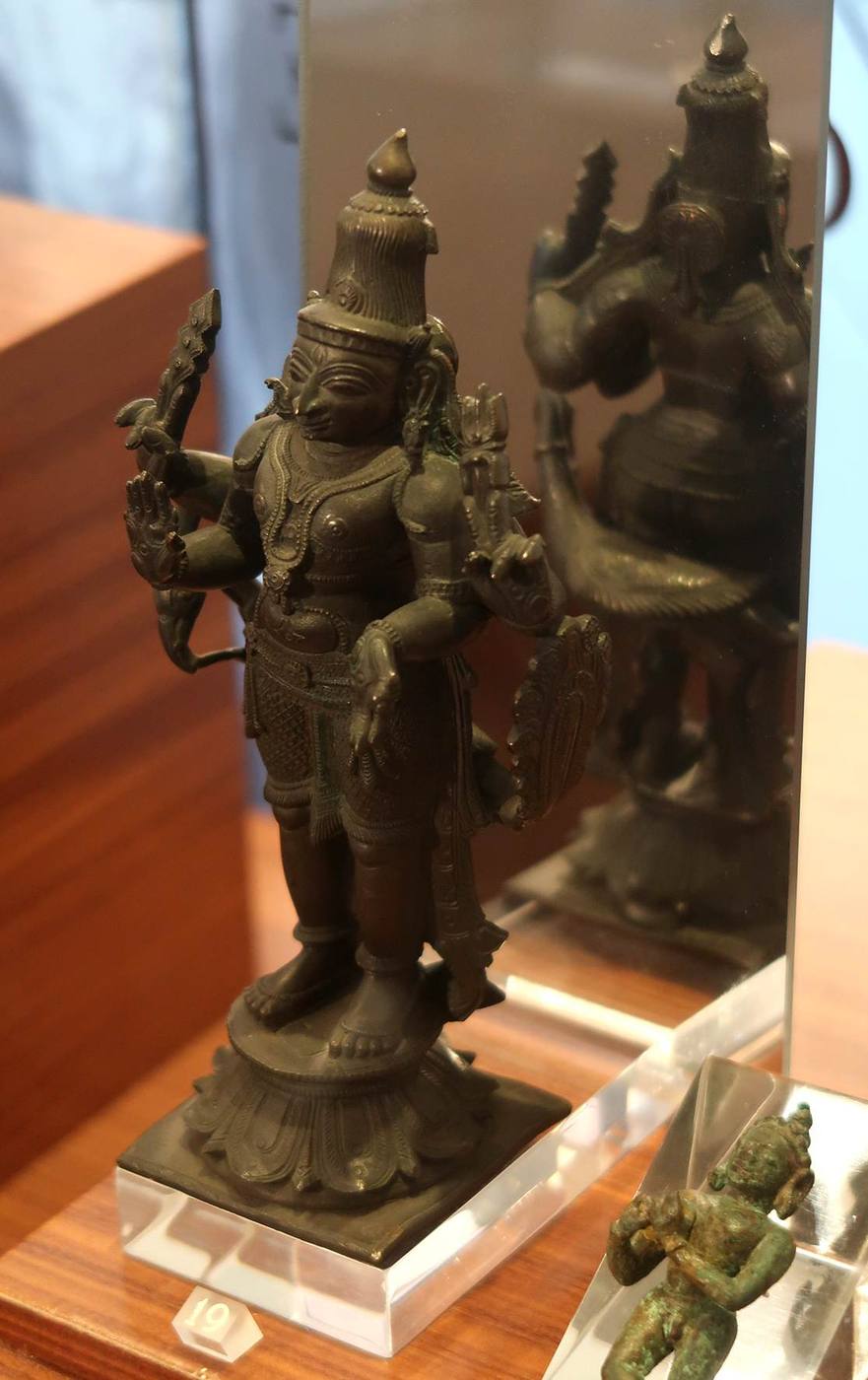
Stand before a South Indian bronze of Muruga and read every piece as part of one tool.
Begin with the Vel, the leaf-shaped spear in his hand. Broad at the base and tapered to a needle tip, the Vel maps Jnana-Shakti, the power of sharp knowing. Mind starts wide, gathering facts from every side, then narrows down to one keen edge that cuts fog without anger.
Look at his six faces, Shanmukha. Five faces stand for the five senses. The sixth stands for one mind guiding them. Swami Muktananda, commenting on the Guru Gita, notes that the text belongs to the Skanda Purana and maps how light wakes along the spine. Quoting verse thirty of the Vijnanabhairava, Muktananda teaches that when mind rests from the base kanda up to the brow, pure light blazes inside the heart. One spine feeds six open windows instead of six leaks.
Look beneath his feet at the emerald peacock gripping a coiled snake in its claws. Tom Kenyon, writing on his travels with Tibetan masters, explains why peacock feathers sit on tantric altars. Tradition holds that peacocks eat poison without harm, so the bird stands for pure mind turning bitter thoughts into bright color. The snake pinned under its claws is restless time and blind craving held still beneath open sight.
Look beside him at the rooster banner. A rooster wakes before sunrise and calls out the first crack of dawn. On the flag, that bird is alert watchfulness guarding the gate before sleep or flattery slips inside.
At Swamimalai, pilgrims climb sixty stone steps before reaching his hilltop shrine, one step for each year in the sixty-year calendar cycle. At Palani, his statue holds only a wooden staff and wears a loincloth. Tamil Siddha lore says the sage Bogar bound nine deadly minerals, called navapashanam, into that Palani figure. Those stories belong to sacred hagiography instead of medicine, yet the picture is plain. Stripped of every title and trophy, even bitter loss turns solid enough to stand on.
Order and wilderness beside one staff
Inside South Indian shrines, Muruga rarely stands alone. Two brides stand on either side of the spear.
On his right stands Devasena, daughter of Indra, raised in heaven beside the elephant Airavata. In the Mahabharata, she is the ordered host and keeping of vows. She stands for Kriya-Shakti, the power of patient structure that builds work to last.
On his left stands Valli, raised barefoot by mountain hunters in the millet fields of Tamil Nadu. She climbed wooden towers to sling stones at green parrots raiding the grain. Muruga walked down into the hills in disguise as a hunter, a tree, and an old beggar asking for millet flour with honey, until she chose him. She stands for Iccha-Shakti, raw longing and living wonder that keeps life warm.
Between ordered Devasena and wild Valli stands the upright Vel. Duty without wonder dries out into stone. Wonder without order scatters in wind. Fifteenth-century Tamil poet Arunagirinathar sealed the secret in his Kandar Anubhuti. Right after calling Muruga the thief who stole the hunter girl, he gives the master's four-word command: be still, with words ceased. Silence holds duty and desire together without letting either rule alone.
Sound that stops the inner prosecutor
Tamil lore says Arunagirinathar once stood atop the eastern tower of Tiruvannamalai ready to jump to his death in ruin. A stranger caught him mid-air, wrote a six-syllable chant on his tongue with a spear, and told him to sing. Out poured over thirteen hundred Tiruppugazh hymns in fierce, rolling drum meters.
In his Vel Vaguppu, sixteen short stanzas swing forward like a hammered blade, each verse ending on the cry of the spear. Centuries later, Vallimalai Sachidananda Swamigal wove those sixteen lines forward, backward, and inward into sixty-four turns called the Vel Maral. The tongue cannot coast on habit through those turns. Breath, jaw, ear, and beat lock together so tightly that self-attacking chatter loses air.
On the shore at Tiruchendur, Adi Shankaracharya's Subrahmanya Bhujangam moves at the opposite pace. Its twelve-beat cobra gait rolls like ocean swells flattening upon wet sand. In verse twenty-six, the poet gathers five doors in four slow breaths: Skanda in sight, his fame in hearing, his story on the tongue, his work in the hands, and the body as his servant.
Across every temple hall rings the open six-syllable key, Om Sa-Ra-Va-Na-Bha-Va, meaning he who rose from the reed-lake. Breathing in on Sa-Ra-Va and out on Na-Bha-Va sweeps attention from teeth to palate to lips in one loop.
Where the six stars burn in the sky
In Jyotisha, Kartikeya rules behind Mars, the planet of iron, heat, courage, and sharp action. Left aimless, Mars picks fights or burns out in rush. Under Muruga, Mars turns into a spear aimed at one clear target.
His birth star cluster is Krittika, spanning from twenty-six degrees forty minutes of sidereal Aries into ten degrees of Taurus. Its brightest star is Alcyone in the Pleiades, near zero degrees Gemini in the Western wheel. Every twenty-seven days the Moon crosses those stars, marking a crisp hour to cut away clutter.
His second star gate is Vishakha in late Libra and early Scorpio, shaped like a forked gate where two roads part. His lunar day is Shashthi, the sixth moon after New Moon or Full Moon, when light and shadow draw a sharp edge. Tuesday is his day, carrying Mars before dawn.
Aiming the six sparks with Muruga
Turn to Muruga when scattered duties pull you six ways at once, or when buried pride keeps you trapped in an old habit that died years ago.
Come on Tuesday before sunrise, or on the sixth evening after a New Moon. Sit tall near a window or a small brass lamp, with both feet planted on the floor.
Name six open loops tugging at your mind today. Search for the one root joining them, just as the wide base of the Vel narrows to one point. Pick one real duty you have been dodging.
Give it voice. Chant Om Sa-Ra-Va-Na-Bha-Va slowly nine or twenty-seven times, breathing in on Sa-Ra-Va and out on Na-Bha-Va. Curl the tongue tip lightly back against the roof of the palate on Na. Feel six wandering eyes pull back behind the brow.
After the last round, sit through ten silent breaths. Remember Arunagirinathar's rule to let words cease. Let noisy argument flatten like waves on Tiruchendur sand.
Mark the close sharply before leaving your seat. Trace one straight vertical line with your right thumb from breastbone to brow like an upright Vel spear, and touch a pinch of dry ash to your forehead. Set a peacock feather or yellow blossom beside your desk. Stand tall and take one concrete step on the single task you named.
Questions people ask about Kartikeya and Muruga
Who are the parents of Kartikeya?
In the Ramayana and Kanda Puranam, he rises from six sparks of Shiva's third eye. Agni and Vayu carry them through the Ganga river into reeds. The six Krittika stars nurse them before Parvati clasps them into one child.
What does the Vel spear represent?
The Vel is Jnana-Shakti, the power of piercing wisdom given by Parvati. Its broad base and needle tip show wide gathering narrowed into one sharp edge that cuts fog without rage.
Why does Muruga have six faces?
The six faces honor the six Krittika star-mothers who nursed him. In yoga and Tamil Siddha teaching, they map the five physical senses united with clear mind along one spine.
What do the peacock and rooster mean?
After the Vel split Surapadman's sunken mango tree at Tiruchendur, his two halves became a peacock and a rooster. Turned by Muruga's glance, they mean buried pride turned into radiance and dawn vigilance.
How can someone connect with Muruga respectfully?
With Tuesday discipline, clear speech, and action. Chanting Om Sa-Ra-Va-Na-Bha-Va calmly at dawn or on the sixth moon, resting in silence, touching ash to the brow, and finishing one real task honors his path.
The reed and the point
Kartikeya is the six-fold spark forged outside old walls, the piercing spear that splits pride into service and gathers scattered sight into one blade.