Clay oil lamps glow along a freshly swept stone courtyard at dusk while pink lotus blooms float on the temple tank beside the steps. Below the still water lies dark pond mud, yet every wide petal above the surface stays spotless.
Lakshmi is the goddess of radiance, order, and living abundance in Hindu tradition. Her oldest name is Sri, meaning light, grace, and wholeness. She is Padmavati, the one born from the lotus. She is also Chanchala, the ever-moving one. She stands as the eternal partner of Vishnu, who holds the fabric of worlds together. Her lotus seat, her pouring hand, and the oil lamp at dusk form a working craft for keeping life in motion. When life stays open and grateful, abundance moves naturally. When greed or fear locks the door, grace walks out.
Why open water keeps life bright
A mountain stream stays clear because water keeps moving over stone. Dam that same stream inside a ditch, and algae chokes the water within a week. Nature keeps its fullness through exchange, never through hoarding.
In The Everything Answer Book, Amit Goswami writes directly about abundance. He names abundance as one of eight root archetypes of consciousness alongside love, beauty, wholeness, truth, goodness, justice, and self. Goswami warns what happens when culture confuses paper bills with the real archetype. Seeking gain without love or ecological care breaks wholeness apart. True abundance grows out of generous alignment with life as a whole.
Anne Tucker explores that same law in her talk Manifest Through Contentment. She points out that grasping out of fear or trying to force tomorrow's harvest blocks the stream. Contentment in the present moment builds a bridge across time so fullness flows on its own. Lee Carroll makes a matching point in his Kryon talk from Boulder. Abundance moves in natural waves and cycles, and impatience or dread is what snaps the current.
The garland trampled and the churning of the sea
Two tales from the Vishnu Purana and Bhagavata Purana show why Sri arrives and why she leaves.
In the first tale, the fiery sage Durvasa met Indra, king of the sky gods, riding his white elephant Airavata. Out of respect, Durvasa took a garland of celestial flowers from his neck and tossed it to Indra. Indra caught the garland lightly and dropped it on top of his elephant's head. Drawn by its sweet scent, the elephant pulled the flowers down with its trunk and trampled them into dust.
Durvasa watched the gift crushed under a beast's foot and spoke at once. Since pride made Indra scorn grace, Sri would leave the three worlds. Within days, gardens faded, rivers shrank, minds grew dull, and the sky gods lost strength before their foes.
To bring radiance back, gods and titans made a truce and churned the milk ocean. They used Mount Mandara as a churning rod and wound the snake Vasuki around it as a rope. Pull after pull rocked the waters.
First out of the sea came Halahala, a black venom hot enough to burn every world. Shiva stepped forward and held the poison in his throat so creation could survive. Next rose Alakshmi, Lakshmi's older sister, clad in dull cloth with tangled hair. She carried sour envy, clutter, and decay. The gods let her pass on her own path.
Only after poison and stagnation cleared did Lakshmi rise out of the foam. She stood bright upon a blooming lotus, holding blossoms in her hands while white elephants poured pure river water over her shoulders. Every king and god wanted her at his side. Lakshmi walked past proud rulers and grasping warriors. She placed her garland around Vishnu's neck, choosing the one who asked for nothing and held the sea in peace.
Later lore adds a story of young Adi Shankaracharya begging for alms. Stopping at a poor hut, he met a woman who owned nothing except one dried gooseberry. She placed that last fruit into his bowl with open joy. Moved by her selfless act, Shankaracharya chanted the Kanakadhara hymn on the spot, praising the grace that answers an open hand.
Clearing the mud first and keeping wealth moving
Read those stories together and two sharp laws stand out.
First, poison and clutter clear before Sri enters. Look at the order in the churning myth. Halahala venom came first. Next came Alakshmi, the spirit of decay. Only last came Lakshmi upon her lotus. Trying to invite fresh grace on top of buried resentment and hoarded mess leaves the house blocked. Clearing space comes before fullness.
Second, circulation keeps Lakshmi present while hoarding drives her away. Indra lost Sri the hour he treated a living gift carelessly and took grace for granted. In the Bhagavata Purana, Lakshmi passes by kings who crave control. She chooses Vishnu because he rests whole inside himself. Swami Muktananda notes in his Kashmir Shaiva talks that Indian lore pairs dharma, right order, with artha, abundance, kama, joy, and moksha, release. None of the four stands healthy alone. Abundance stays bright only when wedded to dharma and an open palm.
Reading the lotus, the hands and the white elephants
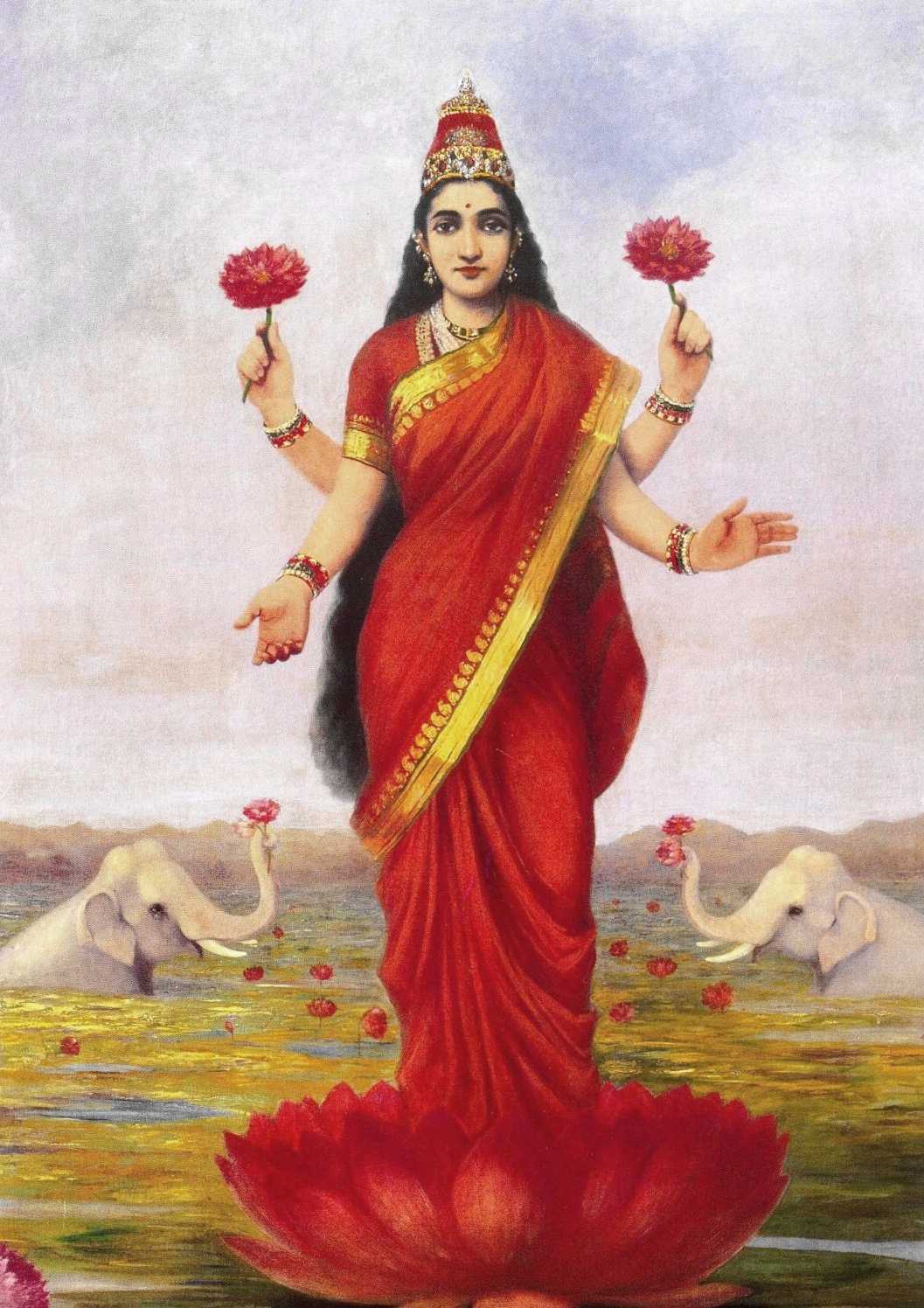
Stand before Raja Ravi Varma's painting of Lakshmi or a South Indian temple carving. Each detail around her shows how abundance stays alive.
Look first at the pink lotus beneath her feet. A lotus sends roots down into mud, climbs through cloudy water, and opens spotless in the sun. Lakshmi asks no one to flee earth to find spirit. She shows awareness blooming inside daily life without drowning in grime.
Look at her four arms. They map the four balanced aims of a human life: right order, useful means, healthy delight, and inner freedom. One hand lifts in the gesture that says have no fear. Another hand tilts downward with coins streaming off her palm. That stream marks movement, never locked storage. Water that pours through a bowl keeps the bowl sweet.
Beside her in Gajalakshmi carvings stand two white elephants lifting jars of water in their trunks. Elephants in Indian lore bring monsoon clouds across dry fields. They stand for rain, good crops, and life shared across the whole village.
Look also at her rare bird companion, the white owl called Uluka. An owl sees clearly in deep dark without losing patience. It warns people not to go blind under bright glare or lose simple wit when seasons turn.
The moving light beside Vishnu and her dark sister
Lakshmi forms a living circuit with Vishnu on one side and her dark sister Alakshmi on the other.
Tom Kenyon writes of the union of Vishnu and Lakshmi in his Bali teachings and his essay on Vishnu the dreamer. Vishnu is silent, sustaining space. Lakshmi is the active light that clothes that space in color, music, fruit, and grace. Swami Muktananda calls that active power Citi, the living energy of awareness that knows its own fullness and radiates beauty outward. Without Vishnu, flow scatters like spilled water. Without Lakshmi, structure turns dry as bone.
Alakshmi stands as her twin shadow, rising from the same churned ocean. Alakshmi is not an evil demon from another sky. She is what happens when flow stops, gratitude sours into complaint, and rooms fill with stale clutter. Diwali lamps lit across thresholds mark that line. People sweep floors, wash doorways, clear old debts, and light rows of clay lamps so stagnant darkness moves out and Sri enters a clear house.
Where Lakshmi moves across the stars
In Jyotisha, Lakshmi aligns naturally with Venus and Jupiter. Venus brings harmony, art, grace, and true worth. Jupiter brings warmth, right order, and open giving. When Venus and Jupiter sit together or gaze across a birth chart with ease, a person tends to draw help through warmth and fair dealing.
Her Vedic sky ties touch Purva Phalguni and Rohini. Purva Phalguni spans thirteen degrees twenty minutes to twenty-six degrees forty minutes of sidereal Leo. Ruled by Venus and marked by bright Zosma on the Lion's back, its Vedic deity is Bhaga, giver of rightful shares and warm welcome. Rohini spans ten degrees to twenty-three degrees twenty minutes of sidereal Taurus, anchored by orange Aldebaran in the Hyades. Vedic hymns call Rohini the star of upward growth, green earth, and nourishment.
In a traditional Jyotisha reading, the second, fourth, and eleventh houses also mirror livelihood, home, and shared harvest when a birth time is known. Venus well placed beside the Moon reflects care for beauty inside the house. Saturn touching Venus asks for patience and fair measure so desires mature instead of turning into waste.
Lighting the dusk lamp for Lakshmi
Turn to Lakshmi when life feels cramped by scarcity fear, clutter, or stagnant habits. She restores clear flow and natural order. Remember that Hindu tradition links her with cosmic harmony, gratitude, and beauty, never shortcuts to cash.
India keeps her hours on Fridays, at twilight when lamps are lit, and on the new moon of Diwali in autumn. Begin with physical space before sitting down. Clear one table or one threshold near your front door. Wipe dust away, open a window for fresh air, and set a small bowl of water or one clay oil lamp on wood.
Sit upright beside that light with shoulders loose and palms resting open on your knees, facing upward like a lotus cup. Breathe smoothly through the nose. On each inhale, notice one simple gift already present in the room: breath, shelter, food, or music. On each exhale, release one tight knot of worry about tomorrow.
Speak Om Shreem Mahalakshmiyei Namah slowly twelve times in an even tone. Or rest softly with the seed sound Shreem humming gently inside the heart center. Sense warmth moving outward from the chest instead of pulling inward like a closed fist. Ask yourself one practical question: where can I pass on kindness, craft, or care today without keeping score?
Finish clearly before stepping back to your evening. Never leave an oil lamp burning unattended. Snuff the clay wick safely with a small brass spoon, and set a bright coin or dried lotus pod on a tidy shelf. Smooth the doorway mat with your hand and open the curtain to fresh dusk air.
Questions people ask about Lakshmi
What does Lakshmi represent in Hindu tradition?
Lakshmi is the goddess of radiance, beauty, cosmic order, and living abundance. Her oldest name, Sri, points to light, dignity, and generous wholeness across spiritual and daily life.
Why does Lakshmi stand upon a pink lotus?
A lotus grows out of pond mud yet opens spotless above the water. It teaches that clarity and grace bloom right inside earthly tasks without needing to flee the world.
Who is Alakshmi and why did she rise first?
Alakshmi is Lakshmi's older sister, standing for stagnation, clutter, and bitter complaint. In the ocean-churning myth she rises before Sri, showing that stale habits must clear before fresh grace settles.
Why is Lakshmi also called Chanchala?
Chanchala means restless or ever-moving. Tradition gives her this name because abundance stays alive only while circulating with gratitude and fairness, and departs quickly wherever greed or pride locks it away.
How do Hindu homes welcome Lakshmi?
Families sweep thresholds clear, wash doorways, place flowers or rangoli patterns by the gate, and light clay oil lamps at dusk, above all on Fridays and during Diwali.
The lamp and the open hand
Lakshmi is the lotus blooming spotless above mud, the open palm that keeps every gift moving in bright circles.