High in icy Himalayan peaks, snow melts into clear water and begins to run downhill. Long ago that river carved a wide bed across northern stone, and seers sat beside its rushing banks to match their breath to its current. Later shrines set a pale stone figure by mountain water, her fingers resting across the strings of a wooden lute.
Saraswati is the goddess of knowledge, music, art, and sacred speech in Hindu tradition. Early hymns in the Rig Veda praised her as a mighty river that purified the land and woke poetic song. They called her the best of mothers, the best of rivers, and the best of goddesses. Later texts named her Vac, the living word by which Brahma shaped forms out of silence. She wears white cloth, rides a white swan, and plucks a stringed lute called a veena. Saraswati turns silent knowing into clear speech and ordered sound, using her four emblems and four rungs of voice to sort truth from noise.
Speech as a moving river
Most people treat words as little bricks stacked in a wall. A word list turns living thought into stiff nouns sitting dry on a shelf. Yet when a speaker tries to talk about consciousness or time with frozen labels, something vital leaks out.
David Bohm saw that trap and wrote a whole chapter about it in Wholeness and the Implicate Order. He showed how common speech slices the unbroken cosmos into separate boxes. As an answer, Bohm built an experiment he called the rheomode, a flowing mode of speech built around verbs and motion. When speech moves like water instead of sitting like gravel, thought stays true to reality.
India knew that secret thousands of years earlier when it named the goddess of speech after a river. Saras-vati literally means she who has flowing pools.
Tom Kenyon bows directly to Saraswati in his Siddhis Meditation Workshop notes from May 2016. He thanks her for giving humanity the bijas, short seed sounds that open subtle states of sight. Kenyon notes that these seed syllables work first in open space before settling into centers of the body. In an earlier essay on Sufi master Hazrat Inayat Khan, Kenyon also describes a vision of an Indian veena. Its strings were the pulsing fields of the human heart, carrying grace directly through sound.
Swami Muktananda records the same craft in his commentary on the Vijnanabhairava. He quotes verses eighteen and nineteen of that scripture. Mind turns into the soul of words to reveal the world, so word and sense share one root. Verse forty-one gives a direct method. Rest your mind on the long, tapering sound of a stringed veena, and awareness enters the open sky of knowledge.
How the river became song and unborrowed speech
Two tales in Vedic and Puranic lore trace how flowing water became living speech and clear song.
In the Rig Veda, Brahma gazed upon a dark void full of silent power. Thought stirred inside him, yet nothing took shape until Vac, living speech, stepped beside him. Once silent will wedded ordered sound, stars, rivers, and creatures walked out into day. Vac proclaims in the Rig Veda that she moves through every god and breathes like wind through all worlds.
A later tale from the Puranas tells of sage Yajnavalkya. As a young scholar he grew proud of all the hymns he learned from his teacher Vaishampayana. After a sharp quarrel over truth, his teacher grew angry. He ordered Yajnavalkya to give back every verse he had memorized.
Yajnavalkya did not argue or cling to pride. He gave back all the chants and walked out into the dawn field empty-handed. Standing under the rising sun, he prayed to Surya and Saraswati for knowledge tied to no school camp. Out of morning light, Saraswati entered his tongue as fresh wisdom. The verses he spoke from that encounter became the White Yajurveda and the Brihadaranyaka Upanishad.
Lore adds one more origin moment for poetry itself. Walking by a river, sage Valmiki saw a hunter shoot one bird out of a singing pair. Shock and grief shook his chest. Without planning a word, his breath broke out in balanced meter. Out of that moment came the first Sanskrit verse and the Ramayana epic.
Returning borrowed words and tuning scattered noise
Two clear laws sit inside the tales of Vac and Yajnavalkya.
First, borrowed noise must be given back before true knowing speaks. Yajnavalkya stayed trapped inside memory until he returned what he had copied. Only an emptied cup hears fresh truth well. In The Quantum Brain, Amit Goswami tells an Indian tale about a swan from the sea landing beside a frog in a well. When the swan speaks of ocean water, the frog leaps across the narrow well. It insists the sea cannot be wider than its stone walls. Habit doubts wide sight until the mind climbs out of its well.
Second, clear tone orders scattered life faster than strain. Pluck a veena string, and air snaps into standing waves. Sprinkle sand on a plate and draw a bow across its edge. Loose grit jumps into sharp rings. Sound orders matter by resonance. When speech grows frantic, fog spreads. When one clear tone rings through, scatter settles into pattern.
Reading the veena, the swan and the white cloth
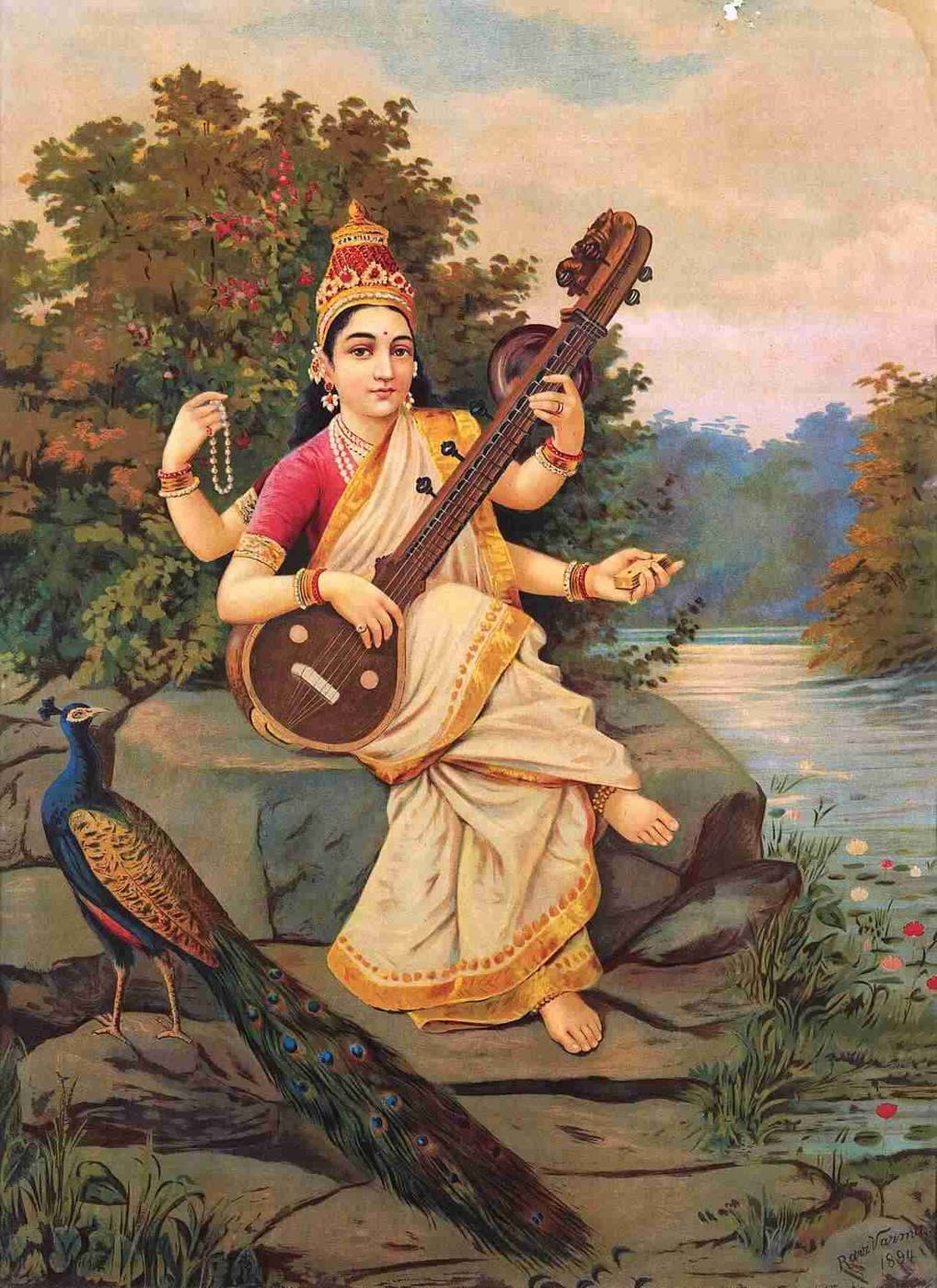
Look closely at Raja Ravi Varma's painting of Saraswati resting by mountain waters. Each detail around her shows how a clear mind tunes itself.
Look first at her clothing. Durga wears battle red and Kali wears dark night, while Saraswati wears white silk. White stands for sattva, clear light free of muddy twist. She carries no sword, no bow, and no club. Truth needs no armor when its edge is clarity.
Look at the Kacchapi veena across her chest and lap. Its hollow gourd bowls and long neck mirror the human head and spine. The strings stretched across frets map the channels carrying breath and sound. Playing the veena means tuning attention until body and mind hum in true pitch.
Look at her other two hands. One holds a palm-leaf book of study. The other turns crystal beads called an akshamala. The book stands for outer study, craft, and sight. The crystal beads mark inner memory, rhythm, and calm. Study without stillness turns dry. Stillness without study turns hazy. Together they keep knowledge alive.
Look beside her feet at the white swan, the Hamsa. Indian lore credits the Hamsa swan with a rare gift. Set down a bowl where milk and water have been mixed. The swan drinks only pure milk and leaves plain water behind. The swan is viveka, sharp sight that sifts truth out of chatter. Notice also her rare peacock friend. A peacock can dance in pride over its feathers, showing the trap of gift when vanity forgets the river.
Four rungs of sound from silence to tongue
Vedic and Kashmir Shaiva texts trace every word we speak through four rungs. Saraswati rules the whole ladder.
The deepest rung is Para, still sound sleeping inside pure awareness before any thought stirs. Nothing moves there, yet every song waits inside it.
The second rung is Pashyanti, the flash of whole sight. Before you find words for an idea, you see the whole answer in one blink, like lightning lighting a valley.
The third rung is Madhyama, the inner workshop where that flash chooses shape, grammar, and beat in silent thought.
The fourth rung is Vaikhari, breath striking throat, teeth, and lips so spoken words reach another ear. Swami Muktananda notes in his Kashmir Shaiva talks how the first sound steps down through these rungs from silent pranava to spoken words. Saraswati's craft walks that ladder up and down without snapping a link.
Where Saraswati sings in the zodiac
In Jyotisha, Saraswati moves through Mercury and Jupiter. Mercury rules script, handcraft, logic, and quick links between ideas. Jupiter rules wide patterns, counsel, and teaching. When Mercury and Jupiter link well in a birth chart, thought flows smoothly from silent flash into clear words.
Her river roots echo Purva Ashadha, the twentieth lunar mansion. It spans thirteen degrees twenty minutes to twenty-six degrees forty minutes of sidereal Sagittarius. Its Vedic deity is Apah, the waters, anchored by Kaus Media in Sagittarius's bow. Modern Jyotish also links Saraswati with Swati, the fifteenth lunar mansion. Swati runs from six degrees forty minutes to twenty degrees of sidereal Libra. Marked by bright Arcturus in Bootes, its Vedic deity is Vayu, the god of wind and breath.
In a classical Jyotisha chart, watch Mercury, Jupiter, and Venus, along with the second, third, and fifth houses. Mercury linked with Venus brings grace to voice, song, and written craft. Saturn touching Mercury slows hasty chatter down into patient skill.
Tuning the mind to the river and string
Turn to Saraswati when noise floods your mind, when speech feels tangled, or before writing and study. India honors her at dawn, on Wednesdays and Thursdays, and on Vasant Panchami in spring. Students lay books, pens, and instruments beside yellow flowers and white cloth.
Begin by clearing a flat desk in front of you. Set down one notebook, a pen or inkwell, or a musical instrument, plus a cup of water. Sit upright on a chair or cushion with your chest open and shoulders low.
Rest your focus first on breath and space, following Tom Kenyon's spacious step. Sense the room around your ears as open air. Then rest inside the still pause behind your brow.
Sound her seed syllable Aim, like the word eye followed by a long mmm hum. Or speak Om Aim Saraswatyai Namah seven or twelve times at an easy pace. Listen to the opening sound. Follow the tail end as the hum thins out into silence, just as the Vijnanabhairava teaches with a plucked veena string. Let your gaze stay soft while that echo lingers behind your eyes.
Sit down and sift one clear thought out of the noise like the Hamsa swan before picking up your pen or speaking. Write one true sentence on the blank page without dressing it up.
Finish your sitting by capping the inkwell or laying your pen flat across the closed notebook. If a stringed instrument sits nearby, touch a string lightly with your fingertip to still any echo, or let the final hum of your chant fade into open air. Speak one clear sentence aloud in your everyday voice, and step away from the desk with calm focus.
Questions people ask about Saraswati
What is Saraswati the goddess of?
Saraswati is the Hindu goddess of wisdom, sacred speech, music, learning, and the arts. She stands for a clear mind and the flow of creative insight from silence into form.
Why is Saraswati linked with both a river and speech?
In the Rig Veda, Saraswati was first praised as a great mountain river that nourished life and inspired sacred hymns. Over time, seers saw that living speech and knowledge move like water instead of sitting rigid.
What does Saraswati's swan stand for?
Her white Hamsa swan stands for clear discernment. In Indian lore, the swan drinks pure milk out of mixed milk and water, showing how awakened mind parts truth from chatter.
What is the instrument in Saraswati's hands?
She holds the Kacchapi veena, a classical plucked string lute. Its hollow gourds and tuned strings mirror the human spine and mind brought into true pitch.
How do students and artists honor Saraswati?
On Vasant Panchami and before daily study, people tidy their desks, offer white or yellow flowers to books and tools, wear pale clothes, and chant Om Aim Saraswatyai Namah with calm focus.
The river and the string
Saraswati is the snowmelt stream that clears the mind, the tuned string that turns silent insight into song.