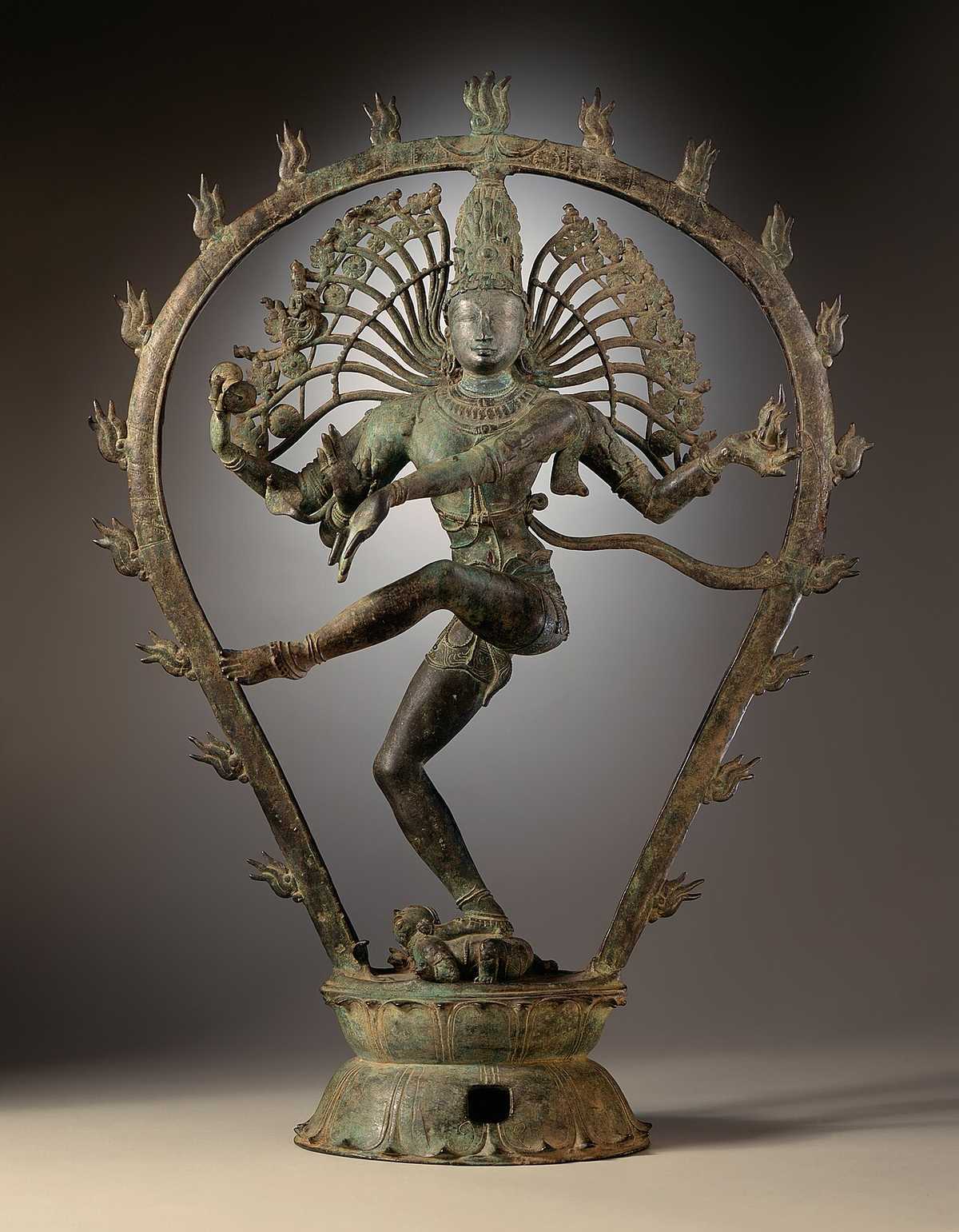
Inside the stone hall of Chidambaram in South India, oil lamps flicker across a dark bronze figure poised inside a ring of flame. His right foot pins a small dwarf to the ground while his left leg lifts across empty air, and three pale lines of ash cross the brow of every priest who enters the shrine.
Shiva is the god of ancient India who wears that sacred ash. He is Mahadeva, the great lord, and Rudra, the storm howler of the Vedas. He is Nataraja, the lord of the dance. He is also Neelakantha, the one with the blue throat. In Hindu tradition he is witnessing awareness. Out of that still ground the world rises, holds its shape, and turns to dust. Around the bronze dancer, the trident, the small waisted drum, and the pause between two breaths, India built a living craft for meeting stillness.
Ten thousand clocks and one dancer
Every river runs downhill. Every star burns through its fuel. A warm cup left on a stone bench grows cold. It never warms itself back up on its own. Physics calls that one-way drift entropy, the long slide from tight order into open scattering.
In The Order of Time, Carlo Rovelli gives this law an ancient face. He writes that the unfolding of entropy is the real dance of Shiva the destroyer. Time does not keep one beat across space. Einstein showed that mass slows time down nearby. A clock on a peak runs faster than a clock by the sea. Rovelli writes that if the world is held up by a dancing Shiva, there must be ten thousand dancing Shivas weaving local beats together.
Ancient India knew this power by two names that look like opposites. In the Vedas he is Rudra, the fierce storm whose bolts bring fever and rain, yet who also guards cool mountain herbs. Later texts call him Shiva, which means the kind or bright one. The storm that breaks dry heat is the same hand that leaves the earth green.
Poison in the throat and river in the hair
Two tales sit near the heart of Shiva lore. Both show how he meets a force too heavy for the world to bear.
In the first tale from the Puranas, gods and titans teamed up to churn the milk sea for Amrita, the drink of deathless life. They wound the great snake Vasuki around Mount Mandara and pulled until the white water foamed. Before any nectar rose, the sea threw up Halahala, a black venom hot enough to burn all three worlds.
Gods and titans fled in fear. No pot in heaven or earth could hold that heat. They climbed Mount Kailash and cried to Shiva for help.
Shiva walked down to the smoking shore. He scooped the black venom into his palm and swallowed it whole. Parvati caught his throat with her hand so the poison could not drop down and wreck creation. Shiva held the fire right there in his neck. He did not swallow it down, and he did not spit it back into the sky. The burn turned his throat blue forever. From that hour he bore the name Neelakantha, the blue-throated one.
In the second tale, King Bhagiratha spent ages calling down the sky river Ganga to wash the ash of his kin. Brahma agreed to loose the river from heaven. Then he warned the king that Earth would crack under her weight. Only one head in the sky could break that fall.
Bhagiratha went to Shiva on Kailash. Shiva stood beneath the falling sky, loosed his matted locks, and caught the flood inside his hair. The river wound round and round through his braids until its rush slowed to a calm stream. Only then did he let one thread drop down onto the plain below.
Letting endings clear ground and holding poison calm
Two plain laws sit inside the blue throat and the matted hair.
First, ending is half of every true start. A hard crust starves the seed beneath it. Until old walls fall or burn, fresh shoots cannot break ground. In the same way, raw power crashes unless something catches its fall and slows its speed.
Second, what enters your gate and cannot be thrown out must be held without panic until it cools. Most minds pass poison down the line in anger. Or they lock it inside until it rots. Shiva holds the burn at his throat, between head and chest, where open sight watches it cool down.
Amit Goswami studied the Ganga tale in The Self-Aware Universe. He linked Shiva's tangled braids to Douglas Hofstadter's golden braid. It is the looping bridge by which unseen laws step down into form without breaking the cup.
Reading the bronze from drum to flame
The Chola bronze of Nataraja is not shelf art. Walk around it from hand to foot, and each gesture maps how awareness moves.
Start at his upper right hand. There a small waisted drum called the damaru sits between his fingers. In Kashmir Shaivism this first beat is called spanda, the subtle pulse by which still awareness wakes into form. Inside that drum, two triangles meet at one narrow waist, pointing up and down like sound and shape meeting at one dot.
Look across to his upper left hand. There a tongue of fire rests in an open palm. As the drum beats worlds out of silence, the fire burns them down to ash. Both hands move inside one ring of flame called the prabhamandala, the wheel of time that turns without rest.
Now look at his lower arms and his face. One right hand lifts open in the sign that says have no fear. His left arm crosses his chest and points down to a lifted foot, showing the road of release. Four arms spin the world and burn it away inside a blazing wheel. Yet his face stays still. Not one muscle pulls tight.
Under his right foot lies a small dwarf named Apasmara, which means forgetfulness. Shiva does not kill him. He pins forgetfulness down with light weight so awareness keeps watch while the play goes on. If forgetting died all at once, the play itself would stop.
Outside the dance ring, Shiva carries the trishula, a three-pronged spear. Maia Nartoomid writes of this three-part shape in her work on the Trident of the Three Crowns, received from Thoth. She notes a neutral central shaft flanked by two side poles, lunar and solar, with three spheres rising into one whole above. In yoga, that central shaft is the sushumna tube running straight up the spine.
Look at his brow. Three pale lines of ash cross his skin around one third eye that opens only to burn lies. A thin moon rests in his locks beside a snake coiled at his neck. The snake is time mastered without dread. The moon is cool mind resting above the heat.
Two halves of one spine
In Kashmir Shaivism, Shiva never stands apart from Shakti, his living force. Swami Muktananda makes this clear in Nothing Exists That Is Not Shiva. Shiva is Chit, witnessing awareness. Shakti is the mirror in which awareness sees itself and knows its own fullness. Like fire and its heat to burn, the two are one fact told in two ways.
Muktananda lists five acts that Shiva plays out at every moment inside both sky and mind. He sends forth an image, holds it awhile, lets it fade, hides his wholeness behind many shapes, and reveals himself again by grace. When the thought of a cow leaves your mind and an elephant steps in, that small turn is creation and ending inside one head.
Indian stone also shows both halves in one frame. The left half has a woman's hip and breast, and the right half has a man's shoulder. That shape is Ardhanarishvara, the lord who is half woman.
Tom Kenyon writes about Ardhanarishvara in his essay The House of Relationship. He explains that yoga maps two side streams along the spine. A cool moon stream called ida and a warm sun stream called pingala run on each side of the middle tube, sushumna. When those twin streams balance, coiled kundalini rises straight up the middle to meet Shiva at the crown. Freedom in this path is the peace of opposite currents meeting in one spine.
Where Shiva marks the sky
In classical Jyotisha, Shiva walks with Saturn and Ketu, the South Node of the Moon. Saturn strips away weak props through slow time and hard truth. Ketu cuts loud show and turns the eye back toward wide space. Modern Western charts also pair Shiva's breaking power with Pluto, which breaks deep roots down to bare rock so new life can sprout.
When Saturn or Ketu crosses the Sun, the Moon, or the rising sign in a birth chart, old roles drop off without warning. Those years feel bare like an ash field. Yet they clear out dead wood before spring. Mars with Saturn tests raw drive under tight measure. The Sun with Ketu asks who stays standing when applause fades.
His Vedic star mansion is Ardra, the sixth nakshatra, ruled by Rudra. Ardra sits in sidereal Gemini and points to one red star, Betelgeuse on Orion's shoulder. Its sign is a teardrop, the storm rain that breaks summer heat and leaves the air fresh for green growth.
Resting in the hinge between breaths
Turn to Shiva when an old chapter has burned out and you are ready to sit in the ash without rushing to rebuild. He meets stillness best when talk stops, not when you beg for prizes.
India keeps his hour at dusk, called Pradosha, when day pauses before night. She also keeps Shivaratri, the dark night before the new moon. Sit tall on a folded cloth with your spine straight and palms open on your knees.
Remember the key from Swami Muktananda. In his notes on the Vijnanabhairava and Siva Sutra, he points to madhyadasa, the still space between an inbreath and an outbreath. The Vijnanabhairava's hundred and twelve doorways all point to that same gap between one pulse of thought and the next.
Breathe through the nose until the breath in and the breath out match in length. Notice the tiny stop at the top before air turns down. Notice the tiny stop at the bottom before air lifts again. Do not lock your ribs or strain. Simply watch that narrow hinge where motion rests for half a beat.
If you use sound, speak Om Namah Sivaya slowly. Or hear the bare breath whisper So going in and Ham going out. In Kashmir Shaivism, mind becomes mantra once awareness stops splitting the singer from the song. Let thoughts wind down like water moving through tangled hair.
End the sitting before you drift into blankness. Open your eyes to the room, take a pinch of cool sacred ash or dry courtyard dust between thumb and finger, and touch a tiny mark to the center of your brow. Picture the small waisted damaru drum resting silent in an open palm, step off your mat into the evening air, and return to ordinary work.
Questions people ask about Shiva
What is Shiva the god of?
In Hindu tradition, Shiva is both the breaker of worn forms and the still witness behind all life. As Rudra he rules storms and wild herbs, and as Nataraja he leads creation, holding, ending, hiding, and grace.
What does the Nataraja dance mean?
The dance shows the world pulsing in and out of shape inside a ring of flame. His drum sounds the first beat of birth, his fire burns old form down, and his calm face shows that witness awareness never shakes.
Why is Shiva's throat blue?
When gods churned the milk sea, black Halahala poison rose before the nectar. Shiva drank it to save all worlds and held it in his throat so it would harm nothing, turning his skin blue.
What is Ardhanarishvara?
Ardhanarishvara is Shiva and Shakti sharing one body, half male and half female. It maps the meeting of witness awareness and active life force when lunar and solar streams balance along the spine.
How do people connect with Shiva?
Through stillness, even breath, and watching the pause between breaths at dusk or dark moon. Sitting tall, sounding Om Namah Sivaya, and touching cool ash to the brow before stepping back into daily life keeps the work grounded.
The ash and the drum
Shiva is the witness who stays still while ten thousand worlds spin, catch fire, and turn to ash.