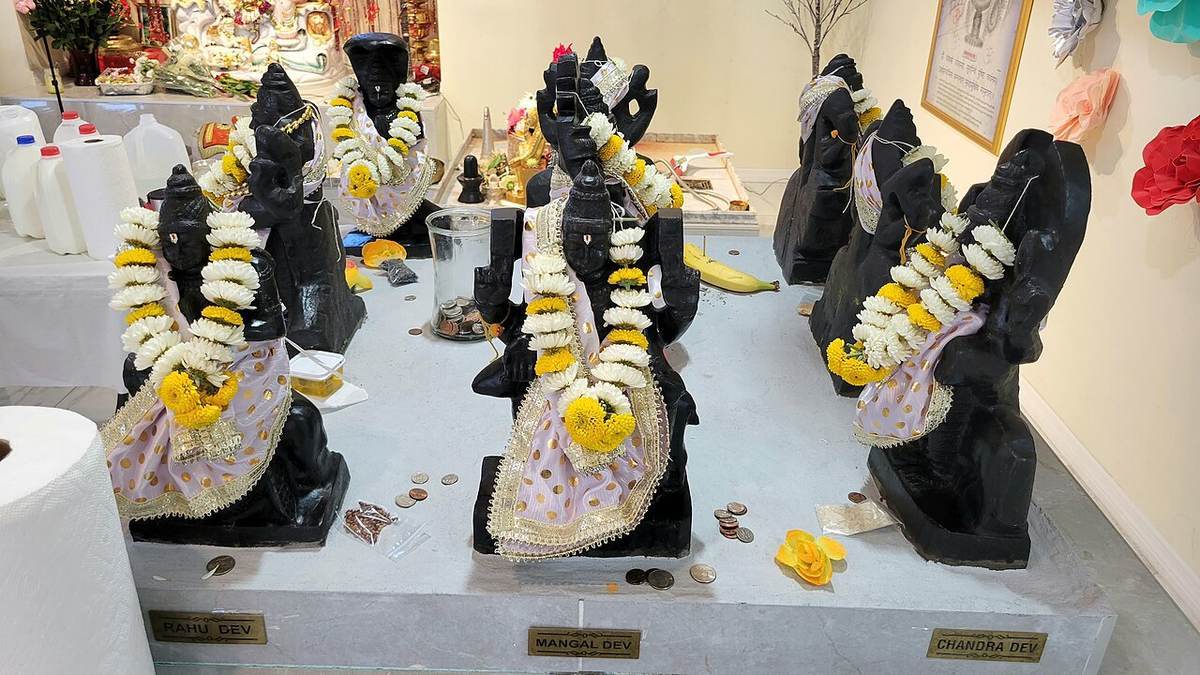
Step into a Hindu temple courtyard in Tamil Nadu or Odisha. Near the outer wall sits a square platform of stone holding nine carved figures. Each rides a different mount. Each holds a different sign. Look closely at how the builder placed them. None of the nine faces straight toward another.
They are the Navagraha, the nine cosmic seizers of Vedic astronomy, temple worship, and Jyotisha. Seven are visible lights crossing the sky: Surya the Sun, Chandra the Moon, Mangala or Mars, Budha or Mercury, Brihaspati or Jupiter, Shukra or Venus, and Shani or Saturn. Two are shadow points where the Moon's path meets the path of the Sun: Rahu and Ketu. Together they form a clock in stone and a map of what grips human thought.
What it means to be seized
In English people call the Navagraha the nine planets, as if they were luck charms handing out prizes or bad days. The Sanskrit word graha holds a sharper truth. It comes from the verb root grah, meaning to seize, grasp, or hold fast.
A graha is a current that takes hold of the mind and breath. When anger flares, Mangala has you by the collar. When pride heats a room, Surya burns too bright. When delay strips away every shortcut, Shani sets his iron weight upon your back.
Physics finds something strangely near this when it looks at mass in space. In The Order of Time, Carlo Rovelli recalls Albert Einstein's discovery about gravity. The Sun and Earth do not tug across empty space by magic. Each body bends the shape of space and time around it. Time itself slows down near heavy mass. Every body in space moves to its own proper time, its own beat. Rovelli quotes the Greek thinker Anaximander, who wrote that things pass into one another and render justice according to the order of time.
When an old habit grabs a person and pulls their weeks into a tight loop, Indian wisdom calls that grip karma. In Physics of the Soul, Amit Goswami writes that karma works like nonlocal links across time. He compares it to two photons paired in Alain Aspect's test. Unfinished themes stay active outside time. They loop back into new lives until inner awareness wakes up and sees through the game.
Lee Carroll, speaking for Kryon, describes karma as an old record in human DNA. It runs on a circle of time until awake awareness spots the track and steps off. Anne Tucker makes a similar point in her talks. The force behind karmic pain is neutral creative fuel. It builds new life as soon as we stop feeding old fear.
The head and tail of the eclipse
Look first at the two shadow grahas whose myth explains eclipses. This tale comes from the Puranas, at the Churning of the Cosmic Ocean.
Gods and demons worked side by side to churn the milk sea for Amrita, the drink of deathless life. Great mountains served as the churning rod. When the jar of nectar finally rose out of the white foam, Vishnu took the form of a maiden to pour it only for the gods.
One clever demon named Svarbhanu saw the trick. He slipped into the row of gods in disguise. He took a seat right between the Sun and Moon. Just as the ladle tipped a drop of Amrita onto his tongue, Surya and Chandra knew him and cried out.
Vishnu threw his spinning disk in a flash of light. The blade cut Svarbhanu's neck before the nectar could reach his chest.
Because Amrita had touched his mouth, neither half could die. His head became Rahu, the North Node of the Moon. Having no belly to fill, Rahu stays forever hungry for what sits just out of reach. His headless body became Ketu, the South Node. Stripped of plotting thought, Ketu carries gut memory and sudden release.
Ever since that dawn, Rahu and Ketu chase the Sun and Moon along the zodiac crossroads. Whenever a New or Full Moon stands near those nodes, shadows cross the face of heaven.
Seven lights and their stories
Each of the seven visible grahas carries a myth that shows how its grip feels in daily life.
Surya, the Sun, drives a gold chariot on one wheel pulled by seven horses. Those seven horses stand for the seven colors of light and seven beats of Vedic song. Long ago his fierce heat drove away his wife Sanjna. To save her, the builder Vishvakarma set the Sun on a lathe and shaved off part of his glare. From those fiery shavings, Vishvakarma forged sacred blades and disks. Surya rules truth, life force, and upright spine. His myth warns that untamed pride burns everyone nearby. Tom Kenyon, writing on the Vedic Gayatri Mantra to Savitur, the solar spark, notes one key practice. When you chant with focus held behind the brow, awareness tunes to the inner sun that lights the mind without scorching it.
Chandra, the Moon, walks through twenty-seven star houses called Nakshatras each month. Myth says he wed all twenty-seven daughters of Daksha, yet stayed only with Rohini. Angered by that neglect, Daksha cursed him to waste away into the dark. Shiva caught the thin crescent and placed it in his matted hair. Thus Chandra was saved under the law of waxing and waning. He rules water and memory, teaching that fullness cannot last unless dimming also has its hour.
Mangala, red Mars, was born when drops of sweat fell from Shiva's brow onto warm earth. He rides a ram and carries four signs: a spear, a mace, prayer beads, and a lotus. He is raw nerve and defending fire. Holding both spear and lotus shows one clear rule. Force without mercy turns brutal. Kind wishes with no backbone fold at the first push.
Budha, green Mercury, was born out of a storm at home. He was the child of Chandra and Tara, wife of Brihaspati. Riding a winged car with a sword, shield, and scroll, Budha rules quick speech, trade, numbers, and cool wit. He brings peace between rivals through sharp thought.
Brihaspati, golden Jupiter, serves as priest and teacher of the gods, often called Guru. Riding an eight-horse car with a water pot and prayer beads, he guards meaning, law, and wide study. He keeps skill anchored in truth.
Shukra, bright Venus, stands as the teacher of the Asuras, the foes of the gods. Wearing a gold crown and holding a jar of grace, Shukra won Sanjivani Vidya, the secret art of calling the dead back to life. He rules music, craft, love, loyalty, and the skill of raising beauty out of ruin.
Shani, dark Saturn, was born to Surya and Chhaya, the shadow left behind by Sanjna. Surya turned away from the dark child at birth. Slow Shani limps across heaven in an iron car pulled by a crow or vulture. He carries bow, arrow, and an iron staff. Across thirty-year rounds, Shani strips away borrowed pride. He leaves only what patient labor earned.
What the temple square encodes
Across South India, and notably in the nine shrines of the Kaveri delta, sacred masons built Navagraha platforms by strict geometry. Step back to that square shrine in the courtyard and ask why no two statues face each other.
In Indian temple craft, two idols staring face to face would let one fierce force swallow its neighbor. Turning each statue slightly aside keeps all nine currents in live balance. No single graha owns the whole person.
Swami Muktananda wrote on this trap while commenting on the Shiva Sutras. He speaks of karmamala, the stain that binds us to the fruits of past deeds. That bond is fed by matrka, the hidden pulse of sound-syllables spinning pictures inside the mind. When we mistake one loud current for our whole self, it drags us around its wheel. When we sit still and watch those pictures rise and fade, the grip loosens.
That is the law of the stone square. A seizer rules you only while you stare into its face and forget the other eight doors.
The nine seizers in your birth chart
Jyotisha and Western star charts read the exact same sky. Classical Indian astrology works with the nine Vedic grahas: the seven visible lights from the Sun to Saturn, plus Rahu as the North Node and Ketu as the South Node. Modern Western charts keep those same nine bodies and add outer planets such as Uranus, Neptune, and Pluto.
One sky note helps when reading Indian and Western charts together. Hindu temple astrology usually uses the sidereal zodiac. It anchors the start of Aries to fixed stars about twenty-four degrees behind the seasonal tropical wheel. That shift changes sign names while keeping every angle between planets the same.
Watch how the grahas pair up in a chart. The Sun beside Saturn ties Surya's wish for purpose to Shani's school of patience. Venus beside Rahu pours hunger into art, charm, and new faces. The Moon beside Ketu sharpens natural gut insight alongside a sudden wish to slip out of noisy rooms.
Keeping time inside the ninefold square
In Hindu homes, honoring the Navagraha rests on humility and the seven-day week, never on fear. No ring or stone buys a way past consequence. Instead, families meet each light on its own day. Sunday belongs to Surya, Monday to Chandra, Tuesday to Mangala, Wednesday to Budha, Thursday to Brihaspati, Friday to Shukra, and Saturday to Shani.
You can practice a simple daily check with no ritual gear.
At dawn or dusk, sit upright for three minutes. Notice which current has gripped your chest today. Is it solar pride, lunar worry, Martian heat, Mercurial chatter, or Saturnian gloom?
If you know the Gayatri Mantra, repeat it softly or silently with focus behind the brow. As Kenyon notes, this turns attention toward the inner light of Savitur. If not, take nine slow breaths, one for each figure in the square. Picture all nine looking outward in peace instead of fighting inside your head.
Name one plain duty you owe today. Name one restless attachment you can set down.
Finish the sitting by lighting one small brass lamp beside a tiny dish of sesame seeds, or by resting your fingertips briefly on a small bowl of sesame grains if you keep no flame. Let go of any tally of lucky or unlucky days. Snuff the brass wick gently, step out of the square in your mind, and go tend one ordinary task on your table.
Questions people ask about the Navagraha
What are the Navagraha in Hindu tradition?
The Navagraha are the nine cosmic seizers of Vedic astronomy and Jyotisha. They are the seven visible lights from Sun to Saturn plus Rahu and Ketu, the two lunar eclipse nodes.
Why are they called seizers instead of lucky planets?
The Sanskrit word graha comes from a root meaning to grasp or seize. Classical texts treat these nine forces as living currents of attention and karma. They hold human life until awareness matures.
Are Rahu and Ketu real planets?
Rahu and Ketu are not physical worlds. They are two mathematical shadow points where the Moon's tilted path crosses the Sun's apparent track around the Earth, marking where eclipses happen.
How do the seven weekdays connect to the Navagraha?
Each weekday takes the Sanskrit name of a visible graha. Sunday is Ravivara, Monday is Somavara, Tuesday is Mangalavara, Wednesday is Budhavara, Thursday is Guruvara, Friday is Shukravara, and Saturday is Shanivara.
Do the Navagraha require costly gems or rituals?
Classical teaching places right conduct, truthful speech, giving, and calm awareness far above costly stones or loud rites. Watching how each current moves through your week costs nothing.
The nine moving lights
The Navagraha are the nine currents of time, holding human attention until balance sets the seizer free.