Inside the lamp-lit inner sanctum of a South Indian temple, brass oil wicks shimmer along a dark granite serpent coiled in endless rings. Upon those coils reclines a calm blue figure, one hand resting beside a white spiral conch while a garland of fresh green tulsi leaves crosses his chest.
Vishnu is the cosmic preserver of Hindu tradition. In the Vedas he measures out earth, mid-air, and sky in three wide strides. In the Puranas he is Narayana, who rests upon the waters before worlds unfold. He is also Padmanabha, from whose navel a lotus lifts the creator Brahma into daylight. Vishnu holds a changing cosmos intact across ages without freezing it dead, using his four emblems, his coiled serpent seat, and his ten earthly descents to keep balance while new life grows.
What endures while forms shift
A river keeps its shape all summer even though every drop of water passes through in an hour. A human body replaces its cells year after year. Still, the person answers to the same name. Physics asks a sharp question about that kind of endurance. How does a pattern hold together when every piece inside it moves?
Physics even borrows Vishnu's name for that law of endurance. In his textbook Quantum Mechanics, Amit Goswami recalls a famous remark by J. J. Sakurai on quantum operators. Sakurai compared the operator that creates a quantum to Brahma. He compared the operator that removes a quantum to Shiva. Then he compared the number operator N, which tracks count and keeps order, to Vishnu the preserver.
Tom Kenyon writes directly about Vishnu in his Thoughts and Observations from August 2024. Kenyon calls Vishnu the Great Dreamer and Sustainer of the cosmos. He looks at paintings of Vishnu floating on the cosmic sea while Brahma sprouts from his navel. Kenyon notes how biology echoes that myth. Through neurogenesis and epigenetics, living brains and genes grow fresh links inside an older body. Even inside an existing world, a new world already sits in bud.
Three steps and the sleep upon the sea
Two tales from Hindu scripture show how Vishnu holds the cosmos together without crushing what lives inside it.
The first story comes from the Rig Veda and the Shatapatha Brahmana, later told in full in the Bhagavata Purana. At the dawn of an age, titan king Bali conquered the three worlds by force of vows and arms. Bali drove the sky gods from their seats. Still, he ruled fairly and held a great rite where he vowed to grant any priest his wish.
Vishnu took the small form of Vamana, a dwarf priest carrying an umbrella and a water pot. Vamana walked into Bali's shining hall and asked for no gold or crown. He asked only for as much ground as he could cover in three steps of his feet.
Bali laughed at the small request and poured water to seal the gift, ignoring his teacher's warning. Then Vamana grew until his head passed the stars. With his first step he covered the whole earth. With his second step he crossed mid-air and all of heaven. Nowhere remained for a third step. Vamana looked down at the kneeling king, and Bali bowed his own head as the third ground. By those three strides, Vishnu measured space without spilling blood. He left Bali to rule the lower realm in peace.
The second scene sits at the turn between cosmic cycles in the Markandeya and Bhagavata Puranas. When an age ends and oceans swallow mountains into flood, Vishnu does not fight the water. He rests in yogic sleep upon Ananta Shesha, the serpent whose name means infinite remainder. Out of his navel rises a green stalk bearing a lotus flower. Inside that lotus sits four-faced Brahma ready to speak the next world into form. When demons named Madhu and Kaitabha creep out to slay Brahma before creation can start, Vishnu wakes at once. He meets them and clears space so the lotus can open.
What the sea and the strides encode
Two plain laws of endurance sit inside the three strides and the sleeping serpent.
First, new life needs a calm sea before it can sprout. A seedling cannot take root inside a landslide. Brahma, the power of fresh creation, sits atop a stalk rooted in Vishnu's own navel while Vishnu rests on still water. Human insight and growth need an unbroken ground beneath them. Without preservation, creation burns itself out in one flash.
Second, true preservation works by measure, never by brute lock. Vamana brought no army to Bali's hall. He changed scale from dwarf to giant and measured three steps that restored order while honoring Bali's own word. Across the Puranas, Vishnu enters crises through ten forms, the Dashavatara. He steps from fish and tortoise through boar, man-lion, dwarf, warrior, prince, and flute player. Each form fits the exact hour.
Swami Muktananda records this firm nature while quoting verse forty-seven of the Guru Gita. He points to Vishnu's ancient name Acyuta. Cyuta means one who slips or falls when time turns. Acyuta means the one who never slips from his post, holding every shifting phase inside one awake witness.
Reading the four arms from conch to lotus
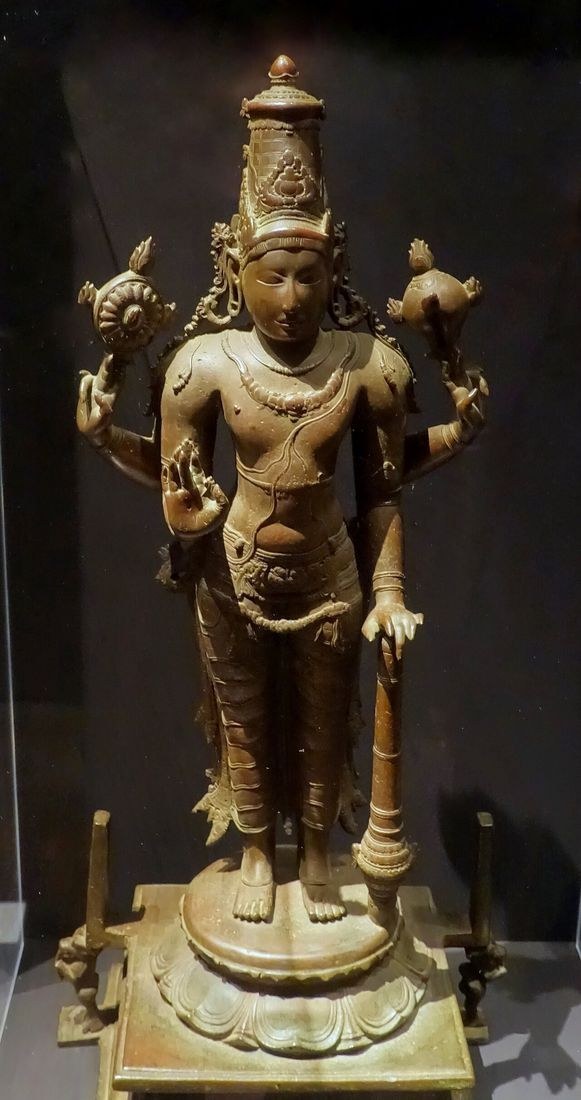
Stand before a stone carving of Vishnu in a South Indian temple and trace what each of his four arms carries.
Begin with his upper left hand, where a spiral conch called Panchajanya rests. Before any form takes shape, sound wakes space. Blowing the conch sends a clear tone across the field, calling scattered attention back into one shared beat.
Move across to his upper right hand, where the Sudarshana Chakra spins on one fingertip. Its name means auspicious vision. A heavy club crushes blindly. A spinning disk cuts straight through knotted fog, trimming back whatever chokes life's rhythm.
Look down to his lower left hand, holding the Kaumodaki mace. A mace gives weight and spine. When soft wishes drift like smoke, the mace keeps dharma upright on solid ground so truth has bone inside it.
Then look to his lower right hand, where a pink lotus opens. Tom Kenyon points out a telling detail in paintings where Vishnu lifts that lotus and smells its scent. Kenyon calls those sweet aromas messages from the living matrix linking all creatures. Vishnu dwells in vast bliss while staying tuned to the sweetness of earthly life. Between the conch of sound, the disk of sight, the mace of bone, and the lotus of sweetness, all four sides of life stay balanced.
Beneath his feet or beside his seat coils Ananta Shesha, the snake of infinite remainder. Nothing real is lost when an age folds down. The memory of past cycles coils calmly under Vishnu's back, ready to carry the next dawn.
Above or beside him flies Garuda, his solar eagle mount. Maia Nartoomid compares Garuda-Vishnu to Quetzalcoatl of Central America, a winged bearer who lifts culture out of chaos. She also notes how Khmer kings built Angkor Wat for Vishnu with five towers mapped to Mount Meru and aligned to spring equinox sunrise. Garuda is wide sight flying high above panic while keeping one eye on earth below.
The dreamer, the bird and the lotus wife
In Hindu lore, Vishnu never stands alone. He forms one pole of a living circuit with Lakshmi beside him and Brahma and Shiva at his sides.
Lakshmi, called Sri, rests on his chest or presses his feet as he dreams upon the sea. Vishnu holds the silent ground. Lakshmi pours living radiance, beauty, and flow through that ground. Ground without flow turns barren. Flow without ground spills into flood. Tom Kenyon writes in his Bali tantra notes that the union of Vishnu and Lakshmi joins sustaining stillness with radiant creative grace.
Brahma rises from Vishnu's navel to shape new worlds. Shiva dissolves worn structures back into ash so space stays fresh. In Amit Goswami's account of Vaishnava practice in The Visionary Window, devotion to Vishnu teaches the seeker to trust the sustaining web of being. Even when storms rock the surface, the deeper sea holds the boat.
Where Vishnu marks the birth sky
In Jyotisha, Vishnu rules Jupiter, Mercury, and the Moon's tidal pulse. His deepest tie is to the twenty-second lunar mansion, Shravana. Shravana spans from ten degrees to twenty-three degrees and twenty minutes of sidereal Capricorn. Its presiding deity in the Taittiriya Samhita and Brihat Samhita is Vishnu Hari himself.
Shravana means hearing, the open ear that catches sacred truth before the mouth speaks. Its marker star is bright Altair in the constellation Aquila, the Eagle, flanked by Tarazed and Alshain. Those three stars sit in a tilted row across the night sky. Ancient Indian sky watchers read them as the three footprints of Vishnu's cosmic strides.
In a classical Jyotisha chart, look to Jupiter and the Moon to see where Vishnu's preserving hand acts. Strong Jupiter pairs with ethical backbone and wide sight, like Garuda soaring above the ridge. The Moon linked smoothly with Jupiter or Saturn supports patient care that tends seeds across decades. When Saturn or the Lunar Nodes cross key points in a chart, Vishnu's lesson calls you to hold what matters, trim what stalls, and trust the long arc.
Anchoring the mind on the calm sea
Turn to Vishnu when change feels dizzying and you want to stand inside firm order without locking up in fear. Hindu tradition honors his hours at dawn, on Wednesdays and Thursdays, and on Ekadashi, the eleventh lunar day of each fortnight.
Begin by sitting upright on a firm cushion or chair, spine tall like a lotus stalk. Rest your hands open on your thighs. Picture dark ocean water beneath your seat, holding your weight without strain.
Tune first to the breath as a conch tone. Inhale smoothly through your nose for four counts. Pause one beat. Exhale for six counts with a soft hum, like sound moving across open water. Notice vibration settle behind your breastbone.
Next, bring Tom Kenyon's lotus image into your chest. Do not dwell on bitter losses. Call to mind one living sweetness in this day: warm tea, sun on leaves, or a friend's voice. Let attention rest on that simple gift for five slow breaths so your chest stops bracing for collapse.
If you use a mantra, speak Om Namo Narayanaya or Om Namo Bhagavate Vasudevaya twelve times slowly, in an even voice. Hear the words as a tune that keeps the room level. Notice where one task in your week needs a sharp cut like the chakra disk. Notice where one small seed needs patient water like the navel lotus.
Finish the practice with the traditional offerings of a Vaishnava shrine. Snuff out a small ghee lamp if you lit one, and place one fresh green tulsi leaf on your tongue or drop it into a cup of water and sip it slowly. Hear the last silent echo of the conch settle inside your chest, and carry that calm order into the care of your home.
Questions people ask about Vishnu
What is Vishnu the god of in Hinduism?
Vishnu is the preserver and sustainer of the cosmos in Hindu tradition. He protects cosmic order, called Dharma, and enters the world in new forms whenever balance breaks down.
Why is Vishnu shown sleeping on a serpent?
He sleeps on Ananta Shesha, whose name means infinite remainder, upon the cosmic sea. The image shows that when one cycle ends, living memory rests calmly and supports the next dawn.
What do the four objects in Vishnu's hands stand for?
His conch sounds the waking pulse of space. His spinning chakra cuts through fog with clear sight. His golden mace anchors weight and right order, while his lotus keeps awareness open to life's sweetness.
Why does Vishnu take ten avatars across ages?
Each avatar, from fish and tortoise to Rama and Krishna, answers a specific crisis in cosmic history. Preservation is never rigid, because truth changes shape to meet what each era needs.
How do people connect with Vishnu in daily life?
Devotees honor Vishnu with clear attention, hymns like the Vishnu Sahasranama, and chants such as Om Namo Narayanaya on Thursdays and Ekadashi. Lighting a ghee lamp, offering fresh tulsi leaves, and caring for living things keep the link alive.
The sea and the measure
Vishnu is the calm sea beneath every storm, the three steps that measure a world and keep the seed safe until dawn.