At Pitambara Peeth at dawn, a yellow silk curtain parts over stone stairs washed with turmeric water. Yellow marigolds float still in a brass basin while a priest smears ochre paste across the shrine threshold. Out in the temple pond, a white crane stands motionless on one leg in the shallows, eyes fixed on a single spot below the surface.
Bagalamukhi is the eighth of the ten Mahavidyas in Hindu and Tantric tradition. She is also called Pitambari, the goddess clothed in yellow, and Stambhini, the power that arrests motion. Her root name comes from words meaning a crane and a horse's bridle. She is the consciousness that freezes spinning noise, panic, and false speech at the source. Around her turmeric robes, her golden throne, and her hand gripping a demon's tongue, Tantra built a craft for halting runaway spin.
The still point inside spinning motion
Most people assume that stopping a loud rush takes a harder push from the other side. Brain research and Tantra point to a sharper trick.
Iain McGilchrist shows a hidden trap inside human sight in The Matter With Things. In a lab test called motion-induced blindness, three yellow dots sit around a spinning grid. When your eyes lock onto the center dot, the yellow dots vanish and return in turn. The left brain clings to its own story and hides real things sitting right in front of you.
Maia Nartoomid describes the same arrest in her writings on Thoth and scalar fields. She speaks of Magna Neutra, a neutral presence that mirrors itself in space as total stillness. When restless waves meet that Still Point, wild motion rushes inward and resets into order.
In her talk Beautiful Practice to Reduce Fear, Anne Tucker speaks to this pause. Setting down resistance brings you into stillness, she explains. Stillness is not dead weight. It is the ground from which clear action and new creation begin.
The tempest at the Lake of Turmeric
This story comes from the Sankhyayana Tantra and Shakta Puranas.
Long ago, in the first age of the world, a great storm rose without warning. Winds tore across mountain peaks and whipped the oceans upward until the three realms shook. Nothing could stand upright before the gale.
Seeing creation near ruin, Vishnu walked to the shore of Haridra Sarovar, the Lake of Turmeric. He sat beside the yellow water and offered prayer to the Mother of the Universe. Day after day he kept his seat while dark waves pounded the earth around him.
Out from the center of the golden lake rose Bagalamukhi, shining like molten gold. Yellow silk wrapped her frame, and turmeric blossoms crowned her hair. She looked out across the roaring sky and spoke her command of arrest, called stambhana. In one instant, the gale froze in midair. Clouds stood still, oceans sank level, and the world kept its breath.
In a companion Tantric tale, a demon named Madanasura won a rare boon from long penance. Whatever words left his mouth came true. Instead of guarding truth, he used his speech to bend minds, spread lies, and torment sages across the land.
Bagalamukhi stepped across his path. Before Madanasura could shout another curse, she seized his wagging tongue in her left hand and raised a golden club in her right. Frozen mid-word, his spell died in his throat. Deceit lost its engine the second his tongue stopped moving.
Braking the gale and starving the tongue
Two plain laws sit inside Bagalamukhi's stories.
First, a chain reaction dies when one link freezes. A rumor, a panic, or a cyclone only grows by passing speed from one part to the next. Push back with rage, and you add fresh wind to the gale. Pull the brake on a single link, and the wheel stops turning.
Second, false power lives inside unchecked speech. Madanasura held no strength in his arms or knees. All his reach lay in a fast tongue spinning illusions faster than listeners could check them. Once the tongue is held still, the spell starves.
Reading the yellow robes and the raised club
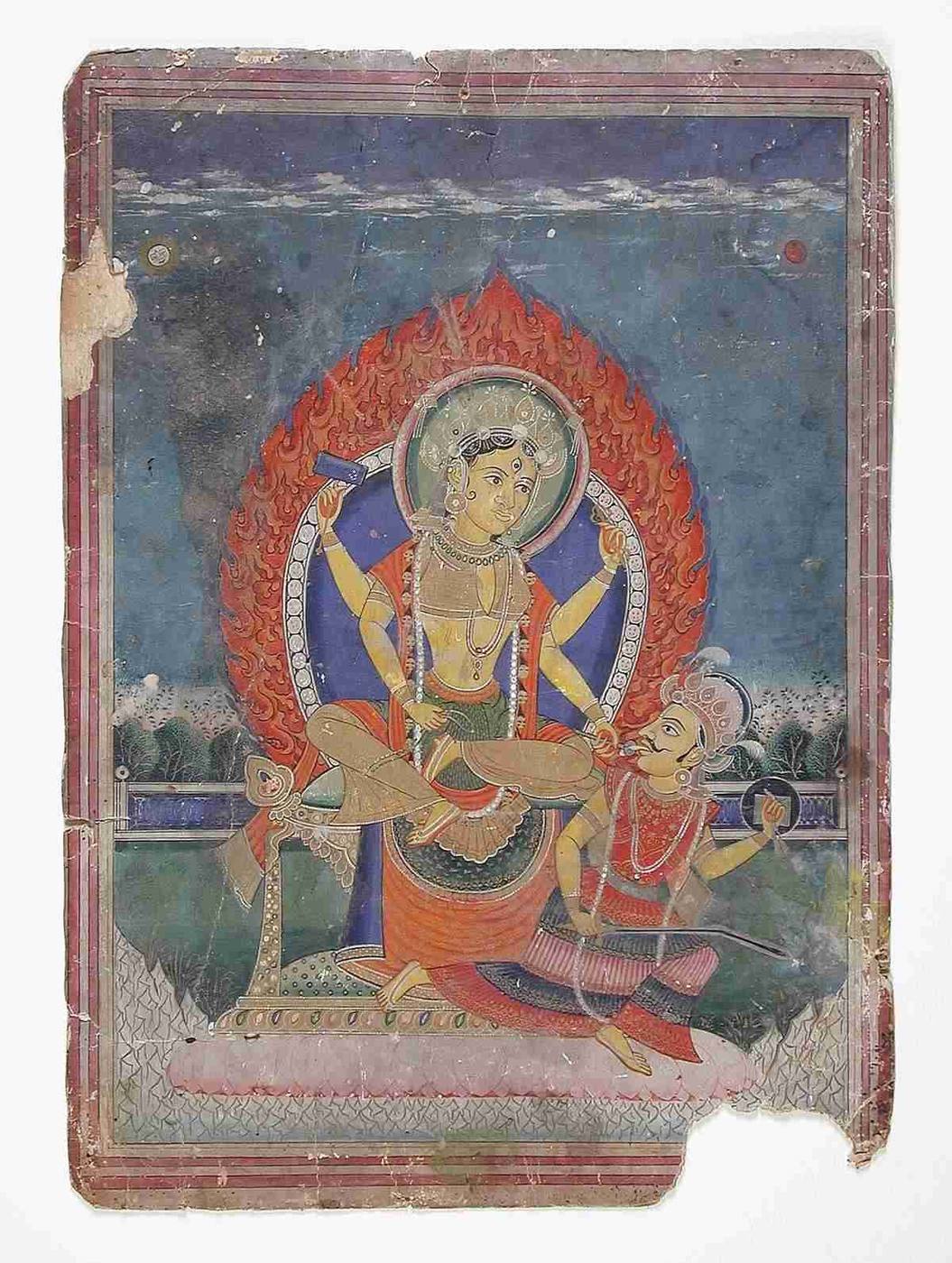
Stand before a Nepalese painting of Bagalamukhi and notice each detail in turn.
Look first at her yellow glow. She wears turmeric robes, sits on a golden throne, and rises out of saffron water. Across India, turmeric marks earth, warmth, and truth that refuses rot. Tom Kenyon notes in his Spatial Cognizance teachings that yellow stands among the Five Pure Lights at the threshold of awareness, birthing gold and silver radiance when inner craft matures.
Look next at her left hand. Her fingers grip the red tongue of the fallen adversary, pulling it outward so no lie can form. That tongue is no mere villain in an old book. It stands for the restless inner narrator that spins panic, slander, and hasty vows before facts can land.
Look at her right hand. She holds a heavy club raised above her shoulder. Notice that she never swings the club down in blind rage. A raised club holds firm check over motion, ready to strike if false words stir again.
Think also of the crane and the horse bridle tucked inside her name. A baka crane stands for hours on one leg in shallow water, still as a reed, waiting for one fish to swim past. A valga bridle sits in a horse's mouth so the rider guides speed instead of crashing into stone.
Stillness between two breaths
Commenting on the Shiva Sutras, Swami Muktananda opens the same door. He explains that outer speech on the tongue is vaikhari, only the last surface ripple of the deeper inner sound called matrka. Before words spill out into fights, thought begins as a soft stir in the heart.
Muktananda also quotes verse twenty-five of the Vijnanabhairava on the breath. Inhale carries the sound ham inward to the heart, and exhale carries the sound so outward into space. Between those two swings lies a tiny natural pause called madhyadasa. When the wandering mind halts inside that brief gap, spinning stops and bare awareness shines.
In the Mahavidya family, Bagalamukhi pairs closely with Matangi, the goddess of wild song and spoken art. Matangi lets fresh truth pour out through the throat. Bagalamukhi puts a cool hand across the mouth before noise takes the wheel. Both guard speech from opposite ends of the same gate.
Where Bagalamukhi holds the sky
In Jyotisha, Bagalamukhi carries the golden weight of Jupiter, the firm check of Saturn, and the raised arm of Mars. Jupiter rules yellow color, turmeric, wisdom, and lawful truth. Saturn brings cold stillness that stops loose chatter in its tracks. Mars lends the crisp courage needed to hold the line without flinching.
When Saturn meets Mercury or Mars in a birth chart, speech slows down and words carry weight. A tight link between Saturn and Mercury can feel heavy at first, yet it trains a speaker to weigh every word before letting it cross the lips. Jupiter beside the Moon calms emotional storms through dharma.
Her star mirror sits in Pushya, the eighth nakshatra in sidereal Cancer. Its Vedic deity is Brihaspati, guru of the gods and lord of golden speech. Pushya's marker star is Asellus Australis near the Beehive cluster. Hindu tradition honors Pushya as the nourishing seat where hasty noise cools into wise counsel.
Holding the still point at sunrise
Turn to Bagalamukhi when panic speeds up, rumors fly, or an inner voice spins worst-case stories. Her work freezes your own runaway spin instead of chasing petty quarrels.
Keep her hour on Thursdays, ruled by Jupiter, or at sunrise when morning light turns gold. Sit upright on a yellow cloth or plain mat with a small brass bowl of ochre turmeric paste or yellow marigolds before you.
Rest your hands flat on your knees and imitate the crane at the pond edge. Keep your spine straight and your eyes soft on one still point across the room. Remember Tom Kenyon's Third Form of the Solar Holon, practiced in stillness without forced sound or motion, and his rule on Ananda Brahma, resting at the gate until agitation drops.
Notice the restless tongue inside your own mouth. Gently press the tip of your tongue against the roof of the mouth behind your upper teeth. Stop rehearsing old fights. Follow Isla's cue in Anne Tucker's recordings and set down resistance to what sits in front of you.
Watch five slow breaths pass. Look for the tiny gap after the outbreath ends and before the next inbreath starts. Rest inside that madhyadasa pause for one heartbeat, letting the spinning grid around you go still.
If you use sound, whisper her seed syllable Hlrim once slowly, letting the final hum fade into silence.
Release the hold gently before standing up. Drop your tongue from the palate, blink three times around the room, and roll your shoulders once. Touch a tiny dot of ochre turmeric paste to the center of your throat or brow. Sit in silent morning light for a few breaths without speaking, then say her gracious name Pitambari once aloud before returning to the day.
Questions people ask about Bagalamukhi
What does the name Bagalamukhi mean?
Bagalamukhi comes from Bagala or Valga, meaning a bridle, and Mukhi, meaning face or mouth. She also links with the baka crane, honoring motionless focus that stops distraction and false speech.
Why is Bagalamukhi always shown in yellow?
Yellow is the color of turmeric, gold, and Jupiter's truth in Hindu tradition. Her yellow robes and Lake of Turmeric stand for earthy purity and radiance that halts confusion without burning life down.
Why does Bagalamukhi hold an enemy's tongue?
In her myth, the demon Madanasura used magical speech to spread terror and lies. Holding his tongue shows stopping harmful words, gossip, and inner panic before they take root as deeds.
What is stambhana in Bagalamukhi worship?
Stambhana is the Tantric power of halting or freezing motion. On a deeper level, it means stopping restless thought loops, fear reactions, and scattered energy so true discernment returns.
How can someone honor Bagalamukhi safely at home?
Sit upright on Thursdays with yellow marigolds or turmeric paste beside you, rest the tongue behind the upper teeth, and wait in the pause between breaths. Finish by touching a dot of turmeric to your brow and speaking Pitambari in silent morning air.
The crane and the golden halt
Bagalamukhi is the golden bridle that freezes spinning noise until truth stands clear again.