Outside a village shrine in Tamil Nadu on the fifth night of the lunar fortnight, brass oil lamps burn beside a dark stone goddess with a boar's snout and upturned white tusks. An iron plow leans against the courtyard wall near a clay water pot and a mound of fresh turned earth. Where winter frost packs black soil too hard for rain to enter, only that heavy blade turns buried roots back into the air.
Varahi is the boar-faced Mother Goddess of Hindu and Shakta tradition, fifth among the Ashta Matrikas, the Eight Mothers. She stands as Dandanatha, commander of Tripura Sundari's army, and Potrini, the plow-snouted one. She is also Vartali, keeper of secret sound, and Panchami, lady of the fifth lunar night. She digs into buried weight, breaks heavy sleep, and lifts sunken life to daylight, using her boar tusks, her plow, her pestle, and her water pot to turn dark earth into strength.
How the planetary plow turns buried ground
Most people picture waking up as floating into pale clouds while leaving dirt behind. Tantra and earth lore move the other way.
In his March 2016 message with the Hathors, Tom Kenyon gives an exact image for deep change. Planetary waves pass like a plow cutting through the soil of the mind. That plow turns up flinty buried roots so hidden shadow rises into view. In Gaia's Song, Kenyon adds that Earth herself is alive and conscious, a vast intelligence far beyond human thought.
Amit Goswami reads India's boar lore through biological growth in God Is Not Dead. In the Puranas, the third divine form in matter is the great boar. It marks the leap where life climbs out of deep seas onto dry land. In Quantum Creativity, Goswami also notes that the plow turned roaming food gathering into farms and clearer thought.
Iain McGilchrist quotes filmmaker Andrei Tarkovsky on the same work in The Matter With Things. The true aim of art, Tarkovsky writes, is to plow and harrow the soul so it turns toward good.
Lee Carroll, speaking for Kryon, notes that Earth's magnetic grid and twenty-six-thousand-year spin stir living memory inside human DNA. Old patterns rise to the top for renewal.
Breaking the sleep stone on the field
This story comes from the Brahmanda Purana and Chapter Eight of the Devi Mahatmyam.
Long before cities stood, chaos drowned the world under dark water. Then Varaha, the cosmic boar, dove into the deep and lifted Bhudevi, Mother Earth, back into sunlight on his tusks. From that dive came Varahi, bearing the same earth strength in female form.
Ages later, Ambika faced Raktabija and his endless clones in the Devi Mahatmyam. Seven fierce Mothers surged from the gods to hold the field. Varahi charged out upon her buffalo mount. She crushed enemy ranks with snout and staff so chaos could not win the plain.
Her sharpest hour arrived during Lalita's war against Bhandasura's brothers. One night, the demon Vishukra crept into the camp and buried a stone diagram called the Jayavighna yantra. At once fog rolled across the Goddess's army. Soldiers dropped their spears. Commanders slumped beside chariots, and heavy sleep locked every fighter in place.
Only Varahi stayed awake in the dark. Riding forward as Dandanatha, commander of the rod, she aimed straight for the buried stone. With one strike of her iron plow and staff, she smashed the Jayavighna yantra to dust. Fog lifted at once. Fighters sprang upright, and victory turned on the field.
Turning sour clay and lifting from underneath
Two clear laws sit inside Varahi's plow and battle.
First, nothing buried under hard crust heals while locked away from air. A field left unturned turns sour and choked with stones. When a plow slices into clay, rocks rattle up into sight and look rough for an hour. Yet only then can rain soak in and green shoots rise.
Second, weight lifts from underneath, never by pulling from above. Varaha dove beneath the drowned planet. He braced his tusks under her belly to raise Earth upward. When fatigue presses down on a home, strength returns by rooting your feet and lifting from the base up.
Reading the tusks, the plow and the water pot
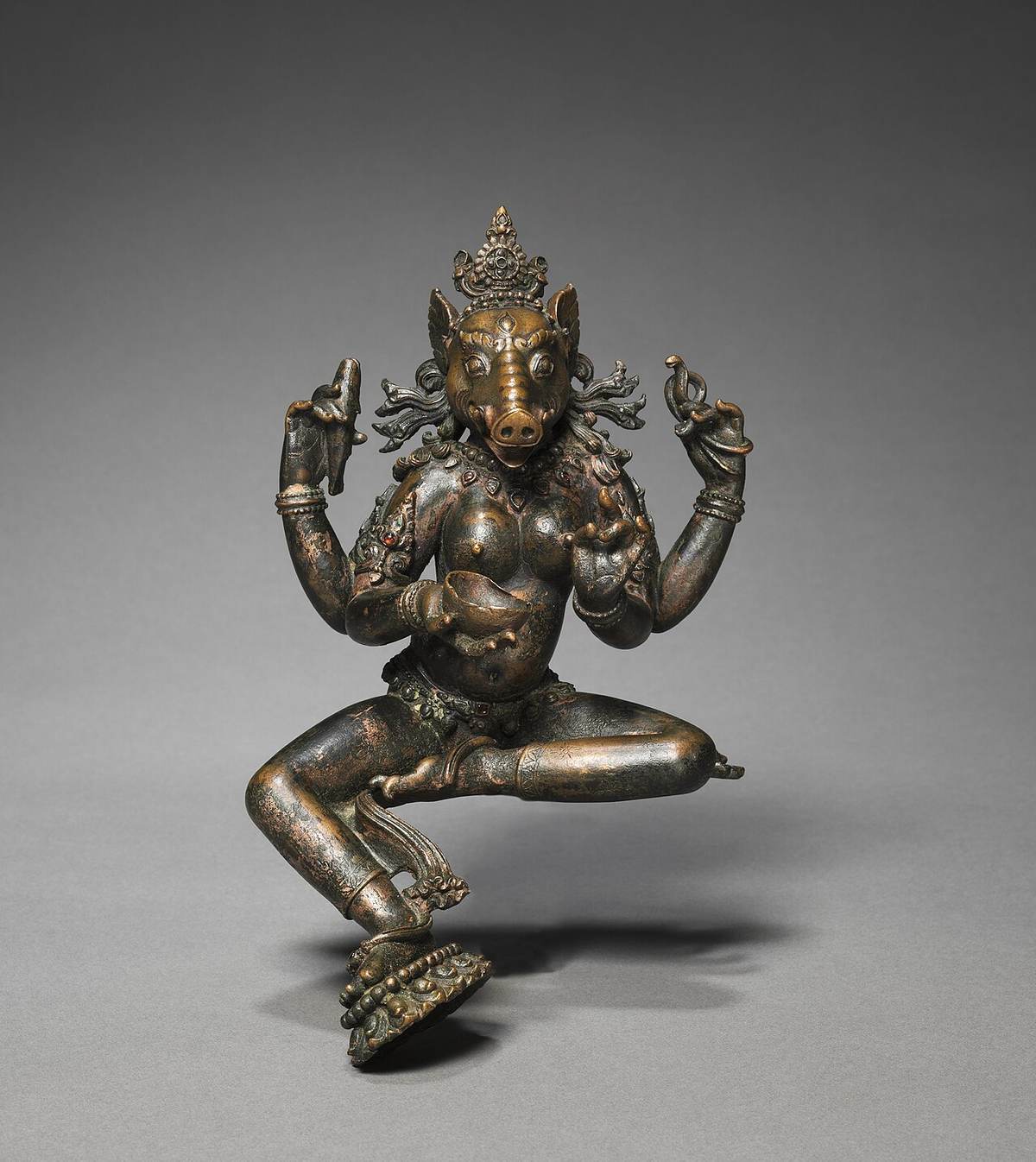
Look closely at the medieval stone figure of Varahi from Nepal in the Cleveland Museum of Art, tracing her upturned tusks down to the tools in her hands.
Start with her boar face and upturned white tusks. A deer or bird skirts around mud and thorns. A boar roots straight through thick brush and stone with its snout. She fears no mess, no dark night, and no heavy past. Her tusks lift whatever sank deep.
Check her two farm tools, the hala plow and the musala wooden pestle. A plow breaks packed crust so air enters soil. A pestle pounds grain inside a stone mortar until dry husks split off the seed. Together they crack crusty habits and stubborn dullness.
Look at her danda, the rod of command, beside her kalasha water pot. Marina Jacobi, who speaks of reality as thought and tone shaping matter, places a bowl of water in the center of a circle. Sound and heart focus charge the water before everyone drinks. That mirrors India's oldest rite. Priests set the kalasha water pot at the shrine center and charge it with Vartali's chant until water carries the pattern into the body as tirtha.
Jacobi also calls the heart a field that draws force in and sends it back out. Yoga names that seat hridaya. The Varahi Tantra uses counted chant, called japa, to wire new rhythm into habit.
The Eight Mothers as watchful guardians
Varahi rarely stands alone. Across stone temples in Tamil Nadu, Odisha, and Nepal, she sits fifth inside the ring of the Ashta Matrikas, the Eight Mothers. Their names are Brahmani, Maheshvari, Kaumari, Vaishnavi, Varahi, Indrani, Chamunda, and Narasimhi or Mahalakshmi.
In Puranic lore, these eight Mothers match eight raw drives that harm a life when left wild. Those drives are lust, anger, greed, delusion, pride, envy, slander, and malice. Tantra does not starve those forces or pretend they do not exist. It turns each force into a guard watching the gate. Varahi guards the belly, root, and night watch where unseen heaviness creeps inside.
Where Varahi roots in the sky
In classical Jyotisha, Varahi moves through Saturn and Mars by night. Saturn brings weight, patience, and stone endurance. Mars gives the warrior spine that marches out at midnight to smash Vishukra's sleep spell. Modern Western charts also pair her with Pluto, which rules what stays hidden under stone, deep earth heat, and renewal from the roots up.
She rules Panchami, the fifth night after the new or full moon. When Saturn or Pluto crosses the fourth house, the Moon, or the rising sign in a chart, old family weight often rises like stones turned up by a plow. Those seasons call for body care and patient work instead of quick escape.
Her star mirror sits in Anuradha, the seventeenth nakshatra in sidereal Scorpio. Its Vedic deity is Mitra, lord of sworn loyalty. Its marker star is Dschubba, sitting at the Scorpion's brow. Anuradha carries the sign of a lotus blooming through dark water, honoring stamina under weight.
Turning heavy ground on the fifth night
Turn to Varahi when dullness drags down your will, when heavy feelings rise, or when you need grounded grit at night. Meet her with plain water, bare earth, and a straight spine. Never rush.
Come on Panchami nights or Tuesday and Saturday evenings after dusk. Set a clay or brass pot of water, your kalasha, on a low board before you. Place a dish of garden soil or one iron nail beside it.
Sit upright with knees uncrossed and heels grounded on the floor, or fold your legs on a cotton mat. Feel your hips drop heavy toward the ground like roots gripping clay. Notice where dullness sits in your belly or lower back.
Rest your focus inside the heart center, hridaya, as an even warm pulse. Picture an iron plow turning up packed earth inside you. Let trapped air rise into the room without fear.
Sound her seed syllable Gloum, or speak Om Aim Gloum Aim Varahyai Namah softly seven times. Keep your eyes on the water pot as you chant. Follow the thread Marina Jacobi points toward and Hindu japa has used for ages. Let sound ring into the water so stillness and strength enter the cup.
Finish the night watch in actual earth before sleeping or rising. Lift the kalasha water pot with both hands and drink three slow sips. Step out to a garden bed or press your fingertips straight down into your dish of turned soil like the blade of an iron plow. Eat a bite of plain roasted root or grain, speak her gentle name Panchami once aloud, and return to sleep or work.
Questions people ask about Varahi
Who is Varahi in Hindu tradition?
Varahi is the boar-faced Mother Goddess, fifth of the Eight Matrikas. She also serves as chief commander Dandanatha in Sri Vidya Tantra. She bears Varaha's earth strength and guards against dullness and hidden blocks.
Why does Varahi have the face of a boar?
Her boar snout and white tusks echo Varaha diving under flooded chaos to lift Bhudevi, Mother Earth. The boar stands for fearless strength that digs through mud to raise buried truth into light.
What do Varahi's plow, pestle, and water pot mean?
The iron plow breaks hardened mental crust. The wooden pestle crushes stubborn husks. The kalasha water pot holds mantra-charged water that carries clear intent into daily life.
Who are the Ashta Matrikas beside Varahi?
The Ashta Matrikas are eight Mother Goddesses born from divine power in the Devi Mahatmyam. Their names are Brahmani, Maheshvari, Kaumari, Vaishnavi, Varahi, Indrani, Chamunda, and Narasimhi or Mahalakshmi. Together they guard sacred space.
How do devotees honor Varahi respectfully?
Varahi is honored at night, above all on Panchami, the fifth lunar night. People sit upright, chant mantra japa beside a kalasha water pot, sip the water, and touch turned garden soil or eat plain root food afterward.
The tusk and the waking furrow
Varahi is the night commander's plow that breaks frozen mud and lifts sunken life back into light.