Inside a South Indian Devi shrine at dawn, rose light spills across an engraved copper plate on the altar. Nine interlocking triangles meet at a tiny center dot, framed by fresh hibiscus blooms and sandal paste. Nothing on that altar begs for attention. Every angle draws the wandering eye straight back to its hub.
Tripura Sundari is the third of the ten Mahavidyas in Hindu and Shakta tradition. She is also called Lalita, the playful one, and Shodashi, the full moon of sixteen parts. Her name means the beauty of the three cities. She is the awareness that weaves waking, dreaming, and deep sleep into one living chord. Around her form, the Sri Vidya lineage built an exact craft. The nine triangles of the Sri Yantra, her sugarcane bow, and her five flower arrows work together as one tuning instrument.
Why order looks like beauty
Most minds treat beauty as paint brushed over hard stone after the building is done. Nature and Tantra both say the opposite. Beauty is what happens when parts lock together in right measure.
In The Matter With Things, Iain McGilchrist shows a simple figure made of six partial circles, half with straight lines sticking out like pincers and half without. When the right half of the brain perceives the implied whole, two overlapping triangles appear resting one on top of the other. When that wholeness fails, the triangles vanish, leaving behind only broken circles and odd pincers.
That simple test shows what Tripura Sundari heals. A split mind sees loose pieces fighting one another. Whole awareness sees the triangle that links them.
Maia Nartoomid speaks of this geometric pull in her transmissions from Thoth on the Solar Logos. She describes living flame letters spinning into an inverted triangle inside the heart, where light mathematics fires the subtle centers into one aligned stream. She also notes how souls nest inside light geometry so they brighten through harmony.
Anne Tucker points to the same doorway in her talks on stepping into harmony. She counsels listeners to pause their urge to force outcomes when change arrives. When you stop gripping the wheel, life has room to form beauty.
How Lalita rose from the fire pit
This story comes from the Lalitopakhyana inside the Brahmanda Purana.
Long ago, Shiva sat deep in stillness until Kamadeva, god of desire, shot a flower arrow at his heart to wake him for the world. Shiva opened his third eye and burned Kamadeva to gray ash in a single flash.
Later, a commander named Chitrakarma gathered a handful of that ash and shaped a doll. When Shiva's eyes fell upon the figure, life entered the dust. Out stepped Bhandasura, a dull ruler who drank up half the strength of anyone who faced him.
Bhandasura built three flying cities across the sky and choked the world in heavy sleep. The gods fought him and lost their will. In desperation, Indra and the other lords made a vast fire pit and stepped into the flame as an offering of pure awareness.
Out from that blazing center rose Lalita Tripura Sundari, glowing like a thousand rising dawns. She wedded Kameshvara, the loving form of Shiva, and rode a great chariot toward the three cities. With her bow of sugarcane and five arrows of fresh bloom, she broke Bhandasura's spell and set his three cities on fire. Desire returned to the world. It came back as awakened delight instead of blind hunger.
Joining the three states and aiming desire upward
Two plain laws sit inside the rise of Lalita.
First, when the three states of life split apart, dullness takes the throne. Tripura means three cities. In Sri Vidya, those three cities are waking, dreaming, and deep sleep, along with the sun, the moon, and fire. When the mind walls off the senses from spirit, life turns gray like Bhandasura's ash. When all three lock onto one center, energy flows without leak.
Second, desire does not need to be starved to become pure. It only needs a finer aim. Burning Kamadeva left ash that bred a worse tyrant. Lalita took the bow of desire back in her own hands and aimed it through wakeful skill.
Marina Jacobi describes reality as thought and tone where three waves merge into one field before matter forms. In Tantra, two opposite poles meet in the bindu, the single center point where sound turns into world.
Reading the sugarcane bow and the Sri Yantra
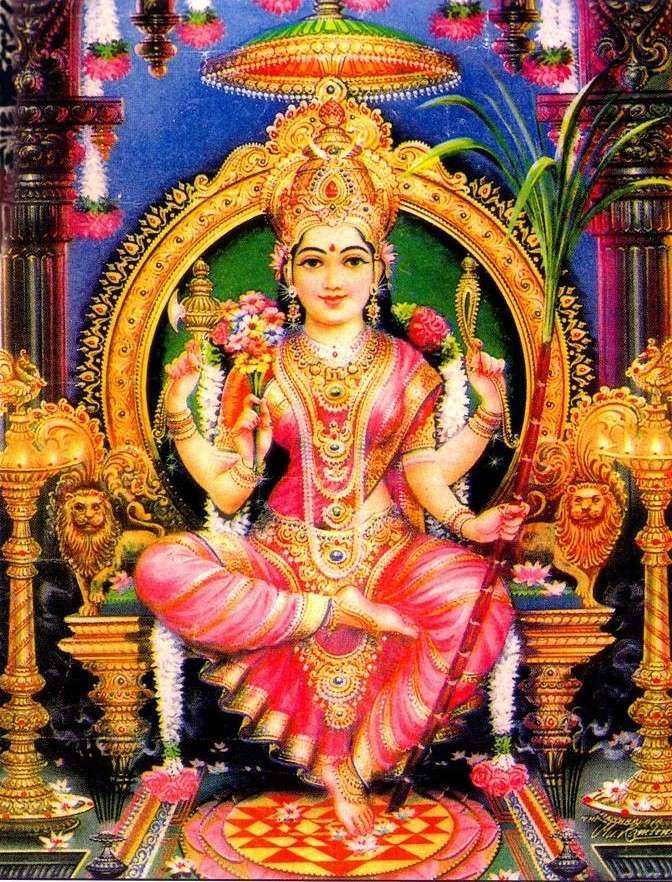
Look at a classical painting of Tripura Sundari seated on her throne, and follow the line from her four hands down to the gods beneath her feet.
First, in her lower left hand rests a curved bow of green sugarcane. Sugar tastes sweet, and the bow stands for the feeling mind. Mind runs toward whatever tastes good. Instead of snapping the bow, she bends it toward clarity.
Second, her lower right hand holds five arrows tipped with flowers. Five is the exact count of human senses: sight, hearing, smell, taste, and touch. Each sense can drag attention outward into scatter, or carry awareness straight home to wonder.
Third, her upper left hand holds a pasha, a coiled noose of light. A noose gathers what has wandered far off and draws it back inside the ring. Her upper right hand holds an ankusha, an elephant goad. A goad wakes up sleepy attention before habit drags the vessel off the road.
Fourth, look beneath her lotus seat. Four gods hold up the four legs of her couch: Brahma, Vishnu, Rudra, and Ishvara. Sadashiva forms the flat plank across them. Creation, keeping, ending, hiding, and grace all hold up beauty as their shared crown.
Fifth, trace the Sri Yantra, her sacred diagram. Nine triangles lock together, four pointing up for Shiva and five pointing down for Shakti. Forty-three smaller triangles ring the center dot, the bindu, wrapped inside lotus petals and a square wall with four gates.
Swami Muktananda opens this secret in his Kashmir Shaiva commentary when he quotes the Svacchanda Tantra speaking directly to Sundari. The words of a chant, the goddess invoked, and the person speaking are never three separate boxes. When the three merge at the dot, the diagram comes alive.
Sixteen moons and the undivided chord
In her younger name, Shodashi, Tripura Sundari rules the number sixteen. The moon takes fifteen nights to grow from black dark to full silver, plus one unseen sixteenth phase that never waxes or fades. That hidden sixteenth part holds the whole wheel together.
Shiva and Lalita sit together on that couch as Kameshvara and Kameshwari. Neither crushes the other. Witnessing awareness provides the still ground, and joyful life force paints the rooms of the house.
Where Tripura Sundari shines in the sky
In Jyotisha, Tripura Sundari moves with the Full Moon, Venus, and Jupiter. The Full Moon carries her sixteen parts at peak glow on Purnima nights. Venus brings form, color, music, and sensory grace. Jupiter gives right measure so pleasure builds life instead of wasting it.
When Venus joins Jupiter or the Moon in a birth chart, art and warmth often open doors that sheer force keeps shut. Venus with Saturn teaches craft through patient hands. Moon with Venus shows where the heart seeks rhythm in color, home, and song.
Her star mirror sits in Rohini, the fourth nakshatra in sidereal Taurus, ruled by the Moon and linked with Brahma, the creator. Its marker star is the orange giant Aldebaran in the eye of the Bull. Ancient sky watchers saw Rohini as the green field where seeds swell, because beauty needs fertile earth to bloom.
Gathering the five senses into one point
Turn to Tripura Sundari when life feels gray, split, or starved of wonder. She meets clear sensory presence, never sloppy indulgence or grim self-punishment.
Keep her hour on the evening of Purnima, the full moon. Or sit at dawn when rose light touches the east. Sit upright on a fresh mat with one flower, a Sri Yantra diagram if you have one, and a small pomegranate or brass cup before you.
Look softly at the center of the flower or the center dot of the diagram. You can also picture a bright dot glowing inside the heart behind your breastbone. Notice all five senses working right now without naming or judging them. Hear the room, feel air on skin, smell the flower, taste water, and let sight rest on one point. Remember Anne Tucker's counsel to pause directive control so harmony can assemble on its own.
If you use sound, chant her seed syllable Hrim softly on the outbreath, or hum one even note from the chest until the ribcage warms. Let the voice hold both strength and sweetness, like a tightened string tuned to pitch.
Finish the sitting by tracing the Sri Yantra geometry back outward into your actual room, from the center dot through the four square gates. Break open a ripe pomegranate or taste one ruby seed in gratitude, speak her soft name Lalita once aloud, and return to the day with open eyes.
Questions people ask about Tripura Sundari
What does the name Tripura Sundari mean?
Tripura means three cities, and Sundari means lovely one. The name honors the goddess who unifies the three states of waking, dreaming, and deep sleep, along with all three realms of life.
What is the Sri Yantra used for?
The Sri Yantra is a sacred map of nine triangles locked around one center dot. In the Sri Vidya path, it trains attention to move from outer sensory noise inward to undivided wholeness.
Why does Lalita hold a sugarcane bow and flower arrows?
The sugarcane bow stands for the feeling mind, and the five flower arrows stand for the five senses. They show that sight, sound, taste, touch, and smell become tools of awakening when aimed with care.
Who are the five gods under Tripura Sundari's throne?
Brahma, Vishnu, Rudra, Ishvara, and Sadashiva form the legs and plank of her seat. They show that cosmic creation, care, and dissolution all rest beneath unified beauty.
How can someone honor Tripura Sundari at home?
Sit still at dawn or full moon with fresh flowers and a Sri Yantra image or clear center point. Tune all five senses to one hub, taste a ruby pomegranate seed in gratitude, and finish with her name Lalita.
The bindu at the heart of the three cities
Tripura Sundari is the living chord of beauty that gathers split senses back into one shining whole.