Sea mist wraps the carved stone wheels of Konark temple in silver along the coast of Odisha. Twenty-four sculpted spokes wait in the pre-dawn shadow until the edge of the Bay of Bengal catches fire. As the horizon reddens, the first bright ray strikes the eastern stone horses as if a great clock just clicked into gear.
Surya is the Vedic sun god, the visible eye of heaven. People also honor him as Aditya, Vivasvan, Bhaskara, and Savitur, the mover inside the dawn. Each morning he drives a gold chariot with one wheel and seven horses across the sky. In Hindu lore he is the witness light that wakes the mind, keeps time, and feeds life on earth. India built its temple dials, its dawn postures, and the Gayatri Mantra as one craft for taking in sunlight without blinding the eye.
Photons, seven colors and the solar relay
Step outside at noon and sunlight feels like one smooth sheet of heat. Look closer through physics and old teachings, and that sheet breaks into steps.
In Helgoland, Carlo Rovelli recalls how Albert Einstein solved a light puzzle in 1905. Light travels in waves, yet when it hits matter it lands in small grains called photons. Niels Bohr added the next piece. Inside each atom, an electron leaps from one orbit to another and frees one exact packet of light, measured by Planck's constant. Every ray on your skin is a rain of crisp packets crossing ninety-three million miles of space.
The Law of One sessions show that pulse on a wider scale. In Session Twenty-Seven of the Law of One, channeled by Carla Rueckert, the teaching states that unity beats outward like a heart from the central sun. Love vibrates to form the photon, the first particle of light. That light then splits into seven bands of color to build the visible world.
Lee Carroll, speaking for Kryon, traces how that pulse moves from deep space into our cells. In a 2014 talk in Newport, Kryon calls the sun a nuclear engine that catches space radiation first as our system moves through the galaxy. The sun shifts its radiance and sends the signal along the solar wind of its heliosphere. It feeds Earth's magnetic grid through inductance, and the grid speaks to human DNA.
Swami Muktananda closes the circle while reading verses twenty and twenty-one of the Vijnanabhairava. He notes that a flame lights itself and everything nearby. In the same way, the sun needs no second sun to be seen. Awareness knows itself by its own rays.
The lathe of Vishvakarma and the legless dawn
Two classic Puranic tales show why the blaze of Surya had to be trimmed before life could bear him.
In the Vishnu and Markandeya Puranas, Surya wed Sanjna, daughter of Vishvakarma, builder of the gods. Sanjna loved him, yet his heat grew so fierce that her eyes burned whenever he came near. Unable to bear the glare, Sanjna shaped her shadow into a twin named Chhaya. She left Chhaya in the palace to raise their children and fled north as a mare to cool herself in mountain grass.
For years Surya missed the swap until Chhaya treated Sanjna's son Yama coldly and the secret broke out. Surya tracked Sanjna north, met her as a stallion, and led her home in peace. Yet Vishvakarma saw the deeper flaw. Love could not live beside untamed blaze. So the builder set Surya on a cosmic lathe and shaved off one eighth of his glare. From those bright shavings, Vishvakarma forged Vishnu's disk, Shiva's trident, and Kartikeya's spear. Shorn of excess heat, Surya grew safe for earth and home alike.
The second tale explains who holds the reins before sunrise. Vinata, mother of eagles, laid two eggs in heaven. Too impatient to wait, Vinata cracked the first egg early. Out stepped Aruna, who glowed red from waist to crown, yet formed without legs below the hip. Too fierce to hide and too frail to walk on earth, Aruna rose into heaven to sit on the front bench of Surya's car. Every morning, red Aruna drives ahead of the orb, turning dark night into soft dawn so eyes adjust before noon strikes.
Trimming raw heat and softening dawn light
Two plain laws sit inside Sanjna's flight and Aruna's dawn.
First, raw power without measure drives away what it tries to warm. Until Vishvakarma trimmed the sun on his lathe, Surya's heat scorched his own house. Those trimmed shavings turned into tools of craft and order. Light builds a world only when form gives it measure.
Second, strong light needs a soft buffer before it lands. Aruna sits ahead of Surya so dark sleep does not slam straight into noon glare. Insight enters the mind smoothly through dawn stillness instead of brute force.
Reading the stone wheel and seven horses
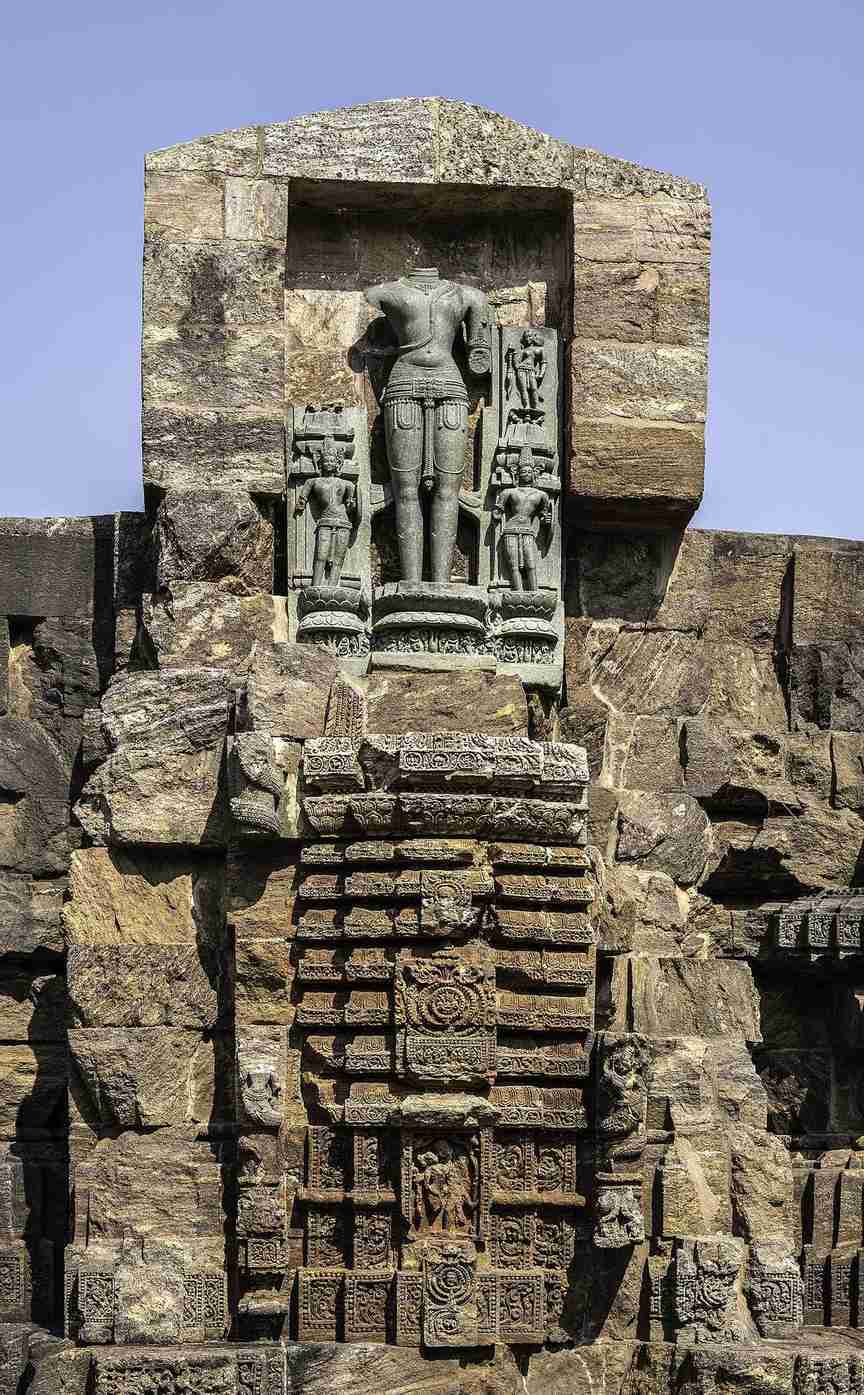
Visit the Sun Temple at Konark in Odisha, and the shrine stands like a stone chariot rolled across sand. Across its walls, each wheel, horse, and lotus shows how Surya's light steps down into form.
Count the chariot wheels first. Twelve pairs line the temple walls, twenty-four wheels in all. Each wheel holds eight wide spokes and eight thin spokes like a sundial telling time by shadow. In Vedic lore, Surya's car rides on one wheel of gold. One wheel means smooth motion with zero wobble between two tracks. Cosmic order turns on a single axle.
Look in front at the seven horses pulling the shaft. Lore names them for the seven Vedic meters and seven bands of the rainbow. Plain daylight looks white until rain drops split it into violet, indigo, blue, green, yellow, orange, and red. One source steps down into seven rhythms.
In Surya's two hands bloom two lotuses. Mud and pond water stay below. Petals open only when sunlight hits the water. Behind his head shines a stone halo, while Aruna grips the reins below his knees.
Savitur, the children of shadow and the Gayatri
Surya's family maps the sweep of light and time in human life. With Sanjna he fathered Yama, lord of death and law, the river Yamuna, and the Ashvins, twin healers of dawn. With shadow Chhaya he fathered Shani, slow Saturn, who teaches patience in dark ink. Light and shadow share one father. Clarity and discipline grow inside one house.
In the Vedas, Surya's disk pairs with Savitur, the hidden sun mover with golden hands who wakes creatures at dawn and calls them home at dusk. To Savitur belongs the Gayatri Mantra from Rig Veda three, sixty-two, ten. It is one of the oldest living chants on earth.
Tom Kenyon breaks down the Gayatri Mantra word by word in his essay on the chant. He calls it a hymn to the sun within. Earth, vital breath, and spirit open the verse, turning toward Savitur to wake and sharpen the mind. Kenyon quotes Master Kirpal Singh: turn attention to the sun inside until its likeness makes the mind clear.
Where Surya shines in the sky
In Jyotisha, Surya sits at the center of the chart. He rules Leo, the heart, the spine, vitality, and calling. Every planet circles his light, showing how will gathers around one center.
Savitur rules the thirteenth lunar mansion, Hasta, from ten to twenty-three degrees twenty minutes of sidereal Virgo. Marked by a hand of five stars in Corvus, Hasta links sunlight to handcraft, matching Vishvakarma's lathe.
Surya also rules three entire star houses in planetary cycles. Krittika marks the cut of spring. Uttara Phalguni at Denebola governs loyal vows. Uttara Ashadha near Nunki marks enduring resolve.
Meeting the dawn ray at the brow
Turn to Surya when fog clouds your path, or when rush and pride have heated your days until clear judgment dims.
Come in the first twenty minutes after sunrise. Face east outdoors or beside an open window. Never stare straight into the glare of noon. Let Aruna's dawn warmth touch your closed eyelids or fall below the horizon of your gaze.
Stand or sit tall with your spine straight, matching the axle of the solar wheel. Rest attention inside Ajna, the brow point between your eyes and back an inch, as Tom Kenyon teaches for the Gayatri Mantra.
Speak or whisper the Gayatri softly three, nine, or twenty-seven times on smooth breath: Om Bhur Bhuvah Svah, Tat Savitur Varenyam, Bhargo Devasya Dhimahi, Dhiyo Yo Nah Prachodayat. In plain words, hold one simple wish at the brow: may light clear this mind. Feel the seven colors settle down through head, throat, chest, and belly like rain entering dry ground.
Finish the practice with a copper water vessel, following the traditional Arghya offering given at sunrise or noon. Lower your eyes from the eastern sky, pour a thin ribbon of water from a copper cup onto sunlit soil or a green pot plant, and take one sip from the remaining water. Stand tall in clear daylight and step straight into the first duty of your morning.
Questions people ask about Surya
Who is Surya in Hinduism?
Surya is the Vedic sun god, the visible eye of cosmic order and source of warmth, time, and sight. He drives a one-wheeled chariot pulled by seven horses across heaven each day.
What is the difference between Surya and Savitur?
Surya names the blazing orb in the sky. Savitur names the golden-handed spark of the sun within that wakes the mind at dawn, honored in the Gayatri Mantra.
Why do seven horses pull Surya's chariot?
The seven horses stand for seven colors of sunlight and seven Vedic meters. They show one light stepping down into ordered rhythm and hue.
Why did Vishvakarma trim the sun on a lathe?
In the Puranas, Surya's wife Sanjna could not bear his heat. Her father Vishvakarma shaved one eighth of the sun's glare on a lathe so life could thrive near his warmth.
How do people connect with Surya respectfully?
Face east at sunrise and keep the gaze soft. Chant the Gayatri Mantra gently with focus behind the brow, then pour water from a copper vessel onto sunlit earth or a plant before starting the day's work.
The wheel and the dawn
Surya is the solar witness, the light that trims its own glare so every creature on earth can wake and see.