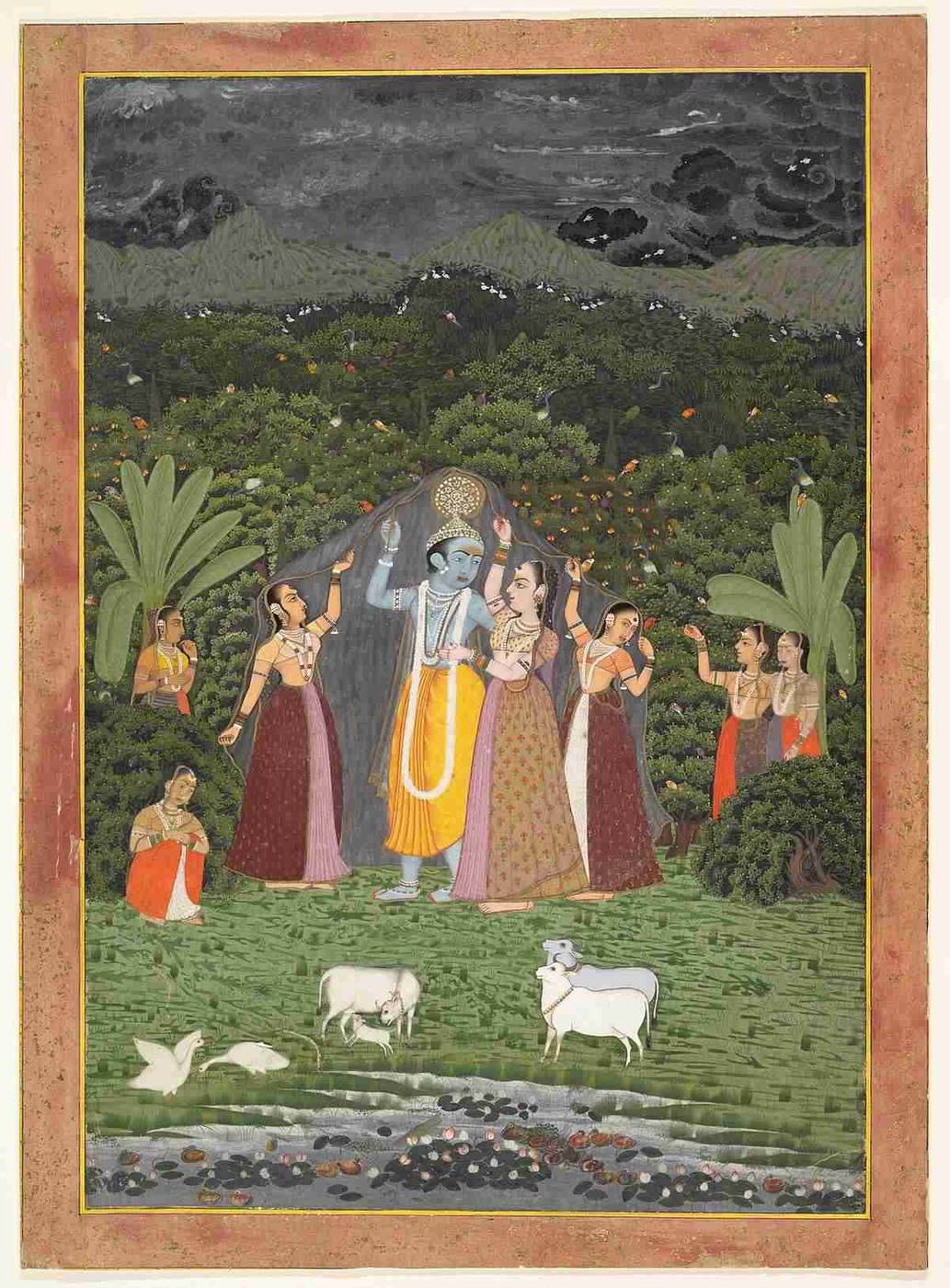
Rain poured through midnight clouds above a river swollen from bank to bank. Inside a locked stone cell in Mathura, iron chains dropped from a father's wrists. Heavy doors swung wide without a sound. A five-headed snake spread its hood over a newborn child carried in a basket through the rising water.
Krishna is the eighth avatar of Vishnu in Hindu tradition. He is the cowherd flutist of Vrindavan and the driver who spoke the Bhagavad Gita at Kurukshetra. People call him Govinda, friend of cows and earth, and Muralidhara, bearer of the flute. He is also Yogeshvara, master of yoga. Cosmic intelligence in him does not hide on a distant peak. It enters dust, music, friendship, and hard crossroads as playful presence, called Lila. His bamboo flute, his full-moon dance, and his chariot counsel form a working tool. They empty rigid pride so action moves in tune with the whole.
Why an empty reed carries clear song
A stick of green bamboo sitting in a grove makes no music when wind blows past it. Cut it, dry it, and burn seven holes along its side. Then hollow out the pith inside until daylight shines through the tube. Now the same breath turns into song that pulls people out of their houses at dusk.
In Quantum Mechanics, Amit Goswami points to a simple law inside wind instruments. A sharp drumbeat spreads across wide wave numbers. A flute tone holds a narrow wave spread, giving it clear pitch and long reach. Hollowing the inner wall turns stray breath into an ordered wave.
Goswami turns straight to Krishna in The Visionary Window and Quantum Creativity. Zeus draws souls with a golden cord in Greek epic. India names that inner pull the sound of Krishna's flute. Once a person hears that note, old habits loosen and the inner path opens. Goswami even maps the Bhagavad Gita as a meeting between the ego, Arjuna, and the nonlocal quantum self, Krishna. In his dialogue When Jane Meets Krishna, Krishna states the law in one line. I am your quantum self, not separate from you.
Swami Muktananda marks a verse from the Bhagavad Gita in his Kashmir Shaiva talks. Krishna calls himself Ksetrajna, the Knower dwelling inside every body. Tom Kenyon adds a key word for that presence inside form. In his essays, Kenyon calls Lila the play of light by which awareness explores bounded shape and unity at once.
Midnight river, cosmos in the mouth and full-moon dance
Three tales trace Krishna's arc from cradle to forest to war in the Bhagavata Purana and the Mahabharata.
King Kamsa threw his sister Devaki into a dungeon to kill her eighth child. At midnight, Krishna was born in the dark cell. His father Vasudeva carried the infant across the flooded Yamuna river to Gokula. There he grew up in the house of Nanda and Yashoda among cowherds. He stole fresh butter and wrestled demons sent in disguise.
One afternoon, playmates ran to Yashoda saying little Krishna had been eating dirt. Yashoda caught his hand and scolded him, ordering him to open his mouth wide. Krishna opened his lips. Yashoda looked in and froze. Inside that boy's mouth she saw the spinning cosmos. She saw rivers, peaks, sun, moon, and stars, and even Gokula and herself looking down at him. Overwhelmed, she shook until Krishna closed his mouth and smiled again as her hungry child.
Years later came an autumn night under a full moon in Vrindavan. Krishna stood beneath the kadamba trees and lifted his flute to his lips. Hearing that note, the gopis dropped churning pots and half-cooked meals. They ran straight into the moonlit woods. Krishna began the Rasa Lila, the circle dance of love. Hundreds of dancers formed a wide ring. Yet each woman felt Krishna's hand holding hers right beside her, dancing with every partner at once as the night stretched long.
Then came the war at Kurukshetra. Krishna stood unarmed as the driver to Prince Arjuna between two armies of kin. Arjuna saw uncles, teachers, and friends lined up to die. He dropped his bow and sat down in grief on the chariot floor. Krishna did not tell him to flee duty. Nor did he preach cold cruelty. He showed his vast Vishvarupa form, filled with suns and swallowing time itself. Then he taught Nishkama Karma: give your whole heart to right action, and release all clinging to the prize.
Emptying the reed and acting without clinging
Look closely at those three scenes and two clear laws appear.
First, only an emptied vessel carries the infinite. A solid rod cannot sing. A puffed-up ego full of private plots cannot hear cosmic timing. Yet when Yashoda looked into a boy's open mouth, whole space opened inside a village kitchen. Goswami calls Yashoda's love a tangled hierarchy. She feeds Krishna as her child while knowing he holds the cosmos. When the small self stays open, wide breadth shines straight through daily tasks.
Second, wholehearted action without clinging to results breaks doubt. At Kurukshetra, Arjuna froze because he wanted an easy win or painless peace. Krishna showed him that action belongs to the actor, while fruits belong to time. Goswami notes in Quantum Creativity how Krishna's dance with ten thousand gopis breaks ordinary space and time. Love and right action turn boundless when given freely without barter.
Reading the flute, the feather and the lifted hill
Stand before a brass image of Krishna and read his signs from crown to foot. Every detail marks how cosmic play moves inside matter.
Look first at his blue skin, called Shyama, the hue of a monsoon cloud heavy with rain. It is neither harsh glare nor empty dark. It is deep sky brimming with water ready to pour over dry earth.
Look at the peacock feather tucked above his brow. A peacock feather holds violet, emerald, gold, and black in one sheen. It refuses to split shadow from light. It weaves sorrow, wit, beauty, and surprise into one bright crown.
Look at the bamboo flute held across his lips. The flute is no sword or staff. It has seven finger holes matching the seven centers along the spine. When a spine clears of stiff pride, living breath moves through it like song. It calls others through resonance, never by shouting orders.
Remember also the tale of Mount Govardhana. Storm god Indra grew angry when villagers stopped offering him feasts. He poured seven days of blinding rain over Vrindavan. Krishna walked beneath the hill and lifted Govardhana on the little finger of his left hand. He held it lightly like an umbrella until Indra bowed and the sky cleared. True strength holds great weight lightly because it moves in step with earth.
The play of Radha, Arjuna and the older sky
Krishna stands inside two twin circuits in Hindu lore. One is devotion, and one is clear sight.
In Vrindavan, Radha stands beside him as the mirror of longing and grace. Swami Muktananda notes that Citi, the active power of awareness, appears as Sita beside Rama and as Radha beside Krishna. Radha is no minor helper. She is the heart's openness that calls the divine out of hiding into dance. Poet Jayadeva once hesitated over a humble line from Krishna to Radha in the Gita Govinda. Tradition says Krishna himself came while the poet walked and wrote the verse back in.
On the battlefield, Arjuna forms the second circuit. Krishna is the calm driver holding the reins of four horses, while Arjuna holds the bow. In the Upanishads, the body is the chariot and the senses are horses. Mind is the reins, and insight is the driver. Krishna shows what happens when willpower hands the reins back to the Knower of the field.
Where Krishna shines in a chart
In Jyotisha, Krishna links closely with the Moon, Mercury, and Venus. The Moon reflects his midnight birth and devotion. Mercury carries his quick wit, playful paradox, and clear counsel on the field. Venus sings through his flute, wildflower garland, and Rasa Lila beauty.
Tradition marks Krishna's birth under the Moon in Rohini, the fourth lunar mansion. Rohini spans ten degrees to twenty-three degrees and twenty minutes of sidereal Taurus. Ruled by the Moon, it points to the orange star Aldebaran in the Hyades cluster. Vedic hymns praise Rohini for upward growth, green pastures, and delight, matching Krishna's early years among cowherds.
In a traditional Jyotisha reading, Venus with the Moon often mirrors a musical ear and warm care, while Mercury beside Jupiter joins playful wit with clear counsel. Astrologers also look to the fifth house of play, song, and craft when a birth time is known.
Hearing the hollow flute with Krishna
Turn to Krishna when duty feels grim and heavy. Call on him when worry over results freezes your hand before you start. India keeps his hours at dawn, on Janmashtami at midnight under Rohini's moon, and through evenings of kirtan song.
Sit with your shoulders loose and your chest soft, like a hollow reed open from throat to belly. Rest your hands lightly on your thighs, palms upturned. Do not clench your teeth or brace your ribs as if set for a fight.
Begin by listening before pushing. Put on a simple flute tune or sit in silence and hear the farthest sound in the room. Let the breath enter through your nose, down past the collarbone into the belly. Then let the air leave smoothly as if blowing across an open reed without strain.
Next, name one task sitting before you that brings tense worry over success. Speak Arjuna's lesson softly inside. Do the work with full care, and hand the outcome back to the field. Notice how tightness leaves your wrists once you stop gripping tomorrow's harvest.
If you chant, speak Om Namo Bhagavate Vasudevaya or Hare Krishna slowly. Let the sound feel warm and unhurried at the center of the chest. Joy in Krishna's path grows out of simple thanks and playful focus, never forced gloom.
Finish lightly before rising from your seat. Take a sip of warm milk or a small spoon of yogurt from an earthen cup, honoring the cowherds' kitchen. Step out onto your front doorstep for one easy breath and carry that light humor into your next errand.
Questions people ask about Krishna
Who is Krishna in Hindu tradition?
Krishna is the eighth avatar of Vishnu, revered as a divine child, the flutist of Vrindavan, and the teacher of the Bhagavad Gita. He embodies love, wit, and clear action inside daily life.
Why does Krishna play a bamboo flute?
A flute sings only because it is hollow inside. It shows that when a human heart empties rigid pride, cosmic breath turns into music that wakes joy in everyone nearby.
What did Krishna teach Arjuna in the Bhagavad Gita?
Standing between two armies at Kurukshetra, Krishna taught Arjuna to act wholeheartedly in line with duty while releasing anxious attachment to rewards or fear of results.
What is the Rasa Lila dance in Vrindavan?
On a full-moon night, Krishna played his flute in the forest and danced in a ring with the gopis. Every dancer felt him right beside her at once, showing divine love beyond space and time.
How do devotees honor Krishna?
Devotees honor Krishna through kirtan singing, reading the Bhagavad Gita or Bhagavata Purana, offering butter, milk, and flowers, and practicing joyful service without clinging to praise.
The reed and the chariot
Krishna is the hollow flute that turns cosmic breath into song, and the calm driver who steers through battle with an open smile.