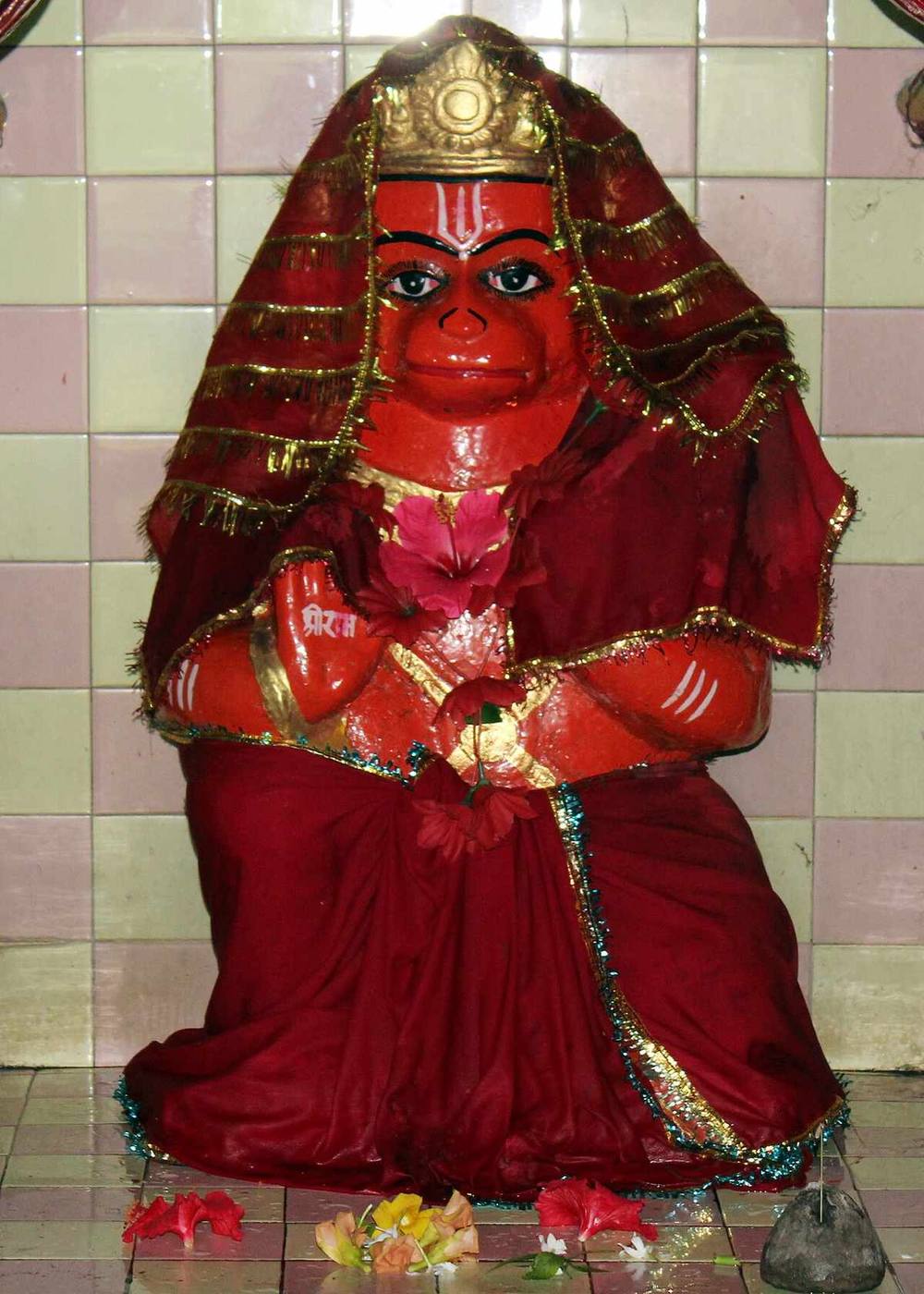
Red vermilion coats the stone figure of Hanuman in a morning courtyard as marigold garlands sway in a sudden gust. A brass bell rings under the eaves, and an oil lamp flickers beside his raised mace. Inside the chest, the breath wakes first and calls hidden strength back to its post.
Hanuman is the monkey-faced hero of the Ramayana and the son of Vayu, the Vedic god of wind and breath. He is Anjaneya, son of Anjana, and Maruti, born of the storm. People call him Sankatamochan, reliever of peril. They also call him Chiranjivi, the deathless one who stays wherever Rama's story is told. Hanuman is fearless vitality wedded to devotion. His forgotten power, his ocean leap, and his open chest form a working tool. They break doubt and turn plain breath into firm courage.
Breath, wind and the jump across the gap
Most people picture strength as heavy muscle pushing inch by inch against a wall. Yet both physics and yoga point to a sudden jump where awareness clears a gap all at once.
In Physics of the Soul, Amit Goswami writes directly about Hanuman. Recounting the Ramayana war in Lanka, he tells how Hanuman flew north to fetch the herb bishalyakarani, also known as Sanjeevani. That herb revived Rama and his fallen troops in the epic. Goswami defines prana, or vayu, as the vital field moving like quantum waves. When rigid habit locks that field, a person feels small and stuck. When devotion opens the channel, a quantum leap crosses barriers that slow toil could never climb.
In The Visionary Window, Goswami explains why devotion, called bhakti, unlocks this leap. Ego draws a tight shell around private safety. Bhakti dissolves that shell through love for what stands beyond pride. It opens wide unity without shrinking into fear.
The Law of One speaks of that same circuit in Session Four and Session Fifty-Seven. Through Carla Rueckert's channeling, the teaching describes deep alignment as the work of wind and fire. When body and mind stay balanced and open, spirit acts as a clear shuttle. It lifts personal will upward while cosmic prana streams down. Service then flows naturally without strain.
Tom Kenyon describes bhakti in his essays as a coherent field. It calms doubt and opens sudden grace. Swami Muktananda adds in his Kashmir Shaiva commentary on the Vijnanabhairava that prana rises from the heart lotus. In his talks on mantra, he notes that repeating a sacred name like Rama turns every breath into clear light.
The sun fruit, the long forgetting and the leap to Lanka
Hanuman's life in the Ramayana turns on three vivid scenes: a child's leap, a long forgetting, and a jump across the sea.
As an infant waking hungry at dawn, Hanuman saw the rising sun above the trees. He took it for a ripe mango. The wind's son leaped straight into the sky to pluck it. Alarmed, the sky king Indra threw his bolt and struck the boy's jaw, leaving him stunned on a ledge. Enraged, Vayu hid every breeze inside a cave until gods and creatures gasped for air. To make peace, the gods blessed Hanuman with lasting life and shelter from weapons. They named him after his marked jaw.
Growing wildly playful, young Hanuman teased forest sages by hiding their water pots and bark clothes. Tired of the tricks, the sages laid a mild spell upon him. He would forget his vast strength until someone reminded him why it existed.
Years later, Hanuman stood with the monkey army on the cliffs of Mount Mahendragiri. They stared across a hundred leagues of dark sea toward Lanka, where Sita sat captive. Old warriors doubted they could cross and return alive. Hanuman sat still on a rock, just as unsure as the rest.
Then elder bear Jambavan walked up and spoke plainly. Why do you sit silent in the corner, son of the Wind? Remember your own birth. Remember how you leaped toward the sun. Remember whose breath runs inside your ribs.
At Jambavan's words, memory snapped back like lightning. Hanuman rose and grew vast as a golden peak until the cliffs shook. He bowed to the sun and to Rama, then leaped out over the sea.
Mid-flight, the serpent mother Surasa rose to test him. She opened her jaws wide as the sky to swallow him whole. Hanuman grew larger to match her. Then he shrank to the size of a thumb and darted in and out of her mouth. He honored her gate without wasting a fight. Next, the sea monster Simhika grabbed his shadow in the waves to drag him down. Hanuman dove into her throat, cut her from inside, and shot back into the air. He reached Lanka and found Sita beneath the Ashoka tree. He burned Ravana's city with his blazing tail while sparing one just house, then returned with hope.
Later in the war, Rama's brother Lakshmana fell struck by a spear. Hanuman flew north again for the Sanjeevani herb. Unable to pick one glowing leaf from another in the dark, he tore the whole peak loose. He carried it across India on one palm and set it beside the camp. After victory in Ayodhya, skeptics asked what prize he carried for his work. Hanuman tore open his chest with bare hands to show Rama and Sita shining inside his heart.
Remembering forgotten strength and fitting every gate
Read Hanuman's story carefully and two plain laws stand out.
First, human amnesia breaks the moment purpose outgrows vanity. Under the sages' spell, Hanuman was never weak. He only forgot what he carried because he had no task worthy of it. Sitting on the shore, he looked like any nervous monkey until Jambavan pointed across the sea at Sita. Strength returned the instant service replaced self-doubt.
Second, true power matches every gate by changing scale without ego. Before Surasa, Hanuman did not roar about his pride. He shrank to a thumb and slipped past smoothly. Before Simhika, he did not stop to argue with the shadow pulling his feet down. He cut the trap at its root and kept flying. And on the peak, when he could not pick one herb in the dark, he lifted the whole mountain. Ego wants to look big. Devotion simply gets the job done.
Reading the mace, the mountain and the torn chest
Look at a Nepalese stone statue or temple painting of Hanuman. Read his emblems from top to bottom. Each piece maps how breath becomes brave action.
Look first at the golden mace, called the Gada, resting over his shoulder. A mace is unbending resolve. It never strikes out of hot temper. It stands behind promises kept when everyone else quits.
Look at the mountain lifted high on his left palm. That peak shows refusal to make small excuses. When one small detail could stall a rescue, full commitment lifts the whole weight at once.
Look at the orange powder, called sindoor, coating Hanuman statues across India. Lore says Hanuman saw Sita place a red dot in her hair for Rama's long life. So he coated his whole body in bright orange to wish his Lord endless days. What looks strange to outsiders marks wholehearted care with zero half-measures.
Look at his open chest showing Rama and Sita inside the heart. Look also at his five-faced Panchamukhi form. In that guardian shape, Hanuman's face joins with Narasimha the lion, Garuda the eagle, Varaha the boar, and Hayagriva the horse sage. Five directions and five powers lock around one loyal center.
Wind, Shiva and the king of Ayodhya
Hanuman forms a living triangle between Vayu the Wind, Shiva the witness, and Rama the king of order.
Tradition honors Hanuman as the eleventh Rudra. He carries a spark of Shiva's stillness inside Vayu's swift breath. That is why his strength never boils over into cruel chaos. Wind moves fast, yet Shiva's calm witness keeps the eye clear inside the storm.
Beside Rama, Hanuman embodies Dasya Bhakti, the path of pure service. Rama carries the bow of measured law. Yet Rama himself cannot cross the ocean to Lanka without the Wind's son. Truth needs breath, nerve, and loyalty to cross from noble thought into earthly rescue.
Where Hanuman moves in the sky
In Jyotisha, Hanuman joins the courage of Mars with the service of Saturn and the loyalty of the Sun. Mars gives his fearless leap and drive. Saturn shapes wild impulse into humble grit. In Indian tradition, devotees visit Hanuman shrines on Saturdays as well as Tuesdays to honor Saturn's discipline and Mars's heat. The Sun anchors his heart, reminding him whose light he serves.
In the Vedic sky, his father Vayu rules Swati, the fifteenth lunar mansion. Swati spans six degrees forty minutes to twenty degrees of sidereal Libra. Marked by solitary Arcturus in Bootes, Swati holds the power to scatter blocks like wind and travel freely. Hanuman's leap also echoes Punarvasu, the seventh lunar mansion around Pollux in Gemini. Ruled by Aditi, Punarvasu links traditionally with Rama's return and renewal.
In a traditional Jyotisha reading, Mars paired with Saturn reflects patient endurance through heavy winters of effort. When Mars meets the Moon or Venus, Hanuman's sense of scale gives a clear pattern. Shrink past petty pride like thumb-sized Hanuman passing Surasa, and save full strength for what matters.
Crossing the threshold with Hanuman
Turn toward Hanuman when self-doubt locks your knees at the edge of a crossing. Call on him when fear says you lack what the hour asks. India honors his days on Tuesdays and Saturdays. Devotees also mark his birth on Hanuman Jayanti under the spring full moon.
Stand or sit tall with your chest wide and feet planted on the floor. Imagine standing on the Mahendragiri cliff facing the open water. Rest both hands on your thighs with your fingers loose.
Start with Vayu, the breath inside your ribs. Inhale smoothly through both nostrils for four slow counts. Sense the air widen your lower ribs as prana wakes. Hold softly for two counts without clamping your throat. Exhale smoothly for six counts. Picture heavy doubt lifting off your shoulders like dust blown away by a sea wind.
Next, bring Jambavan's question into plain sight. Ask yourself where you have been playing small out of habit or fear. Remember the strength already standing inside your lungs. Choose one brave step across the gap today, neither boasting nor shrinking back.
If you use traditional words, speak Om Hanumate Namah or chant Sri Ram Jai Ram Jai Jai Ram eleven times. Keep your tone low and firm in the chest. Let devotion gather scattered force into one clear arrow. Many devotees also read the Hanuman Chalisa at dawn or dusk to focus the breath and mind.
Finish by stepping squarely across a doorway threshold in the room. Touch a fresh marigold flower or press one hand lightly against the doorframe at chest height. Take one brisk breath of morning air, let your jaw loosen, and step directly into the task you named.
Questions people ask about Hanuman
Who is Hanuman in the Ramayana?
Hanuman is the son of Vayu, the wind god, and the devoted ally of Rama in the Ramayana. He is honored across India for fearless courage, quick mind, and selfless service.
Why did Hanuman forget his own strength?
As a playful boy, Hanuman teased forest sages, who placed a spell making him forget his vast powers until an hour of need. Elder Jambavan woke his memory on the southern ocean shore.
What does Hanuman's leap over the ocean stand for?
His jump from Mount Mahendragiri to Lanka shows awareness crossing doubt all at once when purpose becomes clear. Passing Surasa and Simhika mid-flight shows wisdom slipping past ego traps and cutting self-doubt.
Why is Hanuman shown opening his chest?
At Rama's court, Hanuman tore open his chest to show Rama and Sita dwelling inside his heart. The scene proves his vast power flows from love and loyalty instead of pride.
How do devotees connect with Hanuman?
People visit shrines on Tuesdays and Saturdays, offer orange sindoor and jasmine oil, recite the Hanuman Chalisa, and practice even breath and selfless service in daily life.
The wind and the heart
Hanuman is the living wind inside the chest, the strength that remembers itself the moment love calls it across the sea.