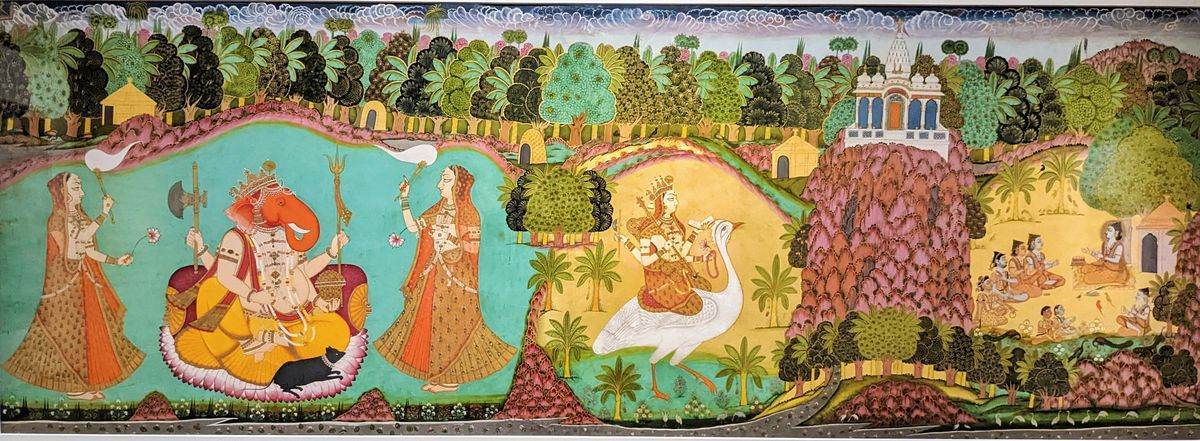
Walk up to almost any Hindu temple in India and stop at the first stone gate. Before you reach the main hall, before you see Vishnu, Durga, or Shiva inside, a stout figure sits in a niche beside the door. He has a human belly, four arms, and the broad head of an elephant. No one enters the shrine without greeting him first.
He is Ganesha, also called Ganapati, lord of all hosts, and Vighneshvara, master of obstacles. He is the son of Parvati and Shiva, honored at the start of every trip, book, wedding, and morning prayer. In Hindu wisdom he is the threshold mind at the base of form. He tests whether a plan is sound before letting it cross the door. His image is also a working tool for anchoring scattered will into solid ground.
Two forms joined at the door
Many readers wonder why an elephant's head sits upon a human torso. Fritjof Capra offers a biological answer in The Web of Life.
Capra writes about biologist Lynn Margulis and her work on symbiogenesis, how new cells and complex species formed when two different life forms merged and lived as one. Looking for a human image of that leap, Capra points straight to Ganesha. Hybrid gods often look strange at first, yet many stand as bringers of good fortune. Capra names Ganesha, human in body and elephant in head, revered across India as the helper who clears obstacles. Long before labs or scopes existed, myth showed how two separate strengths fuse into a stronger whole.
Tom Kenyon uses Ganesha as an active gate in his Siddhis Meditation Workshop. He calls on Shri Ganesha, the elephant-headed destroyer of obstacles, and names him our own innate power of will. Kenyon asks for Ganesha's shakti to clear karmic blocks before placing seed sounds into open space. In his notes on Kundalini Rising, Kenyon also points to muladhara, the root center at the base of the spine where coiled force sleeps. No house stands long unless its sill stone rests flat on bedrock.
In her talk Putting Yourself Last, Anne Tucker notes that Ganesha is never meant to be treated as dead stone. You look right through Ganesha to the divine quality he shows, and bring that quality inside yourself. In her talk 3I Atlas Arrives, Here's What We Can Do Now, Isla adds that a crossing asks you to accept what stands here right now before forcing the next step.
Clay at the bathhouse and a broken tusk
Two famous tales from the Puranas explain how Ganesha gained his head and why one tusk is snapped off.
One morning on Mount Kailash, Parvati made ready to bathe and needed a guard at her door. Shiva was away roaming with his wild followers. So Parvati brushed fragrant turmeric and earth paste off her own skin and molded it into a boy. She breathed life into the clay, placed a staff in his hand, and told him to let no stranger cross the sill.
Soon Shiva came home and walked up to the bathhouse. The boy raised his staff and blocked the way. Shiva frowned and sent his spirit troops to push the child aside. Yet the clay boy held the narrow door against them all. At last Shiva grew angry, lifted his trident, and struck the boy's head from his shoulders.
When Parvati stepped outside and saw her son lifeless on the stone, grief turned to wrath that shook all three worlds. Brahma and the gods begged Shiva to make it right. Shiva sent messengers north with one order. Bring back the head of the first creature you meet facing north. They found a lone bull elephant and carried back its head. Shiva set it on the boy's shoulders, breathed life into him, and named him Ganapati, chief of all Shiva's hosts. He also ruled that every rite in heaven or earth must greet Ganesha first.
Years later, the sage Vyasa wanted to write down the vast Mahabharata epic and needed a fast scribe. Only Ganesha agreed, on one rule. Vyasa could never pause while speaking, and Ganesha would never stop writing.
Halfway through the poem, the reed pen in Ganesha's hand snapped under the speed. Without missing one beat of Vyasa's voice, Ganesha reached up, broke off his own right tusk at the root, dipped the ivory point into ink, and wrote on until all hundred thousand verses were complete.
Why the gate stays shut until you are ready
Look past the drama and two clear laws stand out from these stories.
First, an obstacle is a test of fit, never petty spite. Ganesha is called Vighneshvara, meaning both maker of obstacles and remover of obstacles. At Parvati's gate he stopped even Shiva, showing that no force slips past a door without checking who enters and why. A lock on a floodgate keeps high pressure from bursting weak pipes downstream. When a road blocks you right at the start, friction often checks whether your base can hold what you asked to bring in.
Second, real craft gives up outer symmetry to keep its flow alive. Many people quit when a tool breaks or plans turn messy. Ganesha snapped his own tusk so the song kept moving across the page. A chipped tool that works today beats a smooth prize locked in a box.
From root seat to single tusk
Look at a statue of Ganesha from floor to crown as an operating map.
Start at his root seat. In yoga, Ganesha guards muladhara, the four-petaled center at the base of the spine. Muladhara belongs to earth, bone, smell, and survival ground. Before force can climb, it must touch bottom. Swami Muktananda writes in his Kashmir Shaiva commentary that muladhara anchors the base of the central spine tube. He also notes that Om is the single pulse behind every letter, thought, and act. Ganesha's trunk curves into the exact shape of the Sanskrit sign for Om, linking heavy earth with primal sound.
Look at his head and ears. An elephant walks slowly through thick woods, yet nothing knocks it off course once its foot sets down. Wide ears gather many sounds while small eyes fix on one path ahead. His curved trunk, Vakratunda, can pull down a branch or pick up a single grain of rice without crushing it. Wisdom at a gate joins heavy weight with fine touch.
Check his broken right tusk, Ekadanta. Two tusks stand for split debate, yes against no, win against lose. One whole tusk paired with one snapped tusk shows split argument turned into single resolve.
Look at his four hands next. One upper hand holds a noose, pasha, to rope wandering impulses back inside the fence. The other upper hand holds an elephant goad, ankusha, a hooked rod that nudges heavy dullness forward without hurting it. Noose and goad are the two reins of attention. One pulls scattered drive home. The other wakes up sloth.
In his lower palm rests a sweet ball called a modaka, the fruit of patient work. His other lower palm opens in blessing. Below his huge belly, which digests bitter and sweet days alike without sourness, sits a tiny mouse named Mushika. Left wild in the dark, a mouse chews through ropes and grain sacks. Here the mouse stays awake yet carries the elephant, showing restless worry tamed into a swift scout.
Three circles around father and mother
Another tale pairs Ganesha with his brother Kartikeya, warrior lord of the peacock.
One day their parents held up a prized fruit for whichever son circled the cosmos first and came back to Kailash. Kartikeya sprang onto his peacock and shot across seas, peaks, and star fields.
Ganesha looked at his heavy frame and tiny mouse. Then he walked slowly around Shiva and Parvati three times, bowed at their feet, and sat down. When Kartikeya flew back breathless for the prize, the parents pointed to Ganesha. He had walked around the source from which all worlds spring.
See the circuit. Kartikeya is speed, sharp spear, and far flight through space. Ganesha is center, root, and order. Any fast trip turns hollow if it snaps the cord to its source.
Where Ganesha stands in the sky
In Jyotisha, Ganesha answers first to Ketu, the South Node of the Moon. He also shares ground with Mercury, Jupiter, and Saturn.
Ketu rules headless release from ego pride, deep instinct, and sudden turns at doors. At first glance Ketu looks far from heavy earth, yet Ganesha lost his first head and gained wider sight in its place. When Ketu touches a birth planet, tight plans stall until ego stops pushing and listens for the true gate.
Mercury governs his scribal speed with the Mahabharata, crisp math, and quick wit. Jupiter brings his broad belly, wide lore, and sacred seed words. Saturn lends patience, slow elephant tread, and respect for limits at the start of any build.
In the star sky, Hasta in sidereal Virgo echoes his craft through its sign of the open hand, skilled work, and firm grip on tools.
Grounding the first step at the sill
Turn to Ganesha before starting a new project, crossing a hard doorway, or clearing scattered haste before work.
Come at dawn or right before your first task, before checking messages or making long lists. Sit cross-legged on a firm floor mat, or plant your bare heels against cool stone before a low stool. Let your full body weight drop down into your hips at muladhara. Keep attention low in the pelvis instead of floating up into your head. Feel gravity pull straight down through your seat.
Use Tom Kenyon's pacing from his Siddhis workshop. Sound a seed syllable, then leave fifteen to sixty seconds of open stillness so the tone settles into space before the next sound. For Ganesha, use the seed syllable Gam, or the short chant Om Gam Ganapataye Namah. Speak Gam softly through belly and nose, let it hum like a low bell, and sit completely still in the silence afterward.
Inside that pause, name one real task you plan to start today. Check whether your ground matches the size of that step. If friction keeps locking one gate, pause long enough to ask if that gate is saving you from building on sand.
Set a small brass bell and one sweet modaka dumpling, or a piece of jaggery or sweet fruit, beside you.
Finish in real motion before turning to your desk. Ring the brass bell once, feel your heels solid on the floor, and eat the sweet modaka or fruit slowly. Touch the doorframe with your right hand as you cross into your workspace, and take one concrete physical step on the work in front of you.
Questions people ask about Ganesha
Why does Ganesha have an elephant head?
The Puranas say Parvati molded him from clay to guard her door, and Shiva cut off his head before knowing his own son. To revive him, Shiva placed an elephant's head on his shoulders and made him leader of all divine hosts.
Why is Ganesha worshiped before other Hindu deities?
Shiva ruled that Ganesha stands at the sill of every rite and start. Greeting him first aligns focus, patience, and grounded readiness before calling on other powers.
What do Ganesha's noose and goad symbolize?
The noose, pasha, draws stray thoughts and scattered impulses back to one center. The goad, ankusha, prods dullness and sluggish weight forward into clear action.
Why is Ganesha's right tusk broken?
Lore says Ganesha broke off his right tusk to use as a pen when his reed snapped while writing down the Mahabharata for Vyasa. It teaches giving up outer symmetry to keep vital work flowing.
What is Ganesha's relationship with obstacles?
As Vighneshvara, Ganesha places obstacles in the way of rushed plans and clears them once aim and ground match. His friction acts as a safety gate instead of spite.
The root and the first step
Ganesha is the heavy root and the open gate, the threshold wisdom that makes sure you can hold what you invite in.