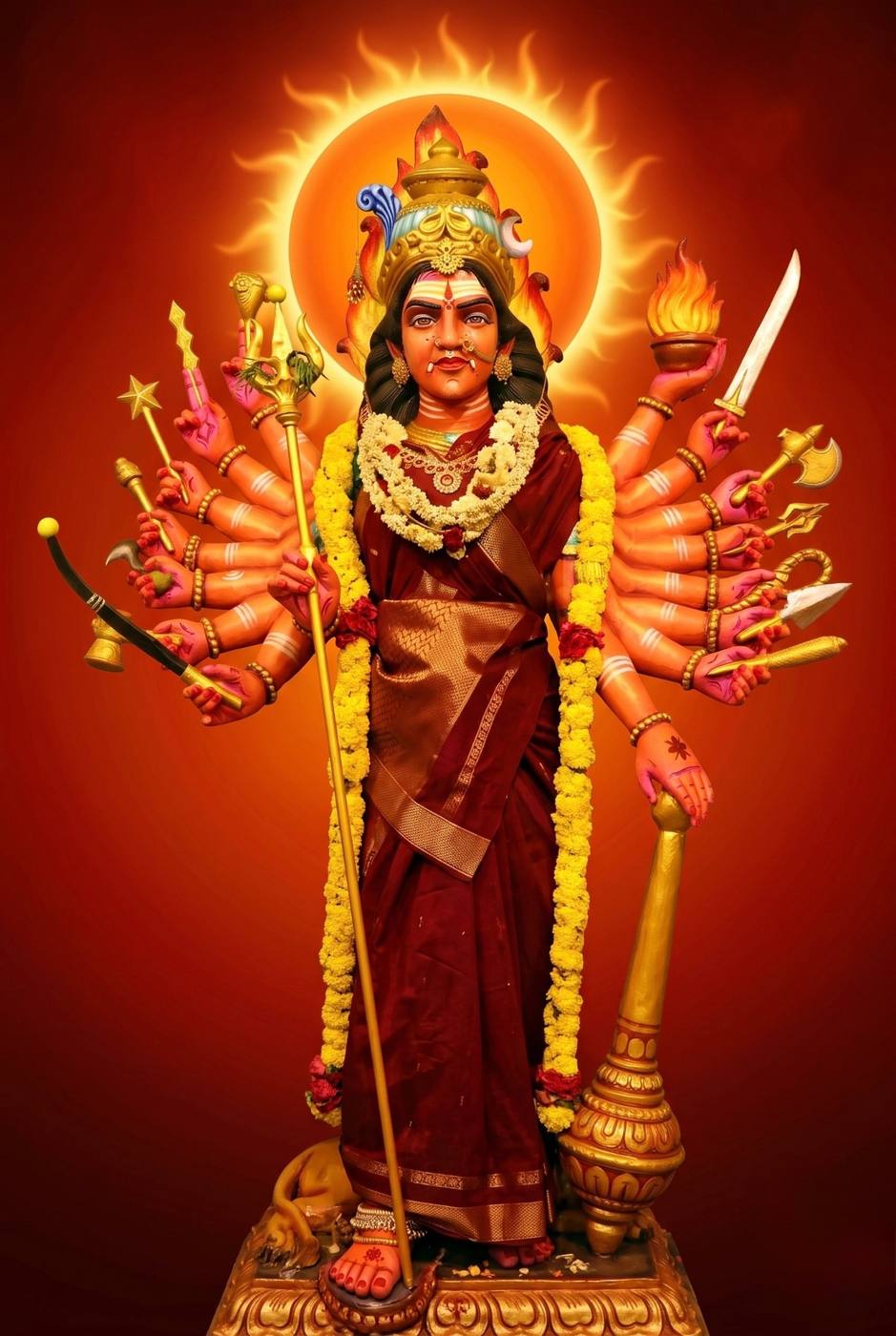
At the edge of a Tamil village the road stops. Past the last house and the last lamp lies the place where the dead are burned. The ground there is gray and soft. At night a few red coals still open and close in it, like eyes.
That is where she lives.
Angali is the fierce Mother of the Tamil south, a form of Parvati who took fire for her dwelling. She is also called Angala Parameswari and Angalamman. Some hear in her name the word for a live coal, and some hear angam, the body, which she rules limb by limb. She burns karma to ash. She frees what is bound. She keeps the border between the worlds. She is a consciousness, and the old science has a name for it. It is supernormal consciousness, the state in which the hidden powers wake. And the Siddhas, the scientist sages of the south, kept a technology for entering it.
The ground where names end
A body goes into the fire with a name, a family, a debt and a face. It comes out with none of them. No one alive can tell the ash of a king from the ash of a beggar.
The universe works in the same way. The calcium in your bones and the iron in your blood were made in stars, and they were set free when those stars came to their end in fire. Every living thing is built from the ash of suns. Creation begins at the burning ground.
The Saiva teachers turned the picture inward. Gopinatha Rao set down their reading in his Elements of Hindu Iconography. The burning ground, they said, is the human heart. There the sense of being someone, with all the deeds it has gathered, is laid upon the wood and lit. He gives a Bengali hymn to the Dark Mother that says it in one breath: "Because Thou lovest the Burning-ground, I have made a Burning-ground of my heart."
The skull that held on
In the beginning Brahma had five heads, as Shiva had five faces. The fifth head looked upward. It saw no one above it, and it said: all this is mine.
Once it sat in Shiva's own place, and even Parvati, seeing five faces there, bowed to the wrong one.
Then Shiva put out his hand, and with the nail of his thumb he took off the fifth head.
The head did not die. It closed its teeth on his palm. And behind it rose the shadow of the deed, the debt that is called brahmahathi, and it walked wherever he walked. The lord of the worlds became a beggar. The only bowl he had was the skull in his hand. People filled it, and the skull ate. Nothing ever reached his mouth. He went from one burning ground to the next, starving, with a bowl that was always full.
He could end a universe. He could not open his hand.
So Parvati called him to Melmalayanur, on the dark night that follows the great night of Shiva. There she put off her gentle form and stood up out of the ash as Angali, as tall as the smoke.
She did not pull at the skull. She cooked. She cooked rice and grain and roots, steaming and red, and she threw it in handfuls across the burning ground. The skull smelled it. It had eaten everything that came to it, and now it wanted everything that did not. It opened its teeth, and it leapt.
She grew until her head was among the stars, and she set down her right foot.
The skull went into the earth. The shadow had no one left to follow, and she drew it into herself as fire draws in smoke. Shiva looked down. His hand was empty, and he was whole.
What opened the hand
Hunger sealed the skull to the hand, and hunger took it off. A thing that clings cannot be torn away, because every pull feeds it. It has to be called out, into the open, by what it craves. Then it stands alone for one moment, and one moment is enough.
Notice also which power could not do it. Shiva is pure awareness, without a second. But the debt lived lower down, in matter, in act and consequence, and there awareness alone had no grip. It took Shakti, the power that moves. The whole science of the Siddhas stands on this. Awareness sees. Shakti does.
And the foot that did it was the right foot. In the Vijnana Bhairava, where Shiva teaches the Goddess one hundred and twelve ways into consciousness, there is a practice of the burning ground. The seeker sees the fire of Time begin in the right foot and climb through the body until there is only ash, and then rests in what is left. It is the same fire, and it starts in the same place.
The queen inside the earth
There was a king at Melmalayanur named Vallalar. He had won a boon that no weapon of gods or men could touch him, and he took the harvest of the whole country. When the goddess came against him he made himself small, and hid in the one place no mother would strike. He hid in the womb of his own queen.
Angali came to the palace door as an old midwife. The child was born, and it was not harmed. The tyrant was.
Then she was so hot that the fields curled around her, and she went down into the ground to cool. Red earth rose over her, grain upon grain, until it stood as an ant-hill with a cobra living inside. The mound is worshiped there to this day.
Most goddesses come down from the sky. This one comes up. An ant-hill is built out of the deepest clay, in the dark, toward the light, and the serpent coiled within it is India's oldest picture of the force that sleeps at the root of the spine. Her shrine is a map of the body.
Bishop Henry Whitehead wrote down the village gods of South India in 1921. In the Telugu villages, where they say Ankamma, he found that her priest was neither a Brahmin nor a king. He was a potter, a man who takes earth and brings it through the fire.
The giver of siddhis
The word siddhi means a thing attained. Patanjali gave the third book of his Yoga Sutras to the siddhis. He says that a mind gathered to one point can know what is past and what is still to come. It can understand the cries of all living things. It can see what is hidden and what is far off, and it can be as strong as an elephant. When James Haughton Woods of Harvard put that book into English in 1914, he had to find a title for it. He called it Supernormal Powers.
One line in it says that whoever holds the light inside the head will see the Siddhas.
The Tamil people count eighteen of them. They were physicians, alchemists and poets of the breath, and they taught that the human body is an instrument with strings that have never been tuned.
Dr. Baskaran Pillai, who teaches from that Tamil line, names the one who tunes them. Angali, he says, is the goddess of all siddhi, of the supernormal powers and of the highest intelligence. She grants them. It is her office.
The physicist Amit Goswami says the powers are simple to understand. Beneath the everyday self he finds another, which he calls the quantum self, and at that depth nothing is kept apart by distance. Telepathy and clairvoyance come easily to a mind that can reach it.
Now the old story shows its other side. The fifth head had power too. It could make worlds, and it said mine. A gift given to that head becomes a skull on the hand. So the burning ground comes first, and the siddhis come after. They come to an empty hand.
The boy who walked up the riverbed
In 1974 a nineteen-year-old named Steve Jobs left his job at Atari and went to India to find a guru. The one he came for, Neem Karoli Baba, had died the autumn before. So Jobs and his friend Daniel Kottke walked on, up a dry riverbed in the hills, to the ashram of a Baba at Haidakhan. He stayed in India for seven months.
One book stayed with him all his life. It was Autobiography of a Yogi, by Yogananda, and he is said to have read it every year. When he died, the guests at his memorial were each given a small brown box. The book was inside.
Behind that book stands a master who does not age, called Babaji. The Himalaya keeps his caves. The Tamil south keeps his lineage. In the telling of the Siddhas, Babaji was once a boy of their own country, and two of the eighteen taught him. One was Boganathar, and the other was Agastyar, the father of them all.
So a line can be drawn. It runs from a founder of Apple to a book, from the book to Babaji, and from Babaji to the Siddhas.
And what did he carry home? He told his biographer that the people of the Indian countryside live by intuition as the West lives by intellect. He had come to believe that intuition was the stronger of the two. The Siddhas would have smiled. To know a thing without being told is the first door of the supernormal, and every other siddhi opens behind it.
He looked for a guru, and he came home with a faculty. Angali is the Mother of that faculty.
Reading her image
Look at her from behind to before. A sun is burning at her back, and her crown is flame. In it rides a thin moon, close to the dark.
Then come the arms, more than the eye can settle on, and each one holds a single act. The long trident pierces the three knots where spirit is tied into matter. The sword and the axe cut. The noose brings back what has strayed. The drum beats time in and time out. The fire lies in an open palm, and the palm is not burned. One hand, the lowest, only rests upon a mace. It is power that does not need to move.
Garlands of yellow flowers hang from her shoulders to the ground, because she is a Mother, and the fire is for what is eating her child. The lion lies behind her like a house dog. And under the right foot something small and dark is being held where it belongs.
The plunder of the burning ground
Once a year the villages do it again. The month is Masi, when February turns to March. On the dark of the moon that follows Maha Shivaratri they keep Mayana Kollai, which means the plunder of the burning ground. One person is painted and crowned and becomes Angali. Drums go before her. The people carry cooked rice and grain and roots out past the last house, and the food is thrown upon the ash, and everyone runs to snatch it up. For one hour the place that no one enters is full of the living.
At Melmalayanur they also bring her out every month, at midnight on the new moon, and seat her on a swing. They sing to her, and the swing goes over and comes back. At the end of each arc there is an instant when it hangs in the air and does not move at all. She is the queen of that instant. The new moon is another. The old light is gone, the new light has not begun, and for one night the sky holds its breath.
Where she stands in the sky
The tie between Angali and a birth chart is a modern one, and it is easy to see. The new moon is hers, so look for a Moon that stands close to the Sun.
Then look for the skull. India's astrologers have always had it in the sky, and they call it Rahu, the north node of the Moon. He drank the nectar of the gods, and Vishnu cut him at the throat, and the head lives on. At an eclipse it swallows the Sun or the Moon, and what it swallows falls out again, for there is no body to keep it. Where Rahu stands, something eats and is never filled. Opposite him is Ketu, the body without a head, and to Ketu they give release and the strange kinds of knowing.
Mars belongs to her for the blade, and Pluto for the underworld. The eighth house and the twelfth are her two burning grounds, the place of endings and the place past the last house. Friday is sacred to her in the villages. Edgar Thurston recorded that in 1912.
Standing at her edge
Interface with Angali when you are ready for the skull to come off, and when you can do without what it was feeding on.
Come on the night of the new moon, after eight and before midnight.
The people of her country light a lamp that is made from a lime. The fruit is cut in half and pressed, the skin is turned inside out until it makes a cup, and a wick is lit there in oil. The inside becomes the outside, and then it burns. Set one before you.
Put a little food on a leaf, and put the leaf on the ground away from you, where the birds will find it in the morning. Say aloud what has been eating your harvest. Then say that its meal is over there.
Stand. Let your weight come down upon the right foot.
See a small fire beginning under the great toe. It is the fire of Time, and it does not hurry. Let it climb. The ankle, the knee, the belly, the hands, the throat and the crown go into it one after another, until there is a shape of ash where a person stood. Someone is still watching. Stay with the one who watches.
Give it her sound while it burns: Om Angali Namaha. Say it low, at the pace of walking, for as long as the lamp lasts.
Afterward sit down, and rock a little, forward and back, like the swing at Melmalayanur. Let each arc be smaller than the last. Where it stops by itself is the place she has brought you to. A thin line of ash on the forehead remembers it. Fire has no use for what is already ash.
Then watch the days that follow. A name comes before the telephone rings. An answer is there before the question ends. Say nothing about it, and claim nothing. She is looking at the hand, to see whether it closes.
Questions people ask about Angali
What is Angali the goddess of?
Angali is the goddess of the burning ground, of karma brought to ash, and of the siddhis. She is a fierce form of Parvati, worshiped in Tamil Nadu as Angala Parameswari, and her great temple is at Melmalayanur.
Are Angali and Kali the same goddess?
They are sisters in the fire. Both live at the cremation ground and both end what is false. Kali is Time itself. Angali is the Tamil Mother who crushed the skull that clung to Shiva's hand, and she lives inside the earth as an ant-hill.
What are siddhis?
Siddhis are the supernormal powers of yoga: knowing past and future, reading a mind, seeing what is far away. Patanjali describes them in the third book of the Yoga Sutras. The Tamil Siddhas take their name from them.
Did Steve Jobs study with the Siddhas?
No record says that he did. He went to India in 1974 to look for a guru, and he kept Autobiography of a Yogi for the rest of his life. The master behind that book, Babaji, belongs to the Siddha line in the Tamil telling. He said that what India gave him was intuition.
When is the best time to call on Angali?
The night of the new moon, from eight until midnight. Her great night is Mayana Kollai, at the dark of the moon after Maha Shivaratri. Fridays are hers as well.
The Angali archetype
Angali is the fire past the last house, the foot that frees the hand, and the giver of the powers that only an empty hand can hold.