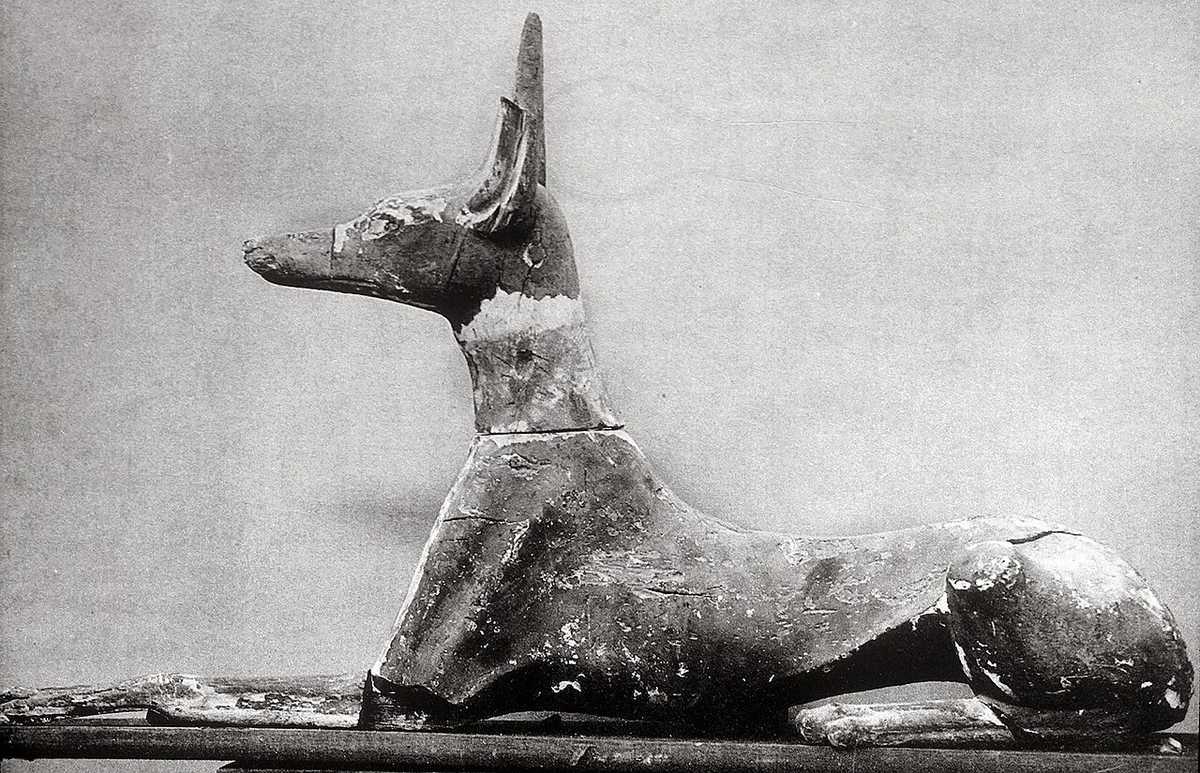
Between green fields and western sand runs a narrow edge where river silt stops and desert stone begins. At twilight a black jackal walks that border without crossing into crops or losing sight of the dunes. Nothing rattles it, and nothing escapes its nose.
Anubis is the jackal god of ancient Egypt, who was called Anpu or Inpu in his own land. He is master of the divine booth, lord of the sacred land, and guardian of the scales in the Hall of Two Truths. At every threshold he does two things. He wraps what must be kept, and he weighs what remains. He is the mind that keeps watch at a crossing. The linen and the plumb-bob are his instruments.
What survives a crossing
When a ship sinks or a star collapses, ordinary sight assumes its story is erased forever. Nothing seems left behind once the surface form vanishes.
Physics discovered a stricter rule at the edge of black holes. In A Brief History of Time, Stephen Hawking describes what happens when matter crosses a black hole horizon and the hole later fades away. At first he believed that the record of what fell in was lost with it. Years later he changed his mind. The account, it seems, is kept along the horizon itself.
He compares it to burning a book. Even after fire turns pages into smoke and ash, the total information stays inside the pattern.
Anubis keeps that law in stone and linen. What is true outlives the form that held it. It is wrapped, measured and carried whole across the border.
Son of twilight and keeper of the beam
This story comes from temple texts and Spell 125 of the Book of the Dead.
Before Osiris ruled the underworld, Anubis already watched over the western edge of Egypt. Later tales named him the son of twilight goddess Nephthys and Osiris, born along the border between houses. Fearing Set's anger, Nephthys hid the infant among marsh reeds. Isis found him, took him in, and raised him beside her own house.
When Set tore Osiris apart and scattered his limbs across the valley, Anubis came to what was left. He knelt beside Isis and Nephthys inside the tent of balm. He anointed the gathered parts with resin and oil. He wound long strips of linen around every limb and sealed the body so its form held together.
From that hour Anubis became the Opener of the Way for every traveler crossing between worlds. He walked each soul by the wrist into the Hall of Two Truths. There stood a brass scale. On one pan rested the heart of the traveler. On the opposite pan lay a white feather of Ma'at, goddess of truth.
Anubis knelt beside the upright post. He said nothing. He checked the plumb-bob hanging from the beam with his own eye and let gravity settle the bar while Thoth wrote down the reading.
Laws beside the brass beam
One law belongs to the linen, and one to the scale.
First, what crosses over must be bound, or it scatters. The seed passes the winter in a husk. The moth dies and is born inside silk. Linen is the husk that Anubis made for Osiris.
Second, truth never needs a loud judge. The brass beam knows its own weight. A heart crowded with deception, pride or unkept promises pulls its side down by itself. A heart free of false weight balances level against a feather without a spoken word.
Watch a stone mason drop a lead plumb line beside a wall. The string never scolds crooked bricks. It hangs straight in gravity and shows the eye where the work leans.
The wolf ring and the open heart
Maia Nartoomid writes Akashic teachings received from Thoth. In her article The Eye of Ra, she describes a containment grid called the Kyoptos, or the Twelve Stations of Anubis. She pairs the jackal of Egypt with the wolf of North America as a guardian of thresholds. In her account, the Anubis-Wolf refuses scattered intent or foggy focus. The rite was once used, she writes, to Open the Mouth. That is to wake the consciousness at the pineal, so that a passage opens through the chaos of the underworld.
Tom Kenyon, who channels the Hathors and teaches Egyptian High Alchemy, looks directly at the Hall of Two Truths in his message The Inner Sun. Beside the scales sits Ammit, part lion, part crocodile and part hippopotamus. Kenyon notes that hieroglyphs place Ammit beside the Djed spine between the solar plexus and the heart.
To the initiates, Kenyon explains, that picture was meant for the living. The Upper Worlds stay shut to a person who lives only for security, desire and power. When the heart opens, they open, and they can be entered without dying. So the whole hall stands inside the body. The pillar is the spine, the devourer waits below the heart, and the scale hangs where the heart opens.
Reading the jackal and the shrine
His shrine can be read like a page, one sign at a time.
His coat is black. Desert jackals are tan in daylight. Egypt painted Anubis black because black is the color of rich Nile silt and midnight germination. Black marks the dark soil where old form dissolves so fresh growth can take root.
In the booth are the linen and a jar of resin. Wrapping protects what is sacred from scattering while an outward shell comes apart.
Under the crossbar of the scales hangs the plumb-bob. A witness adds no weight to either pan. He clears dust off the pivot and watches where the needle stops.
On the lid of the chest lies the jackal himself, as he lay in the tomb of King Horemheb. With ears upright and forepaws stretched flat along the lid, the guardian watches the door so nothing inside is robbed while its owner crosses into a new state.
Where Anubis stands in the sky
The planets nearest to Anubis are Saturn and Pluto, and the pairing is new. Look to both in a birth chart, and to the eighth and twelfth houses if the birth time is known. Pluto marks the end of an old shell that can no longer hold growth. Saturn marks the bone structure, stone frame and patient time required to close a chapter well.
Look straight at the Saturn Return, which arrives near age twenty-nine and again near age fifty-eight. In those years the life you have built is laid on the scale. What rests on real work stays level. What rests on bluff falls from the pan.
Transits of Saturn across the Sun, Moon or Ascendant act the same way. Anubis takes you by the wrist, checks the beam without malice, and has you wrap what is finished before the next gate opens.
How to interface with Anubis
Call on Anubis when a long season is ending, when you must sort truth from excuses at a turn, or when you move across an unfamiliar threshold. His work is with the living, as they close one door and step through the next.
Choose his twilight hour when daylight leaves the wall and evening settles outside. Clear the center of a wood table. Set a strip of white cloth or paper beside a glass of plain water.
Sit straight with both feet flat on the floor. Rest your hands on your knees, palms down, like the forepaws of the jackal atop his shrine. Take seven slow breaths, letting your shoulders drop toward your hips.
Picture a brass balance hanging before your chest. On the left pan place what is ending, and name it aloud, once. Then name the one thing you are keeping from it, and lay it on the cloth. Nothing true is lost.
Now check your heart against the feather on the right pan. Ask what weight is still on the pan. Name it, and take it off the beam.
Close the circuit firmly before standing up. Fold the cloth or paper twice over the thing you are keeping, and put it away in a box. Press both palms flat against wood or stone beneath you to seal the threshold. Drink the glass of water, wash your hands in cold tap water, and step into the next room with an open mind.
Questions people ask about Anubis
Who is Anubis in Egyptian mythology?
Anubis, called Anpu in Egypt, is the jackal-headed god of embalming, thresholds and the weighing of the heart. Nephthys bore him and Isis raised him. He wrapped Osiris in linen, and he leads each traveler into the Hall of Two Truths.
Why is Anubis shown as a black jackal?
Egypt saw jackals patrolling cemetery edges at dusk and chose them as guardians of the border between valley and desert. They painted Anubis black to match Nile mud and transformation, marking hidden renewal instead of evil.
What does Anubis do at the weighing of the heart?
Inside the Hall of Two Truths, Anubis leads the traveler to the scale. He places the heart opposite Ma'at's ostrich feather and checks the plumb-bob carefully so the reading stays fair while Thoth records it.
Is Anubis a god of fear or death?
No. Anubis guards safe passage, dignity and preservation when an old stage ends. In Egyptian initiation traditions, his scales taught living people how to clear regret and false weight long before the end of life.
How does Anubis connect to astrology and the Saturn Return?
By a new pairing. Saturn keeps the scale and Pluto the tomb, so the Saturn Return, near ages twenty-nine and fifty-eight, is the crossing most like his.
The plumb-bob and the border
Anubis is the watchful guardian on the threshold, wrapping what endures and checking the beam so nothing false crosses the gate.
Saturn Return maps those turning thresholds in a birth chart, showing which weights are ready to drop and what firm structure endures for the next chapter.