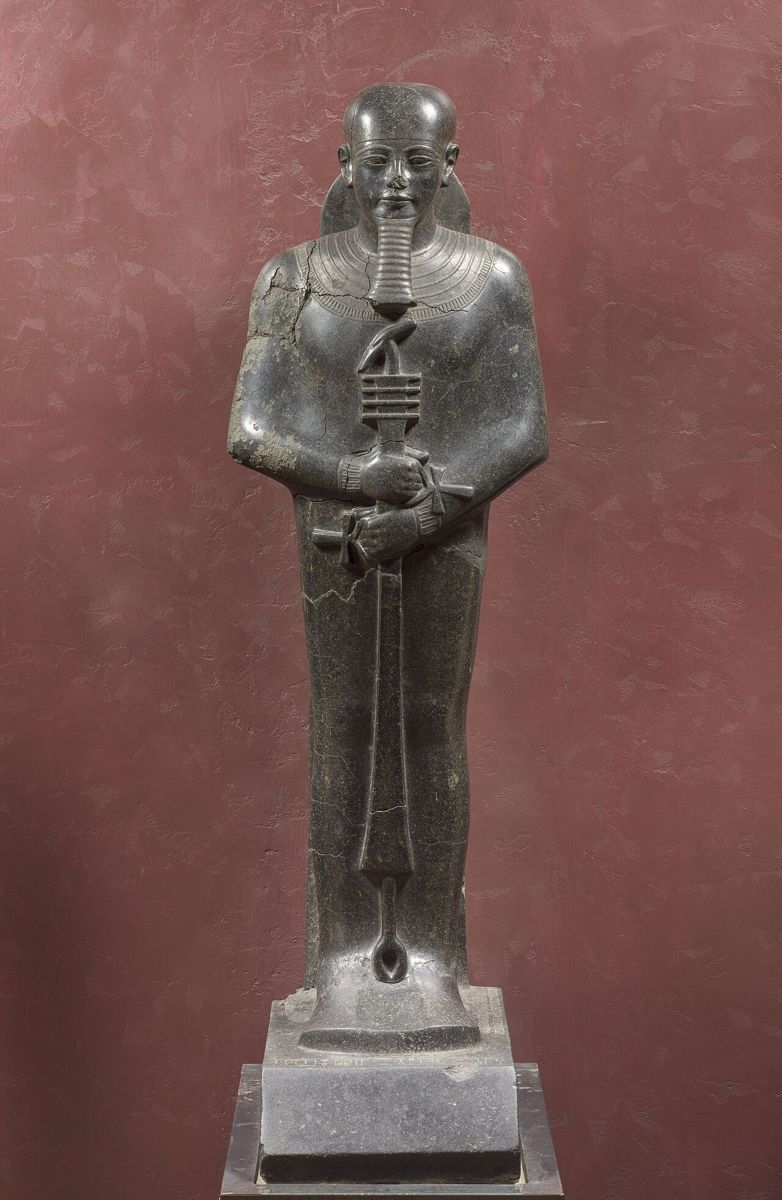
Black earth rose out of the water, and it was the first ground. Egypt called it Tatenen, the risen land. A builder stood upon it, wrapped to the throat in white linen, with a staff in his two hands.
Ptah is the creator god of Memphis in ancient Egypt, patron of sculptors, masons, smiths and builders. His name means the opener or the fashioner. He is the mind that shapes an unseen pattern in the heart, names it with the tongue, and holds it tight until stone, wood or metal takes form. Every statue, door and craft guild in Memphis worked as part of his instrument.
From blueprint to physical stone
Most people suppose bricks and atoms come first and thoughts follow afterward. One physicist turns that order around.
In God Is Not Dead, Amit Goswami calls it downward causation. The solid world acts like hardware, he writes, while mental and vital realms hold the blueprints. Consciousness sees an archetype in the subtle realm, stamps it into a clear design, and then drops that pattern into matter. In The Quantum Doctor, Goswami adds that living organs act as outer copies of these vital blueprints.
The Law of One describes Egyptian building in much the same way. In Session 3, Ra explains that the Great Pyramid was built first as a thought-form. It stood as an exact shape in mind before taking standing form in limestone at Giza.
Egypt carved that law onto rock at Memphis. First the plan lives whole inside the maker. Next the word gives it name and border. Last of all, a chisel touches stone.
How Memphis told the creation
This story sits on the Shabaka Stone, cut into dark granite from a much older text.
Before the gods stepped onto land, Ptah was awake inside his own heart. He did not shape clay by hand or fight sea monsters with spears. Every god, plant and craft took shape first inside the thought of his heart, which Egypt called the ib.
When the pattern stood whole inside him, Ptah moved his tongue, called the nes, and spoke each name aloud. As his voice touched air, the nine gods of Heliopolis came into being. Towns rose along the Nile. Temples gained walls, shrines gained bronze doors, and artisans learned the rules of every guild, from pottery to goldsmithing.
Ptah looked on all he had spoken and saw that it stood firm. Then he entered the statues of wood, clay and stone so human craft could house living mind.
The tools that open the mouth
Egypt kept a second story in the workshops of Memphis and Saqqara.
When a carver finished a statue from granite or cedar, it stayed mere stone or wood until priests held the Opening of the Mouth. They touched the carved lips with an adze whose blade had the shape of the Thigh, the seven stars we call the Big Dipper, and they spoke the words of Ptah.
Ptah forged those blades in his hidden kiln. His chief human builder was Imhotep, the sage who stacked stone into the Step Pyramid at Saqqara and later won worship as Ptah's son. Through Imhotep, Egypt honored craft itself as a bridge between sky and earth.
What the Memphite craft encodes
Read together, these accounts set down two strict laws of making.
First, design comes before speech, and speech comes before stone. A maker who strikes rock before holding the full plan inside the heart makes rubble. Yet an idea kept locked in the chest never builds a wall. Ptah joins heart and tongue in one circuit so thought moves into concrete work.
Anne Tucker's angels say the same of themselves. They are not bound to our language, they tell her in Speak the Language of Angels, yet they "speak ourselves into tangibility." What has no form puts on a word, and by the word it takes form.
Maia Nartoomid has it from Thoth that the name is older than Egypt, and that it means Threshold of Greatness. There is a Holy Flame of Ptah, she writes. It came from a temple of the blue star Rigel, was saved from Mu, and passed through Atlantis to Egypt. It holds the original power of the atom, kept for the day when people light that flame again within themselves. And it was Ptah who helped Thoth to set the clock in the Vault of Osiris.
Second, restraint holds energy until the hour of work. Ptah never leaps or scatters force. He holds pressure inside a tight linen wrap until every line can bear weight.
Reading the statue from base to crown
Stand before a limestone statue of Ptah, and every part shows how a maker keeps focus.
His body is wrapped tight from ankles to throat in white linen. Unlike a warrior striding forward, Ptah stands with feet pressed together. He keeps force inside a narrow shell so nothing leaks before work starts.
Only his hands emerge through a vertical slit in his chest. Both palms clasp one tall rod uniting three Egyptian signs. At the top sits the forked was staff of power. Below it hangs the looped ankh of breath. Forming the shaft stands the four-tiered djed pillar of spine and stability. Power, breath and backbone lock into one grip.
Over his head fits a close cap painted blue like night sky, leaving both ears free to hear fine measure. Across his neck rests the wide collar, and under his feet lies the level plinth of Ma'at. No structure stands long unless its base sits square. Sometimes his skin shines green as Ptah-Tatenen, fertile soil rising from the flood.
Heart, fire and the lotus
At Memphis, Ptah stands inside a three-part circuit. His wife is Sekhmet, lioness of solar fire. Their son is Nefertem, young god wearing an open blue lotus on his brow.
Look at how that family works. Ptah is the plan and the tight kiln. Sekhmet is the heat of the forge and the fierce will that refuses half work. Nefertem is the finished work, open at last.
The potter knows this. Clay that has not met the fire is mud again at the first rain. Clay that meets it too soon will burst. Between the two there is a vessel, and it holds.
In the tombs he is joined with the falcon Sokar and with Osiris, three gods in one figure. Sokar's true power, Nartoomid writes, is to find the portals of the earth and give safe passage through them.
Where the craftsman stands in the sky
Egypt gave Ptah no planet. Astrologers match him chiefly to Saturn and Mercury. Saturn gives him the tight shroud, the chisel, patience with stone and timber, and the bones of lasting work. Mercury gives him speech, the carpenter square, exact measure and skill with hands.
In a birth chart, Ptah speaks clearly through the earth signs, Taurus, Virgo and Capricorn, where ideas demand solid form. Watch the sixth house of daily skill and the tenth house of public mastery.
When Saturn meets Mercury in a chart, the mind speaks plainly and tests every plan against gravity. When Saturn meets Mars, raw heat accepts order, turning wild drive into durable craft like Ptah beside Sekhmet. When Saturn touches the Sun, a person finds their true work through patient building over long years.
How to work with Ptah and close the forge
Call on Ptah when something has been only a thought for long enough. He gives patience, measure and a hand that does not slip.
Come early on Saturday, the day of Saturn, or at sunrise when crisp light hits your desk. Clear every scrap off your table until one surface and one task remain.
Sit upright with heels together, holding your spine straight like the shrouded statue. Lay one palm over your breastbone to check the plan inside your heart. Do not touch a tool until you can picture the finished piece from base to roof.
Now speak the plan aloud in one short sentence. Let your tongue seal what your heart saw, naming what you intend to make and when the session ends.
Pick up one tool in both hands, whether pen, chisel, compass or keyboard. Work for one unbroken block of time. Keep your eyes inside the seam where hand meets material.
When the hour you named is over, bank the forge. Lay the tool down straight. Cover the work with a cloth, as he is covered in linen. Wash the dust from your hands, and do not lift the cloth before morning.
Questions people ask about Ptah
Who was Ptah in ancient Egyptian mythology?
Ptah was the creator god of Memphis and patron of sculptors, builders, smiths and artisans. The Memphite Theology teaches that he imagined the world in his heart and spoke it into being with his tongue.
How did Ptah create the world without fighting monsters?
On the Shabaka Stone, Ptah conceived every god, city and guild inside his heart before speaking their names aloud. His voice organized matter directly, turning clear thought into physical form.
What is the triple staff Ptah holds in his hands?
Ptah holds one scepter joining the was staff of power, the ankh sign of breath and life, and the djed pillar of stability. Grasping all three shows that lasting craft needs strength, life and endurance together.
Who are Ptah's wife and son in Memphis?
His wife is Sekhmet, the solar lioness of fierce fire, and their son is Nefertem, god of the blue lotus. Together they show how strict design paired with passionate heat brings forth beauty.
How does Ptah connect to work and vocation today?
Ptah governs the step between inner blueprint and skilled labor, urging makers to see a whole design before cutting or speaking. Astrologers look for him in Saturn and Mercury, and in the earth signs.
The shape of the word
Ptah is the tight shroud and the spoken plan, the mind that builds until stone holds light.
Career and Vocation looks for the craft in a birth chart: where the hands are strong, where the work is hard, and what the hard work builds.