It is the last hour of the night, and the river runs cold and dark. Something small moves across the sand in the final hour before sunrise. It pushes a sphere larger than itself up a slope.
Khepri is the morning god of ancient Egypt, pictured as a winged scarab beetle or a man wearing a scarab in place of his face. He is the sun at daybreak, the self-created spark pushing fresh light over the ridge. His name comes from the Egyptian verb kheper, meaning to come into being, to transform, to take new shape. Egypt laid his stone beetle over the heart because his form holds a technology for turning spent waste into tomorrow's dawn.
The life that builds itself
Dead machines wait for a mechanic from outside to bolt on new parts. Living cells build themselves from within every second.
In The Web of Life, Fritjof Capra tells how the biologists Humberto Maturana and Francisco Varela hunted for the mark that splits living cells from dead stone. They named that mark autopoiesis, from Greek words meaning self-making. A cell works like a circular shop where every part makes and mends the parts beside it. It weaves its own outer skin straight out of what enters from outside.
A kindred law bridges mind and matter. In God Is Not Dead, the physicist Amit Goswami tells Carl Jung's famous story of the golden scarab. Jung sat with a patient whose stiff intellect blocked every step toward change. While she told a dream about a golden scarab jewel, a real scarabaeid beetle tapped against the window glass behind Jung's chair. He caught it and placed it in her hand. That shock broke her shell open. Goswami notes that the archetype sits beneath mind and matter alike, answering from outside the instant awareness turns within.
Egypt gave that self-making threshold six legs and shining wings. They called it Khepri, the power that remakes itself at every sunrise.
How the sun returns from the dark
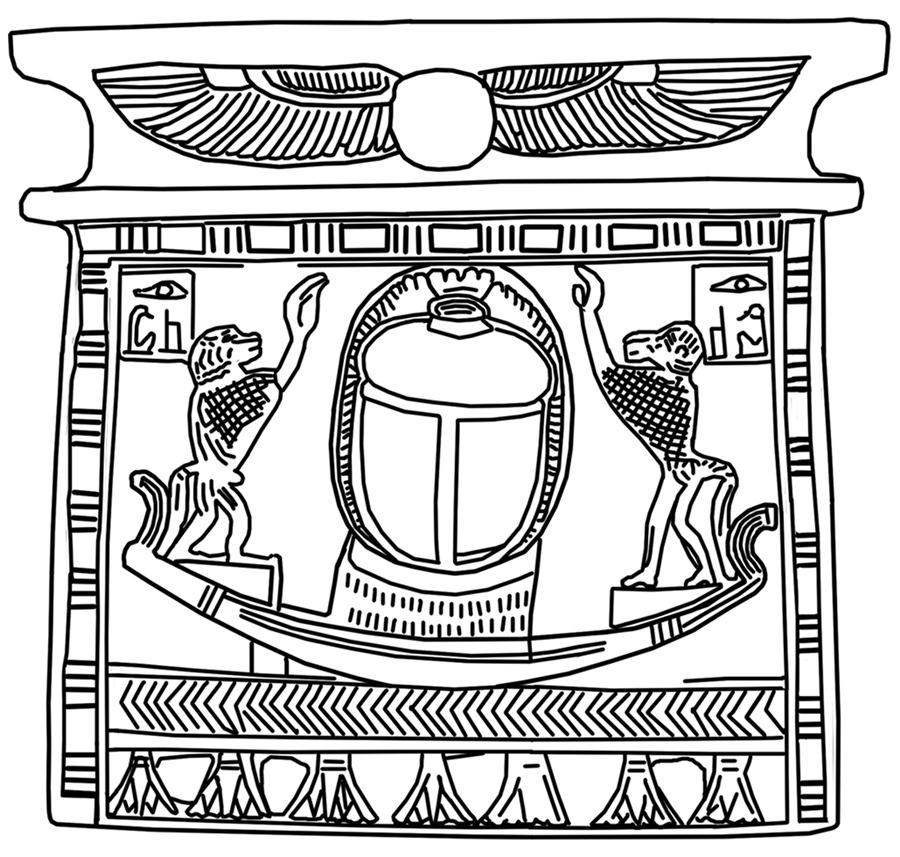
This scene runs along the final wall of royal tombs, in the twelfth hour of the Amduat.
All night the sun had sailed west to east through the dark underworld as a weary, ram-headed passenger. Serpents, fire gates and sandbanks tried to stall the boat. In the twelfth hour, twelve gods hauled the solar bark straight through the spine of a giant snake named Life of the Gods.
At the mouth of the snake the old sun vanished. Out of the opening stepped Khepri, bright and newly formed, spreading his wings under the morning disk. He lifted the sun clear of the eastern ridge while baboons cried out on the cliffs to greet the light. What entered the dark worn out walked out at dawn reborn by its own motion.
The beetle and the green heart stone
Egypt watched the desert dung beetle, Scarabaeus sacer, with close eyes.
A beetle gathered droppings from cattle and sheep, rolled them into a round ball, and pushed the globe backward across dry sand. It buried the ball deep underground. Weeks later, young beetles crawled straight up out of bare sand as if born from nothing at all.
Priests did not turn away from that earthy sight. They carved thousands of beetles out of green jasper and serpentine. They laid a wide heart scarab directly on the chest of the dead. Across its flat base they cut Spell 30B of the Book of the Dead. That spell urged the heart not to stand as an enemy witness when Ma'at weighed the scales. What had been done was done. The beetle would make something of it.
What the morning beetle encodes
The beetle keeps two laws.
First, tomorrow's sun is rolled directly out of yesterday's waste. Khepri never waits for spotless silver or virgin clay before starting. He gathers whatever sits on the sand after the herd passes. He rolls it into a sphere, buries it in the dark, and draws new life from the compost. Nothing in a human year is ruined beyond use once awareness starts rolling it forward.
Anne Tucker's angels teach this in Our First Master Lesson in Creation. The moment that separates us from what we knew, they say, opens a portal, and everything that has not yet been is waiting in it. That is the ball of earth, before the beetle comes out of it.
Second, to be is to become. Egypt wrote the two with one sign, and the sign was the beetle. Tom Kenyon writes in his Egyptian High Alchemy glossary that solar effort yields to darkness every night before waking fresh at dawn. Staying alive means changing shape every day without clinging to yesterday's shell.
Kaylasa Giselle, writing from Maia Nartoomid's True Singularity, ties the winged scarab seal to the sacred word of Ra. Isis learned that word and raised Osiris with it. Kaylasa reads his raising as the light geometry of humanity restored.
The beetle, the wings and the sun triad
Every piece of Khepri's body shows how renewal travels from dirt to sky.
The round ball beneath his hind legs is the globe of raw days, heavy and messy, rolled uphill until it crests. The buried pit in sand is the dark pause where old pride rots into food before wings unfold.
The green stone of the heart scarab carries the shade of Nile papyrus and sprouting barley. Green told the chest it was not dead rock. It could still sprout after winter.
Khepri never works alone across the sky. He forms one corner of the three faces of Ra. At dawn, Ra climbs out as Khepri, the beetle pushing light from the earth. At noon, he sails high as Ra-Horakhty, the falcon of full sight. At dusk, he leans on a staff as Atum, the elder stepping down into rest. Dawn sparks the fire, noon spends it in work, and dusk gives it back so Khepri can begin again at sunrise.
Where the morning spark hits the sky
In astrology, Khepri belongs first to the Ascendant, the eastern rim where the Sun, the planets and the stars come up. When the zodiac came to Egypt, its artists sometimes drew the sign of Cancer as his beetle. Astrologers today give him Aries too, the first sign of the circle.
Look to your Solar Return chart, drawn for the exact minute the Sun reaches its birth degree each year. That chart marks your personal Khepri hour, showing what spent weight you are rolling forward and where a fresh cycle breaks its shell.
When the Sun meets Pluto in a chart or by transit, life asks you to bury an outgrown skin in the sand until new strength crawls out. When the Sun meets Uranus, a sudden beetle taps against the glass and cracks old habits overnight. Planets in the first house mark people who carry Khepri's urge to remake themselves from scratch.
How to call Khepri and close the dawn
Call Khepri when something has ended and nothing has begun. He starts the motion.
Stand outside, or at an east window, just before sunrise, and let the rim of the sky be the first thing you look at. Hold one smooth green stone, or a clay cup of plain water, between both palms.
Name aloud one thing that is spent: a plan that died, a year that is over, a work that failed. Do not polish it. Picture rolling that spent matter into one neat round ball at your feet.
Turn your face toward the brightening east and draw one deep breath through the nose. Name one concrete step you intend to take before noon to put that old material to use. Then begin it at once, with the hands, however small the beginning is.
When the first step is done, bury the ball. Press your palms to the earth and picture it going under, as the beetle's does. Set the green stone where the daylight will find it. Walk away from the place, and do not dig it up.
Questions people ask about Khepri
Who was Khepri in ancient Egyptian myth?
Khepri was the Egyptian god of sunrise, transformation and self-creation, shown as a scarab beetle or a beetle-headed man. He is the morning face of Ra pushing the fresh sun over the eastern rim.
Why did Egyptians use a dung beetle as a sacred symbol?
Egyptians watched the dung beetle roll a round sphere across the sand and later saw new beetles climb out of the buried ball. To them, this mirrored the sun rolling across heaven and renewing itself out of dark earth.
What was a Heart Scarab used for?
A Heart Scarab was a green stone beetle laid over the chest of a mummy and carved with Spell 30B from the Book of the Dead. It urged the heart not to testify against its owner at the Weighing of the Heart.
How are Khepri, Ra and Atum related?
They are three stages of one sun across a single day. Khepri is the rising dawn sun, Ra is the blazing midday sun, and Atum is the aging evening sun descending into night.
When is the best time to work with Khepri?
At sunrise, at the turn of a season, and around your yearly Solar Return when the Sun comes back to its birth degree.
The rising beetle
Khepri is the green stone over the chest and the beetle at daybreak, proof that nothing spent is too low to spark a dawn.
Look at your Solar Return reading to see what fresh light rises on your eastern horizon in the year ahead.