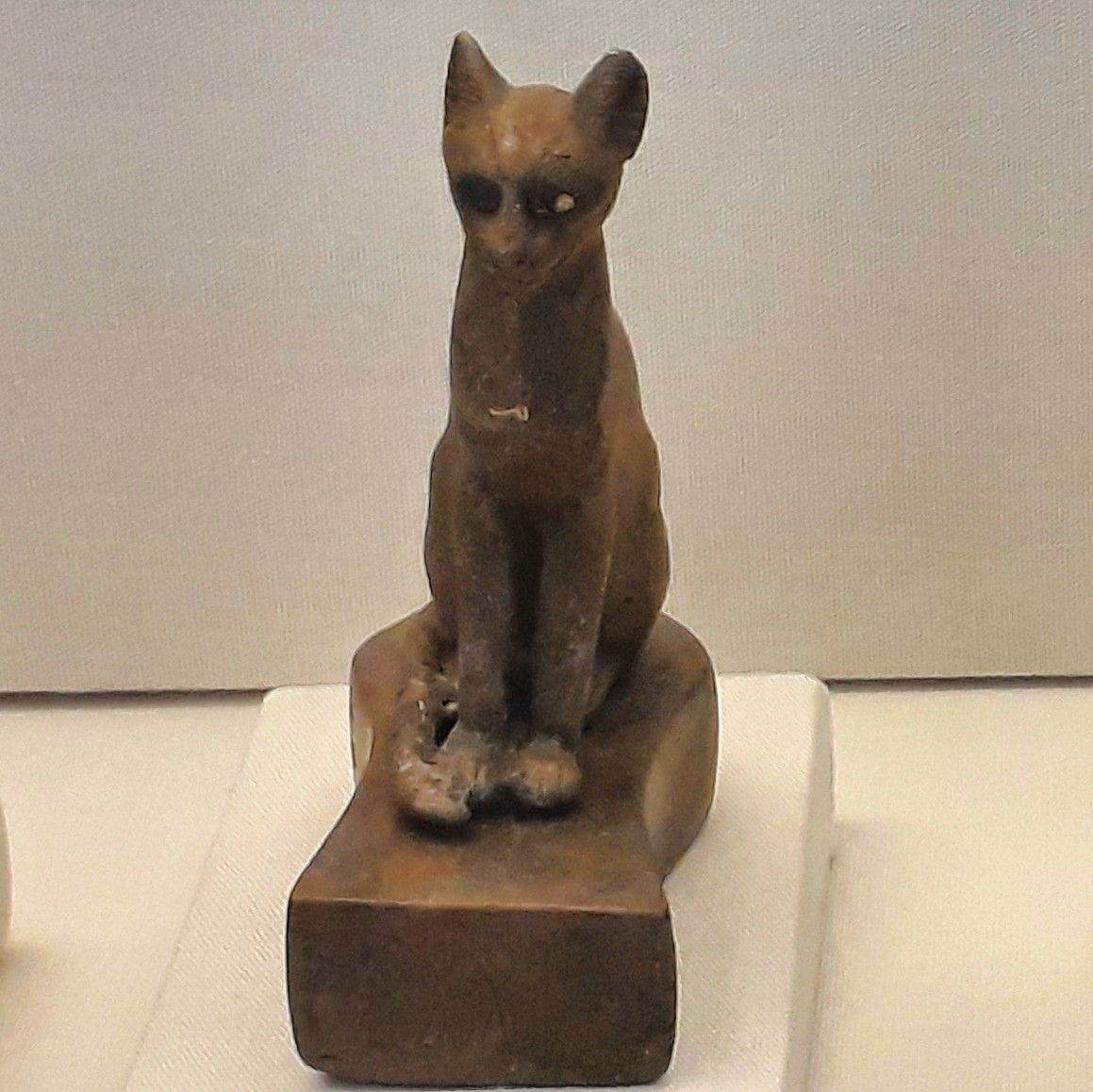
When dusk settles over the Nile delta, reeds along the canal grow cool. Mice stir in the grain stores. A bronze cat sits beside the sill with both ears turned forward, watching the doorway without blinking once.
Bastet is the cat goddess of ancient Egypt, the Lady of Bubastis, and the Appeased Eye of Ra. In the early kingdoms she walked as a fierce lioness on the northern border. Over centuries her heat drew inward into the sleek cat who guards a house from snakes and sickness. She keeps solar fire small enough to live indoors without burning the roof. Her technology is small enough to hold. It is a rattle, a stone jar, and a way of sitting still.
Fire scaled down to a room
Out on the desert plain the sun burns without mercy. That open blaze belongs to Sekhmet. Inside four walls a lamp burns on the table, warming a room without scorching skin.
That is how Bastet holds power. The fire of Ra is still in her. At the back of a cat's eye lies a mirror, and the light that enters is sent through twice. So the eye shines in the dark. The Eye of Ra has come indoors.
In Helgoland, physicist Carlo Rovelli recalls the riddle of Erwin Schrodinger's cat inside a box. Until an interaction crosses that border, the cat's state stays undecided between waking and sleep. Reality settles only when one system meets another across a threshold.
Later in Helgoland, Rovelli explains how human sight works. The brain does not wait idly for light to pile up from outside. It projects a model of the room and wakes at once when one sign breaks the pattern. One detail shifts the whole scene. The cat's ear moves, and suddenly the eye knows whether it faces a house cat or a tiger.
Bastet is that border watch. She lives on the line between ease and alarm, reading each tremor before trouble steps inside.
The Great Cat beneath the tree
This story stands in Spell Seventeen of the Book of the Dead and in the river tales of Herodotus at Bubastis.
Every night the boat of Ra sailed into dark waters beneath the earth. Waiting in the deep channel lay Apep, the serpent of chaos, coiled to swallow the sun and block the dawn.
At Heliopolis stood the Persea tree, whose leaves held the names of kings. Beneath that tree Apep crept forward before morning to strike the root of order.
Then Ra took the form of a cat, the Great Cat of Heliopolis. The cat set one paw upon the serpent's neck, raised a knife in the other paw, and cut off Apep's head before the coil could tighten. Morning broke across the river.
In the delta city of Bubastis they knew that cat as his daughter, and kept a festival for her. Herodotus saw seven hundred thousand pilgrims sailing down the Nile on open barges to the island temple. Women shook bronze sistrums in rhythm and sang into the dusk. More wine was drunk at that feast than in all the rest of the year.
Laws of the guarded sill
First, fire inside a vessel protects what open fire ruins. Heat at the stove bakes bread. The same heat loose in the thatch burns the village. Strength does not lose force when it grows small. It gains aim.
Second, trouble is cheapest to stop at the door. The Great Cat did not fight Apep after the sun vanished. One paw pinned the serpent at the root before the jaws opened. A cat watches a crack in the boards for an hour, then snaps its paw once.
Feline guardians and the sound of the rattle
Maia Nartoomid writes Akashic material received from Thoth. In her transmissions on the Sun Lords, she traces the lion guardians back to the Eye of Ra. She writes that house cats, wild cats and the lion are forms on Earth of those guardian orders. The cat at the door is the smallest of that line.
The rattle in her hand is the sistrum. Tom Kenyon, who channels the Hathors, writes that it sounded in the temples of Hathor beside harps, drums and flutes. With that sound the priests and priestesses entered trance and spoke with beings of other worlds. In his own piece, The BAROD, he joins the voice to the sistrum to open the central channel of the body and charge the Ka, its subtle twin.
Anne Tucker, who channels the angels, was given a message about the animals. They have no time as we know it, the angels said. They find the present moment everlasting, and all of them is in it. A cat speaks mind to mind, and it chooses its own house. You cannot force a cat to stay where a room feels wrong.
Reading the bronze cat and her gear
Hold one of the small bronzes and turn it in the light.
The cat sits with ears upright and tail curled tight around her paws. Nothing hangs slack. The spine stays straight while the ribs soften around breath, showing readiness without panic.
When she has a woman's body, the sistrum is in her right hand. Metal disks slide along crossbars when the wrist flicks, sending a crisp shimmer through flat air. Sound breaks stagnation faster than argument.
Her name comes from the bas, the alabaster jar of scented oil. Egypt sealed ointments in stone jars so perfume lasted through desert heat. Scent reaches the brain faster than thought, marking a room as guarded ground.
At her chest she holds the aegis, a collar shield with the head of a lioness. Even at the festival table, the lioness sits right beneath her throat. Tenderness wears armor at the collar.
On her elbow hangs a basket, and at her feet there are often kittens. Fire made small can raise young.
Sister to the lioness and mother of the lion
Bastet forms a tight triangle with Sekhmet and Hathor, three states of one Eye of Ra.
Sekhmet is the blaze that goes out into the desert to burn corruption away. Bastet is that same Eye brought inside the gate, anointed and awake. Hathor is the song of joy when the Eye comes home in peace.
At Bubastis and Leontopolis, Bastet stood beside her son Maahes, the lion god who strikes falsehood. Warmth, scent and music fill the center of the house, while watchful teeth keep the door.
Bastet in the sky above the hearth
The Sun was hers from the start, as its Eye. The Greeks matched her with Artemis, and so gave her the Moon. Venus is the newest of the three. The Moon governs the house, the kitchen lamp and night watch while everyone sleeps. Venus governs oil, music and welcome. The Sun supplies the spark behind her golden eyes.
In a birth chart, look to planets in Leo and in Cancer. Leo brings the spine and the heart of the cat. Cancer builds the shell, the cupboard and the doorway worth defending. The Moon in Leo is the Eye of Ra beside the hearth. The Moon with Venus is the oil in the jar.
How to interface with Bastet
Call on Bastet when a house needs a guardian. Her work is at your own door.
Wait for the blue hour right after sunset when street noise drops. Sit near your main door or beside a window where twilight enters. Set a bowl of water and one drop of pleasant oil on a dish beside you.
Sit tall on a firm chair with both feet flat on the floor and your back straight, like the bronze cat from Saqqara. Notice your ears and shoulders. Let your jaw soften while your spine stays upright.
Wake the air with sound. Shake a small rattle, bell or ring of keys lightly three times near the room corners. If you have only your hands, clap three times.
Touch one drop of oil to your wrists and breathe it in slowly. Now be still, as the cat is still, until one thing moves that should not. It may be in the room or in the mind. Name it aloud once. Tell it the hearth is closed to it.
Close the circuit before leaving the seat. Place both palms flat on your knees, pulling your elbows toward your ribs as a cat tucks its paws. Drink the water slowly. Wash the oil from your hands in cool water, turn the door latch once with intent, and thank the Lady of Bubastis before turning to your evening.
Questions people ask about Bastet
What is Bastet the goddess of?
Bastet is the Egyptian goddess of the hearth, cats, scent, music and home protection. Egypt asked her to guard childbirth, and to keep snakes and sickness from the door.
Why did Bastet change from a lioness into a cat?
In the Old Kingdom she appeared as a lioness guarding Lower Egypt, close to Sekhmet. As cats began protecting grain stores and homes from snakes and scorpions, Egypt cast her as a cat holding solar strength in peace.
What does the name Bastet mean?
Her oldest name, Bast, links to the alabaster jar used for perfumed ointment. She is She of the Ointment Jar, tying protective power to balm, scent and care of the body.
Is Bastet related to Sekhmet and Hathor?
Yes. All three belong to the Eye of Ra circuit. Sekhmet carries noon fire in the desert, Hathor carries music and returning joy, and Bastet carries watchful warmth inside the home.
How can someone honor Bastet today?
Keep a clear doorway. Wake the room with bright sound and scent, and notice the first small thing that moves. Always close by washing your hands and latching the door.
The ear at the sill
Bastet is the watchful hearth fire, power made small and fragrant enough to guard a house without burning it.
The Whole of You traces how solar warmth, protective instinct and lunar shelter meet inside your own birth chart.