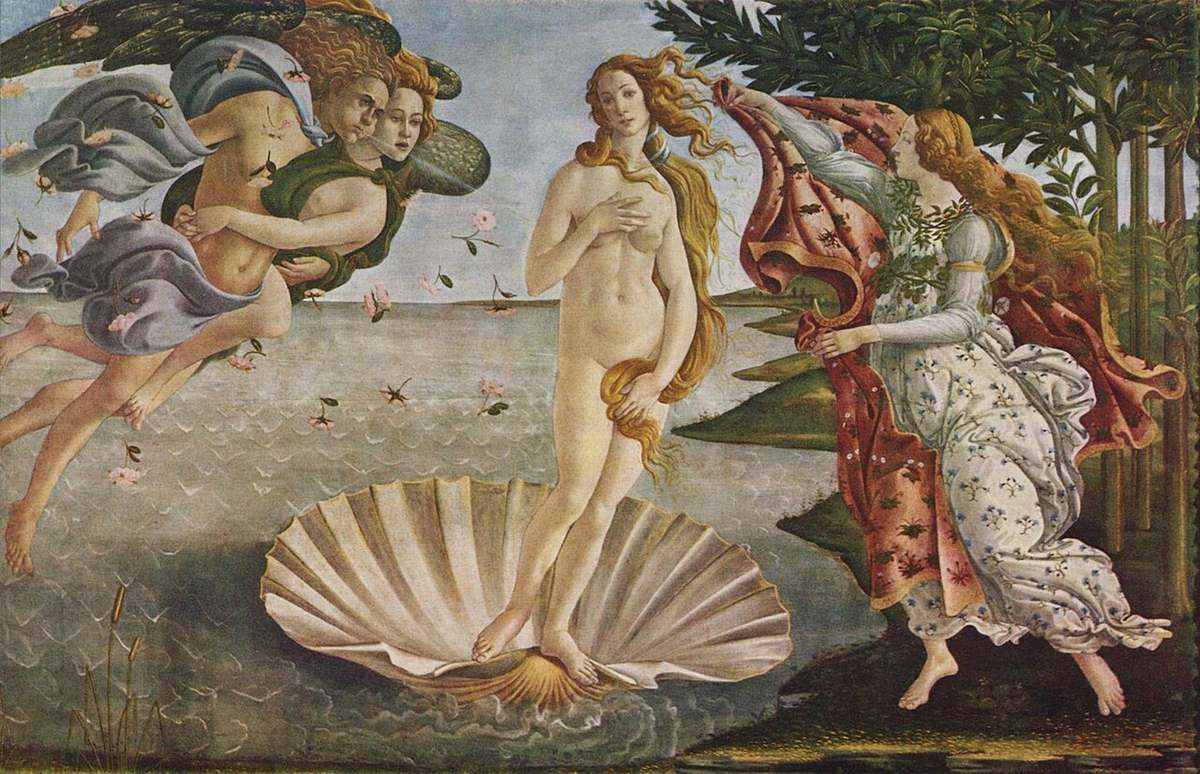
A salt wave breaks white against the rocks of Cyprus. Out of the churning foam steps a woman, already grown, shaking seawater from her hair. Wherever her wet feet press the dry grass along the cliff, red flowers spring up behind her.
She is Aphrodite, the goddess of desire, beauty and union in ancient Greece. Rome later called her Venus. Her Greek name recalls the word aphros, which means foam. She is older than Zeus and older than the court of Olympus. She lives wherever two separate things feel a pull across a gap. The Greeks built temples, songs and bronze mirrors to meet that force with order and return safely when the pull had finished its work.
The pull that orders the world
The Roman poet Lucretius opened his poem on the nature of things by calling upon Alma Venus. She is the power that moves through the sea, the fields and every living creature. Without her, nothing pairs, nothing seeds, and nothing comes into form. Even before a mind counts gain or plans a city, a deeper law already decides what draws close to what.
Science has its own name for a pattern that pulls motion into shape. In The Web of Life, Fritjof Capra writes about attractors in living systems. Picture a real pendulum slowed by friction until its path spirals inward toward a still center, or a frictionless pendulum tracing a closed loop. Mathematicians call that center a point attractor and that closed loop a periodic attractor. Take away the attractor, and motion scatters without shape. What the Greeks called Aphrodite is that principle of attraction inside consciousness itself.
The veil and the three levels of desire
Why does a person feel such hunger for another being or for beauty? In The Law of One sessions spoken through Carla Rueckert, a speaker describes its early civilization once growing upon Venus. Long ago, that teaching says, Venus learned the ways of love and shaped the tarot as a map of the mind. Those same transcripts also describe the veil of forgetting. When consciousness enters a human body, a curtain falls between surface thought and the deeper whole. Without that veil, every soul would know its unity at once, and there would be no ache to seek another. With the veil in place, love becomes a choice made in the dark. Attraction wakes when separation hurts enough to make us reach across the space between us.
Yet not every reach has the same weight. In Three Levels of Desire, Anne Tucker notes that desire moves through three levels. At the first level, desire has not woken yet, and life feels flat. At the second level, desire rises out of lack. You see what someone else has, and hunger tries to seize it to fill a hole. That kind of wanting keeps you divided from the place where you stand. At the third level, desire turns into a bridge of light. It stops chasing what is already known. It pulls you toward union where nothing inside you has to hide.
Lee Carroll and Kryon add the next law of the field. They teach that coherence is not a straight line from one head to one target. When one person enters balance in the heart, that state spreads outward like a bell. Nearby fields begin to tune to it without a word spoken. Desire at its highest pitch is that coherence. It draws matching things together by resonance, like one plucked string setting a second string singing across a silent room.
Iain McGilchrist points to the same truth in The Matter With Things, citing the lyrics of Sappho and the thought of Plato. He writes that eros, the force of life itself, is often the closest thing a secular person meets to the sacred. It breaks open a narrow frame and wakes awe, linking a person to something larger than space and time.
How the foam rose and the net fell
The poets of Greece left four stories that show how this force behaves in the world.
In the Theogony, Hesiod told how she began. Sky, whose name was Ouranos, hated his children and kept them shut inside Earth. Earth groaned under the weight until she shaped a blade of grey flint and called her sons to strike. Only Cronus, the youngest, took the sickle. When Ouranos came down in the night to cover Earth, Cronus cut the flesh of the sky away and threw it into the sea. It drifted upon the waves near Cythera, and white foam gathered round it. Out of that foam a girl grew and floated to Cyprus. Gods and mortals named her Aphrodite, and Eros walked beside her from her first step on shore.
Homer sang another side of her life. On Olympus, Zeus wed her to Hephaestus, the lame smith who worked the volcano forge. Yet her heart turned toward Ares, the god of war. In secret they met inside the house of the smith while Hephaestus was away at Lemnos. Down through the morning air came Helios, the sun who sees all, and told the smith. Hephaestus went to his anvil and beat out chains as thin as spider webs, unseen by any eye. He hung that fine mesh around his bed and told his wife he was sailing away. Ares came swiftly to the house. When the two lay down together, the mesh dropped and bound them hand and foot. Hephaestus returned and summoned the gods of Olympus to look. The gods laughed, while Hermes asked Apollo if he would not bear those chains for one hour beside Aphrodite. Poseidon alone stayed grave and paid a pledge so the two could go free. Aphrodite fled to Paphos in Cyprus, where the Graces bathed her and rubbed her skin with oil that never fades.
Her third story shook the cities of mortals. At a royal feast, Strife rolled a golden apple down the table, marked for the fairest. Hera, Athena and Aphrodite each reached for it. Zeus sent Hermes to lead them to Mount Ida, where Paris of Troy kept sheep. Hera offered him mastery over kingdoms. Athena offered him victory in war. Aphrodite loosened her girdle and promised him Helen, wife of a Greek king. Paris gave the apple to Aphrodite. From that choice the black ships sailed, and Troy burned for ten years.
And there is a fourth story, full of grief. Aphrodite loved a mortal youth named Adonis, who hunted in the hills. She warned him to stay away from boars and lions, for mortal flesh tears fast. One morning he tracked a wild boar through the brush, and its tusk ripped his thigh. Aphrodite heard his cry and flew down in her chariot of swans, too late to save him. Out of his blood on the soil, she raised the anemone, the windflower whose red petals open wide for a few days and scatter in the wind.
What the myths encode
Those four stories carry plain laws about how desire moves in a human life.
The first law is this. Desire begins where the infinite sky meets the salt water. In Hesiod, Ouranos is order so sealed that nothing new can breathe inside it. Until a cut breaks that seal, no world can move. When the sky falls into the moving sea, stillness and motion mix, and attraction is born. You cannot feel real pull inside a locked box where nothing is risked. Longing wakes where perfection breaks open into life.
The second law comes from the house of Hephaestus. Attraction without craft traps itself in its own heat. Ares and Aphrodite meet in secret without a vessel strong enough to hold their fire. Hephaestus is the maker who knows metal, weight and measure. His invisible net is the law of structure catching up with uncontained force. When desire refuses patience, skill and truth, it tangles itself in public sight. When desire honors the forge, beauty lasts.
The apple of Paris adds a third rule. What you love rules what you build. Long before a person makes a vow or chooses a war, desire has already cast the vote. Kingdoms and plans fall behind the pull of the heart, for good or for ruin.
The girdle, the shell and the mirror
In the temples of Greece, each object beside her statue showed how this force works in practice.
Along the coast, the scallop shell carried her to shore in ancient art. A shell is hard lime outside and soft life within. It opens along a hinge to let the tide wash through, then closes again. That hinge is the first tool of Aphrodite. To feel pull without losing yourself, you learn when to open to the tide and when to shut the shell.
Around her waist lies the kestos himas, the stitched ribbon she wore over her breasts. In Book Fourteen of the Iliad, Hera borrows this girdle from Aphrodite to wake love in Zeus. Homer says that inside that band sit love, desire and sweet speech that steals the sense even from the wise. That kestos is presence tuned to one clear pitch. A room changes when a person enters who is whole in their own skin. That field does not beg or chase. It holds a tone, and things around it bend toward that tone.
Beside her stands a mirror of beaten copper. Cyprus, her island, was the copper island of the ancient world, and mirrors were polished from its ore. A mirror makes no light of its own. It returns whatever stands before it. Used well, the mirror shows whether you are meeting another person or staring only at your hunger for praise. Look too long without stepping back, and the surface turns into a cage.
Around her feet stand her creatures and plants. Doves build nests and return across long distances to the same mate. Swans glide smooth upon still water while strong wings work unseen below. Evergreen myrtle grows along salt cliffs where wind burns softer leaves, keeping its scent through winter. Roses open layer by layer around a center, and pomegranates hide packed red seeds inside one rind. Each one marks an aspect of enduring pull: return, hidden effort, salt strength, slow opening and seed held inside one skin.
Two faces of one water
Athens and Corinth split her worship into two clear poles, and Plato wrote about both in his Symposium. One was Aphrodite Ourania, the heavenly daughter of Ouranos, who turns desire toward harmony, art and the stars. The other was Aphrodite Pandemos, Aphrodite of all the people, who binds neighbors, lovers and towns into shared care.
At first they look like two goddesses, one high and one low. In truth they are one current moving between two poles. Without Ourania, desire drops into bare appetite that burns through bodies and grows bored by dawn. Without Pandemos, high love drifts into cold theory that never touches bread, skin or a shared table.
Sparta and Cythera went further and honored Aphrodite Areia, armed in bronze beside Ares. Harbors from Corinth to Sicily prayed to Aphrodite Euploia, giver of fair sailing. The Greeks knew what later ages forgot. The force that pulls two lovers together is the same force that guards a ship across dark water and stands firm beside a friend in danger.
Tom Kenyon and the Hathors place this teaching on a cosmic map. In their account, they came into this universe through the star portal of Sirius and moved first into the etheric realms of Venus before guiding early love temples on Earth. In that view, Venus is more than a world of cloud. It is a relay of harmonic tone that teaches separate hearts how to join without erasing what each one is.
Where she shines in the sky
In the birth chart, Aphrodite speaks through the planet Venus, the living star of this archetype. Ancient sky watchers saw that Venus never wanders far from the Sun and appears in two guises.
Watch how Venus sits beside the Sun in your chart. When she rises ahead of the Sun before dawn, she is Phosphoros, the Light-Bringer, the Morning Star. A person born with Venus ahead of the Sun often steps forward first in love and guards independence fiercely. When Venus trails behind the Sun after sunset, she is Hesperos, the Evening Star. That placement draws feeling inward, savors texture and slow warmth, and weighs trust before opening the door.
Venus rules two signs in astrology, Taurus and Libra. In Taurus, Venus lives through the senses, the garden, the voice, the meal and the body. In Libra, she weighs balance, speech, art and the mirror between two people.
Look at the lines linking Venus to the other planets. Venus with Saturn asks desire to submit to Hephaestus's forge, testing beauty through time and patient craft until what remains is real. Venus with Pluto pulls attraction into deep water, stripping masks away until nothing shallow survives. Venus with Uranus brings sudden sparks and needs wide air around every bond. Venus with Neptune lifts longing toward music and vision, while asking the eye to check the ground so dream never hides fact. And Venus beside Mars sets Aphrodite beside Ares, joining appetite with courage and heat.
Copper mirror and salt tide
Approach Aphrodite when you want to restore true value, beauty and waking presence to your senses. Schemes to control another person fall flat in her temple, because she answers truth in the body, never plots in the head.
Choose her hour. Friday belongs to Venus. The hour just after sunset or just before dawn holds her stillest light, when Venus hangs low above the horizon.
Set a fresh flower or a drop of rose oil beside a polished mirror on a wooden table. Rub one drop of olive oil or rose oil across your wrists, as women in Paphos did after stepping from the sea, so the rush of the day settles.
Wake the senses slowly without a screen. Hold one real thing in your hands, a piece of rough linen, a clay cup, a cut lemon or a smooth stone. Notice its weight, heat and scent for three minutes. Aphrodite wakes through physical attention, because a numb body chases loud noise instead of real nourishment.
Bring one plain question to the mirror. Ask what in your life draws you forward out of joy, and what you chase only to prove your worth. Let the answer rise as warmth or weight in the chest instead of a debate in your head. Watch for the shift Anne Tucker describes, from hungry lack to the calm bridge that wants to share instead of seize.
Look into your eyes in the mirror or a dusk window for ten breaths without fixing your hair or judging your face. Let the glass be a friend, never a courtroom. Speak aloud one plain thing you love about the world today.
Bring the pull back into craft before you leave the table. Desire stirred without a landing turns restless, like foam on an open sea. Turn the mirror face down upon the wood. Eat one piece of sweet fruit, such as a fig or pomegranate seeds, then pick up one plain work of the hands. Cook a warm meal, sweep a step or mend a torn seam. In that patient craft of Hephaestus, attraction finds its home.
Questions people ask about Aphrodite
What is Aphrodite the goddess of?
Aphrodite is the ancient Greek goddess of love, desire, beauty and union, known in Rome as Venus. Greek cities also honored her as protector of sailors across open water and as an armed companion of Ares in Sparta. She governs the attractive force that draws separate beings and arts together.
How was Aphrodite born in Greek myth?
Hesiod writes in the Theogony that Cronus cut the sky god Ouranos and threw his flesh into the sea off Cythera and Cyprus, where white foam gathered and Aphrodite rose fully grown. Homer's Iliad offers a second account, calling her the daughter of Zeus and Dione.
What are Aphrodite's main symbols and animals?
Her best-known emblems are the scallop shell, the copper mirror, the golden apple and the kestos, her stitched girdle of charm. Her sacred creatures are the dove, swan, sparrow and dolphin, beside myrtle, red roses, pomegranates and the anemone.
Who were Aphrodite's husband and lovers?
In Homer's Odyssey, Aphrodite was wed to Hephaestus, the smith god, while loving Ares, the god of war, with whom she bore Eros and Harmonia. Among mortals she loved the Trojan prince Anchises, father of Aeneas, and the hunter Adonis.
How does Aphrodite appear in a birth chart?
She lives in the placement of the planet Venus, by sign, house and phase as Morning Star or Evening Star. Her links to Mars, Saturn, Uranus, Neptune and Pluto show how a person meets attraction, tests commitment and balances freedom with closeness.
The pull of the foam
Aphrodite is the foam where infinite sky meets restless earth, the pull that teaches separate things how to value one another and build something whole.
To trace how that current moves in your own chart, between what you value and how you join with another, look into your Love Horoscope.