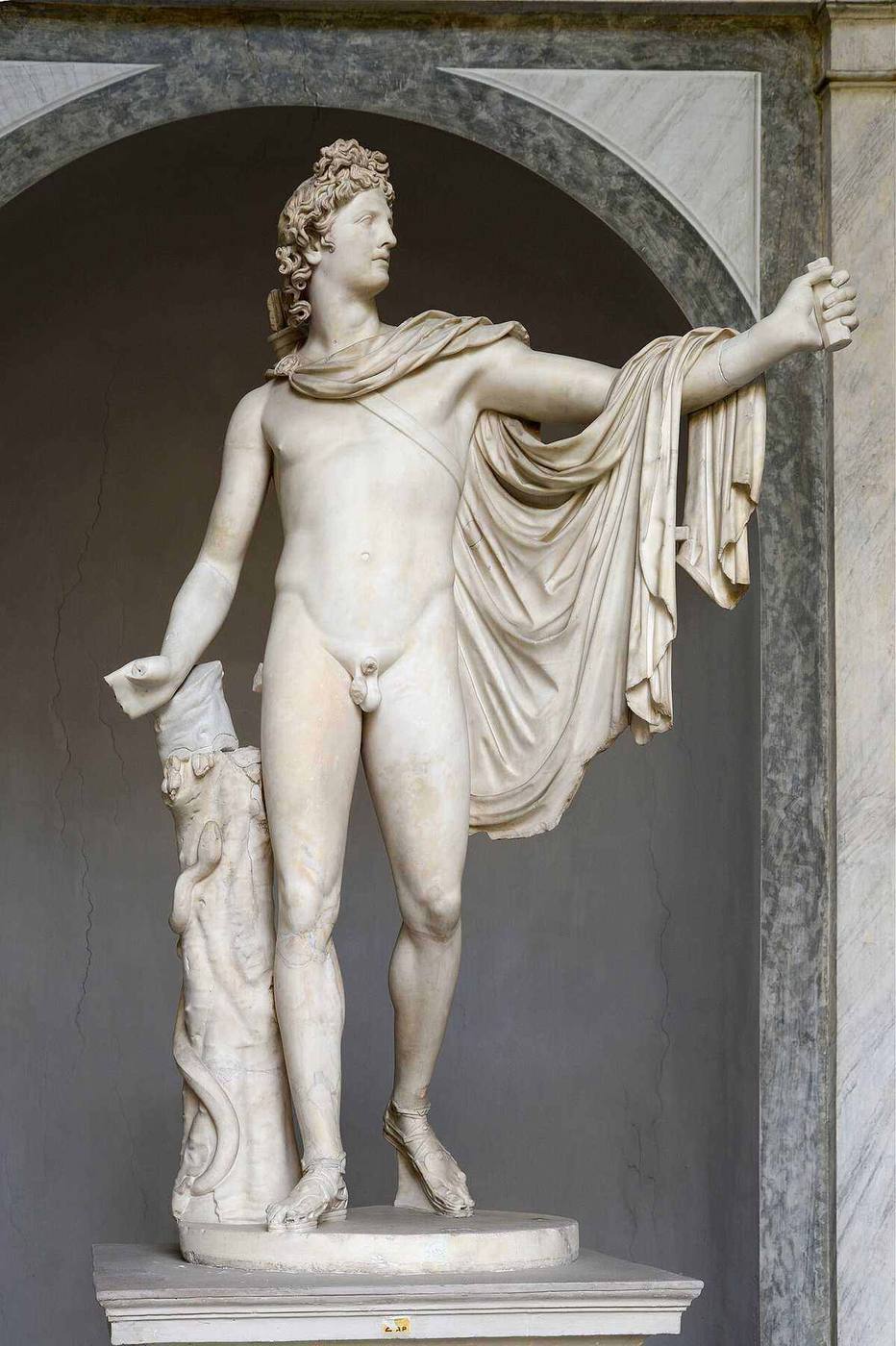
Barren Delos stood fast in the Aegean waves while every richer island turned away. Beside a single palm tree, Leto knelt on rough stone and gave birth to a boy. He tasted nectar, broke his swaddling bands, and called out for three things at once: a curved bow, a seven-stringed lyre, and the clear truth of Zeus.
He is Apollo, the god of music, prophecy, measure, and sight in Greece and Rome. Titan Helios drove the blazing disk across the sky. Apollo is the waking mind inside light itself. He turns loose noise into true notes. He reads hidden patterns from afar and speaks clear words through fog. The Greeks built stone theaters, seven-stringed lyres, and the shrine at Delphi to tune human awareness to that law.
Ratio, harmonics and the singing string
Pluck a loose string lying slack on a table, and you hear only a dull thud. Pull that same string too tight, and it snaps. Fasten both ends to a wooden frame and set the tension between them, and the string rings with clear notes. Even more, touch the string halfway along, or a third of the way along, and whole octaves and fifths leap out of the air.
In Wholeness and the Implicate Order, David Bohm examines how the ancient Greeks understood that music. Our word reason comes from the Latin ratio, which means measure or inner proportion. In the Greek view, Bohm writes, grasping right proportion in rhythm and tonality was the key to harmony in music, in visual beauty like the Golden Mean, and in a healthy mind. Over time, people let measure harden into routine comparison with an outer ruler. Originally, ratio meant direct insight into how parts belong together inside a whole.
Modern physics found the same music inside the atom. In his book Quantum Mechanics, Amit Goswami tells how Louis de Broglie solved an atomic puzzle. Why do electrons sit only in fixed rings around a core? De Broglie loved music. He saw that a wave trapped inside an atom acts like a wave on a guitar string. Only whole waves fit between two fixed ends. Everything between those exact notes cancels out. Matter keeps its shape because nature plays fixed notes, like a lyre.
In The Self-Aware Universe, Goswami also recalls the oldest line carved above Apollo's porch at Delphi: Know thyself. That line points toward the witness inside the mind that sees and shapes the world.
Carla Rueckert's Session 75 transcript in The Law of One carries this rule into sound. There, the teaching holds that sacred tones work by ratio and shared resonance. When set intervals and vowels are sung right, creation itself sings back.
That is Apollo. He is the law of exact interval, where tension between two poles turns chaos into clear song.
Delos, the dragon and the arrows of Troy
The poets of Greece left three cycles of stories showing how Apollo claimed his shrine, traded for his music, and paid the price when light refused to bend.
The Homeric Hymn to Apollo tells of his birth and his march to Parnassus. When Leto walked the sea looking for ground to bear her twins, island after island refused her, afraid of Hera's anger. At last rocky Delos agreed, if her son would build his first temple there. Once Apollo had tasted food from the gods, he took up his bow and walked across mainland Greece to Delphi, high on the slopes of Mount Parnassus. Beneath the cliffs lay a deep cleft in the rock, guarded by Python, a huge serpent born of the dark earth. Apollo loosed one arrow after another until the serpent fell dead beside a spring. There he set his tripod over the vapor rising from the cleft, placed the stone navel called the omphalos at the center, and chose a priestess, the Pythia, to speak his riddles.
His music arrived by another road, told in the Homeric Hymn to Hermes. On the day infant Hermes slipped from his cradle, he found a mountain tortoise. He hollowed its shell, stretched oxhide over the dome, and strung seven gut strings across two horns. Then he stole fifty sacred cows from Apollo's herd in the north. Apollo tracked the thief to an Arcadian cave. There baby Hermes pulled the tortoise shell from his blanket and played so sweet a chord that Apollo forgot his rage. He gave Hermes the cattle and his shining whip. In return, Apollo took the seven-stringed lyre into his own hands.
In the Iliad, Homer shows how fast those hands turn from harm to song. King Agamemnon insulted Apollo's priest and kept his daughter. Apollo stepped down from Olympus like night falling. He knelt apart from the ships and loosed silver arrows onto mules, dogs, and men. For nine days funeral fires burned along the shore. Only when the maiden sailed home with gifts did Apollo lift the plague. Then the Greek youths sang hymns through the afternoon, and Apollo listened with joy.
Three shorter tales told by Ovid and Aeschylus mark the cold edge of his light. Apollo chased the river nymph Daphne through the woods. She prayed to Earth for escape, and bark closed around her waist until she stood rooted as a laurel tree. Next, Trojan princess Cassandra promised him her love for the gift of prophecy, then drew back. Apollo could not take back the gift, so he spat into her mouth. From that hour, she spoke true words and nobody believed her. Last, the satyr Marsyas challenged him with a twin-piped flute against the lyre. Apollo won by turning his lyre upside down and singing while he played. Then he had Marsyas flayed alive for pride.
The rule hidden in the song
Taken together, these stories lay down three plain laws of sight and measure.
True sight needs a dark ground under its feet. Apollo killed Python, yet he did not fill in the chasm at Delphi. He buried the serpent under the temple floor and set his priestess directly over the crack in the rock. Rational light that tries to erase earth, instinct, and mystery goes sterile. Power holds only when clear speech rests directly above the deep root it mastered.
What strikes from afar can also mend from afar. In Homer's camp, the hand that loosed silver arrows of fever was the exact hand that answered the evening hymn. A system that knows the frequency of a disturbance knows the counter-interval that restores balance.
And light that refuses to yield freezes everything it chases. Daphne turned into wood because bright will insisted on seizing what wished to stay free. Cassandra spoke truth that nobody believed because prophecy given without warmth leaves people deaf. Marsyas died because beauty turned into a contest of rank. Whenever solar intelligence forgets the second carving on Delphi's wall, Nothing in excess, light becomes a blade.
The bow, the lyre and the stone at the navel
Hold the objects beside Apollo side by side, and they show how one instrument works.
The silver bow and the seven-stringed lyre are built on one plan. Both consist of curved wood or horn joined by a taut string. Pull the bowstring back and release, and an arrow flies across a valley without your hand touching the target. Pluck the lyre string and a wave travels across a room, tuning every ear that hears it. Both work from distance and exact tension. Slack wood shoots no arrow and sings no note.
At Delphi, the bronze tripod stood with three legs straddling the cleft in the mountain floor. Three legs never wobble on uneven stone. On that three-legged seat sat the Pythia, chewing laurel leaves and breathing the cool air rising from below. Above her hung no dogma, only two short Greek warnings carved into the temple stone: Know thyself, and Nothing in excess.
Beside the tripod rested the omphalos, a stone of white marble bound in carved wool bands. Greeks called it the navel of the world. It marked the spot where earth and sky met at equal reach from every shore. A true witness needs an unmoving center, or every rumor blows it off course.
Around Apollo's brow sat a wreath of laurel leaves. Laurel leaves stay green through winter, smell sharp when crushed, and crackle in temple hearths. Wearing laurel showed that even after Daphne escaped his grasp, she stayed woven into every song and decree he gave.
Down the cliff ran the Castalian Spring. Before any seeker or poet asked a question at Delphi, they washed hair and hands in that spring water. Clear speech starts only after dust and clamor have been rinsed away.
Two sides of the same sun
Apollo travels inside a tight circuit with three companions: Python beneath the floor, Hermes beside the herd, and his twin sister Artemis in the forest.
With Artemis, born a few breaths before him on Delos, Apollo forms the twin poles of sun and moon, open daylight and wild woodland edge. Where Artemis guards what grows untouched in secret thickets, Apollo steps out onto open plazas to name patterns and measure laws. Neither twin works well alone. Light without wilderness turns dry and tyrannical. Wilderness without light loses direction.
With Hermes, Apollo trades cattle for music. Hermes brings quick wit, crossroads travel, and clever theft. Apollo brings form, tuning, and permanence. Without Hermes, Apollo grows stiff and solemn. Without Apollo, Hermes scatters tricks in every direction and never finishes a song.
Historian Sorita d'Este studies the ancient priestesses, Pythonesses, and Sibyls across the Mediterranean. She notes that Delphi and sister shrines worked through women who spoke for the gods. They bridged spirits of the earth and solar counsel.
Tom Kenyon and the Hathors point straight to the oracular temples of ancient Greece. In his lab work on sound and brain states, Kenyon uses the Principle of the Perfect Harmonic Fifth and pure Pythagorean tuning. Those exact intervals guide the brain out of chatter into calm clarity without dulling wakeful sight.
Lee Carroll and Kryon, speaking at Delphi University in Georgia in 2018, drew a sharp line between cold thought and true wisdom. Mere intellect locks itself in a box and brags about hitting its head on closed doors, Kryon taught. Real wisdom rings like a bell inside the body when truth meets care. Earlier, in San Antonio in 2016, Kryon added that high coherence creates harmonic patterns that spread outward and tune nearby fields. Low awareness stays trapped inside one tight circle.
Where Apollo shines in a birth chart
In astrology, Apollo corresponds first to the Sun, though in a distinct key from raw physical heat. Where Titan Helios is the blazing disk of fuel and fire, Apollo is solar clarity, creative skill, voice, and proportion.
Look to the Sun by house and sign, and look closely when the Sun meets Mercury. When those two align in a chart, mind and voice carry sharp focus. The person learns fast and spots false notes in talk. Watch out only for burning the messenger. When Mercury sits within a few degrees of the Sun, heat can shout over softer voices.
When the Sun meets Saturn, Apollo meets the mason's line. Ambition slows down and measures itself against stone, learning the Delphic rule of nothing in excess. When the Sun meets Jupiter, vision widens across philosophy, law, and distant travel.
In houses, Apollo rules the fifth house of music, art, and creative play, and illuminates the ninth house of oracle, high study, and long sight. In signs, his light rings strongest in Leo for radiant form, in Sagittarius for the long-distance bow, and in Aquarius for crisp pattern across a whole group.
Tuning the string at sunrise
Turn to Apollo when your work has lost its inner rhythm, when scattered impressions need clear form, or when you must speak a hard truth without bitterness. Contests of vanity break the string. Remember Marsyas and Daphne, and leave pride outside the door.
Come at his hour. Sunday belongs to the sun, and the clear hour just after sunrise fits his shrine. Open a window toward the east or sit upright on a straight chair with your heels settled on the floorboards. Lay a green bay leaf or laurel sprig beside you, in memory of Daphne and the Delphic hearth.
Sit still for one minute and drop your shoulders away from your ears. Feel your spine rise straight from your seat like a pillar holding a tripod. Picture a single string stretched smoothly between your breastbone and the crown of your head, held taut without strain.
Ask one clear question aloud, or name one craft you want to tune. Keep the sentence brief. Notice where your mind tries to spin long speeches or defend old pride. Recall the words above the porch at Delphi: Know thyself, and Nothing in excess.
Now sound one note, or two notes a fifth apart, softly on an open vowel like ah or oh. Keep the breath smooth, like a bow drawn across a string. Listen to the ring inside your chest and throat instead of pushing loud volume. When the tone settles inside your ribs, stop and sit in the silence after it. Often a clear picture or next step rises out of that ring, simple and exact.
Unstring the bow before you leave the chair. Light that stays up in the skull turns brittle and forgets the earth under the tripod. Hum one low, falling fifth down into your ribs until the note fades into silence. Crush the green bay leaf between your fingers and breathe its sharp scent, or step outdoors to touch the rough bark of a living tree in daylight. Then speak one plain greeting to the world and begin a real piece of work.
Questions people ask about Apollo
What is Apollo the god of?
Apollo is the Greek and Roman god of music, prophecy, poetry, archery, light, truth, and purification. He led the nine Muses and spoke through the famous oracle at Delphi. Both art and clear knowledge fell under his rule.
What are Apollo's main symbols?
His main symbols are the seven-stringed lyre, the silver bow and arrows, the laurel wreath, the bronze tripod, and the raven or swan. Together they map how tension produces music, sight hits from afar, and prophecy rests on earth.
Why did Apollo kill Python at Delphi?
In the Homeric Hymn to Apollo, the god slew the giant earth serpent Python to claim the sacred spring and cleft on Mount Parnassus for his oracle. Yet Python stayed buried beneath the temple floor, showing that solar prophecy still rests over earth instinct.
Why did Daphne turn into a laurel tree?
Apollo mocked Cupid's bow, so Cupid struck Apollo with a golden arrow of desire and struck the nymph Daphne with a lead arrow of refusal. As Apollo chased her down to the riverbank, Daphne prayed to her father for rescue and changed into a rooted laurel tree.
What did Know thyself mean at Delphi?
Carved into the stone forecourt of Apollo's temple at Delphi, Know thyself reminded every visitor to know their true measure as a mortal standing before cosmic order. Paired with Nothing in excess, it warned against pride and blind ambition.
The light that keeps its measure
Apollo is the lucid witness, the taut string that turns collision into song without forgetting the earth below.
To trace how clarity, voice, and disciplined craft line up in your natal chart, explore Career and Vocation.