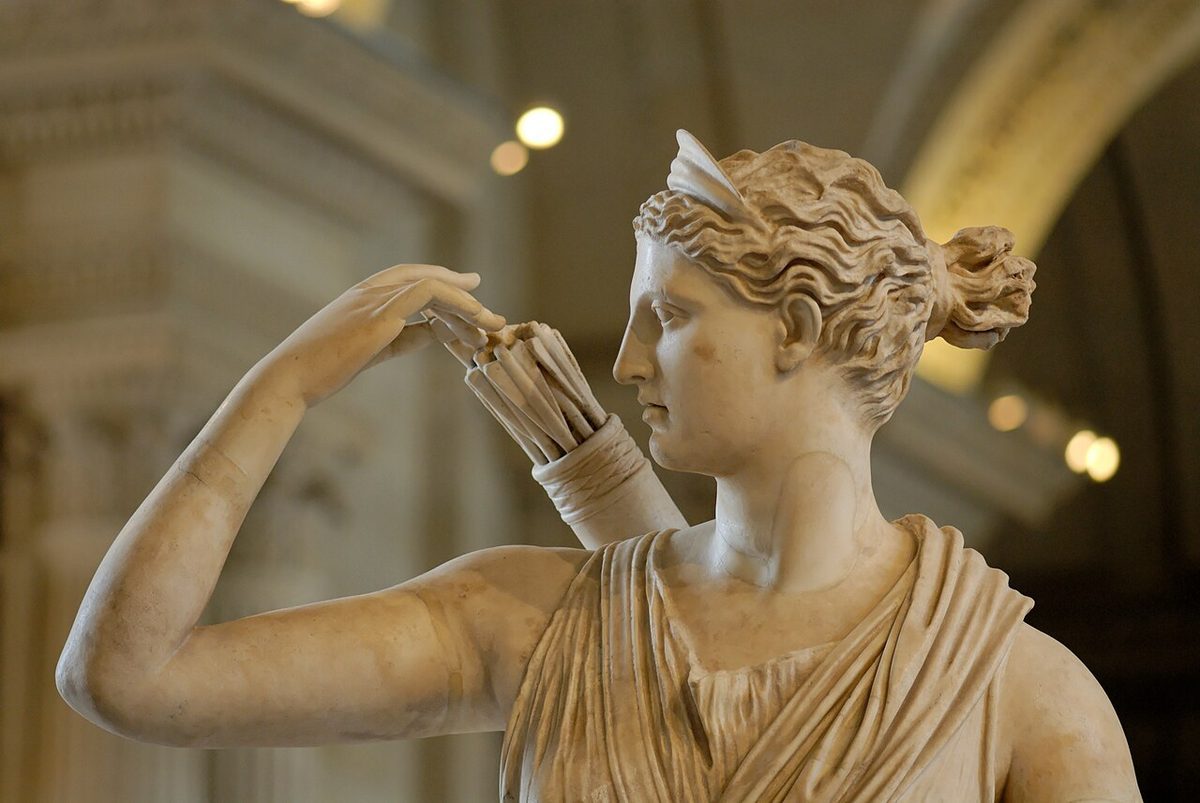
Under cedar boughs high in the hills, a cold spring wells up out of dark moss where no wagon road passes. Wild deer lift their heads from the water and vanish silently between the trunks. On rocky Delos, minutes after stepping out of her mother's womb without a cry, the newborn sister knelt in the grass to help deliver her twin brother into the world.
She is Artemis, mistress of beasts, untamed land, and the waxing moon in Greece. Rome knew her as Diana of the woods, guardian of groves and wild springs. She belongs to no master and asks leave from no city gate. She guards the unbroken edge where living nature stays whole, and stands at the door where new life crosses into breath. The Greeks kept bear groves, hill shrines, and moon vigils to meet her power without taming it.
What virgin meant in the old groves
Modern ears often hear the word virgin and think of shy refusal. Ancient Greece meant something far sharper.
Historian Sorita d'Este, who has written widely on Artemis, Diana, and Hekate, states plainly what the title meant in Greek religion. In that world, virgin meant power, independence, and an incorruptible nature. A virgin goddess belonged to no husband and answered to no house of marriage. She owned herself completely. That self-rule is why Artemis roamed the high mountains with sixty ocean nymphs and carried a silver bow.
Lee Carroll and Kryon, speaking in Anchorage in 2016, use the same word for land itself. They speak of virgin consciousness land, places on Earth unmarked by centuries of war, slaughter, and mass grief. Because the planet holds memory of what happens on its soil, untouched ground carries a clarity that draws people back again and again.
A passage from The Law of One points to that same freshness inside thought. In Session 91 of those transcripts, the speaker teaches that when a seeker's mind grows crowded and tangled with rigid ideas, the adept turns to the untouched, virgin mind. That mind sits free of bias and open to the first spark of creation.
That is Artemis. She is the part of awareness that has never been fenced, bought, or domesticated.
The web beneath the trees
To a hurried traveler, a forest looks like a crowd of separate trunks waiting to be chopped into boards. Science has looked closer under the soil and found a different world.
In Galileo's Error, philosopher Philip Goff describes the discoveries of forest scientist Suzanne Simard and plant researcher Ariel Novoplansky. Novoplansky planted neighbors with shared roots in side-by-side pots. When he gave one plant drought, all the neighboring plants down the row closed their leaf pores to save water. They knew danger was near before thirst reached them.
Simard took that work out into living woods. Using tracers, she mapped an underground network where trees join roots through fine fungal threads. Birch and fir trees trade carbon across species, helping whichever tree sits in winter shade. Mother trees at the center of the grove send defense warnings and extra nutrients to young saplings, lifting their odds of survival fourfold. Beneath the bark, a forest is a living community of mutual protection.
Lee Carroll and Kryon, speaking in Red Deer in 2016, add that when a person walks into an old forest, the trees recognize human breath and speak through their shared roots with Gaia.
Artemis is the intelligence of that living web. She is the grove that feeds its young, warns its own, and refuses to become lumber.
The knee of Zeus, the stag and the shore
Four stories from Greece show how Artemis chose her path, guarded her springs, and tested every hunter who entered her woods.
The Homeric Hymns and Callimachus tell how she began. Leto reached barren Delos and gave birth to Artemis first, with no pain. At once the newborn sister placed her hands beside her mother and helped deliver twin Apollo into the sun. Later, Callimachus pictured Artemis at three years old sitting upon her father Zeus's knee. Asked what gifts she wanted, she refused palaces or robes of gold. She asked to stay forever free of marriage and carry a silver bow. She asked for a hunting tunic, sixty nymphs of the ocean as companions, and every mountain peak. Cities she left to others. Zeus laughed and gave her all the hills and wild groves of earth.
Ovid told a starker tale in the Metamorphoses. A young hunter named Actaeon spent noon tracking deer across Mount Cithaeron with fifty hounds. Hot and weary, he wandered into a valley where cypress and pine framed a cave and a spring. Inside that cove, Artemis stood bathing in clear water with her nymphs. Actaeon stepped through the brush and saw her bare. Instead of turning his eyes away and stepping back, he stood and stared. Artemis had no bow in reach. She scooped water from the spring in her palm and flung it across his face. Go boast that you have seen me, she said, if you can still speak. At once horns sprouted from his forehead. His neck lengthened, his ears grew pointed, and spotted hide covered his skin. Actaeon fled through the trees. His own fifty hounds caught his scent and tore their master down on the moss.
Another tale tells of Orion, the giant hunter who walked beside Artemis across Crete. He was the only man who matched her stride on the mountain trails. In one telling, Orion boasted that he would hunt down every wild beast on the earth until none were left. Earth sent a scorpion out of the soil to sting his heel and stop his boast. In another telling, Apollo grew jealous of the hunter walking beside his twin. He saw Orion swimming far out in the sea with only his dark head above the waves. Apollo challenged his sister to prove her aim by striking that distant mark. Artemis drew her bow and loosed one silver arrow across the water. At dawn, Orion's body washed ashore. In grief she lifted him among the winter stars.
At Brauron on the coast of Attica, Athenian families sent young girls to live for a season inside the sanctuary of Artemis. Wearing saffron robes, the girls were called little bears. A sacred she-bear had once lived tame at the shrine until youths killed it, bringing plague upon the land. To mend the wrong, the city vowed that daughters would serve as bears at the forest edge before entering adult life.
Across the sea in Italy, Diana kept a wooded sanctuary beside Lake Nemi in the hills near Aricia. People called that crater water the Mirror of Diana. Torches reflected across the dark surface at night, while deer and wild horses ran free inside the grove. No Roman army brought iron weapons inside that ring of trees.
What the woods demand
Heard on the surface, these tales look harsh. Beneath the surface, they state exact laws of living edges.
What belongs to itself can shelter birth without fear. Artemis delivered her twin brother minutes after her own birth, and women in labor across Greece called upon her name. An untamed edge is never barren. It holds the still space where new life arrives safely.
Greedy eyes turn the watcher into prey. Actaeon did not die because he walked into the woods by chance. He died because he stood and stared at what was never offered to him, wanting to seize it with his gaze. When a mind treats living mystery as a prize to capture, its wild drives turn around and hunt it down. Actaeon's own dogs killed him, because his appetite tore him apart.
Even skill must know when to lay down the bow. Orion boasted he would clear the earth of beasts, forgetting that a hunter belongs inside the balance of the woods, never above it.
The bow, the crescent and the bear
The bow, the deer, the bear, and the cedar torch show how that wild edge holds.
The silver bow curves like the waxing crescent moon on its third night after the dark moon. A bow holds tension ready to release across space without touching the target by hand. Silver in ancient craft belonged to moonlight and reflection. Tom Kenyon and the Hathors, describing the Seven Pure Lights of consciousness in his Egyptian alchemy writings, note that lights of gold and silver shine together at the edge of pure awareness. That is the edge where duality dissolves. Artemis carries that silver gleam between known road and dark forest.
Beside her walks the stag or the swift hind. A deer hears a twig snap half a mile off and leaps out of sight before a hand reaches for a spear. It moves silently between trunks and leaves no waste behind. In myth, pulling her chariot were four deer with golden horns, swift as breath.
At Brauron stood the she-bear. A bear sleeps through winter in a hollow cave and wakes fierce in spring to guard her cubs. The bear teaches that gentleness and teeth live inside the same skin. To guard what is tender, a creature must also keep claws intact.
In her hand or at Nemi beside her volcanic lake, Diana carried the cedar torch. In one role she lights the night path at birth. In another role, as Tom Kenyon writes of direct experience, living presence acts as the midwife of real change, bringing what is ready out of dark shelter into daylight.
Her temple at Ephesus stood outside the city wall on marsh ground. Diana of Nemi kept watch inside a ring of ancient woods beside her crater lake. Both shrines stood outside civic walls. They marked the border where human rules stop and living earth keeps the watch. One of her oldest titles was Potnia Theron, Mistress of Wild Beasts. Art across Greece shows her holding lions, deer, or swans by the neck or wing, neither petting them nor slaughtering them, holding wild force in balance.
Sun, silver and the crossroads
Artemis moves in a three-part circuit with Apollo and Hekate, bridging daylight, deep night, and the wild border between them.
Born minutes apart on Delos, Artemis and Apollo hold the poles of wilderness and city, silver crescent and solar noon, silence and song. Where Apollo measures intervals in open plazas, Artemis keeps the forest alive so those plazas do not turn into dead stone. When Apollo pushes too hard, as when he tricked her into shooting Orion, grief reminds her never to let another's pride aim her bow.
With Hekate, Artemis shares a close kinship across Greek and Roman ritual. Historian Sorita d'Este has lectured extensively on how Hekate, Artemis, and Diana meet without erasing one another. Hekate stands at the three-way fork in the road holding twin torches over doorways and passages. Artemis stands inside the woods and groves just beyond the gate. Together they guard every transition where a person leaves an old house and steps onto untamed ground.
The waxing crescent in a birth chart
In astrology, Artemis belongs to the Moon. She matches the waxing crescent phase just after the dark moon, when a sliver of light returns to the western sky at dusk.
Look to the Moon's sign, house, and hard aspects in a natal chart. The Moon shows home, shelter, and body rhythm. Artemis wakes whenever the Moon links with Mars, Uranus, or Pluto. Moon with Mars gives fierce instinct that protects what it loves without asking leave. Moon with Uranus refuses crowded cages and needs open sky to think straight. Moon with Pluto smells trespass before a word is spoken and watches currents under the surface.
In houses, her watch turns toward the sixth house of daily rhythm and wild creatures, and the twelfth house of retreat beyond city walls. In signs, her bow aims clearest in Sagittarius, sign of the mountain hunt and wide horizon. Her spring water flows in Cancer, keeper of birth and shelter. Her self-owned focus stands firm in Virgo, the sign of the maiden who answers to her own measure.
Standing at the forest line
Step toward Artemis when noise and crowd pressure have worn down your inner edge. Call on her when you must guard a beginning before it can speak for itself, or reclaim wild instinct from borrowed habits. Hunters who boast or strike out of spite turn the grove against themselves. Remember Orion, and leave conquest outside the trees.
Come at her hour. Monday belongs to the moon, and the dusk hour when a thin crescent hangs in the west fits her watch. Step outside near trees if you can, or stand beside an open window in cool evening air with a beeswax candle or a cedar twig nearby.
Stand upright on your feet with your knees unlocked, alert like a deer listening at the edge of a clearing. Let your eyes soften instead of staring hard at one spot. Notice the width of the room or the skyline all at once.
Speak one border aloud in plain words. Name what belongs inside your grove, and name what must stay outside the brush. Keep it short, like a bowstring drawn and released once. Do not explain or argue with anyone who is not in the room. Remember Actaeon: what is sacred at the spring does not need to justify itself to staring eyes.
Touch the rough bark of a branch or the cedar twig in your hand. Recall the underground fungal web beneath every forest tree, feeding and warning its own in silence. Take five slow steps back from whatever demands your attention tonight, letting distance widen between your chest and the noise.
Leave the threshold calmly when your border is set. Wild alertness must not turn suspicious toward ordinary life. Snuff the candle, step back indoors, and pull the wooden door or window latch shut. Eat a handful of berries, nuts, or plain dark bread, and let the woods keep their own night watch behind you.
Questions people ask about Artemis and Diana
What is Artemis the goddess of?
Artemis is the Greek goddess of the hunt, wild beasts, forests, the waxing moon, young girls, and birth. Rome honored her as Diana, guardian of sacred groves and springs. Both names stand for self-owned wilderness and protection of new life.
What did virgin mean for Artemis in ancient Greece?
In Greek religion, virgin meant belonging to no husband and answering to no master. It marked Artemis's unbroken independence and self-rule, leaving her free to roam mountains and protect wild places.
What are the main symbols of Artemis?
Her main symbols are the silver bow and quiver, the crescent moon, the stag or hind, the she-bear, and the cedar torch. Together they map keen aim, lunar rhythm, swift alertness, maternal defense, and safe passage at birth.
Why did Artemis turn Actaeon into a stag?
Hunter Actaeon stumbled upon Artemis bathing in a forest spring and stood staring instead of stepping away. She splashed water in his face to turn him into a stag, and his own hounds tore him down, showing how greedy intrusion becomes its own undoing.
How does Artemis appear in a birth chart?
Artemis shows through the Moon, especially the waxing crescent phase, and strong links between the Moon and Mars, Uranus, or Pluto. Those placements mark sharp instinct, fierce defense of inner space, and a strong need for uncrowded ground.
The wild edge that keeps itself
Artemis is the ring of the forest, the silver bow that guards the source until new life is ready to walk.
To see how your lunar instincts, inner shelter, and whole chart weave together, explore The Whole of You.