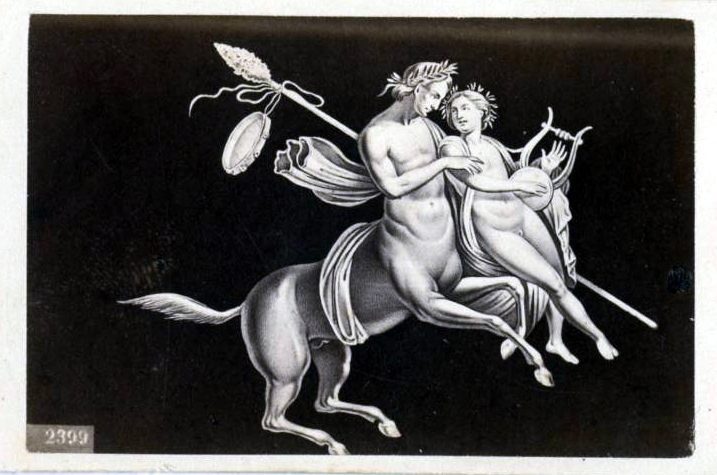
High on Mount Pelion in Greece, ash trees grew straight above cold springs. Bitter herbs clung between the rocks. Below in the valley, wild horsemen raided cattle and smashed wine jars. Halfway up the ridge sat a cave swept bare with pine boughs. There a single centaur tuned seven strings by ear and waited for heroes to climb the path.
Chiron is the wisest centaur of Greek myth, master of music, prophecy, archery, plant craft and mentorship. His name shares a root with the Greek word for hand. Unlike his wild cousins, he is half stallion and half upright teacher. He is a consciousness that holds animal strength and sky intellect together on one frame. He never hides the scar where limit enters. Greece kept his cave, his lyre and his star pattern as a technology for crossing from pride into true witness.
The bridge between two worlds
Walk to the edge of a steep gorge and throw a plank across. A bridge belongs to neither cliff. If it fuses with the rock on one side, it turns into a dead shelf. It works only when it touches both banks and leaves room for traffic between them.
Human awareness runs across the same split. In The Matter With Things, Iain McGilchrist points to the corpus callosum, the band of nerve fibers joining the two halves of the brain. Most people picture that band as an open pipe pouring data back and forth. In truth, much of its work is holding back interference. It keeps the focused grip of one side and the wide presence of the other side distinct. They answer each other without blurring into mud.
Physicist Amit Goswami adds a second rule about how two people meet across a gap. In his writing on consciousness, he contrasts a flat chain of command with what he calls a tangled hierarchy. In a rigid chain, the master stands above and issues orders while the student obeys below. In a tangled hierarchy, both guide and student belong to one shared loop. The teacher listens as closely as the student. Out of that mutual loop, a fresh leap of insight becomes possible.
Greece carved that double truth into bone and horseflesh. Chiron stood half beast and half scholar. He bridged earth instinct and star order through an unclosed limit on his own knee.
The centaur on Mount Pelion
This is the story told by Homer, Pindar and the Greek mythmakers.
Long ago, when the Titan Cronus walked the earth, he slipped from his throne in the form of a stallion to lie with Philyra, a nymph of the sea. When her child was born inside a cave, Philyra looked down at human shoulders joined to a horse's flanks and recoiled. Ashamed of her son's double form, she prayed to Zeus to change her shape. Zeus turned her into a linden tree, rooting her outside the cave while the infant cried alone.
Apollo and his twin sister Artemis found the abandoned boy on the slope. Instead of hiding him, the sun god and the moon hunter brought him into their light. They taught him everything they knew: the seven-stringed lyre, bowcraft, prophecy, star lore and the names of mountain herbs.
Chiron grew up inside a stone cave on Mount Pelion, apart from the drunken centaurs of the valley. In the Iliad, Homer calls him the most righteous of all the centaurs. Kings sent their sons up his steep trail. Chiron taught Asclepius the art of herbs and bone-setting. He trained Jason before the ship Argo sailed. He fed young Achilles on lion marrow and taught him music. He cut the ash spear from Pelion that no other Greek warrior could lift at Troy.
One evening Heracles visited the centaur Pholus in a cave. Pholus opened a jar of wine belonging to all the centaurs. Drawn by the scent across the ridge, wild centaurs stormed the cave mouth with boulders and pine trunks. Heracles drove them back with arrows dipped in the venom of the Hydra.
In the dust and flying shafts, one stray arrow struck Chiron's knee. Heracles ran forward in grief and pulled the barb out. Chiron smeared crushed herbs across the skin. Because Chiron was immortal, son of Cronus, the venom could not kill him. Yet because Hydra blood leaves no rest, no root or song in Pelion's cave could close the torn joint. Pain stayed burning beside his bone year after year. The famous teacher had to limp across his own floor.
Long afterward, Chiron found the only door out. High on a Caucasus crag, the Titan Prometheus hung chained in iron for giving fire to mortals. Zeus swore Prometheus would never go free until an immortal offered to trade places and descend to Hades. Chiron offered his own immortality to end the ache and set Prometheus loose. Zeus accepted the trade and unlocked Prometheus's iron links. He lifted Chiron into the winter sky as a constellation holding a bow and an altar flame.
The open knee and the traded crown
Chiron's wound is no random accident. Inside the torn knee sit two hard truths about teaching and limit.
A guide who cannot close his own wound stops pretending to stand above the student. While Chiron stayed untouched inside his mountain school, he spoke from ease. The arrow in the knee sits right where horse power meets the earth. Once limit strikes him there, every word he speaks carries weight. He knows how mortal dust feels.
At the same time, clinging to endless survival turns a gift into a cage. Immortality sounded like a crown until pain entered the house. Only when Chiron let go of staying untouched forever did Prometheus go free. A star pattern rose into the night. Strength opens its hand when pride lets go of permanence.
Catalyst, bridge and chosen river
Four contemporary voices circle that same hinge without promising quick fixes.
Session Five of the Carla Rueckert transcripts known as The Law of One speaks plainly about the nature of a helper. No helper works change by personal power. The helper serves only as a catalyst, like an open window letting light cross a room. Before anyone can serve as a bridge, those notes add, the mind must learn stillness. It must accept both poles inside itself without harsh judgment. Where impatience sits in the chest, patience stands beside it as an equal half. Wholeness starts when you stop splitting yourself into proud parts and shameful parts.
Tom Kenyon and the Hathors map a similar crossing in a teaching called The Secret Passage. He points to two centers that rarely notice each other: the physical heart beneath the ribs and the subtle heart center opposite the spine. By resting attention inside the space between them, awareness builds a bridge of light without forcing either side.
Maia Nartoomid, writing from her Thoth transmissions, names bridge-beings called Khirons linked with Sirius and the Lion guardians. In her account, they travel across thresholds where separated fragments of light seek return. They carry others safely inside their fields. In her Prayer of the Temple Graces, she speaks of the Gate opened through the strength of the Centaur, where deeper timekeepers reveal their pattern to an open heart.
Anne Tucker addresses Chiron directly in Time Is Collapsing. She compares the wounded helper to someone walking beside a chosen river. Each soul picks one deep pattern to learn through life, like traveling along a riverbank. Whenever you stumble, you fall into that same river. You learn every bend, rock and current by skin and bone. When another walker slips down that bank, you know the water firsthand and point to the shallow stone. Elsewhere she notes how Chiron at nineteen degrees of Aries, and shifting toward Taurus, marks shared lessons where struggle strips away pride and leaves genuine presence.
Horse flank, ash spear and mountain herb
Follow Chiron's body from hoof to brow, and every part shows how that bridge works.
Start with the four hooves and horse flanks. Half of Chiron runs on four legs across grass and rock. That lower half is animal instinct, speed, hunger and earth power. It does not talk in neat theories. It senses storms before the sky darkens.
Above the horse shoulders rises a human chest, neck and two hands. Chiron's very name means hand. A clenched fist is made for striking. An open hand measures weight, presses herbs, sets a bone and tunes a lyre cord. Human hands turn raw animal force into careful craft.
In his hands rests the seven-stringed lyre taught to him by Apollo. In frescoes from Pompeii, Chiron sits beside young Achilles guiding the boy's fingers across the strings. Music tunes tension into order without breaking the cord.
Beside the cave door leans his ash spear from Pelion. Ash wood bends under shock without snapping, joining toughness with spring. A spear points a single line of intent across space, just as a bow sends an arrow toward one clear target.
At his belt hangs a bundle of centaury, the bitter herb named after him. Bitter plants wake the palate and clear fog without tasting like honey. Growth rarely arrives wrapped in sugar.
Finally, look down at the knee pierced by the arrow. The knee is the hinge that lets a horse run or kneel. An unclosed mark on that hinge reminds the rider that speed and pride end at the same dust every mortal walks upon.
Father time, rebel fire and the son
Chiron stands inside a sharp triangle of powers in Greek myth and sky alike.
His father is Cronus, the Titan of time, stone limits and harvest scythes. Cronus swallowed his own children out of fear of losing his crown. Yet he fled as a horse into Philyra's arms. Chiron carries his father's deep endurance without his father's cruelty.
His twin tutors are Apollo and Artemis, sun clarity and wild lunar instinct. From them he inherits music, distance, tracking and star measure.
His release comes through Prometheus, the Titan who stole sky fire for humankind. Prometheus hung chained to rock until Chiron gave up immortality in exchange. Three figures stand in one row. Cronus locks borders. Prometheus breaks locks open for the future. Chiron stands between them with an aching knee, holding the door open so old law and new fire meet without tearing the earth apart.
Where Chiron crosses the sky
In November 1977, astronomer Charles Kowal spotted an icy body moving through the dark between Saturn and Uranus. Astronomers named it 2060 Chiron. They built a whole class of objects called centaurs after its strange path.
Look at the astronomy first, because the sky repeats the myth word for word. Saturn is Roman Cronus, the father who threw Chiron into the world. Uranus is the sky-breaker linked in astrology with Prometheus. Chiron's fifty-year oval orbit swings inside Saturn's rings and crosses near Uranus's track. It stitches structure and awakening together into one bridge.
Since its discovery in 1977, modern astrology has read Chiron in a birth chart by sign, house and tight angles to the Sun, Moon, Mercury, Saturn and Uranus. Because its path is stretched like a bent bow, Chiron lingers anywhere from two to nearly nine years in one sign. Around age fifty to fifty-one, Chiron finishes its first lap around the Sun and returns to its birth spot. Many people meet that Chiron Return as a clear hinge where old masks drop and hard-earned skill turns toward mentoring others.
Watch Chiron moving from Aries toward Taurus across 2026 and 2027. In Aries, Chiron tests courage, identity and the sting of standing alone. As it steps toward Taurus, attention shifts toward earth, daily craft, value and mortal limits.
Wherever Chiron sits in a birth chart marks a tender hinge where smooth confidence runs short. Yet calm witness turns that exact struggle into clear sight for anyone standing beside you.
Sitting on the Pelion bench
Come to the Pelion bench when an old limit refuses to vanish or when clever tricks fail to mend a sore spot. Sit here when you want to stand beside another person's struggle without pretending to hold all the answers. Miracle cures and shortcuts around mortality do not belong in his cave. He left immortality behind on purpose to walk on real ground.
Choose his hour. Saturday belongs to his father Saturn. Early twilight holds the seam between day work and night sky, when the winter stars of the Centaur climb south.
Place two plain things on a wooden bench or stool: a rough stone from outdoors and a sprig of bitter herb, pine needle or rosemary. Set a small cup of plain bitter tea beside them. Notice that you are not building an altar of gold. You are setting a Pelion cave bench.
Sit upright on a chair or on the floor with your knees bent and both hands resting open on your knees. Recall the rule from Session Five of the Law of One: the helper does not force a result, and the key of the mind is silence. Breathe slowly into your belly for two minutes until the rush to fix things settles. Notice where your knees, shoulders or chest feel tight. Do not argue with the ache or demand that it vanish. Treat it like Anne Tucker's riverbank, a spot you know by heart because you have walked there before.
Bring one stubborn limit or hard question to the bench. Speak softly into the room: where have I tried to hide my limit behind pride, and whom can I meet plainly once I drop the mask? Wait three minutes while touching the stone with one hand and the herb with the other. Let whatever image or duty surfaces stand without polishing it.
Move one hand slowly to your chest, recalling Tom Kenyon's bridge between the physical heart and the spine center behind it. Hold both points in awareness for six breaths. Ask nothing except to stay present inside both animal earth and clear witness.
Leave the bench for useful work before sorrow turns inward. Chiron never lingered inside endless brooding. Stand up, set the stone and the bitter sprig on the windowsill, and take a plain tool into your hands. Sweep a step, sharpen a dull blade, or slice food for someone in your house. The name Chiron means hand, and hands on useful work carry the bridge back into daily life.
Questions people ask about Chiron
Who was Chiron in Greek mythology?
Chiron was the wisest and most just of the centaurs, born to Titan Cronus in stallion form and the sea nymph Philyra. Raised by Apollo and Artemis on Mount Pelion, he taught music, prophecy, archery and herbal craft to heroes including Achilles, Jason and Asclepius.
Why is Chiron called the wounded healer?
When Heracles fought wild centaurs at Pholus's cave, a stray arrow dipped in Hydra venom struck Chiron's knee. Immortal yet unable to close his own painful wound, Chiron lived with that limit until he traded his immortality to free Prometheus, turning his ache into deep compassion for mortal struggle.
What does Chiron represent in a birth chart?
In astrology, Chiron orbits between Saturn and Uranus, taking about fifty years to circle the Sun. Its sign, house and planetary angles mark where early limits or sharp vulnerability strip away shallow confidence, ripening over time into calm mentorship and grounded skill.
How is Chiron different from other centaurs?
In Greek myth, most centaurs sprang from Ixion and a cloud and lived in drunken raids and chaos. Chiron came from Cronus and Philyra, learned law and art from Apollo and Artemis, and kept an orderly school on Mount Pelion where kings trusted him with their sons.
What happens during a Chiron Return?
Around age fifty to fifty-one, transiting Chiron returns to the exact degree it held at your birth. Many people meet this cycle as a sober threshold where old wounds stop demanding perfection and turn into mature wisdom, useful craft and generous guidance for younger walkers.
The teacher who chose limit
Chiron is the horse hoof planted in gravel and the open hand stretched across a harp, proving that an unclosed scar can become the exact bridge where sky meets mortal earth.