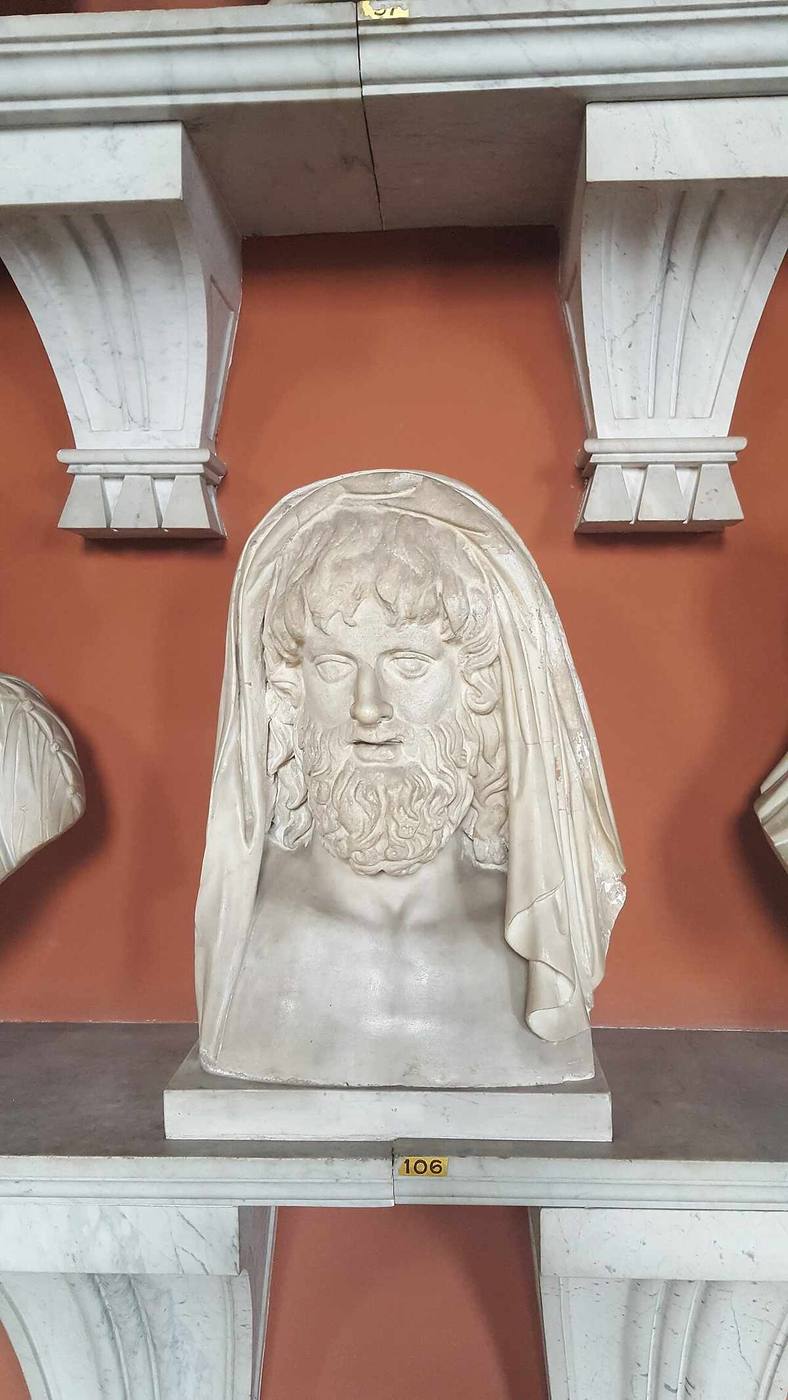
In heavy darkness, Gaia shaped a jagged sickle out of grey flint and placed it in the hand of her youngest son. The sky lay pressed down flat upon the earth with no room for a seed to sprout or a lung to draw breath. Cronus swung the curved stone blade once, and dawn broke into the gap between heaven and soil.
Chronos is the Greek lord of measure and time, fused from the Titan Cronus and Chronos, the river of years. Rome called him Saturn. He rules the sickle, the seed, stone limits and the weight of consequence. Far from a grim jailer, he is the principle that carves clear edges so shapeless dreams can stand in solid matter. Greece and Rome honored his blade, his swaddled stone and his winter table as a way of testing what endures.
Why the clock runs one way
Set a glass cup on a wooden table. Knock it off, and it shatters across the floor. Watch for a hundred years, and the shards will never leap back onto the table whole.
Physics explains why time carries a sharp blade in one direction. In The Order of Time, Carlo Rovelli points to entropy, a measure named from the Greek word for transformation. Heat always passes from a warm body into a cold room, never the reverse. Only where heat flows does past differ from future. Rovelli goes further with thermal time: at the smallest scale there is no giant wall clock ticking outside space, yet our blurred view of moving energy creates the constant march we feel as time.
In A Brief History of Time, Stephen Hawking maps three arrows that point together. Disorder rises in matter. Memory records yesterday, never tomorrow. And the cosmos itself expands outward.
Physicist Richard A. Muller takes that expansion one step closer in his book Now. As space stretches, the universe continuously makes new time. The leading edge of that expanding wave is the present moment. Now is the thin flint edge where choice still turns the future.
The flint sickle and the stone
This is the tale told by Hesiod in his Theogony and remembered by Roman poets.
In the beginning, the sky god Ouranos hated his own children and kept them shut inside Earth. Gaia groaned under the crushing weight until she shaped a jagged sickle out of grey flint and called her sons to strike. Only Cronus, the youngest Titan, took the blade. When Ouranos came down in the night, Cronus swung the sickle and cut the sky away from the earth. Space opened, and the Titans walked free.
Yet once Cronus took the throne, fear entered his hall. A prophecy warned that one of his own children would unseat him in turn. Whenever his wife Rhea bore a child, Cronus seized the infant and swallowed it whole to lock tomorrow inside his belly. Hestia, Demeter, Hera, Hades and Poseidon all vanished down his throat.
When Rhea carried her sixth child, Zeus, she slipped away by night to a cave in Crete and hid the baby there. At dawn she wrapped a block of stone, called the omphalos, in infant cloth and laid it in Cronus's hands. The king swallowed the stone without looking inside the wool. Years later Zeus returned, gave Cronus an herb drink, and forced him to cast up the stone along with all his brothers and sisters.
Roman poets Virgil and Ovid told a second side of his story. Driven from heaven, Saturnus sailed down the Tiber River to Latium in Italy. There he taught farmers to plow, prune vines, sow seed and keep fair measure. Under his rule people lived without locks or war during a Golden Age. Each December, Rome kept his feast called Saturnalia, where masters waited at table on their servants to remember a time before rank hardened into walls.
Two laws of limit and harvest
Those tales from Hesiod and Latium set down two plain rules of time.
Nothing grows without a border. Ouranos was infinite sky with no fence, and under him every seed choked. Cronus's sickle looks harsh until you see what a knife does to a wild grapevine. Cut back dead wood in winter, and spring sap drives straight into sweet fruit. Limit turns fog into form.
Power that fears tomorrow destroys its own seed. When Cronus tried to freeze his crown by swallowing his children, he ended up choking on a stone wrapped in cloth. Hard reality refuses to vanish under anxious control. Time honors builders who pass the torch forward instead of locking the gate.
The rings around the world
Three voices read Saturn's rings as an active border in cosmic order.
Sessions Six, Seven and Nine of The Law of One, channeled by Carla Rueckert, speak of a Council of Saturn. According to those sessions, this council dwells in the eighth dimension around Saturn's rings and guards planetary quarantine. In Session Nine, cosmic energy is described flowing outward and gathering inward to build planetary cycles that turn as precisely as a timepiece. Saturn, Session Thirty adds, holds deep affinity with infinite intelligence and stands watch over this solar system.
Tom Kenyon and the Hathors borrow Saturn's rings as a clear image in a 2007 New Year's message. People and nations nest inside vibrational rings of reality, much like dust and ice circling Saturn. When a collective era turns, what once sat at the center of power shifts toward the outer rim, while shared stewardship moves to the center.
Astrologer Pam Gregory traces that clockwork in talks with Anne Tucker. She notes Saturn's orbit of twenty-nine and a half years, calling its passage through Pisces a time of shedding old karma. When Saturn met Neptune at zero degrees of Aries in February 2026, she marked it as a rare hinge where dissolved structures meet a raw beginning.
Sickle, lead and pruned vine
The sickle, the stone, lead and the pruned vine belong together on one builder's bench.
The curved flint sickle does not smash like a club. It hooks around a stalk and cuts at the exact joint where ripe grain parts from dry straw.
Beside it lies the swaddled stone, the omphalos. Stone cannot be talked out of its weight. It stands for physical fact waiting beneath wishful thinking.
In old alchemy, Saturn's metal is lead. Lead is dense, dull and heavy, guarding against stray rays while grounding wild sparks. Without lead weight at the keel, a ship rolls over in the first gale.
In the orchards of Latium stands the pruned vine. A gardener who refuses the winter shears loses the harvest to tangles of weak leaves.
Saturn's lap around the sun
In the sky, Saturn gleams pale gold inside wide rings of ice and rock. It takes twenty-nine and a half years to circle the Sun, ruling Capricorn and, in older astrology, Aquarius.
Every twenty-nine years, transiting Saturn returns to the exact place it held at your birth. In astrology, this cycle is known as the Saturn Return. Around ages twenty-nine, fifty-eight and eighty-seven, the ring-master audits every promise, skill and shortcut you built. Whatever stands on bare truth stays standing. Whatever rested on bluff falls away.
Watch Saturn's links to other planets in a birth chart. Saturn beside the Sun asks ambition to prove itself through patient craft. Saturn beside the Moon builds endurance while asking a person not to wall off warm blood behind duty. Saturn beside Uranus stages the clash between Cronus and sky-breaker Prometheus, forcing old walls to open windows for new air. And Saturn meeting Neptune at zero Aries pulls high visions down onto timber, brick and calendar dates.
Setting the stone on the table
Turn to Chronos when a plan stays stuck in fog, when half-kept vows drain your strength, or when an ending asks for sober accounting before a new chapter begins. Tricks and bribes carry no weight at his bench. Saturn weighs real work.
Choose his hour. Saturday belongs to Saturn, and dusk or winter twilight holds his clear, cool air.
Set a river stone and a blank sheet of paper on a wood table beside an iron key or a wooden ruler. Leave phones and clocks in another room. Sit straight with both feet planted flat on the floor. Feel gravity pulling down through your heels like lead in a ship's keel.
Bring one unfinished duty or scattered dream to the stone. Speak aloud what needs a clear edge, whether it is a limit on time, a pruned habit or a promise left half-built. Ask one direct question into the room: what dead branch must I cut away now so real fruit can grow? Wait three minutes in silence, letting excuses drop like dry leaves.
Write one concrete step with a calendar day on the paper. Time answers when vague wishes step onto a real date.
Put the stone back in its place when the date is set. Time turns sterile if it freezes at winter's edge. Slip the paper inside a book or drawer for its chosen calendar day, wipe the wooden table clear of dust, and set the river stone outdoors by the doorstep. Eat a simple meal at a fixed hour, and let the clock keep moving while you rest.
Questions people ask about Chronos
Are Chronos and Cronus the same god?
Greek myth distinguished Cronus, the Titan father of Zeus, from Chronos, the personification of time. Later Greek writers and Roman poets blended both names together, giving Saturn the Titan's sickle alongside the hourglass and measure of passing years.
What did Saturn represent to the Romans?
To Rome, Saturnus was a bringer of agriculture, fair measure and Golden Age peace who taught Latium to sow grain and prune vines. Each December, the festival of Saturnalia reversed social ranks for a week to honor shared plenty.
What is a Saturn Return in astrology?
A Saturn Return occurs roughly every twenty-nine and a half years, when transiting Saturn returns to the degree it held at your birth. It marks a major checkpoint around ages twenty-nine and fifty-eight that tests structures, commitments and long-term direction.
Why did Cronus swallow a stone?
Fearing prophecy that a child would overthrow him, Cronus swallowed his newborns one by one. Rhea hid baby Zeus in Crete and wrapped the omphalos stone in cloth, teaching that anxious control eventually chokes on solid reality.
The blade that makes room
Chronos is the flint edge that clears dead wood and the stone that tests every wall, turning passing hours into work that lasts.
To see how Saturn moves across your own birth chart and twenty-nine-year cycles, read Saturn Return.