Far beneath the tree roots and clay wells lies bedrock that sunlight never touches. No storm wind rattles it. Yet every iron vein, every cold spring and every winter seed rests inside that dark vault before climbing into the daylight.
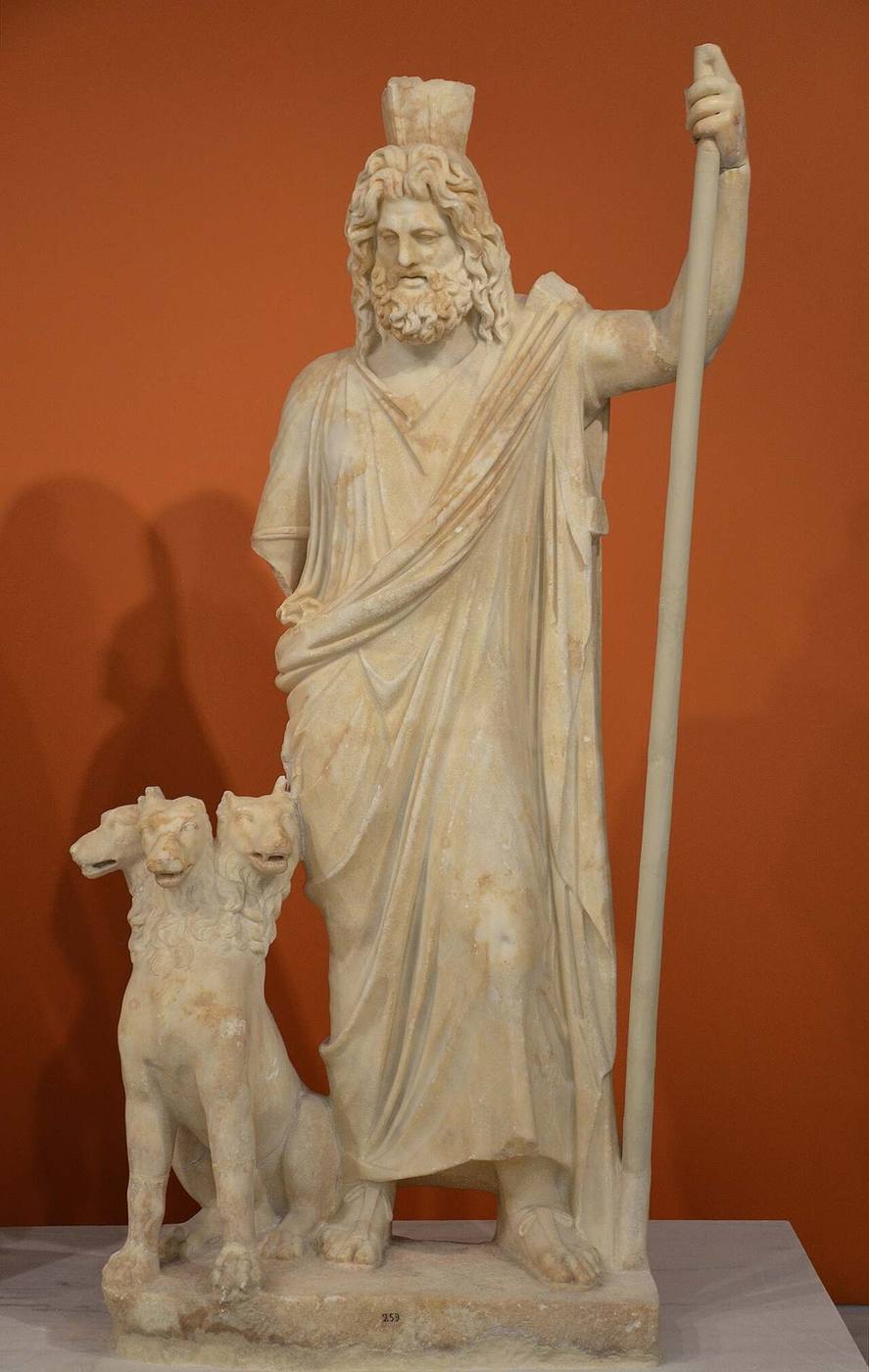
Hades is the ruler of the underworld in ancient Greece. Later Greeks called him Plouton, the giver of wealth. Rome named him Pluto and Dis Pater. His oldest name, Aidoneus, means the Unseen. He is a consciousness of hidden mass and final consequence. His helm of invisibility, his horn of plenty and his one-way gate form a technology for working out of sight and keeping a vow without turning back.
How hidden mass steers the visible sky
People look up at night and assume the glowing stars hold everything that counts. Physics found the reverse.
In A Brief History of Time, Stephen Hawking notes that visible stars add up to less than one hundredth of the mass needed to halt the expansion of the cosmos. Dark matter fills the spaces between stars and clusters, unseen by telescopes. Yet its gravity bends the orbits of every bright sun we see.
Hawking describes a second hidden engine in space: the black hole. When a star collapses tightly enough, its gravity pulls light inward behind a rim called an event horizon. In The Order of Time, Carlo Rovelli adds that mass near a black hole slows time until time stands still at the rim. Nothing escapes outward across that skin. The core stays concealed from outside eyes.
In Scalar Energy and Technology, Maia Nartoomid passes on Thoth's account of this hidden frame. Thoth describes dark matter as non-matter that holds real value beside visible energy. Inside the atom, he points to Magna Neutra, a neutral still point toward which turbulent waves collapse to reset.
Amit Goswami writes in Physics of the Soul that materialist science failed to erase our dread of Hades. In The Visionary Window, he adds that the ego fights hard against any step into shadow work. Yet Greece knew that Aidoneus, the Unseen, and Plouton, the Wealth-Giver, are the same king. What stays hidden carries the weight and stores the gold.
The helmet lots, the lyre and the bare hand
Four classic stories in Homer, Hesiod, Ovid and Apollodorus trace how Hades rules his house.
When the gods overthrew the Titans, three brothers shook bronze lots inside a helmet. Zeus drew the bright sky. Poseidon drew the gray sea. Hades drew the misty world beneath the earth, while earth and Olympus stayed common to all three. Before that war ended, the three Cyclopes forged weapons for the brothers. They gave lightning to Zeus, a trident to Poseidon, and a cap of invisibility to Hades. Wearing that cap, no god or mortal could spot him. Heroes like Perseus later borrowed it when facing danger no naked eye could bear.
Hades stayed inside his hall more than any brother, rarely crossing upward. One day he rose in a golden chariot behind black horses and carried Persephone down. He offered her sweet pomegranate seeds so she would return for a third of every year as queen beside him.
Another day, the singer Orpheus walked down the dark road with his lyre to win back his dead bride Eurydice. His music halted the turning wheels of torment and softened the stony court. Hades granted Orpheus his request under one strict law. Walk straight ahead up the path, he said, and never look back at Eurydice until both feet stand in daylight. Orpheus climbed almost to the cave mouth. Just short of open sun, doubt made him turn his head to check. At that glance, Eurydice slipped backward into shadow.
Later, Heracles came to the same gate to carry up the three-headed hound Cerberus as his final labor. Hades gave consent on one rule. Subdue the dog with bare hands alone, using no iron shield and no spear. Heracles locked his arms around the beast's neck until it yielded. He carried it into daylight and brought it back to its post.
Even Sisyphus, king of Corinth, tried to cheat the hall. He bound Death and slipped back to daylight by tricking his own wife. Hades sent him straight back to push a heavy stone up a slope forever, teaching that no craft outruns the underworld ledger.
Power in the dark and the forward step
Those four stories trace two strict rules of the underworld.
First, true power works without an audience. Hades rarely walked in bright parades or chased monuments. Like dark matter steering bright suns from empty space, he held the foundation beneath every root and coin.
Second, a deep passage breaks when you turn around to inspect it. In The Matter With Things, Iain McGilchrist points straight to Orpheus and Eurydice. Their story shows how living truth vanishes when analytical sight tries to seize it too soon. Orpheus lost his bride two steps from grass because he demanded proof before crossing the exit. Heracles won Cerberus because he trusted bare grip over metal armor.
Helm, hound and the horn of grain
Each tool in the underworld treasury carries out one task in the dark.
His helm of invisibility removes personal vanity from the work. When nobody can see your face, status games drop away. Only the real weight of the act remains.
Three-headed Cerberus guards the gate with bark and teeth. Notice who the hound stops. It welcomes the dead entering inward. It snaps only at anyone trying to sneak back half-changed without paying the fare of the crossing.
His scepter and keys govern locks that stay shut against casual hands. The pomegranate seed binds a vow inside the body so depth stays linked to daylight after you climb back up.
And his Roman horn, the cornucopia brimming with grain and fruit, joins death directly to harvest. Metals, coal, diamonds, buried springs and dormant seeds all ripen in the dark under Pluto's floor before feeding the market above.
Brothers, bride and the keepers of the door
Hades stands at the lower pole of a three-part cosmic frame. Zeus holds expansion and air above. Poseidon holds storm waves and motion across the sea. Hades holds the dense bedrock underneath both brothers. Without him, the sky and ocean would spin off with no anchor.
Beside him rules Persephone, bringing seasonal motion into a still hall so winter soil feeds spring shoots. Sorita d'Este notes in her essays on Hekate that Hermes and Hecate serve as the active guides across his border. They carry souls and torches between dark rooms and open roads.
Pluto in the sky and the birth chart
Ancient Greece had no telescope to spot the ninth planet, naming Hades only after the hidden soil. When astronomers found Pluto in 1930, modern astrologers matched it to the Lord of the Unseen.
Pluto takes two hundred forty-eight years to circle the Sun. It spends twelve to thirty years inside one sign. In a birth chart, Pluto marks where surface comfort breaks down until solid truth holds the floor.
Watch the eighth house of shared weight and inheritance, plus Scorpio, where surfaces strip down to bone. When Pluto touches the Sun, Moon, Venus or Mars, easy comforts fall away until unshakable truth holds the floor. Saturn with Pluto builds long stone walls that outlast crisis. Pluto moving through Aquarius presses hidden systems, shared ledgers and unseen networks into the open.
Among fixed stars, Antares, the red heart of the Scorpion, burns with the fierce weight of deep crossings where pride meets its match.
Keeping a silent vow in the dark treasury
Come to the underworld gate when noisy distractions wear thin and you need mineral depth, a true break from show, or nerve to walk forward without checking behind your shoulder. Meet Hades to honor roots and drop dead shells, never out of gloom.
Wait until nightfall, when rooms grow still. Sit upright in a dim space with one dark stone, iron key or plain copper coin resting in your hand. Keep your spine tall, like a pillar deep underground.
Breathe slowly down into your pelvis and legs until you feel the pull of the floor holding your weight, echoing Nartoomid's neutral still point.
Name one thing you are ready to bury in dark soil so it can compost without applause. Name one forward step you commit to walk like Orpheus climbing toward dawn without turning around for guarantees. Hold both vows in silence for seven slow breaths.
Hades's hall is a storehouse, never a prison, and Orpheus lost his way only when he glanced back at the cave mouth. Stand up, drop the coin, stone or iron key into a closed box or drawer, and shut the lid. Walk straight into a bright room or onto a street without looking back over your shoulder at the seat you left. Touch a green leaf or a stone step outdoors, and finish one visible task before resting.
Questions people ask about Hades and Pluto
Were Hades and Pluto the same god?
Hades was the ancient Greek ruler of the underworld, whose older name Aidoneus meant the Unseen. Greeks later called him Plouton, the wealth-giver, which Rome took over as Pluto.
Why was Hades called the giver of wealth?
Because metals, precious stones, buried springs and grain seeds come out of the dark earth beneath his care. True wealth grows underground before it ever shines in daylight.
What did the helm of Hades do?
Forged by the Cyclopes during the war against the Titans, the cap made its wearer invisible even to other gods. Hades wore it to move unseen, and heroes like Perseus borrowed it.
Why did Orpheus lose Eurydice at the exit?
Hades agreed to let Eurydice return on one rule. Orpheus had to walk ahead and never look back before reaching daylight. Doubt made him glance back near the cave mouth, and she vanished.
What does Pluto mean in a birth chart?
In astrology, Pluto marks deep change, buried truth, crisis and renewal. Its house and aspects to personal planets show where surface habits strip down to bedrock strength.
The bedrock beneath the wealth
Hades and Pluto guard the deep gravity that turns stripped stone into lasting wealth.