Deep under the sea off volcanic islands, red magma meets cold salt water. Steam hisses into the darkness, black stone cools into ridges, and out of the molten rock new land rises above the waves.
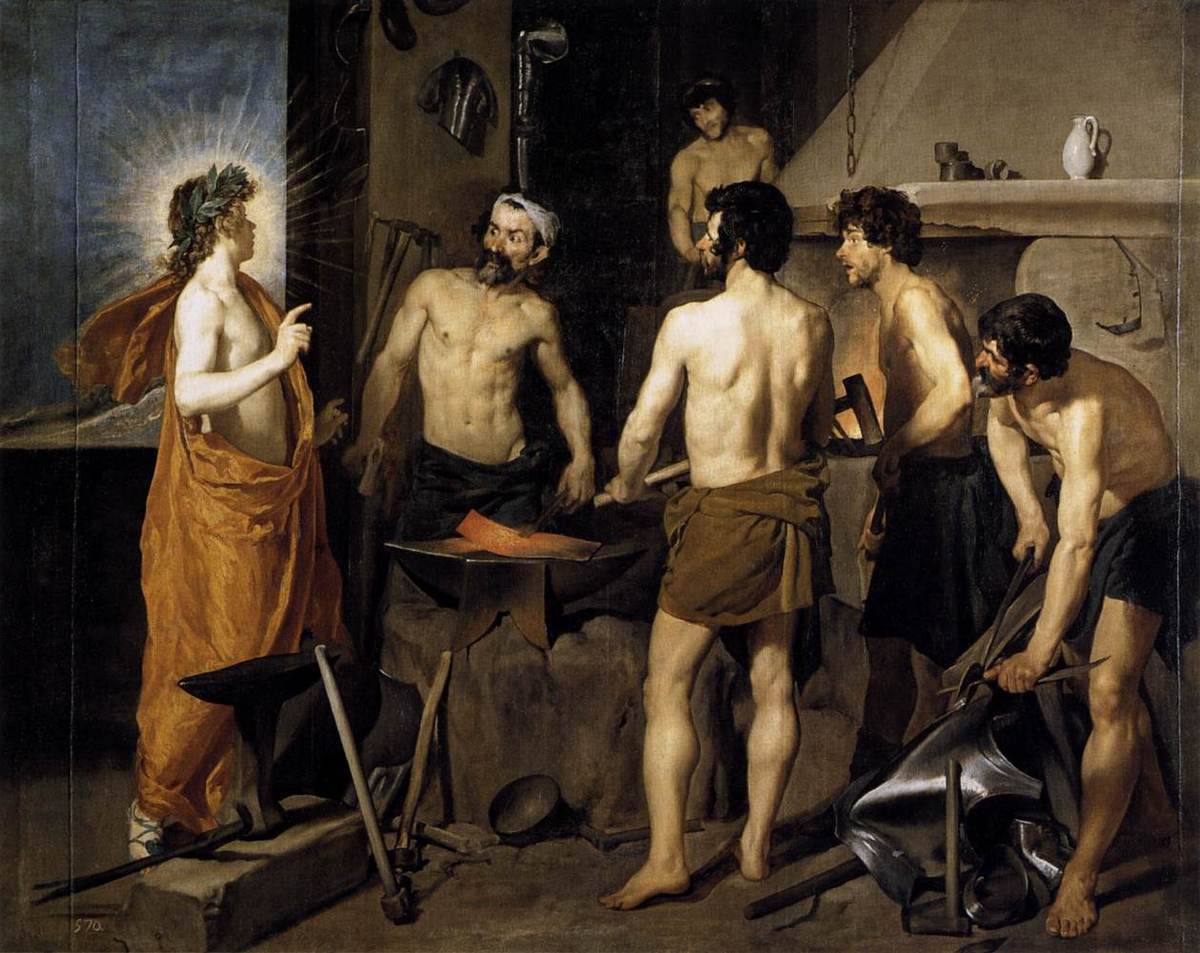
Hephaestus is the Greek god of the forge, fire, metalwork and patient craft. Rome called him Vulcan, the root of our word volcano. Among the tall Olympians, he alone walked with twisted feet and calloused palms. He is a consciousness that lives inside resistance, pressure and slow shaping. And Greece left an instrument of anvil, hammer, bellows and ocean cave to show how raw ore takes lasting form when heat works under measure.
How tool and ore shape each other
A workshop is never a dead bench where a single mind forces passive metal into shape. Tool, flame, air and ore answer each other at every blow.
In Meeting the Universe Halfway, Karen Barad examines the 1922 Stern-Gerlach experiment, where silver atoms flew through a magnetic beam onto a glass plate. At first the trace stayed invisible. The split showed clearly only after the researchers swapped a round metal slit for a rectangular one. Even then, the faint mark appeared only when Otto Stern breathed the sulfur smoke of a cheap cigar onto the plate, turning hidden silver into jet-black silver sulfide. As Barad writes, tools and materials are never inert pellets waiting for orders. Even iron responds to its air by rusting or holding bright, and every cut leaves lasting marks folded inside the form that endures.
That shaping follows three laws. In The Art of Egyptian High Alchemy, Tom Kenyon writes that every change needs three things: raw matter, a vessel to hold the heat, and energy to drive the reaction. Later, in his essay on steel and relationship, Kenyon adds a sharp truth. Once steel cools and leaves the foundry, it keeps its shape forever. To bend it again without breaking, you must return it to heat as fierce as the fire that formed it, guided by harmlessness.
Maia Nartoomid, in her transmission on the Lion-Headed Sun Lords, names that exact working zone. Those who walk the Path of Fire dwell between the flame and the lance, between the hammer and the anvil, where raw force is beaten into structure.
The fall to Lemnos, the golden throne and Achilles's shield
Three myths in Homer and Pausanias show what happens when Hephaestus is cast out, when he builds out of spite, and when he returns in peace to forge the world.
In the Iliad, Hephaestus was born crooked of foot and hurled down from Olympus. In one telling, ashamed Hera threw him out at birth. In another, angry Zeus caught him by the heel during a quarrel and flung him across the sky. All day he fell until he crashed onto volcanic Lemnos, half dead on the rocks. Two sea goddesses, Thetis and Eurynome, lifted him up. They hid him for nine years inside a cave under the roaring ocean. Beside the salt water and secret fire, nobody mocked his stride. There he hammered brooches, bracelets and cups for the nymphs. He learned every secret of ore and flame.
Years later, wounded pride turned his hands toward revenge. He forged a throne of shining gold and sent it up to Olympus as a gift for Hera. When his mother sat down, hidden chains snapped around her wrists and ankles, locking her fast. No god could break the lock, and Ares failed when he tried to drag the smith up by force. At last Dionysus rode down to the workshop, shared wine and laughter with Hephaestus, and led him up the mountain on a mule. Only then did the smith open the catch and set Hera free.
His greatest work came without bitterness. In Book 18 of the Iliad, Thetis walked into his smoky hall seeking armor for her son Achilles, who faced death at Troy. Hephaestus wiped the sweat from his brow with a sponge. He put away his tongs and limped out to greet the goddess who saved his life. Twenty bellows blew at his word. Golden maidens he had built from metal balanced his steps. Tripods rolled on golden wheels across the floor.
He threw bronze, tin, silver and gold into the melting pots. Upon one wide shield he hammered the whole world: earth, sky and sea, the sun, the full moon and all the stars of heaven. He shaped two cities in peace and war. He beat out plowed furrows, ripe vineyards, herds at the river and dancers round a potter's wheel. Along the outer rim he hammered the stream of Oceanus, holding the whole cosmos inside one round edge.
What the forge refuses
Two plain laws rise out of the smoke of Lemnos.
Heat without an anvil scatters into sparks, while an anvil without heat leaves metal brittle. Exile from easy Olympus forced Hephaestus down into pressure, where slow work turned crooked weakness into skill of the hands. What looks like a flaw in early motion often marks the exact spot where deep craft takes root.
The second law warns every builder. Craft steered by resentment builds golden traps. Both the chained throne for Hera and the fine bronze net around his bed worked like perfect machines, yet neither brought peace to their maker. Only when joy entered his shop with Dionysus did he drop spite and hammer a shield wide enough to hold earth and sky.
Reading the tools of the forge
Walk across the soot of the Lemnos workshop, and each iron tool answers one step in shaping ore.
The anvil is heavy iron weight bolted to the floor. It never jumps toward the hammer. It waits in one spot and takes every blow so hot metal has solid ground to push against.
The hammer carries rhythm and intent. Strike too softly and the blade stays dull. Strike wildly and the metal cracks. Rhythm turns heat into edge.
The bellows feed breath into buried coals. Even rich ore sits dark until air wakes the fire inside the bed.
Tongs keep safe distance between skin and hot iron. Craft respects heat instead of grabbing it bare-handed.
His self-moving tripods and golden maidens mark skill pushed to its outer edge, echoing machines that serve the shop without replacing the smith who guides the flame.
Asteroid Hephaestus, Saturn and the chart of vocation
Astronomers named asteroid 2212 Hephaestus in 1978. Modern astrologers trace his forge primarily through Saturn, Mars and the earth signs even without extra asteroids.
In a birth chart, Saturn is the anvil of weight, time and solid bone, while Mars brings the heat and strike of the hammer. When Mars touches Saturn in a chart, raw drive meets iron resistance. At first that contact feels like delay or heavy work, yet over years it forms builders who finish what others drop.
Look also to Taurus, Virgo and Capricorn, alongside the sixth and tenth houses. These places show how you handle tools, patient repair, daily discipline and lasting work that stands in daylight after the noise of youth fades.
At the anvil in the morning hour
Call on Hephaestus in a morning work hour when a task feels too rough to start, when patience wears thin, or when anger has tangled your craft.
Clear one square of wooden table or workbench. Set a plain stone, a piece of iron or a hand tool in front of you beside a coarse cloth rag.
Stand or sit with both soles planted flat on the floor. Look at the backs and insides of your hands, feeling the strength inside your fingers and wrists.
Name aloud the one real thing you are making or fixing today, and state what raw matter sits before you. Recall Kenyon's rule of harmlessness: ask whether your effort aims to build something whole, or to trap someone in scorekeeping. Drop any bitter edge before touching the tool.
Take three slow breaths, picturing the bellows waking low embers in your belly. Work on that single task for twenty minutes with even rhythm, without checking screens or rushing the end. Notice how the material answers your hand at every pass, as Barad reminds us: each cut shapes both the piece and the maker.
A smith never leaves coals roaring in an empty shop. Lay the tool squarely across the stone or wooden block. Rake an imaginary pinch of cold ash over the embers of your work, wipe the dust from your knuckles onto the rough rag, and step out of the room leaving the anvil silent until morning.
Questions people ask about Hephaestus
What is Hephaestus the god of?
Hephaestus is the Greek god of fire, blacksmiths, metalwork, sculpture, volcanoes and patient craft. Rome called him Vulcan.
Why was Hephaestus thrown off Mount Olympus?
Homer tells two versions in the Iliad. Either Hera cast him out at birth for his crooked feet, or Zeus flung him down to Lemnos during a quarrel. Both versions leave him sheltered by sea nymphs in an ocean cave.
What did Hephaestus build in Greek myth?
He forged thunderbolts for Zeus and winged sandals for Hermes. He also made invisible bronze chains, rolling golden tripods, golden maidens and the shield of Achilles.
Why did Dionysus bring Hephaestus back to Olympus?
Hephaestus trapped Hera on a golden throne out of spite, and Ares failed to force him back. Dionysus won the smith with wine and music so he returned in peace to free her.
How does Hephaestus show up in a birth chart?
His forge appears through Saturn, Mars-Saturn contacts, earth signs like Virgo and Capricorn, and the sixth and tenth houses of skill, craft and vocation.
The builder in the sea cave
Hephaestus is the patient fire, the craft that turns pressure and flaw into something built to last.
Career and Vocation maps Saturn, Mars, the tenth house and the structural strengths of your birth chart to show the real work your hands were built to forge.