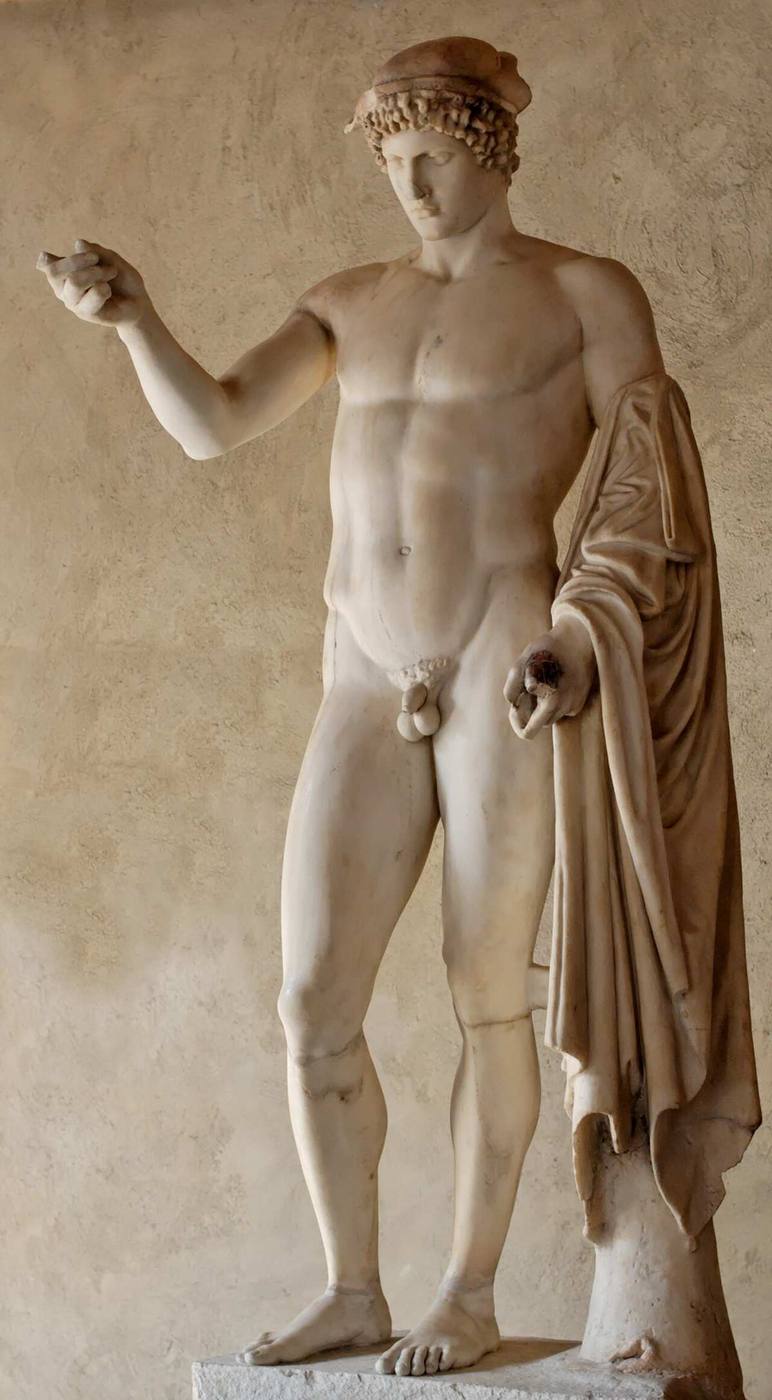
At the edge of an old Greek valley, where one town ended and strange ground began, travelers stacked loose rocks into a heap. No farmer owned that pile. No king taxed that patch of dirt. Each walker dropped a stone onto the cairn and stepped across the line.
Hermes is the Greek god of borders, roads, commerce, language, luck and the passage of souls. Rome knew him as Mercury. His name comes from herma, the stone heap set at the crossroads and the threshold of every house. Where two domains stand apart with an open gap between them, he is the consciousness that carries a signal across intact. Greece built stone pillars, winged rods, lyres and travel rites to meet him in order and ground his speed before it scattered.
The signal that crosses the gap
Picture two bells standing on opposite sides of a valley. Strike one, and the air carries a wave across the grass until the second bell hums. Nothing flew out of the brass except motion, yet both hills now share one event.
In 1989, John Archibald Wheeler argued that physical stuff, which he called it, arises from yes-or-no information, which he called bit. In her paper Is Bit It?, Jennifer L. Nielsen examines that claim closely. A binary bit is a coded signal sent across physical switches from one place to another, and no coded signal can outrun the speed of light. Quantum entanglement links particles outside ordinary signaling, yet no one can send a message through entanglement alone. Even to check the match, a signal must still cross the gap at or below light speed.
Even the planet Mercury proved that space bends around a crossing. In Now, Richard A. Muller tells how astronomers watched Mercury for fifty years and found a puzzle. Each time the planet swung closest to the sun, its oval path shifted forward. Newton's equations could not explain that drift. In 1915, Albert Einstein solved it without adding a single extra number. Gravity near the sun bends space and time, so Mercury traces a turning flower instead of a locked loop.
Greece gave that moving principle a voice and winged shoes. Hermes is the intelligence of exchange, translation and passage across every frontier where one state meets another.
Born at dawn and thief by dusk
This is the story told in the Homeric Hymn to Hermes, sung at festivals in Greece.
Zeus came in the dark to Maia, a nymph hidden inside a cave on Mount Cyllene. At dawn a boy was born. By noon he stepped out of his cradle. By dusk he had remade the sky's order.
Outside the cave he met a mountain tortoise chewing grass. The infant laughed and called it a luck-bringer. He scooped the shell hollow with a chisel, fit reeds along its rim, stretched oxhide across the belly, and strung seven sheep-gut cords. When he struck the strings with a horn pick, music rang across the hills like spring water.
As evening fell, hunger moved him again. He laid the lyre in his crib and slipped north to Pieria, where Apollo's cattle grazed. He picked fifty cows and drove them across the sand. To hide the trail, he braided wicker sandals backward beneath his feet and drove the herd in reverse. Every hoofprint pointed back toward the meadow while the beasts walked away.
By the river Alpheus he rubbed dry laurel until fire caught and killed two cows. He roasted the meat in twelve shares, one for every god, though he had no seat on Olympus yet. He hid the herd in a cave, swept the ashes into the river, and floated home before sunrise. Turning sideways like a breeze, he slipped through the keyhole and pulled the blankets up to his chin.
Maia warned him that Apollo would soon come with chains. The infant answered that he would not stay hidden without gifts or feasts. At sunrise Apollo stormed into the cave, hunting his herd. He searched every corner and found only a baby blinking in cloth. Hermes swore by Zeus's head that he had never seen a cow.
Apollo carried the infant before Zeus on Olympus. Zeus listened to the charge and the clever denials, then burst out laughing. He ordered the boy to lead his brother to the hidden cave. Beside the river, Apollo found the cowhides and flared with anger, until Hermes lifted the tortoise shell and swept his pick across seven strings.
Apollo stood still. Rage left his chest as the song told the birth of the gods. He swore no fifty cows could match that music. Right there in the pasture, Apollo traded the cattle and a golden rod for the lyre. He gave Hermes rule over barter, oaths and roads, and named him the one herald free to walk between earth, heaven and the house of the dead.
Homer kept him moving through later songs. In the Iliad, old King Priam creeps out of Troy at night to beg Achilles for his slain son Hector. Zeus sends Hermes to walk beside the wagon, put the sentries to sleep with his wand, and lift the bar of Achilles's gate. In the Odyssey, Hermes waves that rod to summon dead shades and guide them past the White Rock into Hades.
Why messages travel across a gap
Treat that hymn as a joke about a clever baby, and you miss its teeth. Two strict rules of exchange hide inside the cradle.
First, a message travels only across a gap. If two things fuse together, nothing moves between them. Hermes begins his life by turning a shell into a sounding box, then stretching strings across empty air. Exchange starts when one thing leaves your hand and crosses to another.
Second, insight often enters sideways when straight marches fail. Apollo marched forward along logic and saw tracks pointing back into his meadow. Hermes walked in reverse sandals and slipped through a keyhole like mist. A rigid mind searches only the road it already paved. Hermes finds the crack between locked doors.
Yet speed without weight burns off like steam. That is why every Hermes story sets a stone beside the sprint.
Twin serpents around one staff
To see how this force works inside a human body, look at the rod Apollo placed in his hand. The Greeks called it the kerykeion, and later ages called it the caduceus. Two serpents climb a central staff, crossing three times before facing each other below a pair of wings.
In his essay on relationship and alchemy, Tom Kenyon examines polarity through the union of Hermes and Aphrodite. He points to the Sacred Hermaphrodite, where solar and lunar faces join without erasing either pole. In yogic anatomy, two currents climb on either side of the spine. One is solar and outward, called pingala. The other is lunar and inward, called ida. Between them stands the open middle channel, sushumna. When both side currents balance around that center, perception opens into a wider octave.
Maia Nartoomid, writing from her Thoth transmissions, reads that same blueprint inside the caduceus. She describes the central staff as a golden pillar standing between paired polarities, solar red beside lunar blue, or matter beside antimatter. Two opposite currents coil upward and meet at nodes along one axis, never collapsing into sameness. The wings at the top open only after the crossing reaches balance.
In her card system called the Electrikum, Nartoomid pairs a state named Hermes Cloud with the Eye of Horus. Hermes Cloud works as an ascending triangle that joins mind and heart into a conductive field, while the Eye of Horus enters matter with sharp sight. Where thought and heart cross on one staff, a person stops arguing from one side of the room and hears the signal whole.
In Telepathy Starts This Month, Anne Tucker looks at the sky when Mercury goes direct and meets the North Node. Communication widens beyond spoken words into tone, image and direct knowing. Trying to force that gift with clenched eyes blocks the door like a watched pot. She teaches that open reception works when attention stays loose and present, listening the way you hear wind in leaves instead of grabbing for proof.
Cairn, tortoise shell and winged sandal
Look at a roadside statue of Hermes from the dirt to the brim of his hat, and each piece carries a single job.
Begin with the herma, the roadside cairn and square pillar set at doorways, borders and crossroads. A stone does not run. It marks the inch where home ends and foreign soil starts. Travelers dropped a pebble onto the pile before crossing a pass so the border stayed visible. Without stone, swift thought turns into scatter.
Rise to his talaria, the sandals winged at the ankles. Wings on the heels keep the step light enough to cross mud, riverbeds and guarded camps without sticking in one rut.
In his left hand rests the tortoise-shell lyre. Hollowed and strung, the shell turns friction into pitch. Every string pulls between two pegs at the right tightness. Too slack and it mutters. Too tight and it snaps. Language lives at that exact tension.
In his right hand he holds the caduceus, the herald's rod. No soldier raised a sword against a herald carrying that staff across a field. It declares safe passage between enemies so words cross before blood spills.
Above his brow sits the petasos, a felt hat that shades the eyes from glare on high roads. It shields the watcher crossing the noon plains.
In the Odyssey, Hermes pulls one more tool from dark earth before Odysseus enters Circe's house. He digs up moly, a plant with a white flower and black root. Its blossom shines in air while its root grips deep dirt, keeping a traveler's mind intact against spells. Around his altars stand the ram, rooster and hawk: pathfinder, dawn caller and sky watcher.
Crossroads, Apollo and the triple sage
No Greek god worked alone, and Hermes shows his true edge beside his neighbors.
In her essays on Greek sanctuaries, Sorita d'Este notes that Hermes and Hecate stand side by side across Greek religion without becoming lovers or spouses. Both guard doors, borders, roads and the crossing of souls. Hecate stands still at the three-way fork holding a pine torch so you see the turn. Hermes steps off the sill and walks the road between towns. One guards the hinge. The other carries the letter across the ridge.
Beside Apollo, Hermes forms the other half of mind. Apollo stands back in high sun to see exact form and speak prophecy from a fixed tripod. Hermes climbs down into the market, hears slang, trades coin, sings on gut strings and slips unseen through palace gates. Without Apollo's distance, Hermes turns into rumor and cheap tricks. Without Hermes's road craft, Apollo freezes into cold pride.
When Greek scholars settled in Alexandria in Egypt, they met the ibis god Thoth, lord of measure, writing and the scales of truth. They saw the same intelligence in a second coat and gave him one title: Hermes Trismegistus, Thrice-Greatest Hermes. Out of that meeting grew the Hermetic texts, where mind, word and cosmos answer one another like upper and lower notes on one lyre.
How the messenger moves in the sky
Astrologers look to the planet Mercury to trace Hermes in a birth chart. Orbiting closest to the Sun in eighty-eight days, Mercury never strays more than twenty-eight degrees from solar light.
Watch where Mercury stands beside your Sun. When Mercury rises ahead of the Sun before dawn, sky watchers saw a scout walking in front of light. People born under that morning phase often think aloud, test ideas early and speak before a room settles. When Mercury trails behind the Sun after sunset, it turns into an evening herald that gathers what the day left behind, weighing patterns in silence before speaking.
Three times a year, Mercury appears to slow, pause and walk backward against the stars from our view on Earth. Astrologers call this Mercury retrograde. Like the infant god wearing wicker sandals turned heel-to-toe, retrograde motion scrambles straight highways so missed letters and half-finished bargains return for review.
Mercury rules two signs in astrology, Gemini and Virgo. In Gemini, Hermes gathers voices, compares news across a street and weaves links between strangers. In Virgo, he kneels beside the grain bench, sorting the seed from the chaff and mending tools with patient craft. His third house governs daily speech, short trips and neighbors. His ninth house opposite explores distant lands, foreign tongues and wide maps.
Watch the lines between Mercury and slower planets. Mercury beside Saturn sets a stone cairn beside swift thought, giving words weight and memory. Mercury beside Uranus turns the herald into lightning, carrying leaps of code and invention. Mercury beside Neptune dips the staff into dream water, lending voice to music and deep intuition, so long as facts keep one foot on stone. Mercury beside Pluto refuses small talk and walks down the White Rock road into hidden truth.
Leaving a stone at the crossroads table
Approach Hermes when a message must cross a hard border, when two sides of your mind refuse to speak, or when your days feel sealed inside stale air. Leave crooked bargains and clever tricks outside the door. The god of oaths catches slick schemes in his own net.
Choose his hour. Wednesday belongs to Mercury, and the thin hour of dawn or twilight holds his seam between worlds.
Clear a flat stone or wooden table near a doorway or open window. Lay two contrasting things side by side, such as a black pebble and a white shell, or a copper coin and blank paper. Set a straight twig or brass pen between them. That stick stands for the central staff of the caduceus, holding the gap open without letting either side swallow the other.
Sit upright with your ankles relaxed and your feet braced evenly apart. Rest your hands on your thighs. Notice quick thoughts rushing back and forth like traders shouting across a square. Follow Anne Tucker's cue of loose listening. Watch each thought arrive at one ear and walk out the other, like walkers passing a roadside cairn.
Bring one real question to the table. Name two divided things in your life, or one truth you must carry from silence into speech. Ask to see the hidden track between them, even if it runs sideways. Wait three slow minutes without touching your phone. Notice what image or simple errand rises on its own.
Speak one plain sentence aloud into the room, naming your next step. Words spoken into air cross from private fog into real space.
Hermes scatters like wind if his road has no end stone. Write one plain action on the paper, fold it once like a road map, and set a small river stone on top as your roadside cairn. Slip your shoes back on, open the front door to fresh air, and walk out to finish the errand you named.
Questions people ask about Hermes
What is Hermes the god of?
Hermes is the Greek god of borders, roads, travelers, commerce, language, thieves, craft and the guiding of dead souls. Rome named him Mercury. He governs every crossing where goods, words or people move safely from one domain into another.
What is the meaning of Hermes's caduceus?
The caduceus is the herald's staff wound with two facing serpents and topped with wings. It marks safe passage across battle lines and borders. In inner traditions, the central staff holds balance between solar and lunar currents so opposite forces communicate without destroying one another.
How did Hermes invent the lyre and steal Apollo's cattle?
In the Homeric Hymn to Hermes, the newborn god hollowed a tortoise shell at noon and strung seven cords across it to make the first lyre. At dusk he stole fifty of Apollo's cattle and drove them backward in woven sandals, then won peace by trading the lyre for the golden herald's rod.
Why is Hermes connected to Thoth?
When Greeks built Alexandria in Egypt, scholars saw their swift god of speech and crossings reflected in Egypt's ibis god Thoth, lord of writing and measure. They joined the two names as Hermes Trismegistus, Thrice-Greatest Hermes, around whom the Hermetic writings grew.
How does Hermes show up in a birth chart?
Hermes speaks through the planet Mercury, its signs Gemini and Virgo, and its links to other planets. Watching whether Mercury rises ahead of the Sun at dawn or trails after sunset shows how a mind gathers news, speaks across rooms and crosses borders in daily life.
The stone at the border
Hermes is the cairn beside the gate and the living wire across the gap, teaching swift mind how to cross safely and land on solid ground.
Where in the World maps where each planet in your chart falls across the Earth, showing which roads open your voice and where your steps find firm stone.