Drop a stone into a still pond, and water climbs only as high as the stone sank. Hang two weights on a beam, and neither arm stays up for long when the heavier side drops. Every motion in nature keeps a ledger.
Nemesis is the ancient Greek goddess of proportion, due allotment and moral balance. Her name comes from the verb nemein, meaning to deal out what belongs. Later poets called her Adrasteia, she whom no one outruns, and Rome paired her with Invidia. She is a consciousness of symmetry that corrects excess without spite. Her measuring cubit, her bridle and her clear spring form a technology for catching overreach early before pride tips the scale.
Why conservation needs no angry judge
Modern ears hear the word nemesis and picture an angry rival waiting in the dark with a knife. Physics knows a different law.
In Now: The Physics of Time, physicist Richard A. Muller explains why energy stays balanced across the cosmos. Nobody stands over atoms with a stick counting the total. In 1918, Emmy Noether proved that this law comes straight from time symmetry. The laws of physics stay the same yesterday, today and tomorrow. Because they do not shift with time, energy cannot appear from thin air or vanish into nothing. What goes into one side leaves an exact count on the other.
Psychiatrist Iain McGilchrist ties this balance to Greek drama in The Matter With Things. Hubris is the false dream that a person stands above measure. Carved into stone at Delphi stood the rule meden agan, meaning nothing in excess. Push any drive too far past its mark, McGilchrist writes, and it flips fast into ruin.
Spiritual teachers speak of the same mirror. In Energies From Now to Solstice, Anne Tucker pauses over the word retribution. Tracing its root to the word tribute, she explains that return is an accurate receipt for what a soul has built and carried, coming from order itself when a petty judge is absent.
Tom Kenyon and the Hathors add two warnings along this line. In The Spiral of Ascension, Kenyon notes that rising into new order always meets a natural counterforce of entropy that tests what is real. In Thoughts and Observations, he reminds seekers that logic is an ally to awareness, and in The Way of the White Cloud he warns that nursing personal revenge poisons the person who holds it.
Greece named that automatic balance Nemesis.
The marble block, the white cloak and the pool
Three old accounts from Hesiod, Pausanias and Ovid show how Nemesis works in heaven, war and pride.
In Hesiod's Theogony, primordial Night, called Nyx, gave birth to Nemesis alone, beside Sleep, Death and the Fates. Later in Works and Days, Hesiod sang of the iron age when oath-breakers thrive and cruelty laughs at honor. In that hour, he warned, Nemesis and Aidos veil their faces in white cloaks. They leave earth for heaven, and mortals lose their shield against folly.
Centuries later, in 490 BCE, a Persian army landed at Marathon to crush Athens. So sure were their captains of victory that they carried a huge block of white Parian marble aboard ship, ready to carve a trophy on Greek soil.
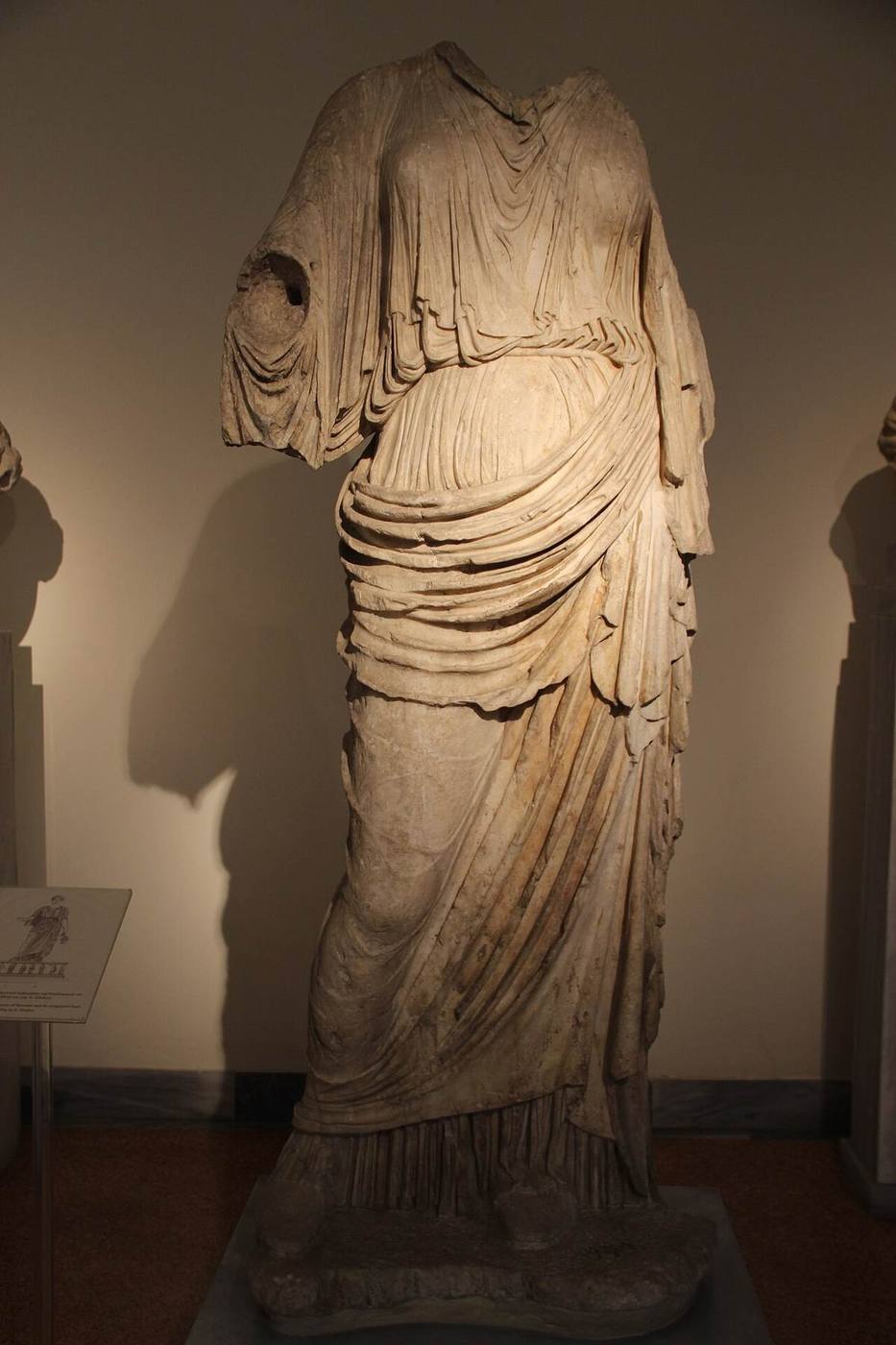
The outnumbered Athenians broke the Persian line and drove them back to sea. Left behind on the shore lay that untouched stone. Instead of smashing it, the Greeks hauled the marble north to Rhamnous. There, the sculptor Agoracritus, from the school of Phidias, carved the Persians' own trophy stone into a tall statue of Nemesis. In one hand she held an apple branch. In the other she held a bowl.
Ovid tells a third story in his Metamorphoses. Young Narcissus possessed rare beauty, yet mocked every suitor who approached him, leaving Echo wasting to a voice in the rocks. One broken suitor lifted hands to the sky and asked Nemesis for fairness.
Nemesis sent no lightning bolt and drew no sword. She simply led Narcissus through still woods until thirst brought him to an untouched spring where no bird or branch disturbed the surface. Narcissus knelt to drink. Looking down, he saw his own face staring back from the water. Captivated by his own image, he could neither eat nor step back from the bank until his body faded away into a flower beside the water.
How excess carves its own stone
Look closely at the Persian stone and the spring, and two strict laws emerge.
First, excess supplies the raw stone of its own correction. Athens never quarried marble to mock Persia. Persia hauled the stone across the sea, and Nemesis simply finished what pride began. When someone pushes past true capacity, the overreach builds its own counterweight.
Second, Nemesis rarely invents an outside torture. She hands an inflated ego an unblinking mirror. Narcissus drowned in his own gaze because he refused to meet another living face. Balance returns the instant reality reflects back exactly what stands before it.
Cubit, bridle and the apple branch
Each object placed in Nemesis's hands works like a piece of one measuring tool.
Start with the cubit rule held against her forearm. A cubit measures exact length from elbow to fingertip. It checks wild promises against real buildable size before work breaks down.
Next hangs a leather horse bridle and bit. A bridle never destroys a horse's speed. It turns raw gallop back into steering so rider and beast arrive alive.
Beside her skirt spins a wheel, marking the turn of fortune. What climbs to the top row eventually rides down the other side, keeping every high seat humble.
Wings grow at her shoulders or heels because correction moves swiftly once measure breaks. At her side walks a griffin, half lion and half eagle, guarding gold against greedy hands. And in her hand at Rhamnous sits an apple branch, reminding mortals that true proportion yields sweet fruit instead of ruin.
Mother Night and the spirit of shame
Nemesis belongs to a tight family circuit carved before Olympus ruled.
Her mother is Nyx, the dark canvas that holds stars without crowding them. Her sisters are the Moirai, who spin and cut each thread of time, while Hypnos and Thanatos govern sleep and death. None of them chases bribes or applause.
Her closest partner on earth is Aidos, the inner sense of reverence and shame that warns a person before stepping over a line. As Hesiod warned, Aidos prevents damage from the inside. When Aidos falls silent, Nemesis arrives from the outside to restore the ledger.
Where the scales tip in the sky
Ancient Greece linked Nemesis to the turning wheel of fate, never to one bright planet. Later astrologers map her ledger through Saturn, Libra and the Lunar Nodes, along with two modern discoveries: Pluto, found in 1930, and asteroid 128 Nemesis, spotted between Mars and Jupiter in 1872.
Look first to Saturn, keeper of time, weight and due return. Wherever Saturn aspects the Sun, Moon or Ascendant, shortcuts break and lasting craft holds.
Libra carries her balance beam across the zodiac, flanked by two real stars in the sky: Zubenelgenubi and Zubeneschamali, the Southern and Northern Scales. The Lunar Nodes mark where past debts ripen and new responsibility begins. When Pluto presses on Saturn or Libra, hidden accounts surface for plain settlement.
How to sit before Nemesis's mirror
Step up to Nemesis's table when pride, unfair debt or an urge for payback clouds your sight. Meet her to restore exact proportion in your own house, and never to wish harm upon a neighbor.
Wait until twilight, when daytime heat cools. Place a straight wooden ruler or measuring tape and one clear glass of water on a flat table. Sit upright with both feet planted squarely on the floor.
Hold the wooden ruler across both hands. Name aloud one place where you stretched past real limits out of pride, or one place where you waited for someone else to pay a bill you owe yourself. Measure that claim against your actual time and strength, just as the cubit tests timber.
Look down into the still surface of the water glass as Narcissus looked into the spring, without blinking away. Acknowledge what is true without blaming anyone else or spinning excuses. Remember Anne Tucker's reminder that retribution is simply a receipt, and let go of any urge to punish another person.
Finish by returning the scale to zero. Set the wooden ruler straight and level across the table, aligned with the wood edge before you. Lift the glass and drink the water so the ledger enters your own frame instead of sitting on display. Put away any mirror in the room, stand up, and carry out one fair act or repair in daylight before sleep.
Questions people ask about Nemesis
Who was Nemesis in Greek mythology?
Nemesis was the ancient Greek goddess of due measure, fairness and balance against hubris. Born from Nyx, the primordial night, she ensured that pride and unchecked luck returned to proportion.
Why was Nemesis carved from Persian marble at Rhamnous?
In 490 BCE, invading Persians sailed to Marathon carrying Parian marble to carve a victory monument. After losing the battle, they left it behind, and the Greeks carved Nemesis from that exact stone.
What did Nemesis do to Narcissus?
When proud Narcissus scorned those who loved him, Nemesis guided him to a clear forest spring. Seeing his own reflection, he fell in love with himself and stayed by the pool until he wasted away.
What are the symbols of Nemesis?
Artists gave her a measuring cubit rule, a horse bridle, a turning wheel, wings, scales, an apple branch and a griffin. Together they represent exact measure, restraint and swift return to balance.
How does Nemesis connect to astrology?
Modern astrologers associate Nemesis with Saturn, the sign Libra, the Lunar Nodes, Pluto and asteroid 128 Nemesis, tracing where excess returns to weight and fair measure.
The weight on the beam
Nemesis is the exact law of proportion that turns every excess back toward truth.