Push a wheat grain under frozen earth, and to any stranger walking past the field looks empty. Below the frost, the root holds next year's harvest intact inside dark clay. Life has folded itself out of sight to wait for spring.
Persephone is the Greek goddess of spring growth and Queen of the Dead. Rome called her Proserpina. Poets first named her Kore, the Maiden, and later honored her as Despoina, the Mistress. She is the consciousness that descends into dark ground when an old shape ends, holds its pattern intact through winter, and rises again with its own authority. Greece built the Mysteries of Eleusis around her path as a technology for crossing loss and return.
How a folded form returns
Drop a spoonful of ink into a jar of water and stir once. The dark cloud spreads thin until it looks gone forever. No spoon can scoop that ink back into one bead.
Physicists know a stranger trick. In his book Wholeness and the Implicate Order, David Bohm describes a machine built from two glass cylinders with thick glycerin poured between them. Place a drop of dark ink inside the clear glycerin and turn the outer glass slowly. The droplet stretches into a thin thread until it disappears completely from sight. To your eyes, the ink is gone. Then turn the glass handle backward the same number of turns. The invisible thread gathers back together and pops into sight as one sharp drop again.
Bohm uses that experiment to show two layers of reality. What stands visible in sunlight is the unfolded order. What sinks out of sight into the dark ground is the folded order. Nothing vanishes when it folds out of view.
Later in that same book, Bohm turns to a plant seed. A great oak grows out of an acorn, yet the acorn holds almost none of the wood, water or sunlight that makes the tree. The soil, air and rain supply the mass. What the seed carries is folded information that directs dirt and water to build an oak.
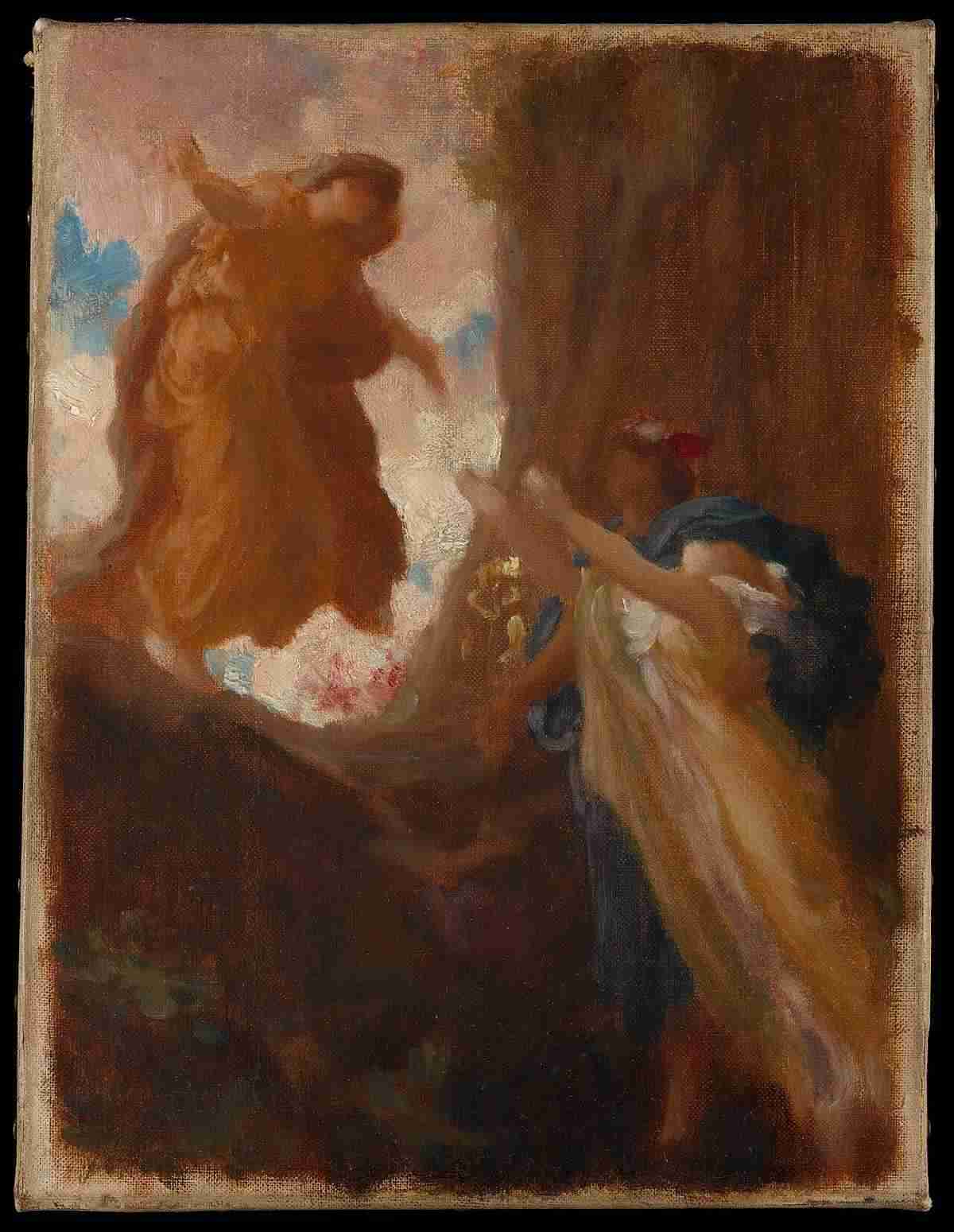
Greece told that law of physics and folded life as a girl picking flowers in a meadow before the earth split beneath her feet.
The meadow, the seed and the winter throne
This is the story preserved in the Homeric Hymn to Demeter, chanted at Eleusis beside the sea.
Kore, daughter of Zeus and the grain goddess Demeter, ran barefoot across the Nysian meadow with daughters of Ocean. Together they gathered roses, crocuses, sweet violets, irises and hyacinths in soft grass. A step ahead of her friends shone a marvel she had never seen. Gaia, the earth herself, had grown a single narcissus with a hundred blossoms on one stem. Its fragrance made the wide sky and salt sea laugh.
Kore reached out both hands to pluck the bright flower. At her touch, the meadow cracked open like a split jar. Up through the chasm thundered Hades, lord of the dead, driving black horses before a golden chariot. He caught the girl around the waist and plunged back down into the dark earth.
Kore screamed to Zeus and the open sky as the horses sank below rock. No Olympian answered. Only Hecate, waiting inside her cool cavern, heard the cry echo past stone. High above in the sun chariot, Helios saw the deed, yet kept driving across noon.
When Demeter heard the echo, grief tore through her. She ripped the veil from her hair and threw a dark cloak over her shoulders. For nine days she flew over land and sea holding blazing torches. She ate no bread, drank no nectar, and washed no dust from her skin. On the tenth morning Hecate stepped from her cave with twin lamps. Together they marched up to Helios, who named Hades as the taker by Zeus's leave.
Demeter turned her back on Olympus in rage. Disguised as an old woman, she walked down to Eleusis and sat by the Maiden's Well beneath an olive tree. There she entered King Celeus's house to nurse his infant son Demophon. Each night she laid the boy inside hearth embers to burn away mortal weakness, until his mother screamed and broke the work.
Then Demeter built her temple at Eleusis and shut up every seed in the earth. No barley sprouted. Oxen dragged plows across empty ridges in vain. Hunger swept the valleys, and altar smoke stopped rising to Olympus. Zeus saw that mortals would starve and gods would lose every feast.
He sent swift Hermes down the steep road into the house of Hades to bring Kore home. Hermes found Hades sitting beside the girl, who longed for her mother. Hearing Zeus's order, Hades smiled and told Persephone to go back in peace to the light.
Yet just before she climbed into Hermes's chariot, Hades placed crimson pomegranate seeds in her mouth. She swallowed them without seeing the snare.
Hermes drove the horses upward through rock and shadow until he set Persephone down before Demeter's temple at Eleusis. Mother and daughter ran together like birds greeting dawn. Then Demeter stopped and asked if Persephone had tasted any food below. Persephone told the truth. By tasting the seed of the underworld, she had bound herself to its law.
Zeus sealed the truce that still turns the year. For one third of every year, when fields lie under frost, Persephone descends to sit beside Hades as Queen of the Dead. For two thirds of the year, when blossoms break open, she climbs back into sunlight to walk beside Demeter. Before leaving Eleusis, Demeter taught the princes of the town her secret rites, showing how grief and grain share one wheel.
What the frost wakes underground
A hasty listener hears only an abduction in a meadow. Look beneath the soil, and two plain rules stand clear.
First, nothing bears fruit until it enters the dark. A seed kept in a bright jar on a pantry shelf stays unchanged for years. Only when dirt covers it and frost cracks its coat does the folded tree inside begin to move. Kore could play in the meadow forever without gaining weight or sight. Her descent strips away borrowed ease so her own power wakes underground.
Second, once consciousness tastes truth below the surface, naive innocence never returns. The pomegranate seeds mark an irreversible step. You can climb back into spring sunlight, yet you never walk as Kore again. You walk as Despoina, the Queen who holds citizenship in both rooms. What looks like loss from above is the root system anchoring the crown.
Stillness inside the winter chamber
Teachers of consciousness point directly to this winter pause when speaking of deep change.
Anne Tucker writes in Timing of the Next BIG Events about why human beings fear endings and rush past them. Most people jump straight from one job, home or chapter into the next without stopping between them. When you leap without a pause, you carry yesterday's habits forward and build tomorrow out of old baggage. Consciousness needs a zero interval of stillness, a dark room where old plans are set down before any new seed sprouts.
Lee Carroll, channeling Kryon, traces the same law on a planetary scale. In his talks on the turning of the equinox cycle, he warns that humanity carries old seeds of past failures in its memory. Because people expect tomorrow to look like yesterday's winter, fear keeps replaying old wars and ruins. Only when the old wheel stops spinning can a new season grow from fresh ground.
In Sessions One and Fourteen of The Law of One, Carla Rueckert recorded a view of cycle endings built on that same farm image of harvest. In those pages, harvest is never an angry judge tossing grain into fire. It is the natural sorting of souls after seventy-five thousand years of growth in sunlight and shadow, measured by how clearly the inner violet light has ripened. Winter and harvest are the same measure seen from opposite ends of the stem.
Sound researcher Tom Kenyon speaks of shamanic descent into the underworld in his teaching on gathering scattered vitality. Going down into the dark chamber is not exile. It is the work of collecting pieces of power left behind in fear, then weighing the heart in stillness until what is heavy falls away.
Narcissus, pomegranate and cut wheat
Each sign in Persephone's hands and temple marks one stage of the crossing from bloom to seed and back. Read them in order.
Begin with the hundred-headed narcissus. That flower smells sweet enough to drug the whole sky, yet its name shares a root with numbness and deep sleep. Life often sets a bright lure right at the edge of an old season so curiosity pulls your hand past safety.
Next comes the golden chariot and black horses. Descent rarely arrives as a polite knock on the porch. It cracks the sod beneath your boots and moves faster than a plan can argue.
At the hinge sits the crimson pomegranate. Cut a pomegranate open and hundreds of ruby seeds shine packed inside white chambers, held under one tough skin. One bite holds both sweetness and binding law. In Greek funerals and weddings alike, the pomegranate stood for life folded inside death, and oath bound to return.
Beside the throne in Eleusis shines the pine torch. Hecate and Demeter carry torches through the dark, and initiates marched down the Sacred Way from Athens holding fire into night. Light underground does not replace darkness. It lets you walk through dark earth without stumbling into ditches.
At the climax of the Mysteries inside the dark hall of Eleusis, priests held up no statue of gold. Without a word, they raised a single cut ear of wheat in silence. A cut stalk looks finished. Yet every grain on that head is a folded spring waiting for soil.
Around her shrines stand the screech owl, the rooster and the cypress tree. Ascalaphus was turned into a screech owl for watching her eat the seed, reminding initiates that dark halls keep watchful eyes. The rooster greets light rising out of darkness. The tall cypress grows dark green beside graves and springs, pointing straight between root and sky.
Daughter, queen and torchbearer
Persephone never stands alone in Greek myth. She forms a living circuit with three figures around her.
Beside Demeter, she is the green shoot rising out of the mother's care and grief. When Demeter withholds grain, the earth proves that sorrow has real weight and will stop false harvests until truth is answered.
Beside Hades, she is no weeping prisoner. Excavations at Locri in southern Italy uncovered clay plaques showing Persephone sitting calm and crowned beside Hades on a twin throne, holding wheat stalks and a rooster while mortals bring gifts to her court. The Greeks rarely feared Hades alone when they knelt in mystery shrines. They honored Persephone as the merciful Queen who knows how warm blood feels and guides newly arrived shades safely through the dark.
Sorita d'Este, a historian of Greek sanctuaries, notes how Hecate completes the bridge between Hades and Persephone. Hecate heard the first scream when all Olympus looked away, walked with Demeter to Helios, and stayed at Persephone's side as guide along the border road. Between mother above and lord below, Hecate holds the lantern at the door so the annual crossing stays whole.
Where the equinox turns in the sky
Ancient Greeks tracked Persephone through the turning of the seasons instead of through distant planets. In modern astronomy, telescopes track asteroid 399 Persephone, discovered in 1895, moving between Mars and Jupiter, while Pluto was spotted in 1930. Modern astrologers trace Persephone's cycle across four patterns in a birth chart.
Look first to the seasonal hinges of the zodiac, the zero degrees of Aries, Cancer, Libra and Capricorn. In March, the Spring Equinox marks Persephone stepping back onto warm grass. In September, the Autumn Equinox marks her turn toward winter soil and the Eleusinian march. Planets sitting near those cardinal zero degrees often carry lives that turn sharply at public hinges of history.
Watch next for strong links between the Moon and Pluto in a natal chart. The Moon governs memory, body rhythm and the mother's hearth. Pluto rules Hades's vault, hidden roots and irreversible change. When the Moon meets Pluto by tight angle, a person learns early that comfort cannot shield them from deep water, and slowly grows into a calm guide for others crossing grief or loss.
Check planets placed in the fourth house of roots and ancestors, and the eighth house of endings, shared wealth and descent. Those rooms show where life pulls you underground to strip off borrowed skin before returning with real authority.
Look also to Secondary Progressions, a timing art where each day after birth unfolds as one symbolic year of life. As the progressed Moon moves through its eight phases and planets slowly change signs over decades, Persephone's seasons play out inside a single lifetime, marking years of winter folding and springs of sudden bloom.
Covering the winter seed in Persephone's bowl
Step down to the winter bowl when an old season has clearly ended, when frost has touched what used to bloom effortlessly, or when you must step into dark ground to retrieve strength without rushing past grief. Her law honors real timing and refuses forced blossoms out of frozen dirt.
Choose her hinge hours. Dusk, the dark of winter, or the week of the Autumn and Spring Equinoxes hold her sharpest doors.
Set a clay bowl of dark soil on a table or porch step beside a candle. Place three whole seeds beside the bowl, such as pomegranate seeds, wheat berries or pumpkin seeds. Light the candle as dusk falls so a warm flame sits beside cold earth.
Sit with your spine tall and hands open in your lap. Recall Bohm's glycerin jar. What feels lost in your life right now may only be folded out of sight into winter. Let your breath drop low into your ribs until rushing thoughts slow down. Follow Anne Tucker's counsel on the pause between chapters. Refuse for five minutes to plan next spring or patch yesterday's meadow. Rest inside the dark chamber without demanding instant light.
Bring one plain loss or ended season to the bowl of soil. Speak its name once, marking that the meadow days of that chapter are over. Ask one question into the flame: what seed inside this ending am I meant to keep and carry forward? Wait three minutes while looking into the candle or dark earth. Notice what firm fact stays when panic clears.
Press your fingers into the soil and bury the three seeds just under the surface. A seed buried in trust is not lost. It is placed in the keeping of winter.
Finish by covering the winter seed safely in its clay bed. Smooth dark soil gently over the three seeds with your fingertips so they rest tucked away from glare. Snuff the candle flame, set the bowl in a cool corner out of direct sun, eat one bite of bread or seasonal fruit, and return to daylight chores while winter keeps the seed.
Questions people ask about Persephone
What is Persephone the goddess of?
Persephone is the Greek goddess of spring vegetation and Queen of the Underworld, known to the Romans as Proserpina. She governs the turning of seasons, grain sprouting from dark soil, and the safe passage of souls between death and renewal.
Why did Persephone have to stay in the underworld?
In the Homeric Hymn to Demeter, Hades gave Persephone sweet pomegranate seeds to eat just before Hermes led her upward. Because she tasted food inside the house of the dead, ancient law bound her to return below for one third of every year while spending two thirds above with Demeter.
What did the pomegranate symbolize in Persephone's myth?
The pomegranate holds hundreds of red seeds packed inside one hard rind, linking life folded inside a sealed coat with death and rebirth. Eating its seeds sealed Persephone's dual rule as both maiden of spring blossoms and crowned Queen of the Dead.
Why was Persephone worshipped at Eleusis?
At Eleusis near Athens, Greeks kept annual Mysteries honoring Demeter and Persephone for nearly two thousand years. Initiates walked the Sacred Way, fasted, drank barley kykeon and beheld a cut ear of wheat in silence, learning that life and death turn together like seed and harvest.
How does Persephone appear in an astrology chart?
Persephone moves through Moon and Pluto contacts, fourth and eighth house placements, the Equinox degrees and asteroid 399 Persephone. She also speaks through Secondary Progressions, which track how inner seasons fold inward and bloom anew across the years of a life.
The seed that knows both worlds
Persephone is the pomegranate seed carried through winter dark and the green shoot breaking frost, teaching consciousness how to descend whole and rise wearing a crown.
Secondary Progressions traces those unfolding years in your own chart, showing which inner season is folding down into root and which part of you is ready to break soil into spring.