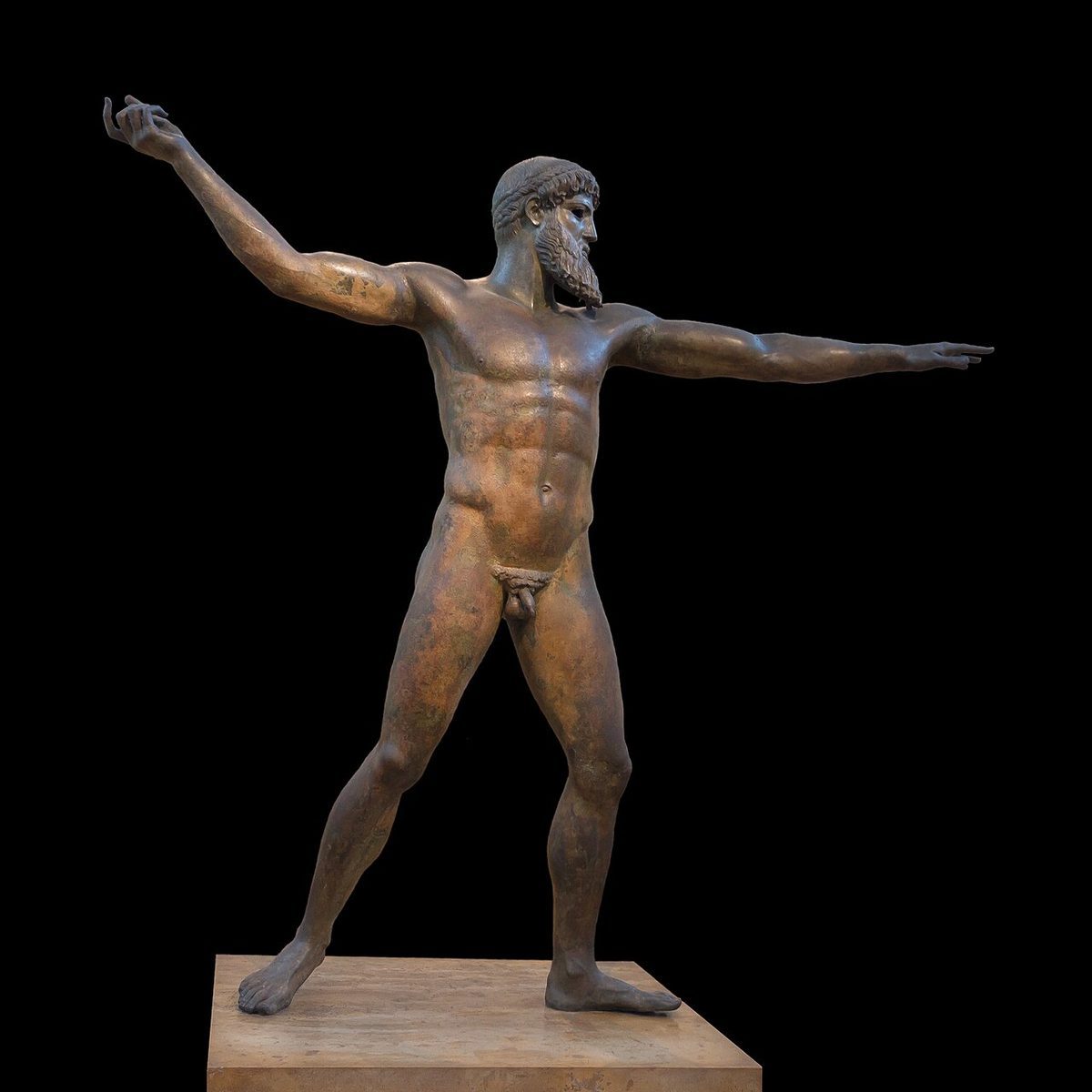
Stand on a limestone cliff above the Aegean Sea and feel the ground hum under your boots. Deep basins under the stone hold more pressure than any river on the surface. When rock shifts or wind crosses open water, that hidden pressure travels in waves from shore to shore.
Poseidon is the god of the sea, earthquakes and horses in ancient Greece. Rome called him Neptune. Bronze Age tablets at Pylos and Knossos name him Po-se-da-o, Earth-Shaker and Earth-Holder, long before later poets narrowed him to ocean storms. He is a consciousness of fluid pressure moving through stone, water and the human field. Greece built coastal temples, bull offerings and sea crossings to meet his resonance.
How waves move through stone and water
Watch an ocean swell roll toward a pier. A buoy bobs up and down as the crest passes, yet it stays in the same place.
Physics explains why. In The Order of Time, Carlo Rovelli notes that a wave is a motion of water while the water itself changes at every moment. The pattern crosses miles of sea, even when the drops stay local.
The Hathors, speaking through Tom Kenyon, bring that physics into the body. In Gaia's Song, they call the human body a standing wave of light and matter forged from Earth's elements. Because our fields sit nested inside the Earth's larger field, pressure along tectonic fault lines touches us as well. In Tectonic Pressure along the Ring of Fire, they describe how rising tension along earth plates opens cracks between worlds and creates fissures in the subtle field. In their teaching on the Holon, they explain that resisting waves of change brings exhaustion, while letting those waves move through brings stability.
Marina Jacobi adds the physical link down to water itself. In her teaching, water acts as the conductor that carries signal across a field from one state to the next.
Anne Tucker tells how Poseidon entered her waking life when she tried too hard to force answers. She saw Poseidon in meditation holding his trident, and later holding a conch shell. Both times, she walked outside that same day and met a giant painting and a ten-foot statue of him with those exact emblems. She recognized that straining to prove things blocked her flow, and she links Poseidon and Neptune to the birth of a new reality.
That is Poseidon. He is deep pressure that breaks stone when trapped and carries a ship when given passage.
The helmet lots, the Acropolis and the winged horse
This is the story preserved by Homer, Hesiod and the sanctuaries of Athens.
Cronus swallowed his children as each one was born. When Zeus freed his brothers, the three drew lots inside a bronze helmet to divide the rule of the world. Zeus drew the bright sky. Hades drew the underworld beneath the shadows. Poseidon drew the gray sea, while the earth and Mount Olympus remained common ground to all three.
When Athens needed a guardian, Poseidon climbed the Acropolis rock beside Athena. Each god struck the hill to offer a gift. Poseidon drove his trident into the limestone, and a spring of salt water burst up through the rock. Athena touched the soil and raised an olive tree. The gods and citizens judged the olive tree richer for oil, food and peace, and named the city for Athena. Poseidon flooded the plain in anger, yet the mark of his trident and the salt spring stayed inside the temple court on the hill.
Years later, Odysseus blinded the Cyclops Polyphemus, who was Poseidon's son. The sea god answered with storm after storm across ten years of sailing. He smashed ships and raised walls of black water until Odysseus clung alone to a splinter of wood. Peace returned only after the wanderer yielded to the deep and carried an oar far inland, where people knew nothing of salt or ships.
Yet Poseidon's force also birthed flight. After Medusa fell by the sword, out of her severed neck sprang Pegasus, the horse with wings, conceived by Poseidon beside the sea. Out of stone, storm and blood rose a creature that walked on air.
Where locked pressure breaks the rock
Bards sang of an angry king chasing ships across open water. Beneath the storm sit two exact laws of energy.
First, a wave carries force without dragging matter across the ocean. Sound, heat and vibration travel through a medium by resonance. You alter a field by shifting the rhythm inside it, instead of wrestling every particle by hand.
Second, pressure sealed under rock splits the floor until it finds a channel. Fault lines crack when plates lock tight. Floods tear through dams that refuse every spillway. When pressure gets an open bed, that same strength turns mill wheels or lifts wings into the sky.
Trident, conch shell and the leaping horse
Each sign around Poseidon belongs to one working instrument.
His trident is bronze with three prongs. It strikes rock to release locked springs and commands three realms at once: surface water, underground stone and storm wind. A single strike reminds hard crust that water still moves below.
His conch shell is a spiral horn. Triton, his son, blows it across the waves to gather or calm the sea. Sound waves travel faster and farther through water than through air, turning raw turbulence into clear signal.
Mycenaean Greeks honored Poseidon as Hippios, lord of horses, and poured offerings to Earth-Holder beside dark bulls. The wild stallion carries speed across the open ground, while the bull shakes the soil with hoof and voice. Both show force moving in full stride.
Pegasus stands at the far edge of that instrument. Born from Poseidon's union with Medusa, the horse with wings reveals what happens when earth-shaking power finds release. Locked fury becomes lift. Even the salt spring inside the temple on the Acropolis reminds a city of reason that ocean depth lives beneath its floor.
Sea, sky and the olive on the hill
Poseidon, Athena and Zeus form a three-part circuit.
Zeus holds command from above. Poseidon drives current from below. Athena shapes craft and measure between them so rising force builds a city instead of drowning it.
Without Poseidon, dry order grows brittle and cracks under its own weight. Without Athena, raw waves wash away the harvest. When the salt spring and the olive tree share the same hill, power finds both channel and form.
Where the tide rises in a birth chart
Ancient Greeks knew Poseidon in sea storms and earthquakes instead of through a distant planet. Astronomers discovered the blue world beyond Uranus in 1846 and gave it Poseidon's Roman name, Neptune. Later astrologers placed Neptune over Pisces and the twelfth house, where borders soften and hidden tides surface.
When the Moon meets Neptune in a birth chart, perception opens to mood, dream and subtle waves in a room. When Saturn joins Neptune, solid walls meet ocean water. That cycle tests where old structures must soften and where discipline must shape a vision so it does not scatter.
The fourth house holds the ground beneath a family line, much like Poseidon beneath the Acropolis. Planets moving there stir memories and pressure stored deep below daily sight. The twelfth house opens the wide sea beyond personal plans, where control yields to a larger current.
Sounding the salt basin for Poseidon
Turn to the stone basin when pressure builds beneath rigid habits and needs a safe channel to move. Meet him with respect for scale, instead of trying to outmuscle the sea.
Set a wide stone or ceramic basin of fresh water with a pinch of sea salt on a table or floor. Sit upright with your knees uncrossed and bare soles or shoes planted squarely beneath you. Sense a line running from the crown of your head down into the floor, like the central axis of the Hathors' Holon.
Tap the rim of the basin once and watch the rings travel across the water and fade. Let your chest soften as the ripples cross.
Breathe deep into your belly and sound one low hum from the throat, like a conch horn carried over open water. Let the vibration roll through your ribs without straining the voice. Notice any tight band inside your chest or jaw, and let it move out on the exhale instead of locking it behind your teeth.
Wait beside the basin until the water settles completely. Rest your hands lightly on your knees and watch every ring flatten until the surface holds a calm reflection of the ceiling above it. Carry the stone basin outdoors, pour the salt water onto dry soil or coastal rock, and listen for a full breath while the earth absorbs the tide.
Questions people ask about Poseidon
What did Poseidon rule before classical Greek myth?
Mycenaean tablets from Pylos and Knossos honor Po-se-da-o as Earth-Shaker and Earth-Holder. Long before later art narrowed him to sea waves, he ruled underground springs, earthquakes and horses.
Why did Poseidon lose Athens to Athena?
On the Acropolis, Poseidon struck rock to bring up a salt spring, while Athena raised an olive tree. The judges chose the olive tree for food, oil and peace, though Poseidon's spring kept its place in the temple.
What does Poseidon's trident represent?
His three-pronged spear acts as an instrument for breaking locked stone and stirring waves. It marks his reach across sea water, underground faults and storms above.
How is Pegasus linked to Poseidon?
Poseidon fathered Pegasus upon Medusa. When Medusa fell, the horse with wings sprang from her neck, showing fluid force rising into flight.
How does Neptune express Poseidon in a birth chart?
Neptune marks where solid borders dissolve into wider currents. Links to the Moon, Saturn or the fourth and twelfth houses show deep tides shaping dreams, endurance and surrender.
The wave that shakes the stone
Poseidon is the living tide beneath solid ground, the force that cracks stone until it finds a channel.
Lunar Return tracks the moon's monthly ebb and surge through your chart, showing when tides gather under the surface and when to let them run.