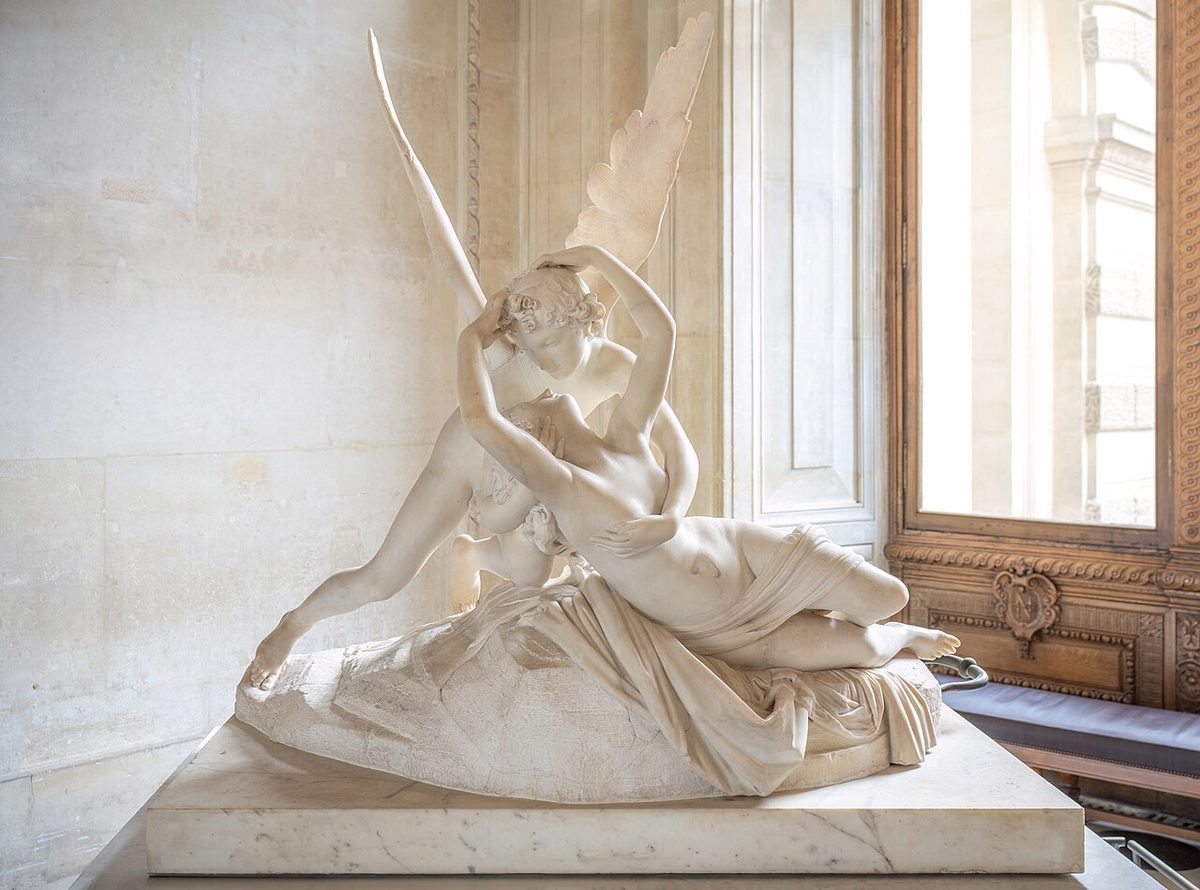
Look closely at a chrysalis hanging from a dry twig in late spring. Inside that sealed shell, the old body dissolves completely into fluid before wings can take shape. When the case splits, what once crawled along leaves steps out into open sunlight.
Psyche is the mortal princess of Greek and Roman myth who married Eros, whom Rome called Cupid, and joined the immortals. Her Greek name, psykhe, means breath, soul and butterfly. She is a consciousness crossing the veil of blind habit through earned sight until love is chosen in daylight. Her oil lamp, her four trials and her wings form a technology for turning scattered longing into whole awareness.
The veil, the lamp and the butterfly's wing
Watch a butterfly cross a garden. We suppose the blue on its wing sits locked inside the scales whether anyone looks or not.
Physics points to a deeper exchange. In Helgoland, Carlo Rovelli writes that the color of a butterfly's wings appears in interaction between observer and wing. Properties show themselves inside that web of entanglement, instead of sitting apart in isolation.
In The Visionary Window, Amit Goswami recalls Chuang Tzu dreaming he was a butterfly, then waking to wonder whether a butterfly was now dreaming him. In God Is Not Dead, Goswami explains that consciousness keeps a parallel bond between the inner psyche and the outer world, choosing experiences across both together.
Carla Rueckert's Law of One transcripts describe a veil drawn between the conscious mind and the unconscious mind. Before that veil, everything lay open, yet little moved a soul toward choice. Drawing the veil turned clarity into mystery so free will and conscious love could grow.
Lee Carroll, channeling Kryon, compares that older state to living in a dark room where people circle together in fear of what they cannot see. Then a door cracks open with bright light. Once someone looks through it, the change from dark to light begins.
Anne Tucker shares a message from the angels saying that an inner layer of our own psyche forms that veil. She ties that word to the Greek princess Psyche, her trials with Cupid, and the Greek word for butterfly. In her view, the myth tells a path of redemption through love.
That is Psyche. She leaves blind comfort behind, pays the price of sight, and grows wings strong enough to meet Love in daylight.
The unseen palace, the hot oil and the four labors
This is the story told by Apuleius in The Golden Ass, drawn from older Greek lore.
A king had three daughters, and the youngest, Psyche, was so fair that crowds left the altars of Venus to praise a mortal girl. Angered, Venus sent her son Cupid to make Psyche fall in love with a wretched creature. Cupid flew to her room at night, scratched his own skin on his arrow, and loved her himself.
An oracle bade the king leave Psyche in funeral dress upon a mountain crag. From that bare rock, the West Wind Zephyr lifted her down into a green valley and a palace built without human hands. There an unseen husband met her only in darkness. He gave her music, warmth and gentle speech, yet warned her never to look upon his face.
When her jealous sisters claimed a monster shared her bed, Psyche hid a blade and lit an oil lamp while he slept. In the glow, she saw Cupid himself, bow resting beside his wings. Startled, she leaned too close, and a drop of hot oil fell onto his shoulder. Cupid woke, saw her broken pledge, and flew out into the night.
Psyche searched across temple thresholds until she knelt at the door of Venus. The goddess set her four hard labors.
First, Venus poured a mountain of wheat, barley, millet, poppy, chickpeas, lentils and beans onto the floor. She ordered them sorted before dusk. Ants pitied Psyche and marched in long columns, separating seed from seed until every grain sat in its own heap.
Second, Venus sent her to bring back wool from fierce rams with golden fleece beside a river. A green reed whispered from the bank, telling her to wait until sunset cooled the flock, then pluck the gold tufts caught on the briars.
Third, Venus handed her a crystal jar to fill from the black spring feeding the river Styx, guarded by steep cliffs and dragons. The eagle of Zeus swooped down, took the jar in its beak, and brought back the icy water.
Fourth, Venus sent her down to the underworld with a small box to ask Persephone for a measure of beauty. A stone tower taught her the road, the coins for the ferryman and the cakes for the three-headed hound. Psyche climbed back into daylight, yet curiosity overcame her. She opened the box, and heavy sleep fell over her like death.
Cupid had healed by then and flew to her side. He gathered the sleep back into the box, woke her with a touch of his arrow, and pleaded before Jupiter. Jupiter gave Psyche a cup of ambrosia, granting her wings and marriage to Love before all Olympus, and their child was named Joy.
Lamp oil and sorted seed
At first glance, the story looks like a romance of royal trials. Beneath the lamp and grain sit two exact laws of consciousness.
First, blind bliss collapses the hour truth asks for light. Staying asleep inside a hidden palace keeps peace only until the mind asks who shares the room. Once the lamp burns, illusion breaks, and the soul must earn in daylight what it first received in the dark.
Second, impossible knots untangle grain by grain after midday heat cools. Charging straight at the golden rams brings ruin, while patience after sunset gathers what snagged on the thorns. Help arrives from ants, reeds and eagles once a seeker stays with the task.
Lamp, seeds, crystal jar and butterfly wings
Each object in Psyche's story works like part of an instrument.
The oil lamp and hidden blade show sight mixed with fear. She reached for truth while still arming for defense, so hot oil spilled. Even clumsy light breaks sleep and begins the real journey.
The mountain of mixed grain marks discernment. A scattered life looks like one hopeless pile until ants sort wheat from poppy, one seed at a time.
The golden wool on the briars teaches timing. Waiting until dusk lets fierce forces rest so wisdom can harvest without war.
The crystal flask and the eagle point to clarity of vessel. Some waters stand too steep for human hands alone, so a calm mind lets higher sight carry the jar. Persephone's closed box warns against stealing another's beauty before your own form has ripened.
Finally, the wings of the butterfly mark the finished turn. Breath and soul leave the narrow shell and move freely in open air.
Soul, desire and the queen below
Psyche, Eros, Venus and Persephone form a four-part circuit.
Eros sparks attraction before sight wakes. Venus guards the measure of form and demands proof through labor. Persephone keeps the deep threshold where old vanity sleeps in the dark. Psyche walks through all three until Soul and Love stand as equals in full light.
Where Psyche flies in a birth chart
Ancient myth knew Psyche as a princess and a butterfly instead of a point in the sky. In 1852, astronomers discovered the metal-rich asteroid 16 Psyche orbiting between Mars and Jupiter. Modern astrologers treat that asteroid as the point where consciousness refines through testing and clear sight.
Venus shows what draws us near, while Pluto, discovered in 1930, tests where desire strips away pretense and asks for full change. When Venus meets Pluto or touches the seventh and eighth houses, partnership moves past surface charm into deep initiation. Mercury adds the lamp of plain naming, turning vague longing into words that hold up in morning light.
Meeting Psyche at the lamp and the bowls
Step up to the lamp and bowls when confusion clouds a choice, or when blind comfort has broken open and left scattered work on the floor.
Set a small dish of mixed seeds or beans on a table beside two empty bowls and a lit candle. Sit upright and look at the mixture without rushing.
Name one truth you have kept in the dark out of fear. Like lighting Psyche's lamp, speak it once in plain words, without blame or panic.
Spend two minutes sorting the seeds into the two bowls by hand, grain by grain. Let your attention match the pace of your fingers, like the ants working before dusk. When the bowls sit apart, rest your eyes on the candle flame for three slow breaths.
When the seeds sit neatly in their two bowls, put the lamplight away. Cover the bowls, lower a brass snuffer gently over the candle wick, and rest both hands lightly against your ribs to feel your breath rise and fall like folded wings. Open a window to fresh air and step into daylight with one choice named plainly.
Questions people ask about Psyche
What does the name Psyche mean in Greek?
The Greek word psykhe means breath, soul and butterfly. Myth used the same word for the mortal princess who passed through trials to gain wings.
Why did Cupid forbid Psyche to see his face?
In the myth, Cupid kept his face hidden so Psyche would trust love inside the dark palace without outside interference. Once doubt entered, lighting the lamp broke blind trust and forced her into waking growth.
What did Psyche's four trials represent?
Each trial trained a single skill. Ants taught discernment, sunset wool taught timing, Styx water taught clarity, and Persephone's box taught endurance.
Why did Psyche fall asleep after opening Persephone's box?
Curiosity led her to reach for beauty from the underworld instead of finishing her task. The heavy sleep showed that borrowed power stalls the soul until Love wakes it again.
How does asteroid 16 Psyche work in astrology?
In a birth chart, 16 Psyche marks where the soul matures through patient testing. Links to Venus, Mercury or Pluto show deep refinement in speech, choice and love.
The soul that grew wings
Psyche is the breath that crosses the veil, the soul that earns its wings in daylight.
Love, Flirtation & Desire traces how attraction, Mercury speech and Venus desire move between two charts, showing where blind habit wakes into real choice.