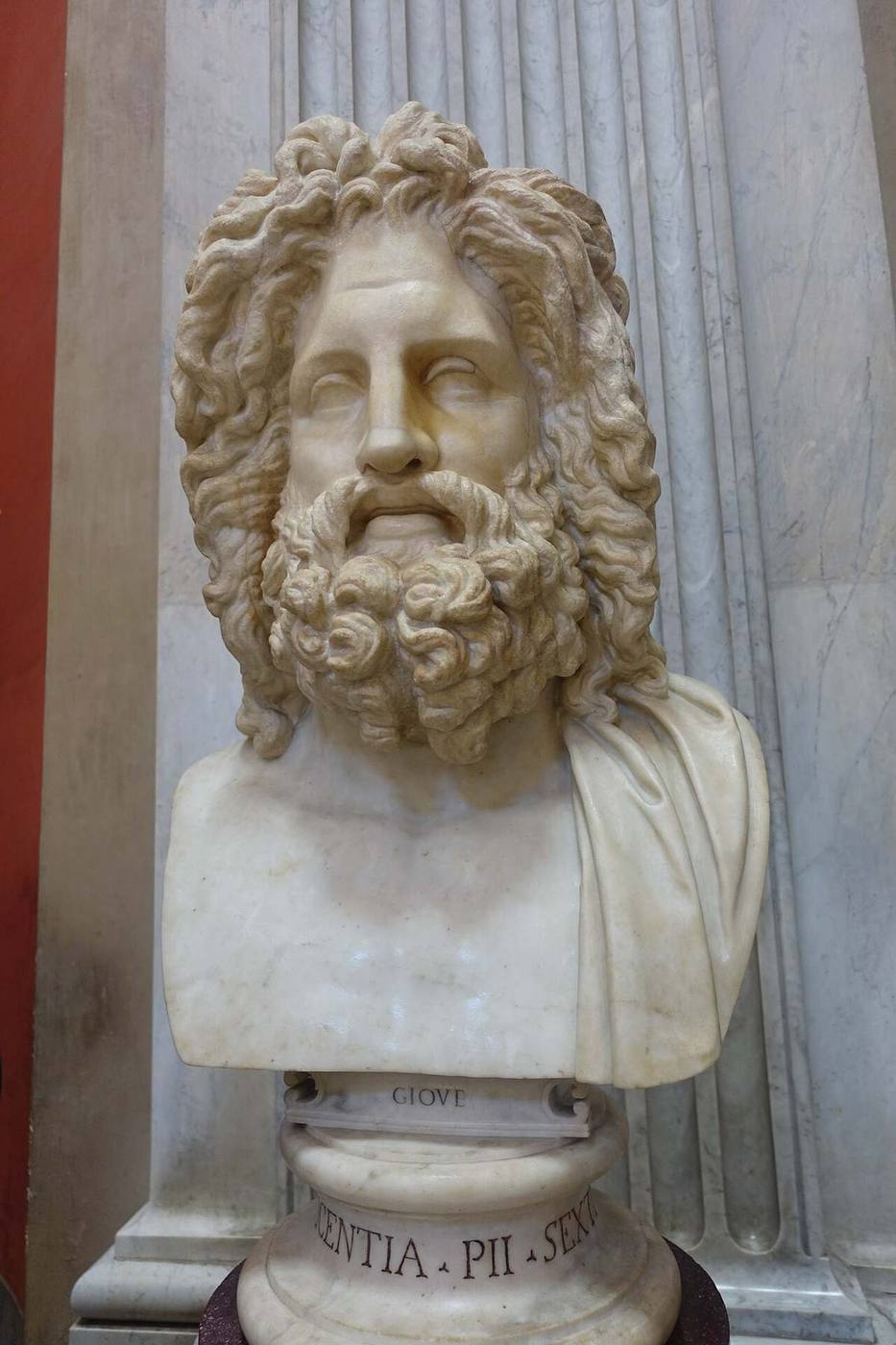
High on Mount Dicte in Crete, a newborn child cried inside a dark limestone cave while mountain spirits clashed bronze shields at the mouth so heaven above would not hear him. Outside, his father Cronus swallowed every new birth to keep time frozen. When that hidden child grew, he climbed out of the rock and set the sky in order.
He is Zeus, ruler of Olympus and keeper of oaths in Greece. Rome knew him as Jupiter, or Jove, father of the bright air. His name comes from an old root that means the shining sky of day. He is a consciousness older than lawbooks. He binds scattered powers into one order and strikes through fog when an oath breaks. The Greeks built oak shrines, scales, and rites of welcome to meet that force and keep it in measure.
The field that holds the worlds
Look up at a clear sky. Nothing visible holds the moon to the Earth, or the Earth to the sun. Planets cross the dark without chains or bridges, yet they keep their paths for billions of years.
Physics calls that invisible order gravity. For a long time people pictured space as an empty box with objects floating inside it. The physicist Carlo Rovelli explains that space itself is a field. In his book The Order of Time, he writes that the gravitational field is not separate from the things of the world. It is the elastic fabric on which every star, stone, and clock rests. Pull or bend that fabric anywhere, and everything near it shifts its course and its speed.
Lee Carroll, channeling Kryon, points to the same daily mystery. Every person on Earth moves inside gravity without ever seeing it with the eye. You do not need faith to work with gravity, he teaches, because every step you take already knows its pull. Beneath the visible world sit laws of harmony that hold matter in place and answer how we move.
Anne Tucker carries that law into awareness itself. In her transmissions, the angels speak of weight and gravity as measures of how much presence a person holds. A mind scattered in fear carries little weight in a room. When a person gathers truth into the body and stands without flinching, that truth gains gravity. It bends the space around it and draws stray things into order, the way a heavy star draws smaller bodies into orbit.
That is Zeus. He is the weight that holds an assembly together, and the flash that clears the air when order breaks.
The cave, the flood and the golden scales
The poets of Greece left three stories that show how this force begins, how it tests mortals, and how it yields to a law above itself.
Hesiod sang the beginning in the Theogony. Cronus, lord of the Titans, feared a prophecy that one of his own children would overthrow him. Each time his wife Rhea gave birth, Cronus took the child and swallowed it whole. When Zeus was born in secret, Rhea carried him by night to Crete and hid him deep inside a cave. She wrapped a stone in cloth and handed it to Cronus, who swallowed the rock without looking. Inside the mountain, the goat Amalthea gave the infant milk, and mountain spirits beat bronze spears against shields whenever he cried.
Zeus grew fast in the dark. When he came of age, he met Metis, whose name means Counsel. She gave Cronus a bitter drink. He vomited up the stone first, and then the five siblings who had lived inside him. Zeus went down into the pit of Tartarus and freed the Cyclopes, the one-eyed smiths chained there by their father. Out of gratitude, they forged the weapon no Titan could face. They gave him the thunder and the three-forked lightning bolt. For ten years war shook sea and mountain until Zeus struck the Titans down and locked them under the earth. Afterward, Zeus, Poseidon, and Hades shook three lots in a bronze helmet. Hades drew the mist below, Poseidon drew the sea, and Zeus drew the broad sky. All three kept the earth in common.
Ovid told a second story in the Metamorphoses. Zeus and Hermes put on worn cloaks and walked through Phrygia as weary travelers. At dusk they knocked at a thousand doors, asking for shelter and bread. Every rich house bolted its gate against them. At the edge of the village stood a hut roofed with reeds. Inside lived Philemon and his wife Baucis, bent with age and poor in goods. They welcomed the guests at once. They raked warm ash on the hearth, boiled garden cabbage, set out olives and wine, and propped a shaky table leg with a shard of clay. As the evening passed, the old pair saw the wine bowl fill itself each time they poured. Then the guests showed their stature and led them up a steep ridge. Looking back, Philemon and Baucis saw the valley drown under a sudden lake. Their reed hut rose into marble columns and a roof of gold. Zeus asked what gift they wished. They asked only to tend the shrine together and die in the same hour. Years later, as they stood on the steps, bark crept up their legs and branches grew from their arms. One became an oak and one a linden, side by side at the gate.
Homer sang a third story in the Iliad, during the war at Troy. Hector and Achilles faced each other outside the walls, and the gods watched from above. Zeus loved Hector, who had burned rich offerings on his altars. Yet Zeus did not reach down to save him by force. Instead, he lifted up his golden scales and placed two fates of death in the pans, one for Hector and one for Achilles. He held the beam in the middle. Hector's pan sank toward the underworld. At that sight, Zeus let go, and Apollo stepped away from Hector's side. The king of heaven himself stood back and let the weight of the balance decide.
Laws inside the thunderbolt
At surface level, these tales look like royal quarrels and rescues. Beneath the crown, each story states a plain law of cosmic order.
Order is born in hidden shelter before it ever rules the sky. The child who will hold heaven must first grow where tyranny cannot see him, fed by earth and counsel. Even when he takes the throne, he does not keep everything for himself. The helmet of lots divides the cosmos into domains so no single force floods the whole world.
Hospitality is a law of the field, far deeper than polite custom. Philemon and Baucis had no silver or meat to give. They offered an open door and full attention to two travelers who looked like dust. The rich houses shut their gates to keep what they owned. When the flood rose, it took everything behind those walls. A system that closes its doors against the unknown rots inside its own fence.
And the highest power bows to a scale above its own wish. Zeus sits over gods and mortals, yet he weighs Hector on scales that he does not rig. When the beam tips, he lets the outcome stand. Force that refuses to be weighed turns into Cronus, swallowing its own future to guard a chair.
Lightning and the golden cord
How does a high center of order touch the world below without micromanaging every grain of sand? Two images answer that question, one sudden and one continuous.
Session 78 of The Law of One maps the deep archetypes of mind, body, and spirit. That teaching describes the beginning state of the spirit as primeval darkness, still and receptive, unable to move by itself. What wakes that darkness into power is lightning. Those transcripts call lightning the original potentiator of spirit, later drawn in the tarot as the tower struck from above. Light arrives in one sudden flash, shatters a closed shell, and wakes what lay sleeping inside.
The physicist Amit Goswami reads lightning and attraction side by side. In Quantum Creativity and The Visionary Window, he notes how sudden insight strikes a prepared mind like lightning across a gap that logic could never walk step by step. In those same pages, Goswami recalls a scene from the Iliad. Zeus challenges the other gods and boasts of a golden cord hanging from heaven to earth, by which he can draw all things toward himself. Goswami compares that cord to the unseen pull of an archetype calling awareness home.
The cord and the bolt belong together. In physics, Goswami also points out how finely gravity is tuned. Make it a fraction stronger, and the young universe collapses before stars can burn. Make it a fraction weaker, and matter scatters too thin for planets to form. Between collapse and scatter sits one exact tension. Zeus holds both ends of that law. He is the pull that keeps worlds in orbit, and the bolt that breaks stagnation when a false shell hardens.
The instruments of the high seat
Each object carried by Zeus or placed in his sanctuaries acts as part of one working instrument.
At Dodona, in the mountains of northern Greece, there were no stone walls around the oldest oracle of Zeus. A tall oak stood there in open air. Priests and priestesses listened to wind moving through its leaves. They listened to doves in the branches. Around the grove hung bronze cauldrons in a circle. When one bowl rang, the sound passed from vessel to vessel around the oak. Tom Kenyon, in his work on consciousness and the void, uses the acorn and the oak as a picture of hidden potential turning into stature. Every branch sleeps inside one acorn before it breaks soil. At Dodona, Zeus spoke through air moving across oak leaves. Real authority listens to breath and subtle vibration before it speaks a decree.
High above the oak flies the eagle. An eagle rides thermal currents without beating its wings at every breath. From altitude it reads whole valleys, rivers, and ridge lines at once. It does not quarrel with ants in the grass. In myth, the eagle carries the lightning bolt in its claws, joining wide sight with swift action.
In his hand or beside his throne sit the golden scales. Scales turn hidden weight into visible tilt. They test whether a promise, a plan, or a boast has substance behind it. Without the scales, the thunderbolt is blind violence. With the scales, the bolt falls only where imbalance demands a strike.
Around his shoulders, and sometimes lent to Athena, hangs the aegis, a shield of goatskin named for Amalthea, who fed him in the cave. The shield remembers the goat that kept him alive when he was small and helpless. Even at the height of heaven, the king wears the hide of the creature that sheltered him in the dark.
And at the center of Greece, in Delphi, sat the omphalos, the stone wrapped in wool. Myth said it was the very stone Rhea gave Cronus in place of the infant Zeus, spat back out onto the earth to mark the navel of the world. Solid fact refuses to be digested by false power, and returns as the center stone of truth.
The king and the older powers
Zeus does not stand alone on Olympus. His power moves in a circuit with the older forces around him, and his failures teach what happens when that circuit breaks.
With Hera, his queen, Zeus forms the axis of oath and covenant. Hera guards marriage, shared treasury, and equal dignity. Whenever Zeus slips out in disguise as a swan, a bull, or a shower of gold to chase appetite without keeping his word, storm breaks over Olympus. Power without covenant spreads chaos in the house. Power wedded to covenant keeps the sky clear.
With Metis, whose name is Counsel, Zeus learned the cost of swallowing wisdom to keep control. Because he swallowed Metis, he gained counsel inside himself, yet he split his own head open to birth Athena. Foresight cannot stay locked inside a skull forever. Sooner or later it breaks out into the light in full armor.
With Hekate, an older Titan goddess of crossroads and night, Zeus shows his wiser side. Historian Sorita d'Este, writing on Hesiod's Theogony, notes that Zeus did not strip Hekate of her realm. Instead, he honored her above others and kept her share in earth, sea, and sky. True order respects what came before it. A ruler who erases older roots leaves himself on bare sand.
Where Jupiter moves in the sky
In astrology, Zeus wears his Roman name, Jupiter. Jupiter is the largest planet in our solar system, with more mass than all the rest combined. Its gravity bends the paths of comets and shields the inner worlds from stray rock.
In a birth chart, Jupiter marks where a person seeks meaning, trust, and room to grow. Its signs are Sagittarius, the arrow aimed at a far horizon, and Pisces, the sea without a fence. Its houses are the ninth house of philosophy and law, and the twelfth house of retreat.
When Jupiter meets the Sun, vision widens and faith comes easily, though pride swells without a scale to check it. When Jupiter meets Saturn, growth meets limit. Saturn lays the stone walls, and Jupiter fills the temple with purpose. Modern astrologers also watch Jupiter meet Pluto, discovered in 1930, when conviction goes underground to search for the law behind visible rank.
Jupiter takes twelve years to circle the zodiac, spending one year in each sign. Astrologers track those yearly turns through annual profections, watching which house steps forward to carry the year.
Weighing an oath on Zeus's golden scales
Step beneath open air when fog covers your path, when an oath needs weight, or when scattered plans need one center to hold them. Bring only promises you intend to keep, and leave petty quarrels over neighbors at the door.
Come at his hour. Thursday belongs to Jupiter, and dawn or the clear hour after a storm fits his sky. Stand outdoors under open air if you can, or near an oak tree, or beside an open window looking toward the horizon.
Stand upright with your feet apart and your spine tall, like an oak rooted in stone. Let the shoulders drop. Feel the pull of gravity down through your heels into the ground. Notice that the earth holds your whole weight without effort. You do not need to strain upward to reach the sky. Gravity already joins your feet to the planet, and the planet to the sun.
Name one question or one oath clearly, in plain speech. Speak it aloud once, without ornament or excuse. Zeus is Horkios, keeper of spoken words. If you cannot say a promise in one plain sentence, it is not ready to be sworn.
Then stop speaking and listen, as the priests at Dodona listened to leaves and bronze bowls. Pay attention to what arrives on its own. Notice wind against your skin, a bird crossing the sky, or a clear sentence rising out of stillness. Notice where your mind wants to swell into grand plans. Picture the golden scales in front of your chest, and ask what the plan weighs in real time and effort. Let hollow wishes lift off the pan until only what carries weight remains.
When the wishful weight has lifted off the pan, put the golden scales down. Lower your eyes from the horizon, let your hands hang still at your sides, and release any claim over another person's fate. Eat a bite of plain bread or a handful of olives in memory of Philemon and Baucis, and walk back into ordinary work with your spoken word intact.
Questions people ask about Zeus and Jupiter
What is Zeus the god of?
Zeus is the Greek god of the sky, thunder, lightning, oaths, hospitality, and kingly law. In Rome he was called Jupiter, protector of civic order and treaties. Together those titles mark him as the force that keeps cosmic and human agreements intact.
What are the main symbols of Zeus?
His main emblems are the three-forked thunderbolt, the eagle, the oak tree, the golden scales, and the scepter. Each tool marks a different part of rule: sight from altitude, listening to living air, weighing measure, and swift action.
Why did Zeus use golden scales in the Iliad?
In Homer's Iliad, Zeus weighs the fates of warriors on golden scales to show that even the ruler of heaven obeys cosmic measure. He refuses to bend the outcome out of private fondness once the balance tips.
What is the story of Philemon and Baucis?
Zeus and Hermes walked through Phrygia disguised as poor travelers. Wealthy homes shut their gates until elderly Philemon and Baucis welcomed them. In return, the gods saved the pair from a flood, turned their hut into a temple, and let them grow side by side as an oak and a linden.
How is Zeus connected to the planet Jupiter?
Ancient Greeks and Romans named the brightest slow-moving wanderer in the night sky after Zeus and Jupiter because its twelve-year orbit carried a stately rhythm across the stars. In astrology, Jupiter marks expansion, philosophy, law, and the search for meaning.
The measure of the sky
Zeus is the weight that holds the worlds in orbit, and the flash that clears the sky when oaths fail.
To see which house of your chart Jupiter rules and which twelve-year and yearly cycles it activates in your life, explore Annual Profections.