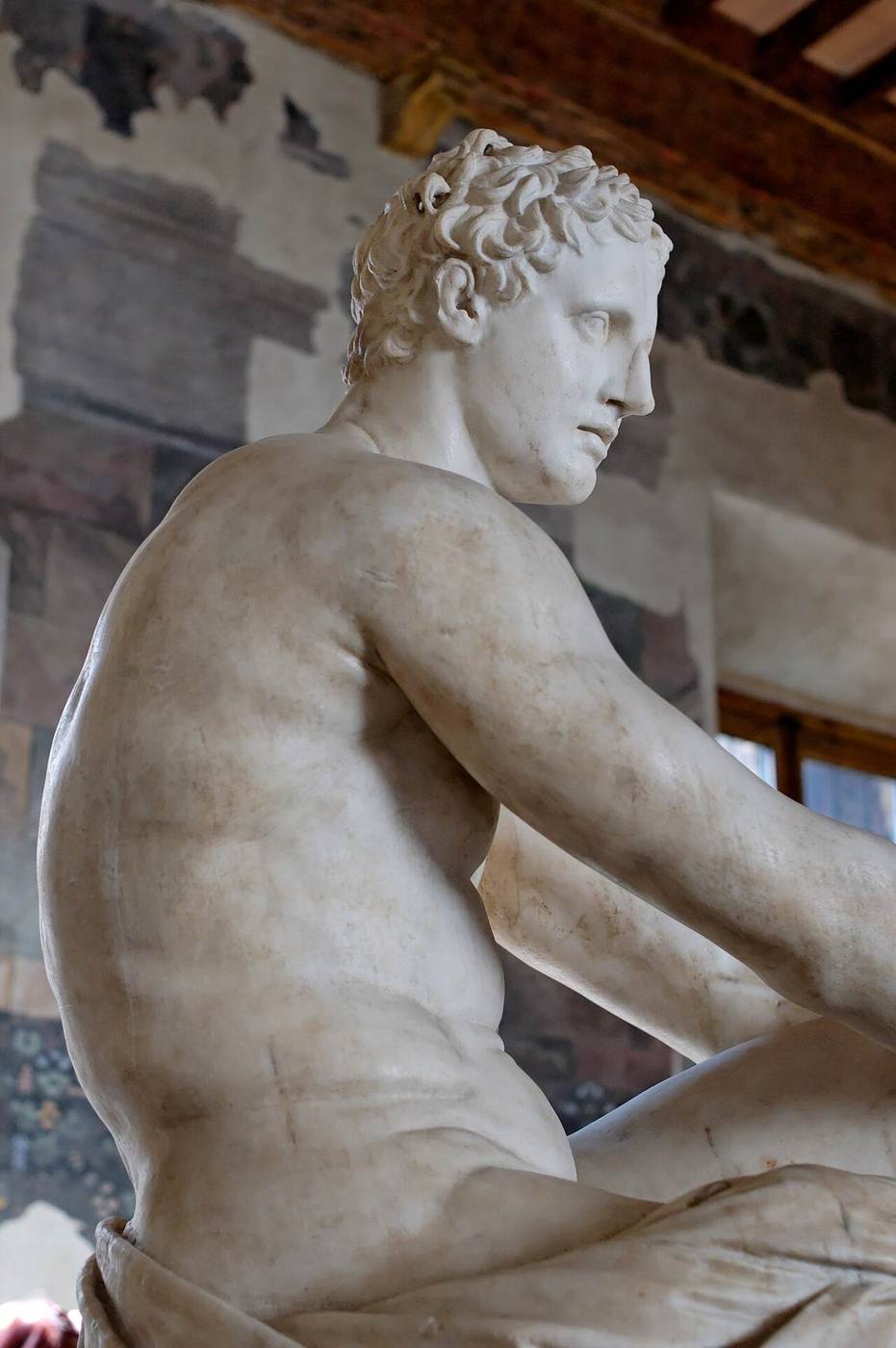
In the cold air of March, Roman priests stepped onto the field bearing twelve bronze shields and iron spears. Frost still gripped the bare furrows where spring seed waited underground. One spark struck from flint caught dry tinder, and smoke rose straight into the morning sky.
Ares is the Greek god of war, heat and raw drive. Rome called him Mars, and long before Rome built legions, farmers knew Mars as the guard of spring crops in March. He is older than any banner. He is the spark of ignition inside matter and will. The ancients used his spear, his shield, his iron and his bronze jar to map how heat wakes, moves and returns to rest.
Why nothing moves without heat
Look at a ball rolling across a wood floor. It slows down and stops because friction warms the boards beneath it. Now picture a world with zero friction and zero heat. Nothing could stop, leave a footprint, or start a new turn.
Physics states this plainly. Carlo Rovelli writes in The Order of Time that the equations of motion work backward just as well as forward, except in one place. The arrow from past to future appears only where there is heat. Without heat, everything bounces back and leaves no trace. A pile of wood sits unchanged for years until one flame opens the gate and turns stillness into ash and movement. Deep in space, a cloud of hydrogen hangs cold until gravity squeezes it hot enough to ignite a star.
That first ignition is Ares. He is the spark held to timber, the heat that pushes potential into a clear direction.
Session 27 of The Law of One, channeled by Carla Rueckert, states that unity holds both stillness and motion. Potential is infinite rest. Tapping that rest yields work, which the session calls intelligent energy, the kinetic focus of creation. Love acts as the activator and the choice of attack that wakes stillness into motion.
Anne Tucker adds in You Don't Have to Earn the New Earth how this heat works inside a person. Change requires combustion, she teaches, just as an engine needs fuel to run. A balloon cannot rise while sandbags drag on the basket. Dropping stale weight frees fuel so the fire inside can lift the vessel. Where we brace against motion, resistance creates friction.
Lee Carroll and Kryon carry that spark back to early Earth. Life started and stopped many times across millions of years before chemistry held firm enough for the spark to root. Across the cosmos, Kryon says, new worlds ignite when membranes touch and send out sparks.
The jar, the spring field and Harmonia
Three old stories show how this ignition behaves when boxed in, when honored in season, and when joined to love.
In the Iliad, two giant brothers named Otus and Ephialtes marched against Olympus. They bound Ares in heavy chains and locked him inside a jar of bronze. For thirteen months the god of war lay sealed inside dark metal. No one on Olympus knew where he had vanished. He would have withered in that narrow vessel had not the giants' stepmother sent word to Hermes. Hermes crept in by night, drew the lid aside, and pulled Ares out, nearly spent from the dark.
Early Rome knew another side of him before empire grew. Every March, the month named Martius, priests called Salii carried twelve shields of bronze and danced through the streets with spears. Farmers sang to Mars Pater, calling him Gradivus, the one who strides ahead of green shoots. Frost still gripped the soil. People asked Mars to stand at the edge of their fields and turn away blight, storm and wolf so grain could sprout safely.
Homer and Hesiod tell a third tale. In secret, Ares met Aphrodite while her husband Hephaestus sailed to Lemnos. Dawn saw them and told the smith. Hephaestus forged chains fine as spider silk, hung them around his bed, and caught both lovers fast. Poseidon paid a pledge to loose them. Out of the meeting between Ares and Aphrodite came a daughter. Her name was Harmonia, which means fitting together.
Laws written in bronze and blood
Those three stories mark how kinetic force behaves in matter and in a life.
Kinetic power sealed without an exit heats its jar from inside until the vessel cracks or the spirit withers. When Otus and Ephialtes shut Ares in bronze, his strength turned hollow. A person who locks away every sharp yes and no suffers the same slow rust. Force asks for a clear path into action, not a lid hammered shut.
The second law comes from Harmonia. Force alone breaks walls, while pull alone longs from afar. When directed heat meets genuine pull, what is born is order that holds two different things in tune.
Reading the instruments of Mars
Each weapon and animal beside Ares marks one stage of clear action.
The spear sets one line of aim. A hammer spreads weight across a surface, while a spear gathers weight behind one tip. That tip asks for one clear choice in place of ten scattered wishes.
The helmet covers the skull and eyes. Before a runner leaves the blocks, the head stops spinning sideways. The helmet shuts out side noise so sight stays fixed ahead.
The shield is the edge between your ribs and the world. Rome kept twelve sacred shields in the temple of Mars, eleven copies and one said to have fallen from the sky. A shield guards your ground so nothing inside spills by chance.
Two horses pulled his chariot across the field, Phobos and Deimos, Panic and Dread. The ancients yoked fear to the front axle so the driver held the reins and never let panic ride behind his back.
Outside the gate, the wolf and the woodpecker belonged to him. The woodpecker taps bark until hidden food wakes. The wolf guards the pack edge through cold nights.
Mars in the sky and the chart
Mars shines red because iron dust rusted across its stone face, giving the planet the look of embers.
In a birth chart, Mars shows how you start action, meet resistance and guard your edge. Look first to the sign and house where Mars sits. Mars in Aries or Scorpio moves fast toward contact. Mars in Capricorn builds endurance stone by stone like a wall. Mars in Cancer guards the hearth before stepping into daylight.
Notice what touches Mars in the natal map. When Mars meets the Sun, will and fuel share one furnace. When Mars meets Saturn, the spark meets iron weight, teaching patience until the hour to strike arrives. When Mars meets Pluto, drive reaches deep and refuses half measures.
When transiting Mars crosses an angle or touches a natal planet, it acts like Rovelli's flame touching dry wood. Sleeping questions heat up, and whatever sat sealed inside a bronze jar pushes against the lid for air.
Striking the flint and laying down the spear
Approach Ares when cold waiting has locked your days, or when anger circles inside your chest with nowhere lawful to go. Blind spite wastes his fire on smoke. You meet him best when you bring heat to break stagnation and take one direct step.
His day is Tuesday, and his hour is first light after dawn, before chatter fills the room.
Stand upright on a bare floor with your feet apart and your weight over both heels. Drop your shoulders and let both arms hang loose. Notice where heat gathers in your jaw, belly, or hands.
Draw one deep breath into the ribs. On the exhale, let the breath hiss sharply once through parted teeth, like flint striking steel. Name aloud the single action you have delayed, in five words or fewer.
Take the first move toward that task within five minutes while the spark stays bright. Write the first line, clear the table, lace the boots, or speak the plain word.
When the step is finished, lay the spear down so fire does not char the house. Set an iron key or heavy tool beside the doorway, step outside onto bare gravel or earth, and breathe slowly out through your nose until your jaw loosens. Eat a bite of plain bread or salted food to bring the heat back into your limbs, and sit in a solid chair until your pulse settles.
Questions people ask about Ares
What is Ares the god of?
Ares is the Greek god of war, courage and kinetic force. In early Rome, as Mars, he also guarded spring fields, cattle and new grain against blight and frost.
Why did the giants lock Ares in a bronze jar?
In the Iliad, Otus and Ephialtes trapped Ares in a bronze jar for thirteen months until Hermes freed him. The tale shows how trapped force starves or turns dangerous when denied an open outlet.
What is the difference between Ares and Athena in myth?
Athena governs strategy, craft and city walls, while Ares carries the sudden spark of heat and physical nerve. Greece honored Athena for winning plans and feared Ares for blind fury, yet both belong to action.
Who are the children of Ares and Aphrodite?
Their union produced Phobos and Deimos, fear and dread, along with Harmonia, goddess of concord. When raw drive meets attraction under measure, friction turns into lasting order.
How does Mars appear in an astrology chart?
Mars marks how you initiate action, spend force and hold your ground under pressure. Its sign, house and aspects show where drive ignites fast or needs patience.
The fire that moves the world
Ares is the kinetic spark, the heat that turns stillness into history.
To trace where Mars and the moving planets cross your birth chart, look at Your Transits.