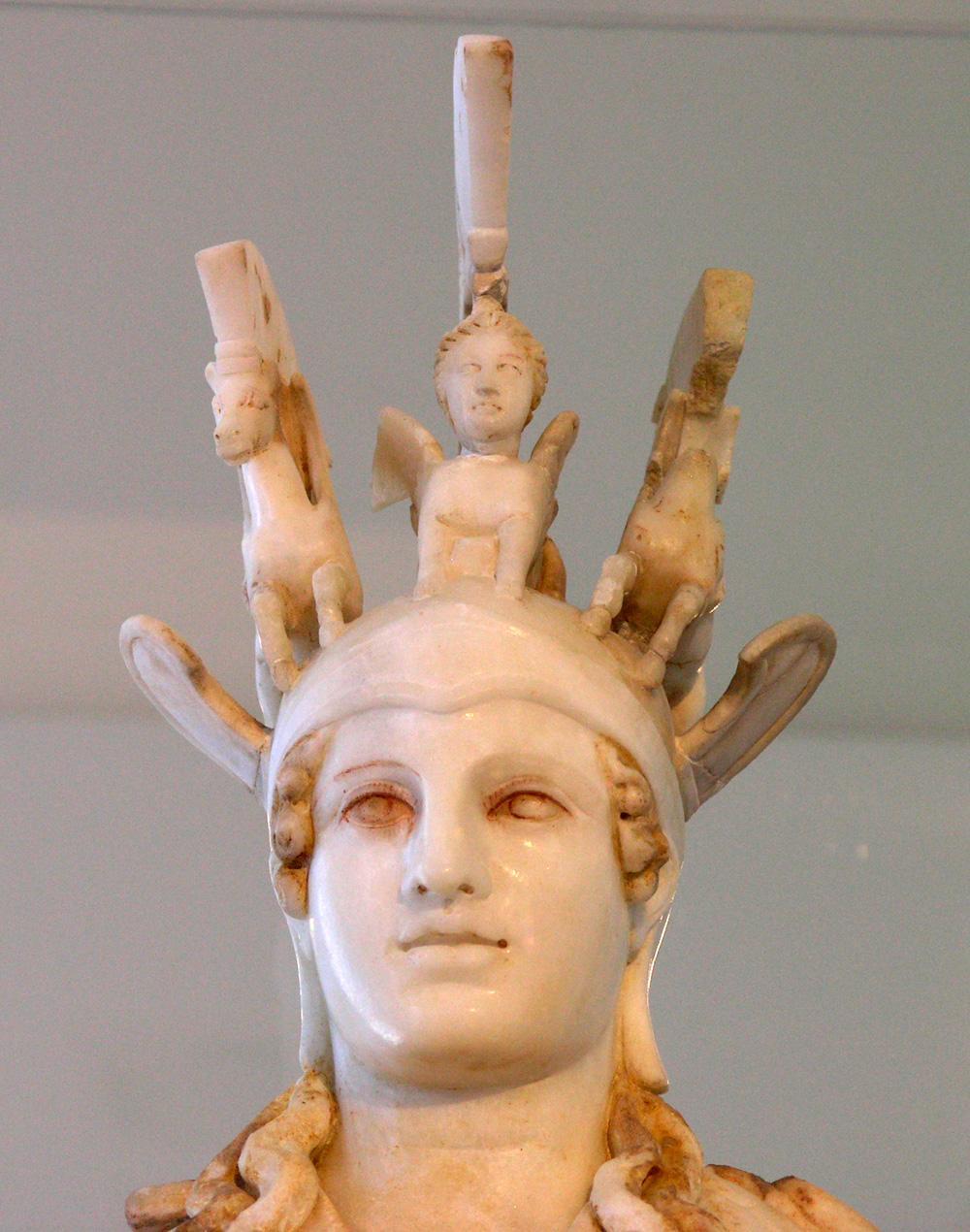
On Mount Olympus, Hephaestus raised a heavy bronze axe and split the aching brow of Zeus. Out of the cleft skull sprang a tall woman in bright armor, shaking a spear and shouting a war cry while the mountain trembled under her feet.
She is Athena, keeper of cities, strategy, and woven craft in Greece. Rome honored her as Minerva, guardian of looms, builders, and law. Her Greek title Glaukopis means owl-eyed, the one whose grey eyes stay awake in the dark. She steps back from panic, sees the whole board, and turns raw terror into usable form. The Greeks built looms, jury courts, and hill sanctuaries to practice that clear sight without losing the root beneath it.
Distance, weaving and real tools
Panic happens when a mind stands too close to a threat. You cannot read a map when your nose touches the ink. To plan a crossing or mend a broken wall, awareness has to step back and open space between itself and the storm.
Iain McGilchrist describes this exact move in The Matter With Things. He notes that the human frontal lobes grew large for one main reason: to stop immediate impulse and put necessary distance between us and the world. From that step back, we can compare paths, test outcomes, and plan a strategy. Yet McGilchrist also warns what happens when the calculating side of the brain goes offline from living reality. It starts mistaking its own neat diagram for the living terrain, and makes blind strategic mistakes.
Building a strategy that holds in the real world takes real labor. The physicist Karen Barad, in Meeting the Universe Halfway, points out that no measuring apparatus springs finished from the head of Zeus. Every real instrument has a history. It must be tuned, adjusted, tested in matter, and maintained by skilled hands before it can show a true reading.
That is the tension inside Athena. She is both the sudden flash from the head of Zeus and the patient craftsperson who tends every thread on the loom.
The split skull, the olive and the court
Four stories from Greece show how Athena enters the world, how she builds a city, how she ends blood feuds, and where her pride trips her.
Hesiod told her birth in the Theogony. Zeus wed Metis, a Titaness whose name means Counsel and practical skill. When Metis carried a child, Uranus and Earth warned Zeus that her son would one day overthrow him. Zeus coaxed Metis with smooth words and swallowed her into his own belly so her counsel would stay inside him. When the time of birth arrived, an ache split his brow. Hephaestus raised a bronze axe and cracked the skull open. Out sprang Athena in bright armor, shaking a spear, while Olympus trembled beneath her feet.
Later, both Athena and Poseidon claimed the rocky hill of Attica. King Cecrops called the gods together to judge the gifts they offered the land. Poseidon strode forward first and struck the stone of the Acropolis with his trident. Out gushed a spring of bitter salt water, roaring like the sea. Then Athena stepped forward and drove her spear into the rock. Where the point touched, an olive tree sprang up, thick with silver leaves and fruit full of oil. Cecrops and the people chose the olive, because salt spray cannot feed a house, while olive oil gives light, food, and medicine. So the city took her name, Athens.
Years later, another trial tested her rule. In the play Eumenides by Aeschylus, Prince Orestes killed his mother to avenge his murdered father. The Furies, ancient spirits of blood vengeance, hunted him across Greece until he clung to Athena's statue in Athens. Athena refused to dismiss the Furies, and she refused to hand Orestes over without a hearing. Instead, she called twelve citizens to sit as a jury on the hill called the Areopagus. When the votes split six to six, Athena dropped her white pebble into the urn to free Orestes. The Furies raged and threatened to blight the soil of Attica. Athena stayed still and spoke with respect. She offered them a permanent chamber beneath the hill, robes of crimson, and honor from every household in the city. One by one, the Furies laid down their wrath and became the Kindly Ones, protectors of the ground beneath the court.
Yet Ovid told a darker story in the Metamorphoses. In Lydia lived Arachne, a mortal girl whose fingers wove wool so fine that nymphs left their streams to watch her shuttle fly. When people whispered that Athena must have taught her, Arachne scoffed and challenged the goddess to a contest. Athena arrived disguised as an old woman and urged her to respect the gods. Arachne refused. Two looms went up side by side. Athena wove the majesty of Olympus in ordered squares, with warning scenes at the four corners. Arachne wove twenty scenes of gods abusing mortals in disguise, and her cloth had no flaw in thread or line. In fury, Athena tore Arachne's woven cloth to shreds and struck her brow with a boxwood shuttle. Despairing, Arachne tied a noose around her neck. Athena lifted her back from death, touched her with bitter herb, and changed her into a spider, swinging forever on a single thread.
And in the war against the giants, recalled by Anne Tucker in her talks on earth changes, the giant Enceladus rose out of the ground to shake Olympus with earthquakes. Athena met him in open battle. She tore up the island of Sicily and pinned Enceladus beneath Mount Etna, where his breath still shakes the rock.
Laws carved in stone and cloth
These four stories stand far apart in mood, yet a single spine runs through them all.
Useful order grows out of living harvest, never out of theater. Poseidon's salt fountain dazzled the eye and rattled the rock, then left the mouth dry. Athena's olive tree took root in thin limestone and fed generations with lamp oil, food, and shade. Power that serves life outlasts power that merely performs.
A true court never erases older rage. When Athena met the Furies, she did not try to kill them with a spear. Blood cannot be washed out with fresher blood. She built a container of civic law beside their cave and gave the Furies an honored seat beneath it. What cannot be destroyed must be given a lawful room in the house.
And intellect goes cruel the instant it fears a rival who knows the truth. Arachne's crime was never sloppy craft. Her crime was weaving an image that showed the rulers of heaven without masks. When skill turns brittle and guards its rank instead of the work itself, it tears the cloth.
The owl, the loom and the Gorgon shield
The owl, the loom, the Gorgon shield, and the olive tree beside the statue of Athena in the Parthenon show how a strategic mind stays grounded in matter.
The little owl sits on her shoulder or perches beside her spear. In Greece, owls hunted at night through olive groves. Their wide forward eyes gather faint starlight when human sight goes blind. The owl does not blink in panic when darkness falls. It waits on a high branch, tracks the slightest rustle in dry grass, and drops straight onto what moves. For Athena, the owl is calm sight inside confusion.
In her hands or in her festivals stands the loom. Every year in Athens, maidens wove a fresh robe of saffron and purple, called the peplos, for the wooden statue of Athena. Weaving joins two opposite directions. Warp threads stretch taut from top to bottom like fixed law. Weft threads shuttle back and forth across them like daily events. Neither warp nor weft makes cloth by itself. Only patient crossing builds fabric strong enough to wear.
Across her breast hangs the aegis, a goatskin cloak bordered with snakes and centered on the severed head of Medusa. Perseus slew the Gorgon by looking only at her reflection in a bronze shield, because meeting her eyes directly turned living flesh to stone. He gave the head to Athena, who mounted it on her chest. Medusa is frozen dread, the sight so terrible it stops breath and turns action into rock. Athena does not bury the head under a floorboard. She sets it facing outward on her armor. Terror faced through a mirror becomes a shield that stops enemies before a sword leaves its sheath.
At her side stands the olive tree, sacred and protected by Athenian law. An olive tree burns slow, lives for centuries, and keeps fruiting in dry stone. It anchors Athena's mind in patience. Speed without root burns out. Craft with root keeps bearing oil through winter.
And beneath her shield on the Acropolis coiled a great serpent, guardian of the hill. Even the sky-born warrior kept an earth snake at her feet, reminding the city that head-wisdom dies when it forgets the ground.
The swallowed mother and the third point
Why did Athena defend the father's side in Orestes's trial, and why did she tear Arachne's cloth? The answer lies in her birth. Because Zeus swallowed Metis before birth, Athena stepped into the world out of a skull, knowing no womb and bearing no mother's face in memory. Intellect born only from the head tends to side with abstract rule over messy flesh.
Yet Metis was never dead inside Zeus. Her name means wise counsel, the shrewd, fluid intelligence of shapeshifters who read water and tide. Whenever Athena remembers Metis inside herself, she works magic in plain matter. She helps Hephaestus teach mortals how to build ships, plows, and clay pots. Both share the fire of craft, though Hephaestus works in volcanic coal while Athena works in clear daylight and measured geometry. Together they join heat with plan.
Tom Kenyon and the Hathors describe a practice they call the Triune Force, which matches Athena's balanced seat on the Areopagus. In a polarized world, Kenyon teaches, human beings swing between two poles: blind attraction that pulls them in, and angry repulsion that pushes them away. When you are hooked by either pole, you lose clear sight. To engage the Triune Force, you step back and rise above both corners of the triangle to a third point. From that higher point, you neither cling nor attack. You observe the pattern as a whole, spot hidden signs before stepping into a trap, and choose your next move with clear eyes.
Notice how Anne Tucker's note on Enceladus completes the picture. Earth-shaking turmoil rises up from below when pressure builds without form. Athena meets that tremor face to face. She places solid weight over the fault line, giving raw earth a mountain to hold its fire.
Athena in the birth chart
Astronomers named the second known asteroid, discovered in 1802, Pallas after Athena. In modern astrology, people also read her pattern across Mercury, Saturn, and Mars in a birth chart.
Look first to Mercury and Saturn. Mercury handles quick pattern recognition, language, and craft of the hands. Saturn provides structure, patience, and stone law. When Mercury and Saturn meet by conjunction, square, or trine in a birth chart, Athena is speaking. The mind tests ideas against reality, spots weak seams in an argument, and builds plans that hold weight over years.
Look also to Mars joined with Saturn or placed in air signs such as Aquarius and Libra. Raw Mars strikes first and looks afterward. Mars tempered by Saturn holds the spear at rest until the right angle opens. Action comes with precision instead of heat.
In houses, Athena governs the tenth house of public craft and civic work, and the first house where a person sets armor or clear posture before the world. Signs that carry her signature include Aquarius for wide systems view, Virgo for careful sorting of thread and detail, and Libra for the Areopagus scales of public fairness.
Drawing warp and weft at the table
Sit down with Athena when a knot of conflicting loyalties locks you in place, when a craft or plan lacks backbone, or when noise makes it hard to tell true warning from panic. Petty grudges and contests of pride tear the cloth. Remember Arachne, and keep your eyes on the work itself.
Come at her hour. Tuesday and Wednesday mornings carry her keen edge, or the calm dusk hour when the first owl hunts and the day's clamor drops. Sit at a table of plain wood with nothing scattered across it. Clear the surface before you ask for clear sight.
Sit upright with your spine straight, knees uncrossed, and your soles resting firmly on the floor or woven rug. Rest your hands open on the wood, palms down, feeling the grain under your fingers. Take three slow breaths until the chest stops lifting toward the throat.
Name the problem aloud in one plain sentence, as if laying a case before a twelve-seat jury. Do not argue for one side yet. Instead, practice the Triune Force taught by Tom Kenyon and the Hathors. Picture a triangle on the table in front of you. On the left corner sits what pulls you with desire or loyalty. On the right corner sits what makes you recoil in fear or anger. Lift your attention to the top corner above both. Ask what you would see if you stood behind the bronze shield and looked only at the reflection, the way Perseus met Medusa without freezing.
Take one sheet of paper and draw two straight lines, one vertical and one horizontal, like the warp and weft of a loom. Write down only the facts you have seen with your own eyes. Leave out what you fear might happen next. Look for the single loose thread that, if woven into place, holds the whole cloth. Decide one concrete action of craft you can finish with your hands before tomorrow night.
Step down from the watchtower before the mind goes brittle. Thought that stays perched high in the skull grows cold and forgets the serpent coiled beneath the Acropolis. Fold the woven grid paper neatly and set it under a stone or a wooden bowl. Rub one drop of olive oil into your fingers, honoring the tree that beat the salt spring, and smooth the edge of a linen cloth. Step outside into open night air for two minutes, feel the dark ground beneath your feet, and leave the strategy resting on the table until morning.
Questions people ask about Athena and Minerva
What is Athena the goddess of?
Athena is the Greek goddess of wisdom, strategy, woven craft, civic law, and defensive war. In Rome she was honored as Minerva, patron of artisans, teachers, and builders. Both names point to clear intelligence expressed through real skill.
Why was Athena born from Zeus's head?
Zeus swallowed his pregnant wife Metis, whose name means Counsel, to prevent a prophecy that her child would surpass him. When the child came to term inside him, Hephaestus split Zeus's brow and Athena sprang out armed, symbolizing thought leaping straight from the mind.
What does Athena's owl symbolize?
The little owl sees clearly in darkness without panic. On Athena's shoulder it stands for alert, calm perception that reads hidden pattern when ordinary daylight disappears.
Why did Athena turn Arachne into a spider?
Arachne was a mortal weaver whose skill rivaled the goddess, and she wove pictures exposing the gods' cruel tricks in love. In Ovid's telling, Athena tore the flawless cloth in wounded pride and transformed Arachne into a spider when the girl tried to hang herself.
What is the meaning of Medusa's head on Athena's shield?
Medusa's face turned onlookers to stone through sheer terror. Mounted on Athena's goatskin aegis, that same dread faces outward, turning what once paralyzed the mind into an unbreakable wall of defense.
The pattern that endures
Athena is the clear eye in the dark, the shuttle that joins stray threads into structure that feeds a city.
To see where discipline, strategic craft, and long-term calling meet in your birth chart, explore Career and Vocation.