Step outside on a clear night far from city lamps and look straight up. Every bright star hangs inside a black field wider than itself. Without that dark sky behind it, no star could show its face.
Nyx is the goddess of the night in ancient Greece. Rome called her Nox. The poets named her Protogenos, the Firstborn, and Kourotrophos, the nurse of gods and mortals. She is a consciousness older than Olympus. She is the unlit ground that holds sleep, dreams and hidden order. Greece met her through night chambers, cave oracles and the pause between days.
The dark ground that holds the stars
We think of darkness as an empty gap where light forgot to go. The sky tells a different story. Light is the visitor, and dark is the house that holds it.
Physics met that same surprise when astronomers asked why midnight is dark at all. In A Brief History of Time, Stephen Hawking examines the puzzle tied to Heinrich Olbers. If space went on forever and stars had burned without a start, every line of sight into the sky would strike the face of a star, making the whole sky shine as bright as the noon sun. Darkness holds between the stars because they turned on at a finite time in the past, leaving deep reaches whose light has not yet arrived. Night is the open interval of cosmic time itself, holding space between distant fires.
Consciousness keeps that same rule. In The Visionary Window, physicist Amit Goswami examines waking, dream and deep sleep as three states of one awareness. Brain waves slow down and rise in height as a person moves from waking into dream and then into dreamless sleep. Yet consciousness stays present beneath all three states, which is why someone wakes and says, I slept well. Indian tradition calls that watchful sleep yoga nidra, a doorway into awareness without division.
In Session 78 of The Law of One, recorded by Carla Rueckert, the Matrix of the Spirit is named the Night of the Soul, or Primeval Darkness. It rests unmoved in deep receptivity until lightning strikes it and wakes a new creation.
In How To Move Through the Void, Anne Tucker calls this interval a gap where old shapes drop away. When an old chapter ends and the next has not yet started, people rush to fill the dark. Lengthening the stillness inside that interval lets the starlight of a new path take shape.
The Hathors, speaking through Tom Kenyon, point beyond even that threshold. In their teaching on the Aethos, pure stillness strips away personal noise until opposition vanishes and awareness rests in itself as the Mother of All Things.
That is Nyx. She is the dark field that lets stars shine and minds reset.
When Zeus halted at her door
This is the story told by Hesiod, Homer and the Orphic singers of Greece.
In the beginning, Chaos yawned open. Out of Chaos came Nyx, and beside her came Erebus, the shadow beneath the earth. Nyx mingled with Erebus and gave birth to Aether, the brightness above the clouds, and Hemera, the day. Light did not make the night. Night bore the day.
Then Nyx brought forth her other children alone. From her own womb came Hypnos, who is Sleep, and Thanatos, who is Death. She bore the tribe of Dreams, and Nemesis, who weighs every deed, and the Fates, who spin and measure and cut every thread of life. Even the length of a king's rule lay inside her house.
At the edge of the world stood a house of bronze in Tartarus, where Atlas held the sky on his shoulders. Night and Day shared that threshold. When Nyx stepped through the bronze door to walk across the earth, Hemera waited inside. When Hemera came out at dawn, Nyx stepped back in. They greeted each other on the step, yet the house never held them both at once.
Even the king of heaven remembered who stood first. In the Iliad, Hera needed Zeus to fall asleep so the tide of battle could turn. She went to Hypnos and begged him to close the eyes of his lord. Hypnos shook his head. Once before, he had put Zeus to sleep while Heracles sailed home. When Zeus woke and saw what had happened, his wrath shook Olympus. He hurled gods across the floor while hunting for Sleep.
Hypnos ran for his life and slipped beneath the cloak of Nyx, his mother. Zeus chased him to the edge of her door, and there the ruler of thunder stopped cold. He held back his hand and swallowed his rage. Homer says Zeus feared to displease swift Night.
In later Orphic verses, Nyx sat inside an oracle cave wrapped in darkness, prophesying to the gods. When Zeus needed to know how to hold a divided cosmos together, he climbed down to her cave. He asked Night how all things could be both one and many. She answered from the dark, and from her counsel Zeus built the order of the world.
What grows inside the dark interval
A poet hears courtesy in that pause at the gate. Nature writes two stricter laws.
First, contrast makes sight possible. A candle held against the noon sun vanishes. A lantern carried into a dark hall marks every door and step. Dark space gives form to every beam.
Second, a living system cannot renew itself while it stays lit around the clock. Seeds open in dirt, away from sun. Muscle repairs itself in sleep. Dreams sort the day's noise after the eyes shut. Whenever an old order locks up, growth stops until it enters an unlit interval. Zeus threw lightning across the sky, yet he had to kneel outside a dark cave before he could build a lasting world.
Cloak, wings and the bronze gate
Each sign carried by Nyx marks one part of a single instrument.
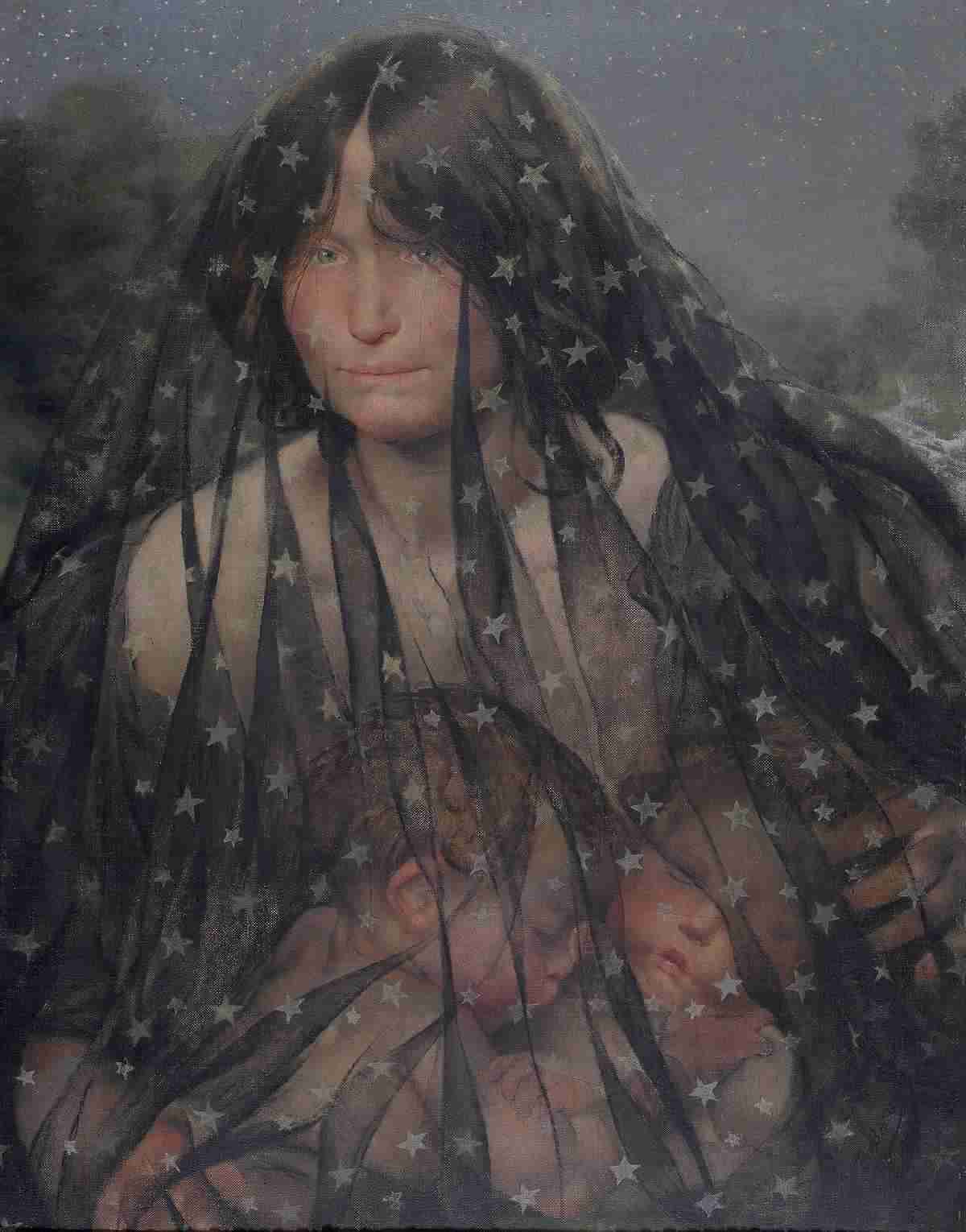
Her cloak is dark and pricked with stars. It wraps the earth at dusk, shutting out daytime glare so the wider sky becomes visible. Pulling that cloak around a room trades local noise for cosmic scale.
Her wings are wide and black, and the poets call her swift. Night does not crawl over a hill like an army. When the sun drops, darkness covers a hemisphere in one breath.
In Greek art, Nyx often carries two infants in her arms. One is white Hypnos, Sleep, and the other is dark Thanatos, Death. Carrying both marks her secret. Night holds small endings every evening and final endings at the close of life. Sleep teaches release so a person learns to let go without panic.
Her chariot rolls on silent wheels behind black horses, while the owl watches and the poppy nods. The owl sees where daylight eyes fail. The poppy folds its petals and brings rest. And her cave in Orphic song is the chamber of counsel, where answers arrive through stillness in the dark until the signal clears.
Night, day and the watcher of heaven
Nyx never fights Zeus. She does not race Hemera at the gate. Her circuit works by turn and measure.
Day goes out and spends force. Night gathers the scattered thread back into wholeness. Without Hemera, the world freezes. Without Nyx, it burns out in noon heat. One gives clarity and action, while the other gives depth and repair.
Between Zeus and Nyx runs a second circuit. Zeus rules thunder and visible command. Nyx holds the Fates, Dreams and Sleep beneath it. When waking power grows loud and rigid, it loses the whole pattern. It must return to the cave of Night and wait for the pattern to speak again.
Where night sits in the birth chart
Ancient Greece gave Nyx the night sky itself, between sunset and dawn. Later astrologers map her ground through the Moon, the dark of the month and the hidden houses.
The Moon is the lamp of night. At a New Moon, the Moon stands between Earth and Sun with its dark face turned toward us. Nothing shows on the surface, yet the coming lunar cycle is seeded in that invisible hour.
In a birth chart, the twelfth house holds the hours before sunrise, where forms dissolve before a new day begins. Planets placed there work like Nyx in her cave, gathering insight out of sight before speaking.
Saturn adds weight and patience to the dark, while modern astrologers also watch Pluto, discovered in 1930, dig beneath the crust to uncover what daytime memory buried. When those planets touch the Moon or the twelfth house, a person learns to trust intervals where nothing moves on the surface. Astronomers also track the modern asteroid 3908 Nyx, found in 1980, which later astrologers treat as a private sanctuary untouched by daylight clamor.
Stepping beneath Nyx's cloak
Enter Nyx's hours when noise has worn out its usefulness and you need counsel from beneath busy thought. Seek her to see in the dark, and never to hide from living work.
Wait until night, when daytime duties end. Dim or turn off every lamp until shadows soften the walls. Sit upright in a chair or lie on a firm mat. Pull a dark blanket over your shoulders like her starry cloak, and close your eyes.
Follow the breath out slowly, longer than you breathe in. Let the day's lists drop, like the Primeval Darkness in Session 78 resting unmoved before light arrives.
If a question weighs on you, speak it once in plain words, as Zeus spoke at her cave. Ask how the scattered pieces belong to one pattern. Then stop asking. Rest behind your eyelids and let dreams or sleep carry the work.
While stars still hold the sky, step outside under the dark dome for one last look upward, honoring the bronze gate where Nyx and Hemera trade places. Stand in the cool night air for three slow breaths, then go back inside and write down one image from the stillness before morning claims the house.
Questions people ask about Nyx
Who is Nyx in Greek myth?
Nyx is the primordial goddess of night in ancient Greece. Born from Chaos at the dawn of the cosmos, she is older than the Olympian gods and bore Day, Sleep, Death, Dreams and the Fates.
Why was Zeus afraid of Nyx?
In Homer's Iliad, the god of sleep hid beneath Nyx's cloak after putting Zeus to sleep without permission. Zeus chased Sleep to her door and stopped short, fearing swift Night, who stood older and higher in cosmic order.
Who are the children of Nyx?
With Erebus, Nyx bore Aether, the upper brightness, and Hemera, the day. Alone, she bore Sleep, Death, Dreams, Nemesis and the Fates, along with other forces that govern limits and destiny.
What happened at the bronze gate of Night and Day?
Hesiod describes a bronze threshold in Tartarus where Nyx and Hemera meet each morning and evening. One steps out as the other steps inside, so the house never holds both at once.
How does Nyx show up in a birth chart?
She speaks through the New Moon, the twelfth house and strong lunar links to Saturn or Pluto. Those placements mark cycles of silent withdrawal where deep insight forms before dawn.
The nurse of the dark
Nyx is the unlit matrix of the cosmos, the stillness where stars and counsel appear.
Lunar Return tracks your monthly moon cycle through its dark seed and full light, showing when to withdraw and when to step out.