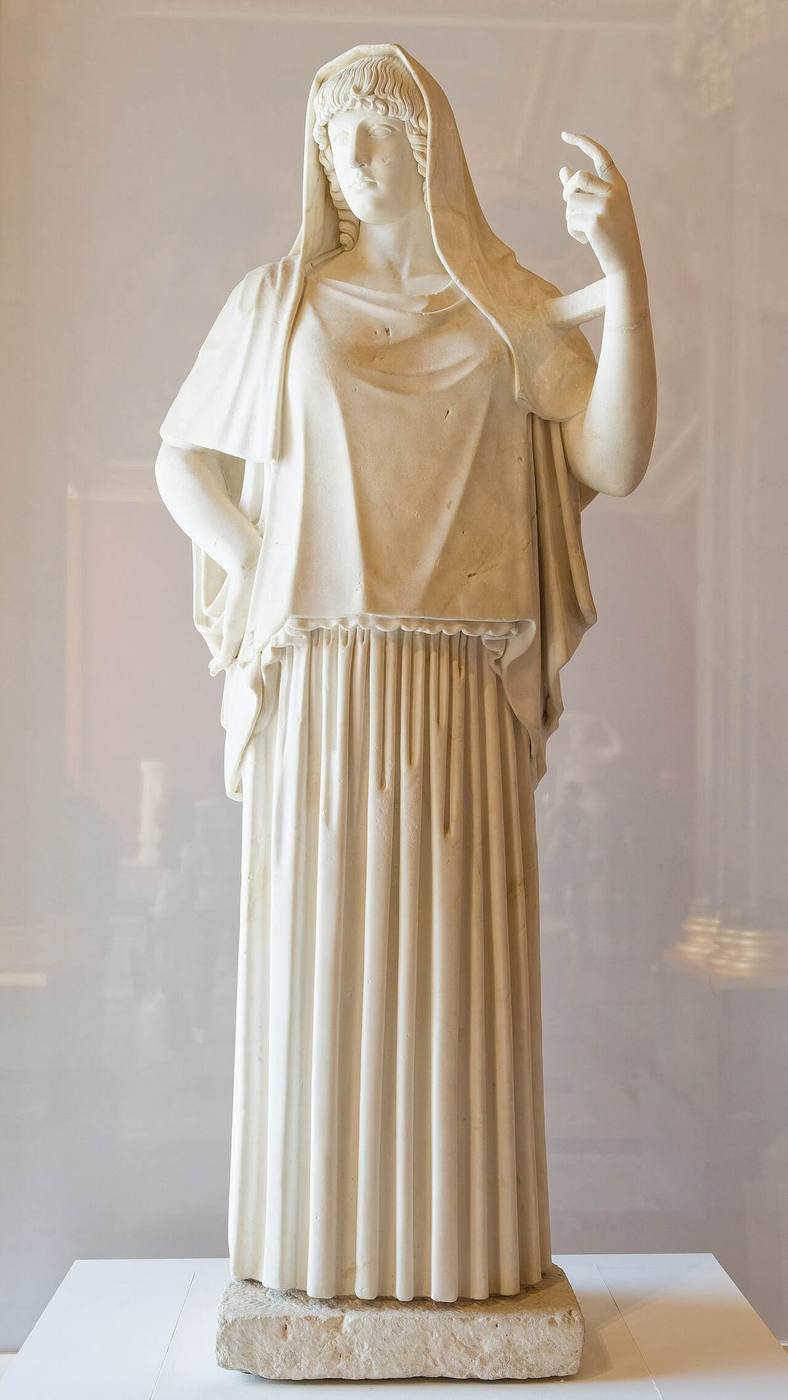
Strike a spark inside a ring of bare stone, and an open camp turns into a house. Keep that coal alive under grey ash, and a colony remembers its mother city across an entire sea. Without a center that stays put, walls mean nothing and guests wander past.
Hestia is the Greek goddess of the hearth, the home and the civic fire. Rome called her Vesta. Her name means the hearth itself, the fixed stone where flame stays inside measure. She is a consciousness older than city gates. She is the still center around which a room, a city or a mind holds its shape without scattering. Greece and Rome built round altars, colonies of live coal and daily rites of pouring to meet her.
The still point inside the noise
Look at a spinning wheel. The rim flies fast enough to blur in sunlight. The hub in the middle barely turns at all. Yet if the hub breaks, the wheel flies into splinters across the road.
Physics keeps bumping into a similar stillness beneath moving matter. In a review on consciousness and physics, researcher Joachim Keppler points to the zero-point field, a base electric field that fills all of space even when every particle and lamp is removed. Everything that moves in the physical world swims inside that unseen background. In Now, Richard Muller notes that Georges Lemaitre modeled the cosmos with galaxies sitting at fixed reference coordinates while space stretched between them.
Greece named that fixed reference point Hestia. She does not chase across battlefields or race chariots over clouds. She holds the hub so the wheel can turn.
In her pages on the Still Point, Maia Nartoomid writes from a voice she calls ThothHorRa. She speaks of Magna Neutra, a neutral presence in the cosmos that carries no outer charge of its own and mirrors itself in space as stillness. In her account, disordered energy in constant motion is drawn inward toward that Still Point to reset and find rest. When scattered vibration meets an unmoving center, the noise collapses into order.
Session 79 of The Law of One points to the same still root inside thought. There, the Matrix of Mind is described as unmoving, yet the source from which every movement of thought begins.
In Today, We Change Direction, Anne Tucker names that same center the zero point between chapters. Most people leap straight from one task or season into the next without stopping. When you pause in that stillness, she notes, old habits drop off and something genuinely new can rise from the sacred flame inside your presence.
That is Hestia. She is the uncharged hub where restless motion lays down its burden and resets.
The firstborn who stayed at the table
This is the story told in the Homeric Hymns and in the lore of Rome.
Cronus, king of the Titans, feared his own children and swallowed each one at birth. Hestia was the firstborn child of Cronus and Rhea, so she entered the dark belly of her father first of all. Years later, after Zeus grew up in secret and gave Cronus a bitter drink, the Titan threw up his children in reverse order. Hestia came back into daylight last. By that turn of fate, she became both the eldest and the youngest of the Olympians.
When peace settled upon Mount Olympus, two great gods came to ask for her hand. Poseidon, lord of the sea, wanted her. Apollo, lord of sun and bow, wanted her too. Both stood before her in full glory.
Hestia stepped forward and laid her hand upon the head of Zeus. She swore a great oath that no god would move. She would never marry, never take a side in battle, and never leave the hall.
Zeus accepted her vow and answered with a gift no other god held. While the others rode across the sky, the sea and fields of war, Hestia received the center of every house and every temple on earth. At every mortal table, whether in a palace or a hut, the host poured the first drop of wine for Hestia before eating, and poured the last drop for Hestia before rising. No feast began without her, and no feast closed without her.
Later, when Greeks sailed away to build new towns across the sea, they never left Hestia behind. Priests lifted a glowing coal from the mother city's round hearth and carried it inside a clay pot across the waves. Only when that live ember touched new stone did the new city truly begin.
In Rome, six maidens called Vestals guarded her fire inside a round temple in the Forum. As long as that flame burned, Rome stood whole. If carelessness let the fire go out, all courts and markets stopped at once. No person could relight it with a common flint from a kitchen. The chief priest had to drill dry wood from a lucky tree until friction caught spark, or focus sunbeams through bronze until sky fire landed back in the bowl.
What holds the coal inside the ring
An ember inside a clay jar looks humble beside a thunderbolt. Look closer at the hearth, and two strict laws of energy stand clear.
First, fire needs a stone ring to serve a room. Lightning splits a tree and vanishes in a breath. Wildfire eats a forest and leaves black ash. Only fire set inside stones stays in one spot long enough to warm cold hands, boil water and turn dough into bread. Power without a center burns its own house down.
Second, whatever begins a circuit must also close it. Hestia was swallowed first and returned last, so she holds both doors of every meal. Start a day or a task in haste without touching center, and the thread frays before noon. End a day without gathering attention back to the stone, and the mind keeps spinning all night.
Stones, veils and live embers
Each piece around Hestia's shrine works as part of one simple instrument.
Begin with the round shape of her altar. In Rome, other temples had four walls and sharp corners. Vesta's temple was a circle with no corners at all, like the earth and like the rim of a campfire. A circle has one point equidistant from every edge, and that point is the flame.
Next comes her veil. On the great marble statue of Hestia in the Torlonia collection, a plain cloth covers her head and falls straight down her shoulders. She lifts one hand slightly and keeps her eyes level. The veil is there to turn attention inward. Nothing leaks outward looking for applause.
Beside the veil stands the ember pot of the colonists. A spark carried inside ash can cross a rough sea and survive days of rain. You do not move a whole house across water. You carry one live coal and let the new stones gather around it.
Then come the first and last drops of wine. The ancients poured a small splash onto the floor or into the ashes before the cup went around, and a second splash after the cups were empty. That small gesture marked a clear rim around time. Inside those two drops, the gathering belonged to peace.
Even the lowly donkey appears in Ovid's Fasti beside Vesta. One night while the goddess slept after a feast, a creature crept toward her in the dark, and a donkey brayed so loud that Vesta woke and chased the intruder out. Watchfulness at the hearth does not depend on grand armor. A small, stubborn alarm keeps the gate safe.
Hermes at the door, Hestia at the center
Greece paired Hestia with Hermes across countless shrines and porches. Their pairing forms a working circuit.
Hermes stands at the doorway, the crossroads and the highway. He rules speech, trade, swift footsteps and crossing borders. Hestia stands inside the room at the unmoving stone. She never travels down the road.
Think about a wheel or a breath. An out-breath travels into the world, meets strangers, trades goods and gathers news. That is Hermes. An in-breath returns to the ribs, sorts what was gathered and warms the blood. That is Hestia. Without Hermes, a house turns stale and shut off from news. Without Hestia, a traveler forgets where home sits and burns out on the road.
Where the hearth burns in the sky
Ancient Greece honored Hestia at the center of the house instead of on one star. In modern astronomy, telescopes track asteroid 4 Vesta, discovered in 1807, between Mars and Jupiter. Vesta has a bright silicate crust and reflects more sunlight back to Earth than any other asteroid in the main belt. You can sometimes spot it with binoculars under a dark sky.
In a modern birth chart, Hestia also lives strongly in the fourth house of home, roots and ancestors, and right at the Imum Coeli, the midnight point at the bottom of the chart. Planets sitting near that lowest angle act like stones beneath the floorboards. They hold everything above them upright only when tended in peace.
Notice also strong links between the Moon and Saturn. The Moon marks the living body's daily shelter, kitchen and memory. Saturn gives stone bounds so that warmth does not spill away. When the Moon meets Saturn in harmony or hard angle, a person learns how to build an inner hearth that outlasts changing weather.
Banking the embers at Hestia's hearth
Step up to the hearth when your attention scatters across too many rooms, when noise fills every corner of the day, or before starting a work that needs calm endurance. Her fire answers only in stillness.
Come at dawn before the house wakes, or at dusk when chores slow down. Set one beeswax candle or small oil lamp inside a ceramic bowl or on a stone coaster in the middle of a table.
Sit with your spine upright, heels tucked comfortably under your knees, and your weight balanced evenly on the chair. Rest your hands lightly on your thighs. Watch the base of the flame, right where blue light hugs the wick without jumping. Let your breath slow down until the belly softens.
Bring your attention behind the navel and up to the solar plexus. Recall Tom Kenyon's teaching on the inner sun. Direct simple gratitude toward that warm center inside the chest and belly without forcing images or straining for visions. Stay there for five minutes while random thoughts walk past like guests passing a doorway. Let them walk out without chasing them.
Name one place, one room or one piece of work that needs your center today. Speak its name softly to the flame, just once. Know that whatever leaves your hands today still stays linked to this calm point.
When the five minutes finish, bank the fire as Greek hearths did at night. Do not blow wildly across the flame. Lower a metal snuffer or an upside-down clay bowl over the candle so the wick cools into dark air while leaving the wax whole for tomorrow. Touch the warm rim of the bowl once to seal the day's center, turn away from the table, and step into the room's work.
Questions about Hestia and the hearth
What is Hestia the goddess of?
Hestia is the Greek goddess of the sacred hearth, the home, architecture and the civic fire of the city. Romans called her Vesta and honored her flame as the living heart of Rome.
Why did Hestia never marry?
When both Poseidon and Apollo sought to marry her, Hestia placed her hand on the head of Zeus and vowed lifelong independence. By staying free of factions and marriage ties, she could sit at the center of every house and receive peace from all sides.
What did the first and last libations mean?
At every Greek meal or sacrifice, people poured the first splash of wine and the final splash to Hestia. Honoring her at both ends turned ordinary eating into a protected circle from start to finish.
How is Hestia connected to Hermes?
Greek shrines often placed Hestia and Hermes together because they rule opposite halves of movement. Hermes guards doors, travel and roads outward, while Hestia anchors the unmoving center inside the house.
How does Hestia show up in a birth chart?
Hestia speaks through asteroid 4 Vesta, the fourth house of roots and dwelling places, the Imum Coeli at the bottom of the chart, and grounded Moon and Saturn links that hold space together.
The fire that stays home
Hestia is the round stone beneath the flame, teaching consciousness how to gather its scattered sparks back into one unmoving center.
Local Space maps those hearth lines across your actual rooms and directions, showing where your chart anchors calm power right where you live.