Outside the walls of old Greek villages, three dirt tracks met where the dark woods bordered the orchard grass. A dog barked once along the fence. A single pine torch threw yellow light ten paces down the rough stone, never claiming to show the next valley.
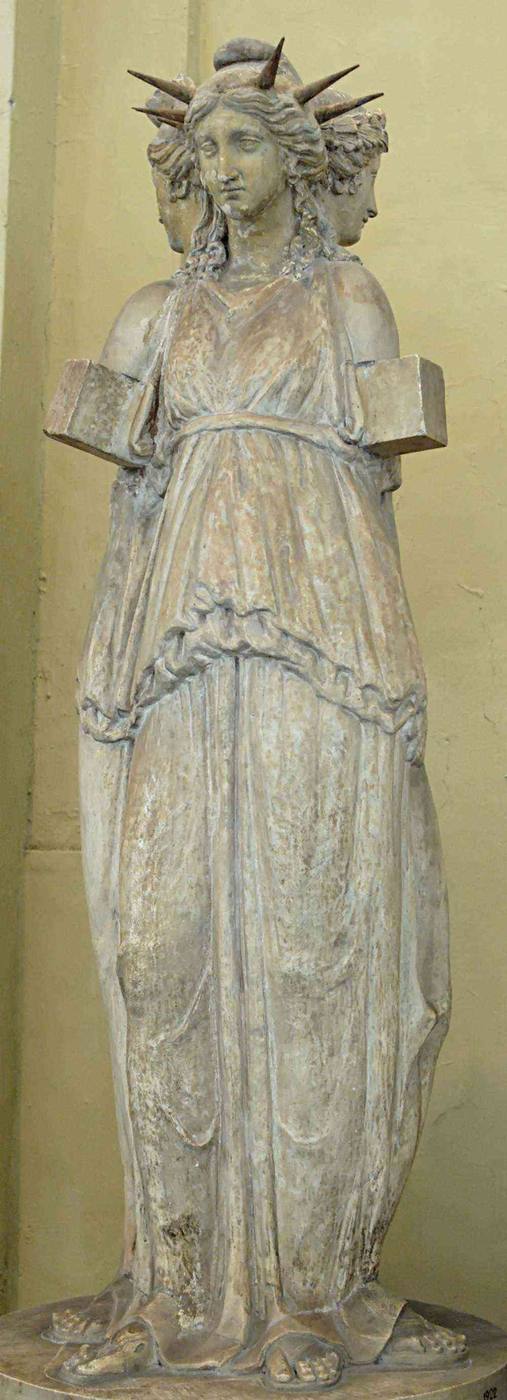
Hecate is the ancient Greek goddess of crossroads, doors, keys, torches and hard turns. Later centuries painted her as a screaming witch crouched inside foggy woods. Yet Greek towns bolted her small pillars onto front gates to shield houses from harm. Where a road runs out and three hard choices wait ahead of your boots, she holds just enough light to choose your next step awake. Her three bodies, her torches and her brass keys form an instrument for crossing an irreversible turn.
When a river splits at a boulder
Think of a clear hill creek flowing smoothly over mossy rock, week after week, with scarce a ripple changed. Pile heavy rain upstream, or roll big boulders across the current until pressure builds past a tipping edge. All at once the smooth water breaks out of its old channel. Foam spins, mud caves in, and the creek cuts into a brand-new riverbed it never ran down before.
Once water splits around a rock into a lower trough, it never climbs back up the hill into yesterday's stream. A town gate works by that same rule. When an iron bolt slides home at dusk, the road behind the traveler locks shut, and only the road ahead stays open.
Greece met that moment at every three-way fork outside its walls. They called a three-road crossing a triodos, and carved Hecate in limestone with three watching faces right above the gravel.
The Titaness who kept three kingdoms
Long before later stages cast her as a midnight hag, Hesiod sang her true line in his eighth-century Theogony.
Hecate was daughter to the Titan Perses, whose name means piercing force. Her mother was Asteria, whose name shines like starlight. She belongs to a sky race older than Zeus and older than the high snow on Mount Olympus. When war shook heaven and Zeus cast the beaten Titans underground, he paused before Hecate. Zeus took no crown away from her hands. Hesiod tells how he honored her above every god. He left intact her share across the earth, the sea and the starry sky alike.
In her essays at Covenant of Hekate, historian Sorita d'Este examines the old sanctuaries directly and clears away a second error about the goddess. Greek poets called Hecate a virgin goddess. That old word had nothing to do with timid shame. In temple Greek, virgin meant belonging to no husband and obeying no king. She stood whole under her own law.
Her clearest deed stands inside the Homeric Hymn to Demeter.
One morning, Hades tore open the meadow grass and dragged Demeter's young daughter Persephone downward into his cold house below the earth. Persephone cried aloud as the chariot horses plunged past gray rocks, calling to heaven above.
No Olympian king moved. The sun god Helios saw every bright field down below from his high chariot reins, yet kept still behind bright rays. Temple stewards swept the steps below. Only Hecate, waiting inside her cool cavern wearing a bright headband in the twilight gloom, heard that sharp cry tear across the rocks.
When broken-hearted Demeter searched nine days without bread or bath, Hecate stepped out of her cave holding twin torches. Neither knew who stole the girl yet. Hecate stood beside Demeter until both women marched straight up to Helios's morning wheels. Together they forced the truth out into the noon light.
Zeus later struck a seasonal truce. Persephone walked into the grass each spring and sank under the frost each winter. Year after year, Hecate stepped forward to hold the door. She walked beside Persephone as a guide across the thin line linking dark soil roots with the open sky.
No town hid her in wet bushes. At Athens, families set stone pillars called hekataia beside their front doors. They called her Apotropaia, Protector Against Harm. Across western Anatolia at Lagina in Caria, crowds marched down limestone roads holding her sacred key. That key path joined her countryside cave straight to the town halls. By the second century after Christ, mystics reading the Chaldean Oracles praised Hecate Soteira, the Saviouress. They saw her as the luminous World Soul bridging pure mind down into warm flesh.
What the story reveals at the gate
Look closely at that cave beside Demeter, and two hard laws rise straight off the old stone.
First, big changes sound first along dark borders, long before loud palaces notice trouble coming. Helios looked down on continents from high bright clouds. He stayed silent until confronted at dawn. Hecate sat inside cool twilight rock, tuned close to broken voices passing across borders. An alert mind kept at the edge hears cracks long before high courts file morning reports.
Second, a gate swings in one direction when its hour hits, never backward toward dead safety. After Persephone tasted the underworld seeds, girlhood could never lock shut again. Once a creek cuts a new bed, the water never climbs back up the ridge. Maturity asks only if your torch still burns while the old ground drops behind your boots.
Standing firm when old roads snap
Teachers working with rapid change arrive at that same gravel junction from another angle.
In an October 2014 Hathor message called Escalation of Chaotic Nodes, Tom Kenyon writes that earth shocks, strained talk and sudden stress braid into tight Chaotic Nodes. Old habits fail whenever outer change speeds up past comfortable bounds.
Kenyon shares a sound practice for passing through those nodes intact. He gives no complex geometry for the mind to wrestle. He asks only that the listener rest plain attention inside the physical body while listening, letting sound settle spinning thoughts out of panic.
Then Kenyon drops into ancient threshold speech. We stand at a clear fork in the road, he writes, alone and all together. One fork drags confused minds down toward breakdown, numbness and fear. The other opens contact inside inner stillness and clear sight. The worst blunder at any chaotic fork is straining every muscle to tape yesterday's cracked plaster while the whole floor moves underneath.
In her talk Waves of Coherence with Isla, Anne Tucker speaks about bifurcation. Splitting one whole into two clear branches, male beside female or left brain facing right, gave souls room to learn contrast inside earth life. Yet rising light calls divided branches back into coherence instead of blind conflict.
Hecate stands right where Kenyon's fork meets Anne Tucker's twin bridge. She never pulls the world down on your neck. She holds a flame bright enough so you stop walking asleep into old ditches. Refuse panic at the gravel fork, and your eyes widen ten paces ahead until the ground holds again.
The pillar, the torch and the brass key
Look at a carved pillar of Hecate from sandal to torchlight, and each piece serves one task at a border.
Begin with her three bodies, carved across Greece as Hekate Trimorphis. Three women stand back to back around one solid pillar, watching all three roads meeting at once. Fear grows whenever we pretend one path exists or keep twisting backward hoping a barred hinge drops open. Three watching eyes leave zero blind corners. One face checks where you came from. One watches danger along the grass shoulders. One fixes sharp sight straight ahead onto the open gravel.
In her upper hands blaze twin pitch pine torches, giving her the title Phosphoros, Bringer of Light. Look closely at a pine resin flame. It lights no three-mile highway so pride feels safe until next spring. Pitch torches throw yellow warmth roughly ten or twelve feet ahead in the wet night. You spot rolled ankle stones, mud holes and snakes before your boots while distant hills stay dark. Hecate offers exact sight for the next ten paces, starving anxious hunger for fake ten-year guarantees.
Across her lower fingers rattle bronze and iron keys, giving her the title Kleidouchos, Keeper of the Keys. Soldiers splinter oak frames down using heavy iron rams. Keepers carry cold teeth filed precisely for each lock. Brute pushing breaks timber before the season ripens. Accurate timing clicks one pin back and swings heavy hinges wide.
Beside her skirt stands a dark hound alert toward the outer fence lines. Dog ears pick up steps over wet turf long before human pupils widen. Dogs hold the edge of camp yards where strangers cross into light before motives show plain faces.
Around her ankles wind coiled serpents shedding papery old skins beside warm stones. Growth requires leaving tight cracked scales behind in the dirt instead of dragging dead armor into fresh clover.
On old stone carvings she keeps a short blade beside twisted cords or whips. A knife cuts finished vows loose from live breath. A braided rope ties scattered attention firm before crossing dark roads so wandering thoughts stop drifting off the path.
Guardian between worlds
See Hecate alongside her neighbors walking Greek skies, and her station turns clear at once.
Hermes sprints along trade routes and underground halls like liquid silver carrying news between worlds. Hecate rarely runs errands down highways. She watches the gatepost itself. Persephone walks back and forth across frost and spring leaves, falling into soil and rising green above the wheat ridges. Hecate steps beside her with lamp and key so crossing between damp underworld caves and noon light never splits a soul in half.
Sorita d'Este traces those long key processions down dusty roads outside Lagina to remind readers of one fact: whenever dead chapters press against living rooms, somebody tends the lock without bribery or panic.
Mystics of the Chaldean Oracles went further. They saw Hecate as a burning membrane stretched between pure celestial intellect and solid matter below. Light flows down through her lamp, and warm life climbs back through her open door. Remove that door, and spirit floats blind above dust while clay turns dark and cold.
Where she watches in the sky
Astronomers found asteroid 100 Hekate in 1868 in the main belt between Mars and Jupiter. Modern astrologers trace her threshold pattern in three places across a birth chart.
Look first to the Dark Moon and Balsamic Moon, the last three slim days before the New Moon clears the night sky. People born under shrinking silver slivers often keep their nerve around bedside closes, inheritance shifts and late research nights.
Check natal Moon aspects touching Pluto, Saturn or Uranus next, plus strong planets inside the eighth or twelfth houses. These contacts strip cheap illusions off early in life. They train plain nerve when familiar ceilings drop away.
Watch Chiron or outer planets stationed near sign cusps or chart angles too. Those spots record early moments when others called your sight bleak or cold because you saw loose beams cracking long before ceiling plaster fell.
Keeping the dark-moon supper at the doorpost
Come to Hecate when a chapter has truly ended, three roads open at your shoes, and smooth excuses have run dry. Leave behind any wish for cheap drama or bright tricks to force dead doors open again without sweat.
Pick her ancient night: the dark moon evening right before thin new light returns. Athenians called this household night Hekate's Deipnon, her threshold supper.
Clear your physical doorway first. Sweep dried mud off your porch step, wash stale finger marks off wood door frames, return borrowed books sitting overdue near tables, and shift old boots blocking outer entryways. Hecate rarely meets people inside cramped entryways choked with overdue debts.
Lay three plain gifts on a small clay dish beside your outer doorpost at dusk. Set down a peeled garlic clove, a spoon of wild honey or plain water, and three dry twigs laid in a fork. Place one beeswax candle inside clear glass near your shoe edge so yellow warmth lights ten feet of cold step.
Stand barefoot or flat-heeled straight on the sill where indoor heat touches night air. Refuse begging for bright answers covering five whole winters ahead. Borrow Kenyon's simple cue: sink raw attention straight inside skin, soles, ribs and warm belly breath until spinning thought drops down into bones.
Speak one calm question into the cold darkness: which old road behind me has locked shut, and what clear next step stands inside ten paces before dawn? Wait through two silent minutes without checking glowing glass screens or grabbing false comfort.
Finish the Deipnon by the old threshold law. Leave that small clay dish outside beside the dark grass. Step inside your own hall, swing the wooden door shut, and turn the brass key in the lock once until the bolt clicks home. Hang the key on its hook beside the frame, and walk into the house without glancing back out any window before sunrise. A threshold holds firm only when you trust the crossing and refuse twisting backward to stare at old shadows.
Questions people ask about Hecate
Who is Hecate in Greek mythology, and who were her parents?
Hecate is an ancient Greek pre-Olympian goddess born to Titan Perses and star goddess Asteria. In Hesiod's eighth-century Theogony, Zeus honored her above every beaten Titan, leaving untouched her full rightful share across earth, sea and starry night alike.
What is Hecate the goddess of?
In history and temple craft she governs three-way crossroads, house doors, edge stones, dark moon passages, soul crossings between worlds, neighborhood protection and sharp sight during heavy change. Athens kept small Hecate pillars right beside home gates to keep danger outside.
Why does Hecate have three faces and appear with dogs, keys, torches and serpents?
Built as Hekate Trimorphis watching three roads at once, she tracks past, present boot step and curve ahead without blind spots. Twin torches throw light ten feet down dark stone, keys unlock ripe gates, hounds guard outer fences and serpents model shedding dried skin.
How did Hecate help Demeter and Persephone?
In the Homeric Hymn to Demeter, only Hecate heard Persephone cry out when Hades carried her underground. Holding twin torches beside Demeter until truth broke from Helios, she became Persephone's trusted companion guiding every spring and autumn crossing between dark earth and bright sun.
What is Hecate's Deipnon, and why did later centuries fear her?
Deipnon was a monthly dark-moon supper laid beside three-way crossroads after sweeping dust and stale rubbish out of home doorways. Later polemics and stage plays like Macbeth twisted her torchlit doorway guard into scary witch tales, hiding how warmly ordinary towns kept her beside front porches.
The torch and the key
Hecate is the ten-pace pine light and brass key standing watch where smooth maps break into three new roads.
Electional studies moving skies across calendars so your first open step falls right when iron bolts slide freely back.