Where the plowed field stops and oak trees begin, a narrow border runs in twilight. Beyond that edge there are no fences, no stone walls and no ledgers. Every track belongs to creatures that know the forest from inside.
Cernunnos sits along that border.
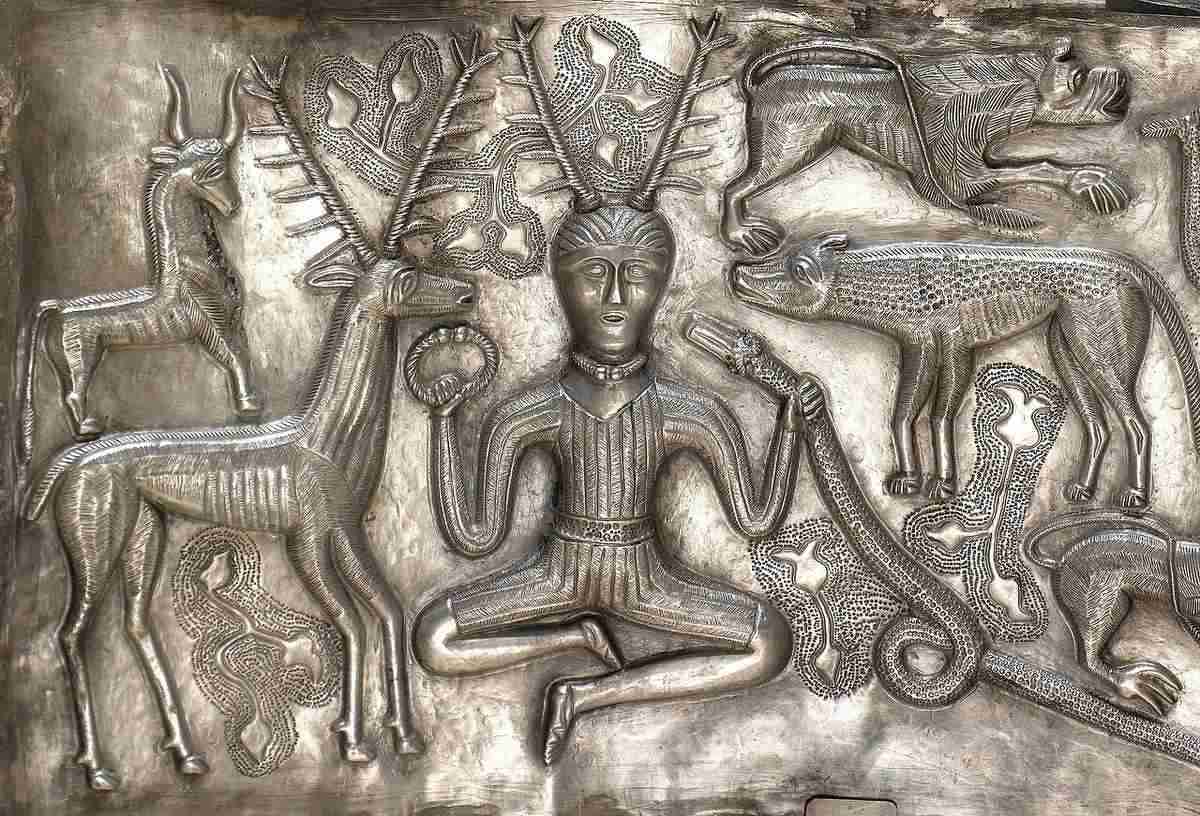
Cernunnos is the horned god of Celtic Gaul and northern Europe, carved on the first-century Pillar of the Boatmen in Paris and beaten into silver on the Gundestrup Cauldron. He wears the branching antlers of a stag while holding a metal neck-ring in one hand and a horned serpent in the other. He sits at the edge where human craft and wild instinct meet without war. His branching antlers, his two full hands and his cross-legged posture form a stone and silver map of that truce.
The self-making web around the clearing
Most people treat a forest as timber and dirt waiting for human hands. Systems science describes a different world.
In The Web of Life, Fritjof Capra traces the work of biologists Humberto Maturana and Francisco Varela. They named the trait of living things autopoiesis, a Greek word meaning self-making. Every cell and organism is a network of processes that keeps making its own skin and rebuilding itself from inside. Capra links this to the Gaia theory formed by James Lovelock and Lynn Margulis. Earth's rocks, oceans, air, microbes and forests couple tightly into feedback loops. Those loops keep temperature and breath balanced across billions of years.
Tom Kenyon and the Hathors speak of that planetary intelligence in Gaia's Song. They teach that Earth is awake and conscious, though her mind moves nothing like human thought. When a person breathes out gratitude from the heart, the body aligns again with Earth's elements as a standing wave of light and matter.
Lee Carroll carried that view further in his Kryon talk at Pico Island in the Azores. Watching whales and dolphins off the coast, he spoke of animals carrying awareness as vital gears inside Gaia's design. Anne Tucker says much the same in her talk What Happens to the Animals in the Shift. Wild and tame creatures are sentient travelers sharing the road with us, never mute furniture.
Cernunnos sits in the middle of that living web. He does not stand above the animals with a whip. He sits among them as part of the ring.
What the silver cauldron and the stones show
No written story of Cernunnos survives from the ancient world. Rome left letters and poems about Jupiter and Mars. The Celts passed down their lore by memory and voice. What remains of Cernunnos stands before us in stonework and hammered silver.
In Paris, river traders set up the Pillar of the Boatmen during the first century. Above a bearded face crowned with deer ears and sprouting antlers, the pillar carries his name carved in Roman letters: Cernunnos.
At Reims, another altar shows him seated in the center between Apollo and Mercury, gods of order and trade. From a bag in his lap, Cernunnos pours a stream of grain and coins onto the earth below. A stag and a bull stand beside him, looking up toward the gift.
The clearest scene survived inside a peat bog in Jutland, Denmark. Workers dug up the silver plates of the Gundestrup Cauldron, shaped over two thousand years ago. On Plate A of that vessel, Cernunnos sits cross-legged upon the ground in a tunic and belt.
Around him move a stag, a wolf, a bull and a lion, beside a figure riding a dolphin. None of the beasts attack one another. The wolf walks near the stag. The lion paces beside the bull.
In his right hand, the horned figure lifts a twisted torc toward the sky. He wears a second torc around his throat. In his left hand, he grips the neck of a serpent crowned with the horns of a ram. He looks straight forward with open eyes, holding both the ring of metal and the creature of soil at one height.
Shedding horn and full scale
Those stone and silver scenes map two laws of balance between the city and the forest.
First, everything that grows out of Earth must know how to shed in season. A stag does not keep its antlers forever. Every spring bone rises fast under velvet skin, hardens for autumn, and drops off the skull before winter ends. When a person clings to last year's crown, the weight bends the neck and breaks the rhythm of the year.
Second, human wealth stays lawful only while the wild world keeps its seat in the opposite hand. Look at the Reims altar and the Gundestrup plate. Cernunnos holds coins, grain and the torc of craft on one side, while gripping the horned serpent on the other. Trade and harvest thrive only while rivers run free, soil breathes and animals keep their room. Take one hand away from the scales, and the clearing collapses into dust.
Antlers, torc, horned serpent and seated frame
Four parts of the Gundestrup Cauldron image work together like the pieces of a scale.
Above his brow rise the branching antlers. In The Matter With Things, Iain McGilchrist notes a striking fact about deer. No two stags grow identical crowns, yet the left and right antlers on one animal grow as mirrored twins. Even if both antlers are cut back, the stag regrows the same pattern from memory held inside the whole body. On Cernunnos, the antlers show a mind rooted in seasonal renewal.
In his right hand shines the twisted torc. Celtic smiths hammered gold, bronze and silver bars into neck rings worn by nobles and warriors. Holding a second torc aloft shows wealth offered outward instead of locked inside a chest.
In his left hand coils the ram-headed serpent. Serpents live close to roots and underground springs, while rams carry the thrust of spring growth. Held by the neck without harm, the horned serpent marks earth-force guided by wakeful grip instead of crushed under a heel.
Beneath them rests the cross-legged frame on the cauldron floor. Crossing the legs locks the hips into a triangle upon the ground. The spine rises like a trunk between roots below and antlers overhead, turning the body into a bridge between earth and sky.
Cernunnos among the earth signs
No planet bears Cernunnos's name. Modern astrology traces his woodland balance through the earth signs and the slow cycles of a birth chart, though Celtic lore itself kept no written horoscopes.
Taurus and Capricorn carry the weight of his clearing. Taurus rules fertile loam, herds, grain, copper coins and growing grass. Capricorn rules bone, mountain stone, winter endurance and the ridge where trees shed leaves before spring.
Look at Saturn, Venus and Jupiter working across the sixth and tenth houses. Venus brings harvest and beauty in craft. Jupiter brings generosity, like grain pouring from the lap of the Reims altar. Saturn supplies the frame, seasonal limit and respect for time that keeps wealth from turning to greed. When Saturn touches Venus or the earth houses, Cernunnos asks what you build and what you give back to the soil.
Stepping to the woodland border
Stand at this threshold when human noise grows loud, when work pulls you away from nature, or when you need balance between earning and keeping roots. Come at twilight, near trees if you can, or beside a window looking out on the sky.
Set a dish of plain water and a pinch of grain upon a wooden table or flat stone. Sit cross-legged on a blanket, or sit upright on a chair with both feet on the floor. Rest your right hand open on your right knee and your left hand on your left knee.
Close your eyes and picture Earth beneath the floor, rocks, roots and water working together as Capra described. On each slow out-breath, send gratitude down through your ribs into the ground, following Kenyon's practice from Gaia's Song.
Now check both hands of the scale. In your right palm, name one piece of craft or daily work you tend this month. In your left palm, name one part of nature you share space with, whether wind, trees, birds or your tired body. Ask how the two can feed each other without theft.
When the prayer ends, return the offering to the border. Uncross your legs if you sit on the floor, and carry the dish of water and the pinch of grain outdoors. Scatter the grain and pour the water under a tree or onto bare soil. Touch rough bark with one fingertip, leave the wild edge unbroken, and step inside without looking back.
Questions people ask about Cernunnos
What is Cernunnos the god of?
Cernunnos is the Celtic god of wild beasts, forest borders, seasonal renewal and lawful abundance. Altars and silver reliefs connect him with stags, serpents, grain, coins and the meeting between trade and living nature.
Does any written myth of Cernunnos survive from antiquity?
No written story of Cernunnos survives from Gaul or Britain. What historians know comes from carvings and inscriptions, above all the Pillar of the Boatmen in Paris, the altar at Reims and the Gundestrup Cauldron.
What is shown on the Gundestrup Cauldron?
On Plate A of the Gundestrup Cauldron, a bearded figure with stag antlers sits cross-legged among a stag, a wolf, a bull and a lion. He holds a torc in his right hand and grips a ram-headed serpent in his left.
Why does Cernunnos hold both a torc and a serpent?
The torc stands for human craft, wealth and rank, while the horned serpent stands for earth-force and animal instinct. Holding both at once shows that prosperity lasts only when people keep partnership with living nature.
What planets match Cernunnos in astrology?
Cernunnos mirrors Saturn, Venus and Jupiter working through the earth signs Taurus and Capricorn. Those placements tie skilled craft and lasting reward directly to patience, stewardship and seasonal cycles.
The antlers and the ring
Cernunnos is the horned guardian at the forest edge, holding human wealth and wild earth together in one balanced seat.