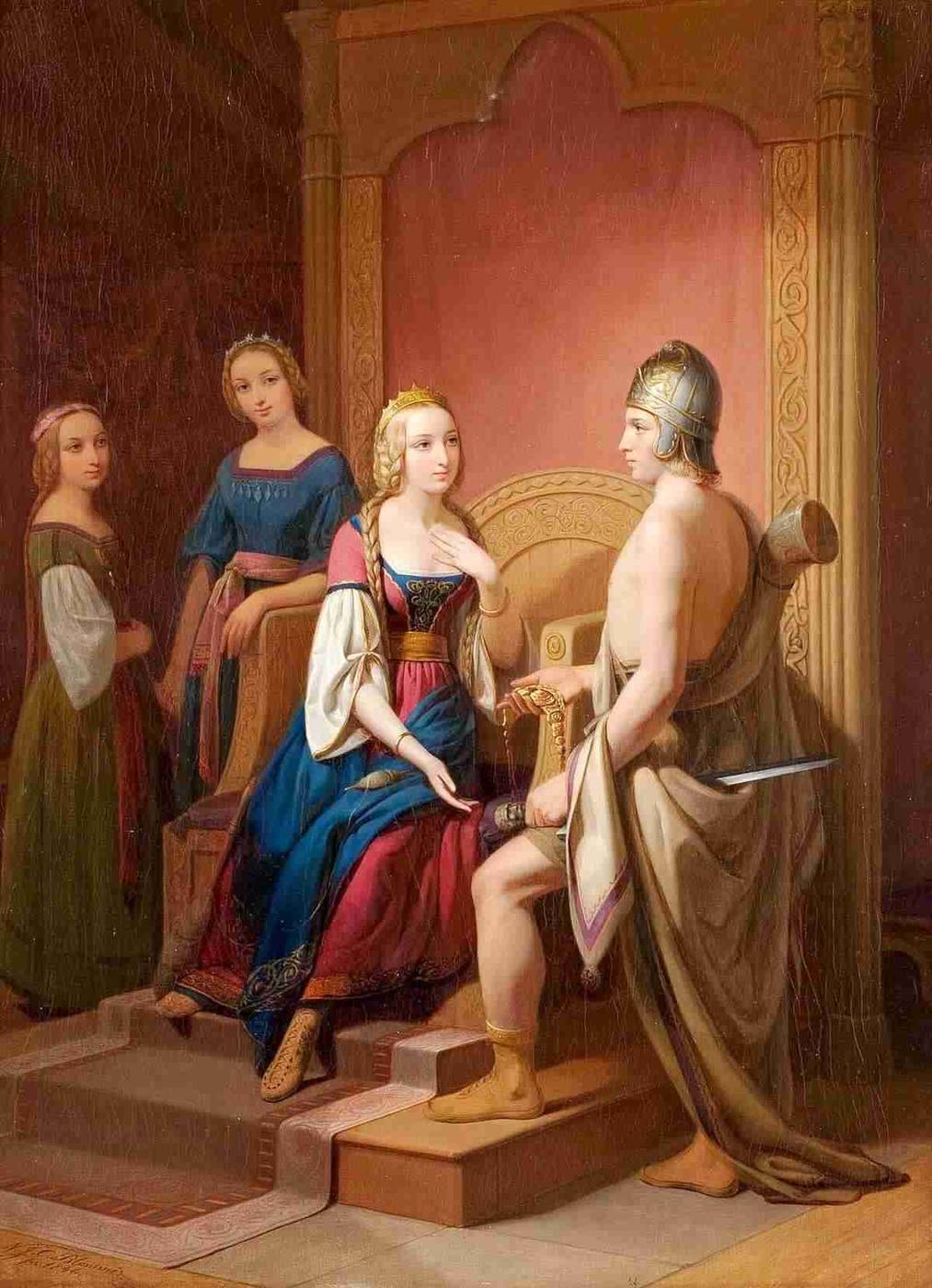
Long ago, two tribes of gods fought until neither could win. The Aesir of the sky and the Vanir of the earth and sea made peace by exchanging their brightest hostages. Out of the Vanir camp came Njord, his son Freyr, and his daughter Freya.
Freya is the Norse goddess of desire, gold, trance magic and battle-slain souls. Her name means The Lady. Across the old poems she bears titles such as Vanadis, Lady of the Slain, and Mardoll, the one who shines upon the sea. She is older than the timber halls of Asgard. The North preserved her craft in a dwarf-forged necklace, a feathered cloak and the trance song of seidr.
The pull that keeps its own center
We often split longing from strength, as if desire makes a person soft and power makes a person cold. Freya refuses that split.
In the poem Grimnismal, she rides out to the battlefield beside Odin and takes first choice of the dead. Half of the fallen warriors ride to Odin in Valhalla. The first half belong to Freya in her meadow Folkvangr and her hall Sessrumnir. In the Saga of the Ynglings, she brings the trance art called seidr from the Vanir. She teaches it to Odin himself, even when warriors mock the craft.
Look at how lodestone and amber behave in nature. A magnet draws iron filings across open air without lifting a finger. It keeps its own poles intact while every shard turns to meet it. Rub golden amber against raw silk, and a charge wakes on the surface. Loose threads lift toward the stone without breaking either one.
That is Freya. She is a magnetic current that enters union whole and refuses to be owned by what she draws near.
The necklace, the rage and the gold tears
Three stories in the Eddas show how this force behaves under pressure.
In the poem Thrymskvida, the frost giant Thrym steals Thor's hammer and refuses to give it back unless the gods send Freya to his hall as a bride. Odin and Thor bring the proposal to her chamber and tell her to put on the bridal linen.
Freya answers with fury. She shakes where she stands until every beam in Asgard trembles, and the necklace Brisingamen snaps off her neck and springs to the floor. Desire that belongs to itself cannot be traded to pay another's debt.
Another tale tells how she came by that necklace. Four dwarves forged Brisingamen in a cave under the earth, and Freya wanted it more than silver or land. She paid the price they asked in her own person and wore the shining collar around her throat.
Snorri Sturluson records a third story about her husband Odr, whose name shares its root with Odin's wind of inspiration. Odr travels far along distant roads and stays away for long seasons. Freya sets out across strange lands under many names to look for him. As she walks, she weeps, and her tears fall upon stone and turn into red gold.
Why desire snaps or turns to gold
Taken as court gossip, those tales look strange. Taken as an anatomy of desire, they are exact.
Desire has levels, and most people stay trapped at the bottom rung. In her talk Three Levels of Desire, Anne Tucker shares Isla's teaching on three stages. The first is the void before longing wakes. The second is desire born from lack, which compares what you have against what someone else holds and keeps you inside old limits. The third sets down lack and lifts desire into a bridge toward what is not yet known.
Freya's tears show that bridge in action. When Odr is gone, she does not freeze her heart or turn bitter. Grief moves through her body and leaves behind incorruptible gold. Value is not ruined by loss when the center stays intact.
Speakers in The Law of One sessions describe love and sexual exchange as a vibratory bridge between space-time and time-space. Blockage happens, those transcripts explain, only when fear hides the truth that the other person belongs to the same source.
Lee Carroll adds in his Kryon talk New Attributes of Love that love acts as a signal carried in our DNA, both receiving and transmitting across the Field. When that signal opens, coherence spreads through the body like a wave.
Freya holds the switch for that current. When coerced, Brisingamen snaps off. When given freely, the gold flows.
The cloak, the cats and the boar
Each sign around Freya belongs to her craft of attraction and clear flight.
Around her throat shines Brisingamen, forged from fire beneath the earth. It sits at the voice and the collarbones, the gate between what the heart wants and what the mouth agrees to. When a bargain insults your worth, the tremor at the throat is the necklace refusing to clasp.
Hanging on her wall is the valshamr, her cloak of falcon feathers. With it she flies above Asgard, Midgard and the giant lands, lending it only when speed and high sight are needed. Desire grounded in the body still keeps wings ready, able to rise above the thicket and read the whole terrain.
At her chariot pull two cats, creatures no whip can train. They give warmth on their own terms and keep claws hidden in velvet paws. Beside her runs Hildisvini, the boar with bristles of gold, built to charge straight through dense brush. Tenderness and teeth live in the same meadow.
Where Freya shines in the sky
Old Norse sky-lore named Friday for Frigg, whose Proto-Germanic name means Beloved, and across Scandinavia both Frigg and Freya became tangled around that day. In the Icelandic poems, though, Freya stands apart as the Vanir lady of desire and trance. Astronomers later named belt asteroid 76 Freia after her in modern times, though natal charts work without it.
In a birth chart, her current speaks first through Venus. Look at Venus in its angles, or in Taurus, Libra and Scorpio, to see how a person draws value, pleasure and union toward themselves.
Modern astrology adds Pluto, Black Moon Lilith and Chiron to that older picture, since none of those three were known to Old Norse sky-watchers. Pluto touches Venus or Mars with the depth of seidr and the tears of red gold, stripping away polite masks so love meets truth. Mars beside Venus adds the nerve of Hildisvini and the falcon cloak, giving the courage to claim Folkvangr instead of mild comfort. The second, fifth, seventh and eighth houses, along with Lilith and Chiron, show where shame once muzzled longing and where self-respect restores its heat.
By amber spark and feather cloak
Come to Freya when you are ready to separate real desire from anxious need. Her gift belongs to longing that respects its own worth, never to a chase born of panic or pride. She answers only what rings true at the throat.
Come at twilight on a Friday, when Venus rises or sinks near the horizon.
Sit barefoot or with both feet on wood or earth. Place one hand over your sternum and two fingers lightly against the hollow of your throat, where Brisingamen rests.
Name aloud one place in your life where you have been bargaining away warmth to keep an uneasy peace. Feel whether the throat tightens or opens. Notice Anne Tucker's distinction from Isla: ask whether your longing comes from lack, or from a bridge calling you forward into something larger.
If grief sits in your chest for something lost or absent, let it move for a few breaths without turning it into blame. Think of Freya walking the stone road, letting tears fall as gold instead of acid.
Give the signal one clear sound. Hum a low note into the breastbone until the chest vibrates, then let the note lift into the throat and out into the room. Rest in that field for three slow breaths, feeling how the body draws and radiates without straining.
When the song finishes, lay down the cloak so desire does not scatter into restlessness before midnight.
Lower your hand from your throat. Imagine lifting the falcon-feather cloak from your shoulders and hanging it upon a wooden peg by the door. Hold a piece of amber or gold in your palm for three breaths. Then eat a bite of sweet fruit or honeyed bread. Speak one line aloud: what is mine stays whole with me, and I walk in my own skin.
Questions people ask about Freya
Who is Freya in Norse mythology?
Freya is the Norse Vanir goddess of love, desire, gold, fertility, trance magic and battle-slain souls. Daughter of sea god Njord and twin sister of Freyr, she came to Asgard as a peace envoy and dwells in Folkvangr.
What is the difference between Freya and Frigg?
In the Old Norse Eddas they are distinct beings. Frigg is Odin's Aesir queen in the marsh halls of Fensalir, while Freya is the Vanir mistress of seidr, Brisingamen and Folkvangr, though scholars note both names may share deep Germanic roots.
Why does Freya claim half of the slain warriors?
Grimnismal 14 states that Freya chooses the first half of those who fall in battle for Folkvangr, leaving the rest to Odin. In the North, life-force and love stood equal to war-craft at the gate of death.
What is Brisingamen?
Brisingamen is Freya's collar forged by four dwarves under the earth. In Thrymskvida it snaps off her neck when she rages against being traded to a giant for Thor's hammer, marking desire that refuses coercion.
Why does Freya weep tears of gold?
When her husband Odr travels far away, Freya searches for him across strange lands and weeps tears of red gold. Sorrow felt without bitterness turns into durable value.
The Freya archetype
Freya is the magnetic heart, the desire that knows its own worth in both union and loss.
Love Horoscope reads how Venus, Mars and Pluto weave attraction, devotion and true desire across your chart.