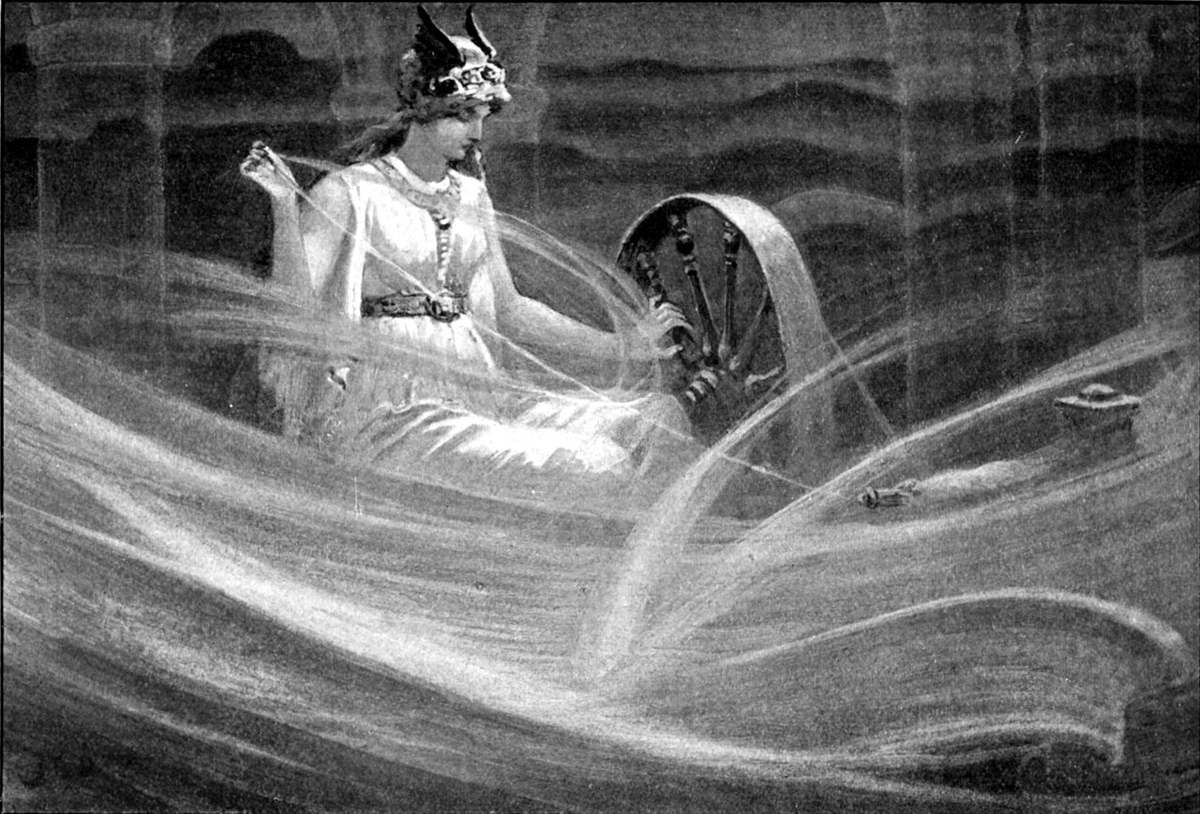
Mist gathers over low reeds while thunder builds far above Asgard. Dark water sits under the marsh grass, holding every ripple still as the sky turns heavy. In that dim lowland stands a hall called Fensalir.
Its mistress is Frigg.
Frigg is the Aesir queen of Norse tradition, wife of Odin, daughter of Fjorgynn and mother of Baldr and blind Hodr. She governs marriage, the household loom, motherhood and silent foresight. Older than the shields hung along Valhalla's roof, she works through the marsh hall, the three-star distaff in the winter sky and a tongue that knows when to keep its counsel.
The knowledge that stays unspoken
Odin hangs on the ash tree and sends ravens out at dawn because he is hungry to know what is coming. Frigg already knows, and she says nothing.
In the poem Lokasenna, Loki bursts into a feast of the gods and begins slinging insults around the table. When he mocks Frigg, Freya steps in with a stark warning. She tells Loki to hold his tongue, because Frigg knows all fates, though she speaks none aloud.
Think of raw wool wrapped onto a wooden distaff before the spindle starts to turn. Inside that loose bundle, a whole winter cloak exists as unspun fiber. No thread has been pulled tight or locked into a knot yet, so the pattern remains open to every turn of the hand.
Frigg sits with the unspun wool in silence. She holds the whole pattern before hasty words pull it onto a single narrow thread.
The oaths and the young mistletoe
This is the story told in the Prose Edda of Snorri Sturluson and in the poem Voluspa.
Baldr was the brightest of the gods, so fair that light shone from him. One season he began to dream dark dreams that his life was in danger. When he told the Aesir, dread fell over the hall.
Frigg did not stay by her loom. She set out across the worlds to bind every danger by oath. She took a solemn pledge from fire and water, from iron and all metals, from stones, earth and trees, from sickness, beasts, birds and venomous snakes. Every one of them swore never to harm Baldr.
After that the gods made a sport of her success. Baldr stood in the center of the assembly while the others threw darts, swung axes and struck him with stones, and nothing left a scratch upon his skin.
Only one plant escaped the oath. West of Valhalla grew a young shoot of mistletoe. When Frigg passed it, she thought it too young to demand an oath from, and walked on.
Loki saw the sport and smelled a secret. Putting on the shape of a woman, he went to Fensalir and asked Frigg whether every single thing in creation had truly sworn. Frigg answered that all had sworn except one shoot west of Valhalla, which seemed too young to ask.
Loki slipped away, tore up the mistletoe, and brought it to the assembly. There stood blind Hodr, Baldr's brother, outside the ring because he had no sight. Loki placed the twig in Hodr's hand and guided his aim. The dart flew straight and dropped Baldr dead upon the grass.
The gods stood speechless. Frigg asked who would ride down the road to Hel and ransom her son. Hermod took Sleipnir and rode nine nights through dark valleys until he reached Hel's gate. Hel answered that Baldr could return if every living and lifeless thing wept for him. Frigg sent messengers across earth and stone. Trees, metals and beasts wept alike, until one giantess in a cave refused. So Baldr stayed below until the world's renewal.
Silence and the small gap
The myth of Baldr's oaths carries two hard laws about foresight and care.
First, wisdom does not shout. In his Kryon talk at Delphi University, Lee Carroll contrasts loud intellect that bangs its head against closed doors with unbridled wisdom, which sits still and knows without boasting. Frigg does not broadcast what she sees on Hlidskjalf. Speaking a fate too early forces people into fear or clumsy attempts to dodge it. Holding the thread inside silence gives life room to breathe.
Second, no wall of control can seal every root in a changing cosmos. Frigg bound iron, poison and fire, yet tragedy walked in through a soft shoot she deemed too small to matter. The lesson is neither careless neglect nor tighter panic. It is knowing where protection reaches its limit, and meeting grief without breaking into spite when the unforeseen arrives.
The marsh hall and the stars of the distaff
The hall, the stars and the attendants around Frigg show how she guards an unseen pattern.
Begin with Fensalir, the Marsh Halls. Odin's Valhalla has rafters of ash spears and a roof of shields, built for war and spectacle. Frigg lives among reeds and mist-covered water. Marshes look plain from the road, yet they filter runoff, feed springs underground and shelter fragile life out of sight. That is the hidden climate of a home, tended before trouble knocks on the door.
Look next into the winter sky of the North. Watchers named the three bright stars of Orion's Belt Friggjarrokkr, meaning Frigg's Distaff. A distaff is the wooden staff that holds unspun wool or flax in order before the fingers twist it into thread.
In her Vault of Osiris writings, Maia Nartoomid calls Orion a passageway between past and future, through which light-patterns enter the earth. On the northern sky-map, those three stars hold the fiber of time before it is drawn out into events.
Beside Frigg in Fensalir stand her helpers. Fulla carries her wooden chest and keeps her secrets. Gna rides the wind with messages, and Hlin guards those whom Frigg shields. Even when she sits beside Odin on his high seat Hlidskjalf, looking over all nine worlds, she keeps her counsel until the right hour.
Where Frigg waits in the sky
English Friday comes from Old English Frigedaeg, meaning Frigg's Day, matching Roman Venus's day across the week. Astronomers named belt asteroid 77 Frigga after her in modern times, though a birth chart speaks for her first through the Moon, Saturn and the fourth house.
Begin with the Moon, which maps instinctive care, dream-memory and the weather inside a home. Look at the Moon's sign and aspects to see what feels like Fensalir shelter behind closed doors.
Watch next where Saturn meets the Moon. Saturn brings the discipline of the distaff and the silence of Lokasenna, holding feeling in structure across hard winters. People with Moon and Saturn linked often notice consequence early in life, learning that devotion does not mean total control.
When a birth time is known, inspect the fourth house at the root of the chart, alongside Cancer, Capricorn and the Lunar Nodes. Modern chart readers also check Chiron here for the mistletoe spots where a small oversight once changed everything, though Chiron itself was discovered long after the Eddas.
Turning the silent spindle
Sit with Frigg when you need to hold a matter without rushing into speech or panic. Her way is patient counsel, never a demand for guarantees against loss. Even the Queen of Asgard could not swear the mistletoe.
Wait for evening, when the noise of the house settles and cool air sits outside.
Sit near a window facing the night sky, with a wooden spool or plain length of thread resting beside you. In winter, look for the three stars of Orion's Belt overhead, her distaff in the dark.
Hold one concern in mind about a child, a home or a bond you carry. Notice the urge to fix it tonight by talking, warning or tightening rules. Instead, treat that concern like unspun wool on a distaff. Let it rest whole in your awareness without twisting it into a verdict.
Keep one week of Lokasenna restraint around that matter. Say nothing about it out of anxiety or pride. Watch in stillness, and wait until action or speech is called for.
Then check for one small mistletoe. Ask yourself what small habit, unspoken tension or open door you brushed off as too minor to look at. Mend that one thing plainly tomorrow with warmth, and leave the giant stones alone.
When you have named the small stitch, set the distaff down. Carrying every fate through the night turns care into strain.
Rest your hands lightly on your knees, uncurl your fingers, and exhale slowly into the room. Speak one line aloud: what can be guarded is guarded, and the rest stays with the sky. Step back into the lit house and tend one small ordinary task before sleep, like folding a coat or setting a kettle ready for morning.
Questions people ask about Frigg
Who is Frigg in Norse mythology?
Frigg is the Aesir queen of Asgard, daughter of Fjorgynn, wife of Odin and mother of Baldr and Hodr. She rules over marriage, motherhood, home craft and silent prophetic sight from her hall Fensalir.
Why is Friday named after Frigg?
English Friday comes from Old English Frigedaeg and Proto-Germanic Frijjoz dagaz, meaning Frigg's Day, created when Germanic speakers matched Roman Venus's day to Frigg. In later Scandinavian lore she was sometimes paired with Freya, yet the Eddas keep them distinct.
Why did Frigg overlook mistletoe when swearing oaths for Baldr?
After Baldr dreamed of his death, Frigg extracted oaths from fire, water, iron, stones, beasts and illnesses so nothing would harm him. She passed over a young shoot of mistletoe west of Valhalla because it seemed too young to swear, and Loki used that single gap to kill him.
What is Friggjarrokkr?
Friggjarrokkr means Frigg's Distaff, the old Scandinavian name for the three stars of Orion's Belt. It links the goddess to cloud-weaving, unspun wool and the patient holding of fate before it unfolds into time.
Why does Lokasenna say Frigg knows all fates?
In Lokasenna 29, Freya warns Loki that Frigg knows every fate even though she speaks none aloud. Her silence contrasts with Odin's restless questioning and shows strength held without boast.
The Frigg archetype
Frigg is the keeper of the marsh hall, the foresight that holds the thread whole until the hour is ripe.
Child's Horoscope explores the Moon, fourth house and Saturn patterns shaping a child's nature and how to care for who they actually are.