Lightning strikes dry oak in the dark, and a thin thread of smoke rises through the roof-beams of Asgard. Nothing inside a sealed room stays fixed once a spark touches frost.
Loki is the trickster and catalyst of Norse tradition, blood-brother to Odin and father of monsters. His father Farbauti was named Cruel Striker, like lightning hitting dry wood. His other name, Loptr, points to air and sky. Older than the timber halls of the Aesir, his spark still shows itself through four signs: the shape-shift, the net burned in ash, the mistletoe shoot and Sigyn's wooden bowl.
When a closed hall needs a crack
A sealed room feels safe until the air inside goes stale. Every system built to last tries to lock out surprise, and over time that defense turns into stone.
In Meeting the Universe Halfway, Karen Barad quotes Donna Haraway's remark that the world is a coding trickster with whom we must learn to converse. Reality refuses to sit still like furniture inside a museum.
Carla Rueckert's Law of One sessions teach a parallel principle across consciousness. Those teachings name the third archetype of the mind Catalyst, the outer shock that crosses the veil. Without catalyst, awareness sleeps inside habit and makes no real choice.
Loki carries that spark straight into Asgard. Whenever the gods grow proud behind their walls, he opens a crack in the roof.
The treasures forged out of trouble
This is the story told across the Poetic Edda and the Prose Edda of Snorri Sturluson.
In the early days, Loki and Odin blended their blood together and swore never to drink ale unless both were poured a cup. Yet Loki never stayed loyal to comfort.
Once, a giant mason offered to build Asgard a wall no foe could breach. He asked for the sun, the moon and Freya as pay. Loki urged the gods to agree, sure the giant would miss winter's deadline. When the mason's stallion Svadilfari hauled stones twice as fast as planned, the terrified gods threatened Loki with death. Loki shifted into a mare and lured the stallion into the woods. Months later he returned leading Sleipnir, the eight-legged horse that became Odin's finest steed.
Another day, Loki sheared off the golden hair of Thor's wife Sif. Caught by Thor's grip, he swore to fetch hair of gold from the dwarves. In the mountain smithy, Loki buzzed as a fly to spoil the work of smiths Brokkr and Eitri. He stung Brokkr on the eyelid until blood hid his sight. Out of that wager came Sif's gold hair, Odin's spear Gungnir, Freyr's ship Skidbladnir, the ring Draupnir, the boar Gullinbursti and Thor's hammer Mjolnir. Even then, the winning dwarf sewed Loki's lips shut with leather thong, leaving him free to speak once the stitches ripped out.
Years passed, and Asgard grew fearful of Loki's children. The gods cast his daughter Hel down into Niflheim, dropped the serpent Jormungandr into the sea, and bound the wolf Fenrir with broken faith.
Then came Baldr's dark dreams. Frigg walked across the worlds taking oaths from iron, fire, water, stone and beast never to harm her son. She skipped only a shoot of mistletoe west of Valhalla because it seemed too young. While the gods threw spears at Baldr in sport, Loki took another form and learned the secret from Frigg. He plucked the mistletoe, placed it in blind Hodr's hand, and guided his aim. Baldr fell dead upon the floor.
At Aegir's hall under the sea, Loki broke into the feast and sang out every hidden shame of the gods in Lokasenna. Each secret he named was true. Then he fled to a mountain house with four doors facing every way to watch all roads.
By day he turned into a salmon and hid in Franangr's Waterfall. By his hearth fire, he knotted twine into a mesh to test how gods might catch him. When he saw them marching near, he threw the net into the coals and leaped into the river.
The gods entered the empty house and read the net's pattern glowing in the white ashes. They wove a new net from that ash-print and dragged the stream. Loki leaped over the rope once, leaped again, and Thor caught him by the tail above the mesh.
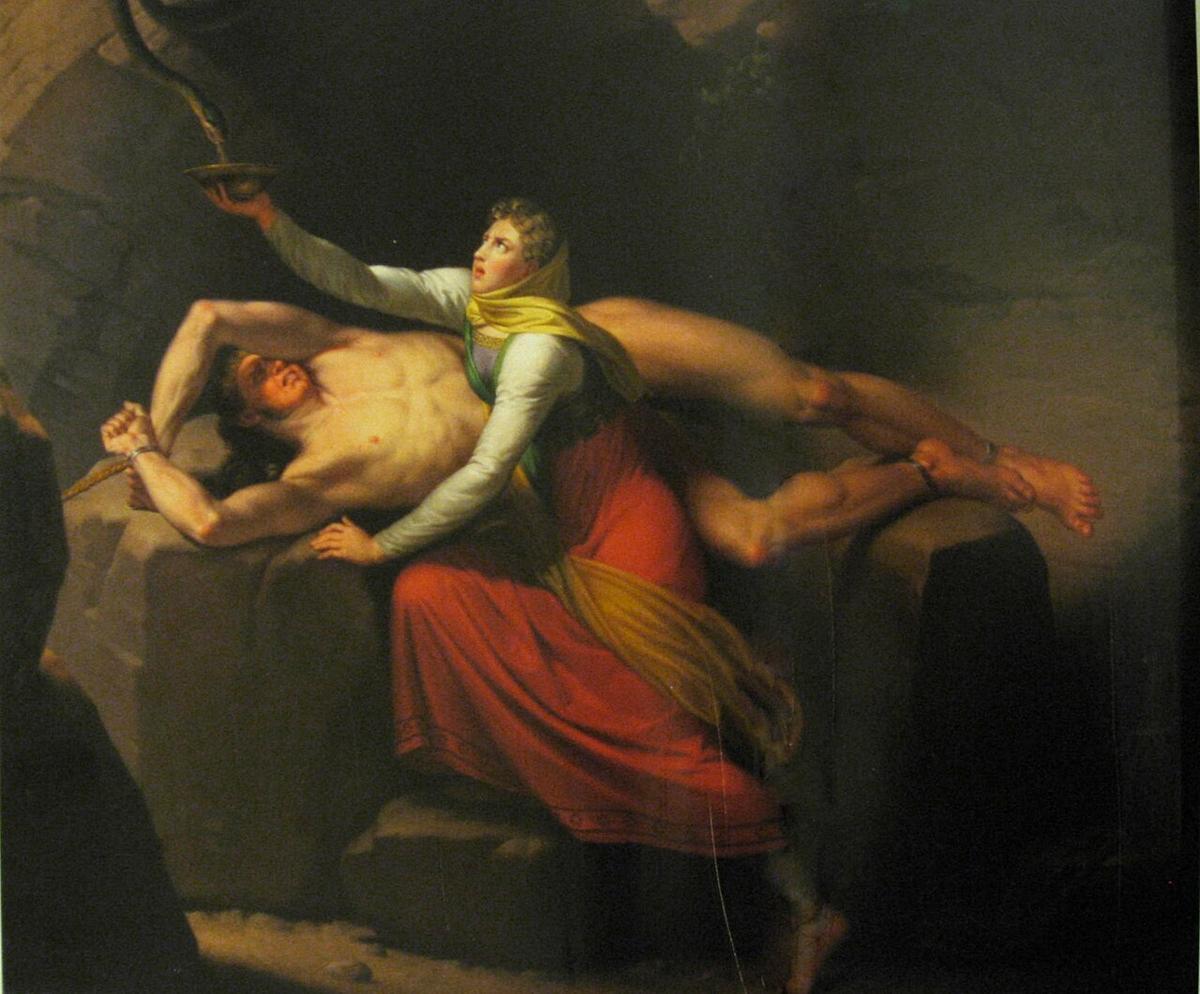
They bound Loki across three stones with the entrails of his slain son. Above his face, Skadi hung a serpent whose venom dripped toward his brow. His wife Sigyn stayed beside him with a wooden bowl to catch the poison. Whenever she stepped away to empty the bowl, venom hit his face and his thrashing shook the earth. The North said he lies there until Ragnarok. Then his chains snap, he steers the ship of dead men's nails, and he meets Heimdall at the world's end.
The fly's sting and the ash-print net
Taken as gossip about one villain, the tale shrinks. Taken as a map of friction and change, two clear laws stand out.
First, every locked order carries the seed of its own fracture. Asgard gained its greatest tools only after Loki broke the peace. Without his reckless bets, Thor had no hammer and Odin had no eight-legged horse. In Chaotic Nodes and Dimensional Attunements, Tom Kenyon and the Hathors describe times of upheaval as Chaotic Nodes. When chaos strikes a rigid plan, expectation breaks and a doorway opens. One person freezes in fear, while another sees the cosmic joke that our solid walls were made inside our own minds.
Second, disruption without a container turns into poison and traps its own maker. Loki invented the fishing net to guess his enemies' move, burned it to hide the secret, and was caught by the trace he left in the ash. In The Visionary Window, Amit Goswami notes Carl Jung's insight on the trickster archetype as unlived creative force outside the ego's rulebook. When a room mocks or chains that spark instead of conversing with it, the spark turns bitter. What could have renewed the hall destroys it instead.
The bowl, the ash and the sewn lips
Every object around Loki works like a gauge on a pressure line.
Look first at the fishing net burned on the hearth. Nothing vanishes without leaving its geometry behind. When Loki weaves a trap in his mind to outwit the world, that very mesh waits for him in the river. Cleverness without wisdom always builds its own snare.
Look next at the mistletoe shoot. It is neither tree nor herb, rooted high on oak branches between earth and sky. In any fortress of oaths and rules, collapse enters through the tiny detail dismissed as harmless.
Look third at Loki's scarred lips and Sigyn's wooden bowl. Truth spoken out of spite scars the mouth, yet even venom can be held when someone refuses to flee the room. Sigyn does not cure the serpent, and she does not fight the gods. She holds a vessel under the drip until it fills, pours it out, and returns to her post.
Where Loki moves in the sky
Norse tradition gave Loki no fixed weekday. Pairing him with Uranus, Pluto and Black Moon Lilith is a modern lens, since those outer bodies and points were added to astrology long after the Eddas.
In a natal chart, Mercury carries his swift tongue, shape-shifting wit and double edge. Uranus brings the bolt of Farbauti that cracks stale rooms in a single afternoon. Black Moon Lilith marks the exile outside the gate who remembers what the hall chose to bury.
When Uranus or Pluto crosses your natal Sun, Moon or Mercury by transit, old routines lose their seal. Things overlooked like young mistletoe suddenly demand weight. Truth spills out uninvited in those seasons. It asks whether a person grows bitter or rebuilds from the ash.
Reading the ash-net at the hearth
Turn to Loki when a pattern in your life has gone airless and polite excuses no longer move it. Approach him when you need clear sight to spot the tiny crack you have been ignoring. Tricks aimed at punishing another person or proving how clever you are backfire fast, leaving your own net printed in the ash.
Wait for a windy evening or sit beside a single candle flame.
Take a plain string or strip of paper and knot it once, or trace a small cross-hatch line in dust or salt on a plate. Look at the mesh you made. Name aloud one rigid rule or habit you built to stay safe that now traps your movement.
Next, name one small truth you have left unsaid, like the mistletoe left unsworn behind the wall. Speak it plainly to the air, without bitterness and without theatrics. Ask the spark to show where your own cleverness has woven a net around your heels.
Hold an empty cup in both palms for three slow breaths. Imagine any sour spite dripping into the vessel instead of splashing into speech.
Leave the net behind before you go. A spark left untended burns the timber of the house.
Brush the salt or dust mesh off the plate into a scrap of paper, step outside, and scatter it to the wind or onto bare soil. Empty the imagined cup outdoors and snuff the candle flame with a lid or snuffer. Walk back inside speaking one line aloud: the pattern is seen, the knot is loosed, and I leave the snare in the ash.
Questions people ask about Loki
Is Loki a god or a giant in Norse mythology?
Loki was born to the giant Farbauti and Laufey, yet he swore blood-brotherhood with Odin and lived inside Asgard. In the Eddas he sits between both houses, serving the Aesir until fear and betrayal split them apart.
What great treasures of the gods came from Loki's tricks?
Through his wagers with the dwarves Brokkr, Eitri and the sons of Ivaldi came Thor's hammer Mjolnir, Odin's spear Gungnir and ring Draupnir, Freyr's ship Skidbladnir and boar Gullinbursti, and Sif's golden hair. His mare-shift also birthed Odin's horse Sleipnir.
Why did Loki cause the death of Baldr with mistletoe?
Frigg asked every creature and element to swear not to harm Baldr, skipping only young mistletoe. Resentful of Asgard's praise and unbroken pride, Loki found that single gap and placed the shoot into blind Hodr's hands.
How did Loki get caught in his own fishing net?
Hiding as a salmon in Franangr's Waterfall, Loki knotted linen twine to test how gods might trap him, then threw the net into his hearth fire. The Aesir read the woven pattern left in white ash, built a matching net, and caught him by the tail.
Who is Sigyn and why does she hold a bowl over Loki?
Sigyn is Loki's faithful wife. After the gods bound Loki beneath a venom-dripping serpent, she stayed beside him in the cavern holding a wooden bowl to catch the drops, stepping away only when the vessel filled.
The Loki archetype
Loki is the spark inside the sealed hall, the catalyst that cracks dead form so real movement can begin.