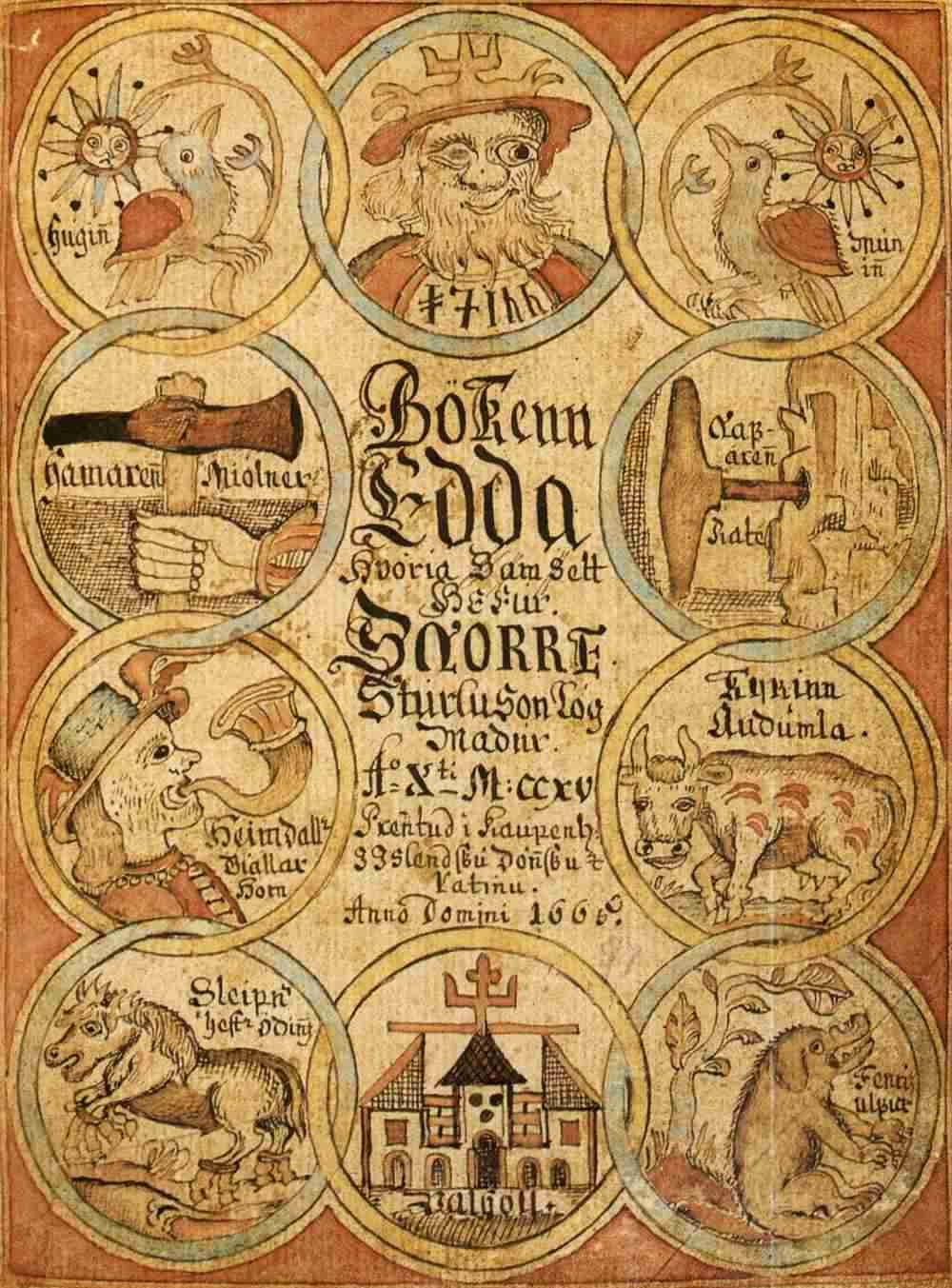
High on a windswept ridge above a frozen fjord, a traveler in a grey cloak pulls his broad hat low over one blind eye. Below him, woodsmoke curls from the turf roof of a king who thinks he already knows every secret in his hall.
That road-weary stranger is Odin.
Odin is the one-eyed god of Norse tradition, who with his brothers shaped sky, sea and middle earth from the giant Ymir out of Ginnungagap, the great void between ice and fire. He is ruler of Asgard, master of runes, poetry, war and the dead. His name comes from an Old Norse word for wind, fury and poetic breath. The tree, the well, the rune and the road form an instrument for meeting him.
The wind that asks what the world knows
Most gods stay inside their walls. Odin goes out on foot.
In the Icelandic books he wears a grey cloak and a broad hat pulled over his missing eye. He walks under fifty names, calling himself Masked One, Road-Weary, or the Man Who Knows. He stops at farms in winter and sits by the hearth of kings to trade riddles or listen.
In physics, a question is never idle. John Archibald Wheeler spent his last years studying how matter relates to meaning. He summed it up in three words: it from bit. Every physical thing rises out of information, out of yes-or-no answers given when reality is asked. As Jennifer L. Nielsen writes in her study of Wheeler's work, a system of signals cannot explain itself from inside. A player inside a game cannot read the whole code from within the screen.
Odin knew that limit in older words. You cannot sit on a golden throne and learn how the worlds hold together. You have to step to the edge and ask the dark itself. He trades comfort, pride and part of his body to draw one answer out of the deep.
One eye and two ways of seeing
Most people look with two eyes and think they see one picture. The brain tells another story.
In The Matter With Things, Iain McGilchrist studies how the two halves of the brain attend to reality. Attention changes what we find. One half narrows its beam to grasp what is useful, breaking things into pieces so it can name and hold them. The other half opens wide, watching the whole field at once and staying alert for what is new.
In birds and small creatures, McGilchrist notes, the right eye serves that narrow focus, while the left eye keeps watch over the sky and the horizon.
The North put that split onto the face of its chief god. Odin had two eyes like any man, and then he gave one away into a dark spring beneath the tree so the other eye could see behind appearances. When he sits in his hall, two ravens perch on his shoulders to scan the world for him. One is Thought, and one is Memory.
Between them, he holds both kinds of sight. One eye aims like a spear. Two wings sweep the earth before dark.
The pledge at the well
This is the story told in the Poetic Edda and in Snorri Sturluson's book of myths.
Beneath one root of the ash tree Yggdrasil lay a spring of water. Mimir kept it. Every morning Mimir dipped a horn into the well and drank, and by that water he knew what had passed and what was coming.
Odin walked down to the root in secret. He asked for a drink from the well.
Mimir did not refuse, and he did not give it away. Wisdom at the root of the tree had a price, and Mimir named it. Odin must leave an eye in pawn.
Odin reached up to his face. He tore one eye from its socket and laid it into the water. Then he took the horn, lifted it to his mouth, and drank. From that day forward his missing eye stayed at the bottom of the spring, looking upward at the roots of the world. His remaining eye walked the roads of Midgard.
Nine nights upon the tree
There was another knowledge that even the well could not give. The runes did not live in the water. They lived in the dark below the roots, where no god had gone down alive.
So Odin went back to Yggdrasil. He took his spear Gungnir and drove the point into his side. Then he hung himself from the branches of the tree, with no friend near him and no hand to bring relief.
He himself told what happened there, in the verses of Havamal.
He hung for nine nights in the wind, wounded by the spear and given to Odin, himself to himself. No one gave him bread. No one held a horn to his lips. The tree shook above him, and the abyss yawned beneath his feet, and no one knew where the roots of that ash went down.
On the ninth night he looked downward into the dark. He saw the runes waiting below. With a great cry he seized them up out of the pit and fell back from the tree.
When he touched the earth again, he held songs of healing, words to blunt a blade, charms to break chains, and eighteen shapes cut into wood. From that hour he knew how to wake the dead under the gallows and speak with them.
The theft of the mead
The well gave him sight, and the tree gave him the runes. A third journey gave him the gift of speech that wakes the soul.
Long before, the gods had made peace after a war by spitting together into a jar. Out of that shared life came Kvasir, the wisest being in the worlds, who answered every question asked of him. Two dwarves killed Kvasir in secret and mixed his blood with honey in two vats and a kettle. Whoever drank that mead became a poet and a scholar.
Later a giant named Suttung took the mead and hid it inside a mountain called Hnitbjorg, setting his daughter Gunnlod to guard the jars.
Odin set out under a false name, Bolverk, meaning Worker of Harm. He reached the field of Suttung's brother Baugi, where nine thralls were mowing hay. Odin sharpened their scythes with a whetstone until they cut twice as fast. When all nine asked to buy the stone, he threw it into the air, and in the scramble the thralls cut one another down.
Bolverk offered to do the work of all nine men through the summer for one wage: a drink of Suttung's mead. Baugi agreed. When harvest ended, Suttung refused him a drop.
So Odin made Baugi bore a hole through the mountain wall with an auger. Odin turned into a snake and slid through the drill-hole. There he lay with Gunnlod for three nights, and for each night she granted him one draught of the mead. In three swallows he drained the kettle and both vats dry.
Then he shifted into an eagle and flew toward Asgard, with Suttung chasing hard behind him in eagle form. Over the walls of Asgard the gods set out vats, and Odin spat the mead into them as he cleared the rampart. A few drops spilled backward as he fled, falling to earth as the share of clumsy poets. The rest stayed in Asgard, kept for gods and for those whose tongues catch fire.
What the three stories encode
Look beneath the bloodshed and the cunning of those three journeys. Each one obeys the same hard law.
A closed world cannot see itself from inside. As long as Odin sat on his throne in Asgard, he saw only what the hall already held. To receive the runes, he had to become both the sacrifice and the god who receives it. Offered myself to myself.
That line in the Havamal turns the whole myth inside out. Consciousness steps out of the role of watcher and becomes its own ground of discovery. The same awareness that sets the riddle endures the nine nights on the branch and lifts the runes from the dark.
And every answer leaves a mark that must be paid for. In The Order of Time, Carlo Rovelli explains that memory and traces exist only because something slows down and loses energy as heat. A meteor strikes the moon and leaves a crater. Fossils hold the shapes of creatures from long ago, and books hold our history. In a world where nothing is spent, everything bounces off everything else and leaves no trace behind.
Odin could not borrow wisdom on credit. His eye had to stay in the well. His blood had to wet the bark of the ash. His summer had to go into the giant's hayfield before the mountain opened. Real knowledge alters the one who carries it, and that change is the price of the trace.
Thought, memory and the Akash
Every dawn, two ravens lift from Odin's shoulders and fly across the nine worlds. By evening they return and whisper in his ear all that they saw and heard.
Their names are Huginn and Muninn. Huginn means Thought, the mind that moves out to explore and compare. Muninn means Memory, the mind that holds what has happened and feels its weight.
In the poem Grimnismal, Odin says he fears each day lest Huginn fail to come back, yet he fears far more for Muninn.
Think of what happens when Thought flies fast and Memory never comes home. An intellect without memory invents clever tools every morning and forgets every fire it started the night before. It repeats the same folly in new clothes because nothing sticks to it.
In his Kryon talk Akashic Evolution, Lee Carroll calls the personal Akash a living record woven into our cells and DNA. Every experience sits together on a single page, ready to answer when awareness asks what worked and what broke. When a person looks at that record directly, the old loops lose their grip and true wisdom wakes up.
Muninn is that page. Huginn asks the question. Muninn brings back what every past answer cost.
The tree, the spear and the wolves
Around Odin stand the tools of his hall. Together they show how consciousness holds its place between worlds.
At the center stands Yggdrasil, the World Ash. Its name means the Steed of the Terrible One, because in old verse a gallows was called the horse of the hanged man. Yet Yggdrasil is also the pillar holding heaven above the abyss. Maia Nartoomid describes the Tree of Life as the axis linking the stars with the waters below. In her work on the runes, she writes of an initiate placing her soul into the living code of each sign. On Yggdrasil, Odin becomes the wire between the canopy and the roots in the dark.
In his hand sits Gungnir, the spear forged by dwarves that never stops mid-thrust. Once the eye aims and the hand lets go, the line holds until it lands. Hesitation belongs to a mind that wants two outcomes at once. Gungnir belongs to a mind that has chosen.
Beside his bench sit two wolves, Geri and Freki. Both names mean greedy. Odin gives them every scrap of meat from his plate and lives on wine alone. Even after hanging on the tree, raw appetite does not vanish from a creature. He neither starves the wolves nor lets them sit on the throne. He feeds them at his feet under watch, while his strength runs on inspiration.
Under his saddle runs Sleipnir, the horse with eight legs. Four legs belong to the earth. Eight legs carry the rider across sea, air and the border of the dead. It is a mind that moves between states without getting stuck in one room.
The trap inside foresight
The Norse poets did not flatter their chief god. They showed his gift, and they showed the poison inside his sight.
Odin knew from the seeresses that a day of ending would come. Ragnarok waited at the far side of the age, when the wolf Fenrir would break his cord and swallow the sun and the king together.
That foreknowledge curdled into fear. To build an army for the last battle, Odin began collecting brave warriors from the fields of men. He broke truces between kings who had sworn peace. He turned victory against heroes who deserved to live, just so their souls would walk into Valhalla.
Here is the warning carved into the North. When foresight turns into dread of tomorrow's storm, cleverness breaks today's faith. The mind that hung on the tree to learn truth starts rigging the game to outrun an ending it cannot stop.
In the end, the fear did not save him. At Vigrid's plain, Odin rode out in his helm and met Fenrir anyway. His silent son Vidarr, who spoke little and waited without panic, stepped upon the wolf's jaw and lived into the green earth rising from the sea.
Where Odin walks the sky
Old Norse sky-lore knew no outer planets like Uranus or Pluto. The stars knew Odin through the winter wind and the hunt across the dark, and matching him to Mercury, Uranus and Pluto inside a birth chart is a modern astrological reading.
Look first to Mercury close to Pluto, Uranus or Saturn. Mercury beside Pluto carries the depth of Mimir's well, a mind that ignores small talk and digs until the root motive lies bare. Mercury with Uranus catches flashes from the canopy of the tree, seeing the shape of a thing years before others name it. Mercury with Saturn keeps the ledger of Muninn, carving patience and memory into craft.
When a birth time is known, look at the ninth house of long roads and foreign lore alongside the twelfth house of solitude, sleep and the waters below. Those two houses mirror his hat and his well.
Look also at contacts from Pluto or Uranus to the Sun or the Moon. Those are the seasons when old walls come down and a person hangs between who they were and who they are becoming, waiting for the pattern to show.
Keeping the night watch beneath the ash
Step into Odin's watch when you are ready to drop certainty and ask one true question of the pattern. Bring him real hunger for truth, not a wish for easy comfort or luck. He never paid in anything small, and he does not answer noise.
Wait for dusk or the hours before dawn, when the wind moves outside and the house is still.
Sit straight with one candle lit, and keep the room dim. Let the second eye of distraction rest. Close every extra book and screen.
Hold one question in mind. Not ten worries at once, only one root thing you are ready to see. Rest your hands on rough wood or a stone table, feeling the grain beneath your fingers.
Breathe slow and wait without forcing an answer. On Yggdrasil, you are not commanding the dark to obey you. You are hanging in the wind between what you knew yesterday and what has not yet spoken.
If a thought comes, let Huginn fly with it and return. Take a sheet of paper and write down one memory from your road that matches this moment, especially a time you ignored a sign or paid a price for wisdom. Give Muninn a mark on the page, because insight without memory fades before morning.
Watch for the rune. Not a trick in the air, just the single shape or line that cuts through the fog and stays standing after the rest falls away.
When that line stands clear on the page, step down from the watch. Blow out the candle. Trace a single straight stave with chalk or a dry finger on a piece of ash bark, a wooden post or the doorframe, and fold the paper beneath a stone on the sill. Break a piece of bread and drink a cup of ale or water, because the body on the tree went nine nights without either and needs to return to earth. Speak one line aloud: the question rests for tonight, and the watch is over.
Keep one eye on the root, keep one foot on the ground, and leave the rest to the morning.
Questions people ask about Odin
Who is Odin in Norse mythology?
Odin is the chief god of the Aesir, son of Borr and Bestla, husband of Frigg, and father of Thor, Baldr and Vidarr. He rules from Asgard yet spends much of his time walking middle earth in a grey cloak and broad hat under dozens of names.
What is Odin the god of?
He governs wisdom, poetry, runes, prophecy, battle ecstasy, trance magic and the gathering of the slain to Valhalla. His Old Norse name links directly to wind, breath and the fire of the inspired mind.
Why did Odin lose his eye and hang on Yggdrasil?
Odin dropped one eye into Mimir's well beneath the world tree to earn a drink of deep memory and foresight. Later he pierced his side with his spear Gungnir and hung nine nights on Yggdrasil without food or drink, offering himself to himself until he grasped the runes.
What are Odin's two ravens, two wolves and horse named?
His two ravens are Huginn (Thought) and Muninn (Memory), who fly across the nine worlds each day. His two wolves are Geri and Freki, who eat the meat from his table while he drinks wine, and his eight-legged horse is Sleipnir.
What happens to Odin at Ragnarok?
In the final battle on Vigrid's plain, Odin rides forth with Gungnir in hand and faces the wolf Fenrir. Fenrir swallows Odin whole, and Odin's son Vidarr avenges him by killing the wolf and living into the renewed earth.
The Odin archetype
Odin is the seeker at the root of the tree, the mind that pays in certainty to read the code of the world.
The Whole of You traces how those initiations, sudden insights and hard-won memories fit into the design of a birth chart.