Beneath the world-ash Yggdrasil, three deep roots drink from hidden springs. Beside the third root lies a bright pool of water and white clay, where three women stand over the living wood.
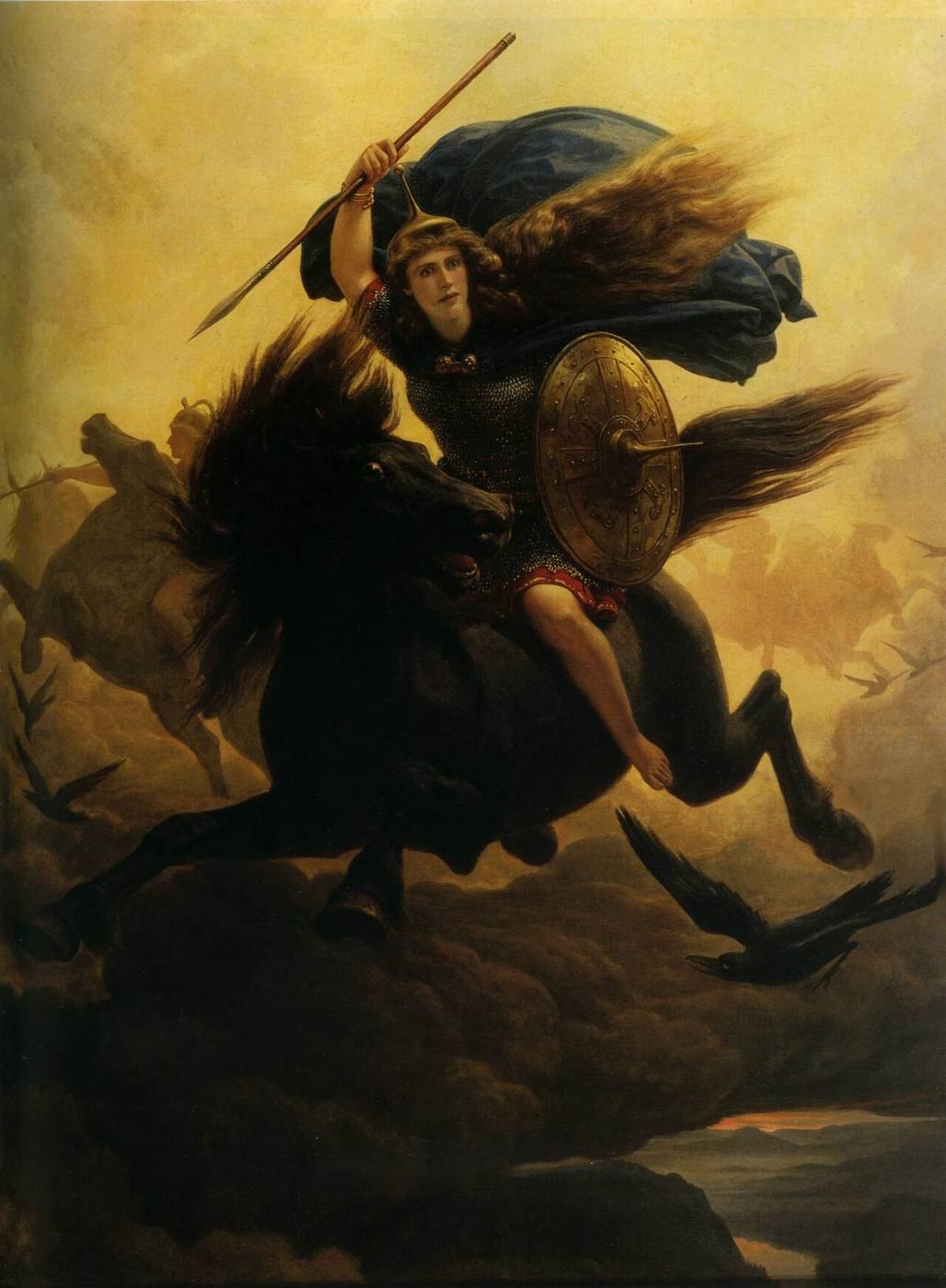
Above them, through storm-clouds and spear-light, riders cross the air on swift horses.
The three beside the pool are the Norns, Urdr, Verdandi and Skuld, keepers of layered consequence and time. The riders overhead are the Valkyries, the Choosers of the Slain, who decide which warriors cross into Valhalla or Freya's meadow Folkvangr. In Voluspa, the youngest Norn named Skuld also rides out with a shield among the Valkyries. They are one single consciousness in two parts. And the North left a technology for reading them. The clay well, the carved wood, the spun thread and the ring of fire are parts of that instrument.
White clay at the roots of the tree
Most people think fate is a steel script stamped before birth, leaving no room to move. The North built a sharper picture.
In The Order of Time, Carlo Rovelli writes that even the hardest stone is an unfolding event, like a wave moving through the sea. Our eyes miss the restless motion beneath solid things and mistake old habits for fixed walls.
Beside Urdr's Well, the Norns tend that living flow with water and white clay. What has already happened sets the soil under the tree, while the living branch above still stays open to the rider.
The three at the well and the riders in storm
This is the story told across Voluspa, Grimnismal, Sigrdrifumal and the Prose Edda of Snorri Sturluson.
In the first age, the gods played board games with gold pieces on green grass and lacked nothing. Then three giant-maidens came out of Jotunheim, huge in power, and the carefree playtime ended.
They took their seat beside Urdr's Well under Yggdrasil's third root. Their names were Urdr, meaning What Has Become, Verdandi, meaning Unfolding Now, and Skuld, meaning What Must Be. Every day they drew clear water from the well and mixed it with white clay from the bank. They poured that mixture over the World Ash so its bark would neither rot nor dry out. They carved notches into wooden tallies, spun threads of orlog, and laid down laws for every life entering the world.
High above, across battlefields and sea-storms, rode the Valkyries. Some wore cloaks of swan feathers and flew over wild lakes. Others rode cloud-stepping horses whose manes shook dew into the valleys and hail onto tall oaks.
Valkyries did not serve one master alone. In Grimnismal, Freya claims the first half of every slain hero for Folkvangr, while Odin welcomes the rest into Valhalla's shield-roofed hall. And in Voluspa, when the riders gather with gleaming shields to choose the fallen, Skuld rides among them beside Gunnr, Hildr and Gondul.
One famous Valkyrie, Brynhildr, dared to cut down a king Odin had favored, choosing courage over obedience. For that choice, Odin pricked her with a sleep-thorn and locked her inside a ring of roaring flame upon a mountain peak. Only a rider fearless enough to spur through the fire could cross the ring and wake her.
Where layered past meets an open branch
Two laws of time sit inside the well and the shield.
First, past deeds set the soil, yet the tree lives only through present tending. Orlog, the Norse word often flattened into fate, literally means primal layers laid down before. Urdr holds what has already happened, like rings inside oak timber. Yet if the Norns stopped ladling water and white clay onto Yggdrasil each morning, the great tree would wither by dusk.
Second, a fork in the road cannot be walked both ways at once. In New Earth - We Have a Choice To Make, Anne Tucker describes how consciousness reaches a split where two incompatible paths separate. A person cannot hold two opposing frequencies in one vessel simultaneously. Stepping onto a new branch means releasing the old grip fully through daily focus.
The Hathors, speaking through Tom Kenyon in The Cave of Altruin, say probable timelines are never dead concrete. Under intense pressure, outer observation joined with calm inner focus moves awareness onto a clearer branch instead of shattering like coal.
Skuld stands at that exact hinge. She belongs to the well of consequence and to the riders who cut the tie at the threshold.
The well, the thread and the ring of flame
White clay, alder tally, spun wool and wildfire each hold one turn between memory and choice.
From Urdr's Well comes white clay, which is mineral memory softened with water. When spread over living wood, it seals cracks against rot. Tending your past does not mean hiding it. It means keeping the root fed so new leaves can open.
Beside the well lie the wooden tally and the spun cord. Before ink reached the North, people notched debts and vows into alder or ash sticks. Thread spins many loose fibers into one line that can bear tension. Neither stick nor thread forces your hand tomorrow. Both record what weight you agreed to carry.
Above the roots rise Brynhildr's ring of fire and the swan cloak. Wings carry awareness above narrow fighting on the ground so it sees the whole field. The ring of fire tests whether a wish is real or merely talk.
Where the Norns and Valkyries cross the sky
Old Norse sky-lore watched the seasons and spun threads instead of modern planetary nodes. Linking the Norns and Valkyries to Pluto and the Lunar Nodes is a modern astrological reading. In a birth chart, Urdr's Well speaks through Saturn and the Lunar South Node. The Valkyries and Skuld flash across Mars, Pluto and the North Node.
Saturn holds the rings of time, bone and orlog, showing what earlier years laid at your roots. The South Node traces familiar grooves you already know by heart. Look toward the North Node and tenth house to see where the Valkyrie horse climbs out of old comfort toward a harder, wider horizon.
When the Lunar Nodes cross your natal Saturn, Sun or Angles by transit, life arrives at a fork in the road. Two paths sit side by side, and waiting forever lets the ash bark dry out.
Drawing from the well and spinning the thread
Call on the Norns and the Valkyries when you stand before a clear fork in the road and keep stalling between two lives. Come when past history feels heavy and you need to separate what is fixed from what remains open today. Bring them a real turning where your own hands can step onto one path before nightfall.
Choose dawn or a clear morning hour before the day's noise crowds in.
Set a clay bowl of well or tap water beside a length of wool or linen thread on a wooden board. Sit upright and rest your hands on your knees.
Touch one end of the thread and name aloud what belongs to Urdr: three concrete facts already laid down in your past that you cannot undo. Do not complain about them. Simply state them like rings counted inside wood.
Slide your fingers to the center of the thread, which belongs to Verdandi. Name the single live choice standing in front of you right now, today, inside this room. Ask yourself plainly what fire ring you have been circling instead of riding through.
Touch the far end of the thread, belonging to Skuld, the Valkyrie-Norn. Name one clear action to take before sunset that commits you to one branch and leaves the other behind.
When that act is named, tie one firm knot in the thread to mark today's choice, and leave the rest of the skein unspun. Carry the bowl outside and pour the water onto the roots of a tree or a potted plant, feeding what grows without asking tomorrow's share. Speak one line aloud: what is past feeds the root, today's choice is set, and tomorrow stays free until dawn.
Questions people ask about the Valkyries and the Norns
Who are the three Norns in Norse mythology?
The three great Norns are Urdr (What Has Become), Verdandi (Unfolding Now) and Skuld (What Must Be). They sit beside Urdr's Well beneath the third root of Yggdrasil, spinning orlog and carving laws into wood.
How are the Valkyries connected to the Norns?
In the Eddic poem Voluspa, Skuld appears both as the third Norn beside the well and as a Valkyrie riding with a shield across battlefields. Together they join layered past consequence with active choice at turning points.
Why do the Norns pour white clay over Yggdrasil every day?
Snorri Sturluson writes in the Prose Edda that the Norns ladle water and white clay from Urdr's Well onto the World Ash each morning. They do this so its bark stays fresh and never rots or dries out.
What does orlog mean beside Urdr's Well?
Orlog literally means primal layers laid down beforehand. Far from blind iron fate, it describes the stacked soil of earlier deeds and conditions within which new present choices take root.
Do the Valkyries only serve Odin?
No. In Grimnismal stanza 14, the goddess Freya chooses first among the slain for her field Folkvangr, taking half while Odin receives the other half in Valhalla.
The Valkyrie and Norn archetype
The Norns and the Valkyries are the root and the rider, tending what has become while choosing the living branch ahead.